What Is Video SEO? The Ranking Guide for SaaS (2026)
Your team made a great demo video. It sits on YouTube with 40 views, most of them from people who already work at your company. Meanwhile, a prospect typing "how does [your category] software actually work" into Google never sees it — because nothing about that video was built to be found.
That's not a video problem. The video is fine. It's a video SEO problem, and it's one of the few growth channels left where a B2B SaaS team with no dedicated video team can still win, because almost nobody in your category is doing it properly.
This guide covers what video SEO actually is, the six ranking signals that determine whether a video gets found, why most "video SEO" advice stops at YouTube when your buyers are searching Google and AI Overviews too, and a practical workflow for turning a demo video into a search asset without hiring anyone new.
In this guide
- What is video SEO?
- Why video SEO matters more for B2B SaaS in 2026
- The 6 ranking signals that determine video SEO
- Video SEO vs. YouTube SEO: what's actually different
- The video SEO mistake almost every demo video team makes
- How AI Overviews are changing video SEO
- A practical video SEO workflow for B2B SaaS teams
- How to measure video SEO performance
- Video SEO tools: what's built in vs. what you'll still need
- FAQ
What is video SEO?
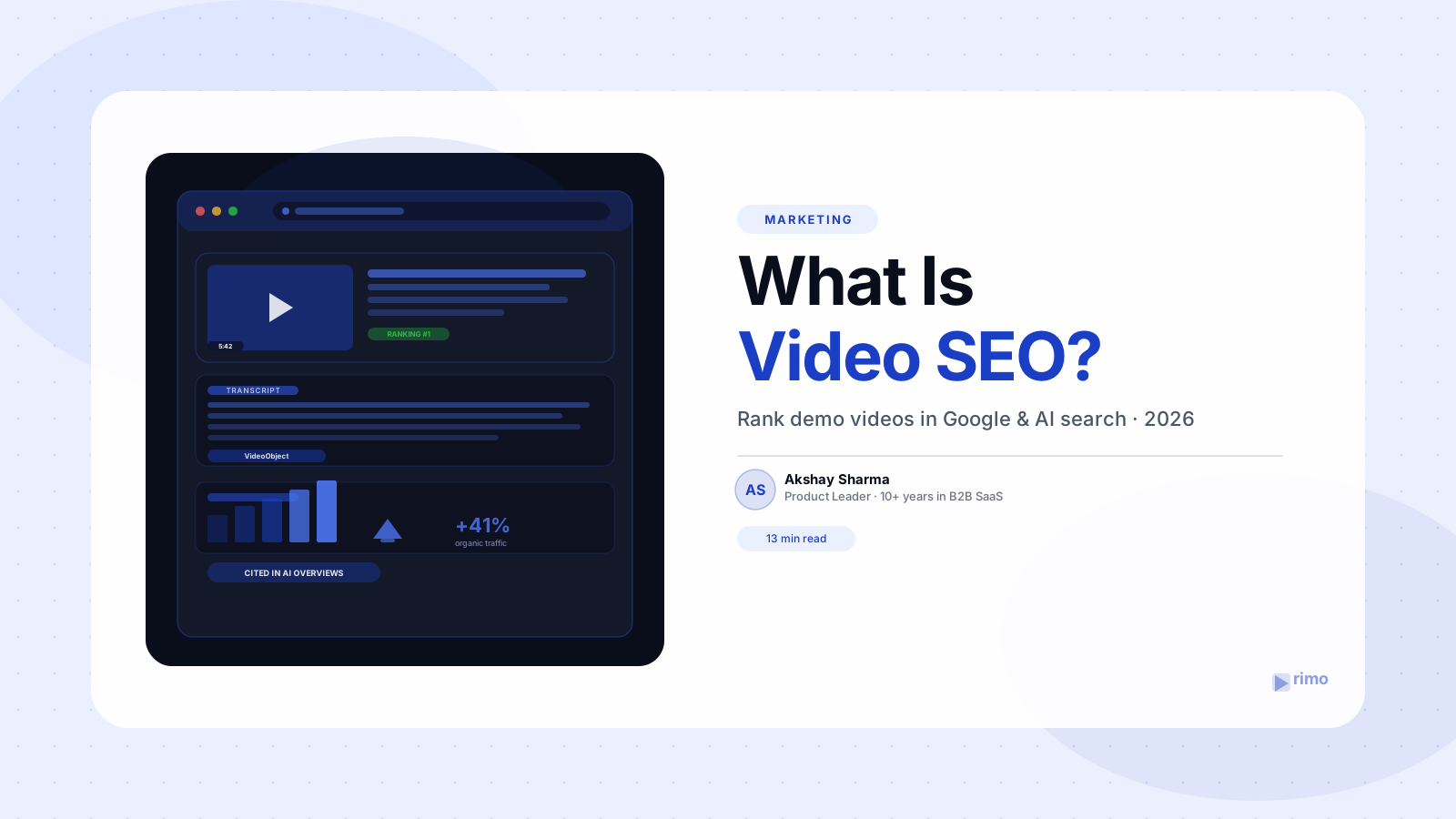
Video SEO is the practice of optimizing video content — and the page it lives on — so that search engines and AI answer engines can find it, understand what it's about, and rank or cite it for relevant queries. Think of it as a specialized branch of SEO: it covers everything from the words in a title to the schema markup in the page source to whether the video has a readable transcript at all.
The confusion most marketing teams run into is treating video SEO as a subset of YouTube strategy. It isn't. Video SEO spans three separate surfaces: Google's main search results (where a video snippet can outrank a text page), YouTube's own search and recommendation engine, and — increasingly in 2026 — AI Overviews and chatbot answers that cite video transcripts as source text.
A search engine cannot watch a video. It can only read what surrounds it: the title, the description, the transcript, the schema markup, and the page content around the embed. Video SEO is the discipline of making sure that surrounding text is complete, accurate, and aligned with how real buyers search — not just optimized for whatever the editing team happened to name the file.
Why video SEO matters more for B2B SaaS in 2026
Every category has the same content gap: dozens of blog posts comparing tools, almost no video ranking for the queries that actually signal purchase intent — "how does [product] work," "[product] demo," "[product] vs [competitor]." Those are exactly the searches a product demo video is built to answer, and exactly the searches where a properly optimized video can outrank a wall of text.
Google has made the opportunity explicit. Video snippets — the thumbnail-with-duration result that appears above standard organic listings — now show up on more than a quarter of all search results pages, and on a majority of pages when any kind of "how" or comparison query is involved (Backlinko, 2026). For competitive B2B SaaS keywords, that snippet slot is frequently still open, because most competitors haven't built a video with the metadata required to win it.
Here's the part that should change how product marketing teams think about budget: video isn't a distribution cost anymore, it's a ranking asset with compounding returns. A blog post needs continuous promotion to keep traffic flowing. A well-optimized demo video, once indexed, keeps earning impressions for the lifetime of the product cycle it documents — with zero additional spend.
The unexpected part is who benefits most. Large, well-funded competitors with big content teams often under-invest in video SEO specifically, because their video work sits with a separate creative team that has no SEO mandate. A smaller team that treats every demo video as a search asset from the brief stage can out-rank a competitor with ten times the content budget. That's a genuinely rare position in B2B SaaS marketing — most channels favor whoever spends more.
The 6 ranking signals that determine video SEO
Strip away the agency jargon and video SEO comes down to six concrete signals. Get these right and a video competes; skip any one of them and it's invisible no matter how good the content is.
Title and on-page metadata
The video title is still the single highest-weighted signal. It needs the target keyword close to the front — within the first 40 characters, before mobile truncation — and it needs to describe what a viewer actually gets, not a vague brand phrase. "Demo: How [Product] Automates Invoice Approval" beats "Product Walkthrough — Q2 Release" every time, because it matches what someone actually typed.
Transcripts and captions
This is the signal most B2B SaaS teams skip, and it's the one with the biggest payoff. A search engine cannot index spoken audio. A full, accurate transcript — published as visible on-page text, not buried in a hidden caption file — is what gives Google's crawler something to actually read and rank. Caption and transcript adoption on hosted video grew 572% since 2021 (Wistia, 2025), which tells you two things: it works, and most of your competitors only started doing it recently.
VideoObject schema markup
Schema markup is the structured-data layer that tells Google explicitly: this is a video, here's its duration, here's its thumbnail, here's its upload date. Without it, Google has to infer video content from page structure, which it does imperfectly. Here's the minimum implementation:
{
  "@context": "https://schema.org",
  "@type": "VideoObject",
  "name": "How [Product] Automates Invoice Approval",
  "description": "A 4-minute walkthrough of the approval workflow.",
  "thumbnailUrl": "https://example.com/thumb.jpg",
  "uploadDate": "2026-06-01",
  "duration": "PT4M12S",
  "contentUrl": "https://example.com/video.mp4"
}
Hosting location
Self-hosting a video — or embedding it with proper schema on your own domain — lets that video pass SEO credit directly to your page. Hosting exclusively on YouTube means the ranking equity accrues to YouTube's domain, not yours. The right answer for most B2B SaaS teams is both: publish to YouTube for discovery and embed the same video, transcribed and schema-marked, on the relevant product or feature page.
Engagement signals
Watch time, click-through rate from the snippet, and completion rate all feed back into ranking — particularly on YouTube. The first three to five seconds of any product walkthrough video determine most of this: open on the outcome, not the logo screen.
Page context
The text immediately around a video embed matters. A video dropped into an otherwise empty page with no supporting copy gives search engines very little to associate it with. A video embedded inside a page that explains, in writing, the same workflow shown on screen reinforces relevance for both.
Video SEO vs. YouTube SEO: what's actually different
These two terms get used interchangeably, and that's where most B2B SaaS teams go wrong. YouTube SEO is a subset of video SEO — it's optimization specifically for ranking inside YouTube's own search and recommendation system, which weighs session time across the whole platform, not just one video.
Video SEO is broader. It includes ranking in Google's main search results (where the video snippet competes against text pages, not other videos), and increasingly, being cited inside AI-generated answers. A video can be excellent YouTube SEO — high watch time, strong subscriber conversion — and terrible video SEO in the broader sense, if it was never embedded with a transcript anywhere Google's main crawler can read it.
The practical implication: if your team's video strategy lives entirely inside YouTube Studio analytics, you're optimizing for one-third of the opportunity. The other two-thirds — Google web search and AI answer engines — require the video to exist, transcribed and marked up, somewhere on your own domain.
See how Rimo automates this → Every Rimo demo video ships with an auto-generated transcript and ready-to-embed schema, so the SEO layer happens by default instead of as a separate task nobody owns.
The video SEO mistake almost every demo video team makes
Here's the contrarian part: most B2B SaaS teams that do invest in video SEO still get the sequencing backwards. They produce the video first, publish it, and then — weeks or months later, if at all — go back to add a transcript and schema markup as an SEO afterthought.
By the time that happens, the video has already missed its best indexing window, and the transcript is usually written by someone other than the person who made the video, which means it inevitably drifts from what's actually shown on screen. Generic transcription tools make this worse: they transcribe the audio track faithfully but have no idea what's happening visually, so a transcript that says "as you can see here" with no further context is technically accurate and SEO-worthless.
The fix isn't a better transcription tool bolted on after the fact. It's treating the transcript as a deliverable of the brief, written alongside the script, before the video is recorded — so the words that will rank the video are the same words that describe what the video actually demonstrates.
How AI Overviews are changing video SEO
Video SEO used to mean "rank in Google and YouTube." That definition is already out of date. G2's March 2026 Answer Economy Report found that 51% of B2B software buyers now start research with an AI chatbot more often than with Google — up from 29% just seven months earlier. A growing share of those AI answers cite video transcripts directly as source text, the same way they cite blog posts.
This is the connective tissue between video SEO and generative engine optimization: an AI Overview or chatbot answer can't watch your demo video either. It can only cite the transcript, the schema description, and the surrounding page copy — exactly the same assets that win a traditional video snippet. Teams that built those assets for Google get an AI-citation lift essentially for free. Teams that skipped them have nothing for the AI to extract, regardless of how good the video itself is.
This is also where most generic "video SEO" content — including nearly everything ranking for this term today — falls short. Almost none of it connects video optimization to AI-answer visibility, even though it's the same underlying asset (a clean transcript) doing double duty. If you're already producing demo videos for sales enablement, the marginal cost of making them AI-citable is close to zero — you just need the transcript and schema to exist in the first place.
A practical video SEO workflow for B2B SaaS teams
This is the part most guides skip entirely: a repeatable process, not just a list of ranking factors.
- Write the transcript-first brief. Before recording, draft the spoken script as the transcript you want indexed — keyword-aligned, in plain language, describing the workflow being shown.
- Record against the script. Whether it's a live screen recording or an AI-generated demo video, keep narration tied closely enough to the script that the transcript stays accurate without heavy post-editing.
- Publish the transcript as visible page text, not a hidden caption file — directly below or beside the embedded video.
- Add
VideoObjectschema to the page, matching title, duration, and upload date to the actual video. - Embed on the highest-intent page, not just YouTube — the relevant product or feature page where someone evaluating the workflow would already be reading.
- Cross-link the page to and from related content, so both the video and the page it sits on inherit topical relevance from the rest of your site — for example, linking to a SaaS demo video best practices guide for readers who want the broader production playbook.
None of these steps require specialized SEO knowledge. What they require is making the transcript and schema markup a non-negotiable part of the production checklist, not a follow-up task assigned to whoever has spare time.
How to measure video SEO performance
Three metrics tell you whether video SEO is actually working, distinct from general video engagement metrics:
Organic impressions to the page hosting the video. Pulled from Google Search Console, filtered to the specific URL. A rising impression count with no change in promotion spend is the clearest sign the page is being surfaced for new queries.
Video snippet appearances. Search Console's "video" search type filter shows whether your video specifically is winning the rich snippet, separate from whether the page itself ranks.
Branded vs. non-branded query share. If most of a video's traffic comes from people already searching your product name, it's working as retention content, not acquisition. The goal for video SEO specifically is growing the non-branded share — people who found the video without already knowing your product.
Video SEO tools: what's built in vs. what you'll still need
Most video hosting platforms market video SEO as a feature, but the implementation is inconsistent in ways that matter. Vidyard, for instance, gates meaningful SEO optimization behind its higher-tier plans — reviewers on G2 note that the SEO-relevant features simply aren't available on entry-level plans, even though hosting and basic analytics are. Per-seat pricing on Vidyard's Teams plan runs roughly $99 per user per month, which makes the SEO tier a real budget conversation, not a checkbox.
Wistia's pattern is similar from a different angle: hosting and analytics are genuinely strong, but G2 reviewers consistently flag pricing as the top complaint — quoted list pricing of $79/month rarely reflects what a typical B2B marketing team ends up paying once bandwidth, seats, and add-ons like the automation suite are factored in. Built-in editing is also limited, so teams still reach for a separate tool to produce the video before they ever get to the SEO layer.
The pattern across both: video SEO capability exists, but it's priced and gated as a premium add-on rather than a default. For a B2B SaaS team trying to make every demo video search-ready without a dedicated video SEO specialist, that gap is exactly where production speed and built-in transcript/schema generation matter more than any individual hosting platform's analytics dashboard.
If you're evaluating tools across the category broadly, the best demo video software comparison covers hosting, editing, and AI-native options side by side. And if you're specifically looking for a platform that builds the SEO layer in by default rather than gating it behind a premium tier, Rimo generates a transcript and embed-ready schema with every demo video automatically — no separate SEO step required.
Where this leaves your next demo video
Video SEO isn't a separate workstream to bolt onto a finished video. It's a small number of decisions — the transcript, the schema, where the video gets embedded — made at the brief stage, before a single frame gets recorded. Teams that make those decisions early get a search asset that compounds for free, and it folds neatly into any broader B2B video marketing plan rather than sitting apart from it. Teams that treat it as cleanup work after publish get a video that sits at 40 views forever.
If your team is already producing demo videos for sales or onboarding, the fastest way to start is the next one you make: write the transcript first, publish it on the page, add the schema, and stop hosting it exclusively on YouTube. Start free with Rimo and every video ships with the transcript and schema generated automatically — the SEO layer is the default, not an extra task.
FAQ
What is video SEO in simple terms?
Video SEO is the process of optimizing a video and the page it sits on — titles, transcripts, schema markup, and hosting location — so that search engines like Google and AI answer engines can find it, understand it, and rank or cite it for relevant searches. It works alongside, not instead of, regular text-based SEO.
How is video SEO different from YouTube SEO?
YouTube SEO is optimization specifically for ranking inside YouTube's own search and recommendation engine. Video SEO is broader — it includes ranking in Google's main search results via video snippets and being cited in AI Overviews and chatbot answers, both of which depend on the video having a transcript and schema markup published on your own domain, not just on YouTube.
Does a video need a transcript to rank in Google?
Effectively, yes. Search engines cannot index spoken audio directly — they read the text around a video, and a full, accurate transcript published as visible page content is the single highest-impact piece of that text. Caption and transcript usage on hosted video grew 572% since 2021 (Wistia, 2025), which reflects how much ranking value teams have realized sits in this one step.
What is VideoObject schema and do I need it?
VideoObject is a structured-data format that explicitly tells Google a piece of content is a video, including its title, duration, thumbnail, and upload date. It isn't strictly required for a video to be indexed, but it materially improves the odds of winning a rich video snippet in search results, which is where a meaningful share of B2B SaaS search traffic now goes.
How long does it take for a video to rank after publishing?
There's no fixed timeline — it depends on domain authority, competition for the target keyword, and how complete the on-page signals (transcript, schema, title) are at the moment of publishing. Videos published with full transcripts and schema markup from day one are typically indexed faster than videos that have those signals added weeks later, because the crawler has everything it needs on the first pass.
Can AI Overviews cite a video the same way they cite a blog post?
Yes, increasingly. AI answer engines can't watch video content, but they can extract and cite a transcript the same way they cite written text. A video with a clean, accurate transcript and schema markup carries the same AI-citation potential as a well-optimized article — which means the work of optimizing a video for Google search and for AI Overviews is largely the same work, done once.
Akshay Sharma
Product Leader · 10+ years in B2B SaaS
Akshay has spent 10+ years building and marketing B2B SaaS products. He writes about product storytelling, demo production, and the operational side of product marketing.