What Is B2B Video Marketing? The Complete Guide for SaaS Teams
Your marketing team produced three videos last quarter. One lives on the homepage. One gets emailed after demos. One was made for a campaign that already ended. The homepage video is four minutes long. Nobody can tell you how many people watched any of them to completion.
This is what most B2B video marketing programs actually look like from the inside — not bad intentions, just an ad-hoc approach that produces effort without strategy. Videos get made when someone asks for one. Distribution is an afterthought. The connection between a specific video and a specific outcome is never established.
B2B video marketing works when it's treated as a system: defined formats tied to specific funnel stages, a production process that can keep pace with a fast-shipping product, and a measurement framework that tells you which videos move pipeline, not just which ones get plays. This guide covers all of it — including the one thing most B2B video strategies get wrong that no one talks about.
In this guide
- What is B2B video marketing?
- How B2B video marketing differs from B2C
- The 6 video formats that drive B2B results
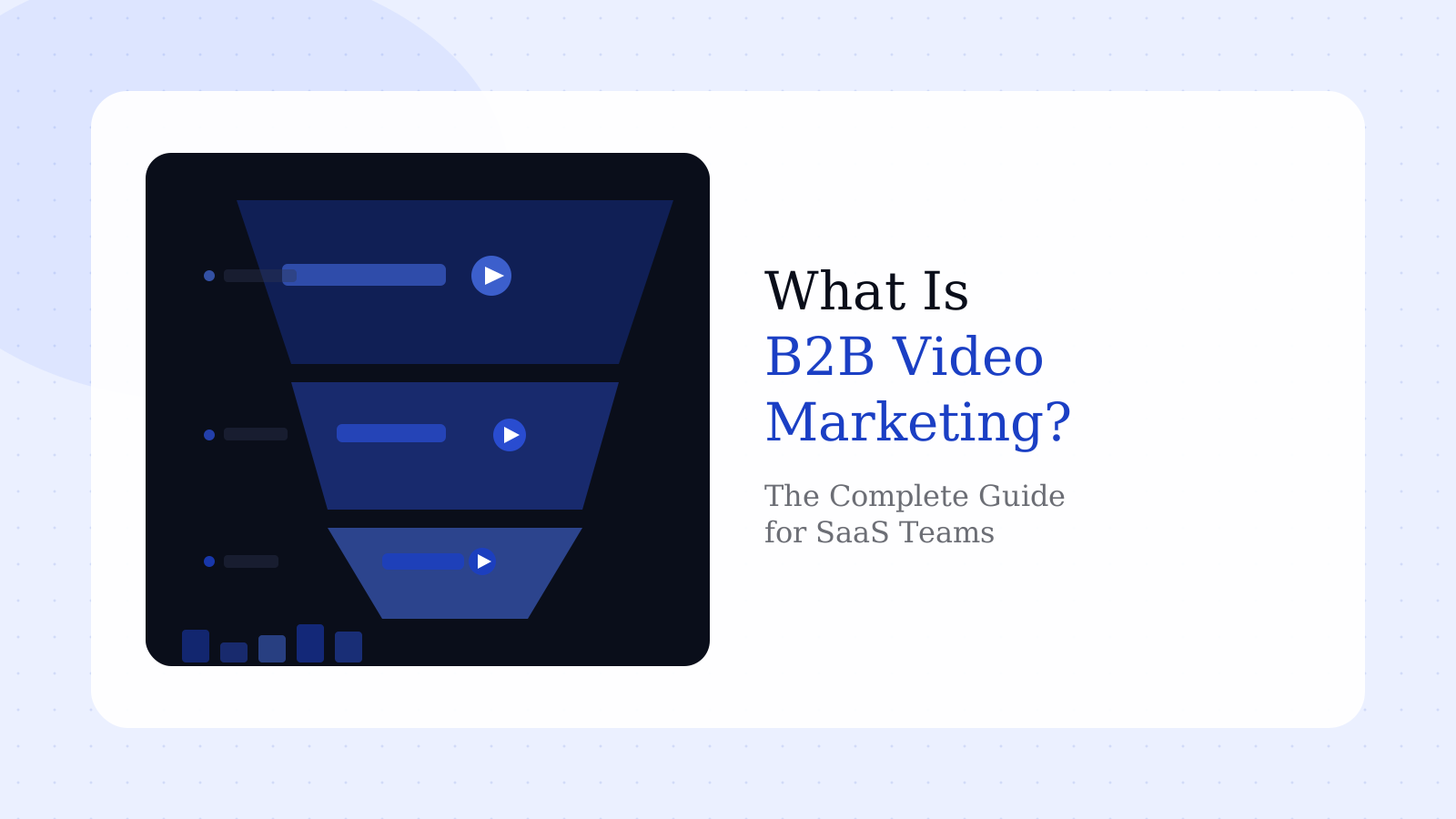
- Mapping B2B video marketing across the buyer journey
- The production velocity problem: why most B2B video programs fail
- What to actually measure in B2B video marketing
- How to build a sustainable B2B video marketing program
- FAQ
What is B2B video marketing?
B2B video marketing is the strategic use of video content to reach, educate, and convert business buyers across the full customer journey — from first awareness through to purchase, adoption, and expansion.
That definition is technically accurate. But here's the more useful version: B2B video marketing is how your product, your people, and your proof get in front of a buying committee that will never talk to your sales team until they've already formed a strong opinion about whether to buy from you.
Gartner's research puts this in stark terms. B2B buyers now spend only 17% of their total buying journey in direct contact with potential vendors (Gartner, 2024). The other 83% is independent research — reading, comparing, watching. By the time a prospect books a demo call, most of the decision has already been shaped by the content they encountered before they raised their hand. Video is the format that shapes those decisions fastest.
This isn't a prediction about where B2B marketing is going. Vidyard's 2025 Video in Business Benchmark Report, which analyzed more than 940,000 business videos created with a business video maker, found that 70% of B2B buyers already watch video content during their purchase decision process. The behavior is already established. What most B2B teams lack is the system to take advantage of it.
The scope of B2B video marketing includes:
- Videos that generate awareness at the top of the funnel
- Videos that educate and build consideration in the middle
- Product demo videos that help buyers evaluate fit during active comparison
- Testimonial and case study videos that build social proof at the decision stage
- Onboarding and tutorial videos that drive adoption and reduce churn post-sale
- Personalized sales videos that help individual reps move specific deals
Each category has its own goals, formats, and production requirements. Treating them as the same content type — just "videos" — is what produces the unfocused library most SaaS teams are sitting on.
How B2B video marketing differs from B2C
Most marketing guides treat video as video — regardless of the audience or context. This is where B2B SaaS teams go wrong early.
B2C video marketing is built for fast decisions made by individuals. A consumer watches a 15-second Instagram clip and buys a skincare product. The video works in a single touchpoint. The buyer and the decision-maker are the same person. Emotional appeal carries most of the weight.
B2B buying is structurally different in three ways that change everything about how video content needs to work.
First: multiple stakeholders, not one buyer. A typical B2B software purchase involves six to ten people across the committee — a champion, an evaluator, a budget holder, IT security, a skeptic. Each has different questions and different objections. A single generic video can't address all of them. B2B video marketing has to think in terms of audiences within the audience — and build content that the champion can use to sell internally after the demo.
Second: a much longer buying cycle. B2B SaaS deals that close in a single week are the exception, not the rule. Video content needs to stay relevant and credible across weeks or months of evaluation. This is why product demo videos go stale faster than any other format — and why the teams that maintain an active video library consistently outperform those that produce a single "hero" video and let it run for twelve months.
Third: rational trust is the primary currency. B2C buyers need to feel something. B2B buyers need to believe something — that your product works the way you claim, that your team understands their industry, and that other companies like them have had good outcomes. That's why product explainer videos alone don't convert in B2B the way they do in consumer contexts. Concepts aren't enough. Evidence is required.
One stat that clarifies this: 92% of B2B buyers trust peer recommendations over branded content (Vidico, 2026). Testimonials and case study videos aren't optional extras — they're the trust infrastructure that makes your other videos work.
The 6 video formats that drive B2B results
B2B video marketing is not one format used everywhere. It's a set of six distinct formats, each suited to a specific audience mindset and a specific job to do.
1. Product demo video
A product demo video shows the software working in a realistic context — real screens, real workflow, a recognizable outcome. This is the mid-funnel format for buyers in active evaluation who need to see evidence, not explanation. The goal is to help them answer "does this actually work the way they claim it does?" in under three minutes.
Vidyard's 2025 benchmark data found that product and interactive videos increase conversion rates by up to 70%. That number only holds if the video shows the right workflow for the right buyer persona. A generic product tour converts no persona particularly well.
2. Product explainer video
An explainer video uses narrative — often with animation or voiceover — to describe a concept or a problem/solution arc. This format dominates the top of the funnel where buyers don't yet know your product exists and need context before they're ready to evaluate.
Explainer videos are the most commonly overused format in B2B SaaS. Teams produce them for every use case, every feature, every launch. The problem is that an explainer video tells a buyer what the product does. A demo video shows them. Don't use the former when the buyer is ready for the latter.
3. Customer testimonial and case study video
Nothing in B2B marketing outperforms social proof from a recognizable peer. A 90-second testimonial video featuring a customer in the same industry, same company size, and same role as your buyer does more persuasion work than any amount of your own copy.
These videos are most powerful at the decision stage, when a buyer is narrowing from three vendors to one. But the real insight is that testimonials are most effective when they're specific — a specific company, a specific problem, a specific result with a number attached. "We cut demo production time from six weeks to three days" is twenty times more persuasive than "we've been very happy with the platform."
4. Product walkthrough and tutorial video
A product walkthrough guides a user through a specific workflow step by step. Unlike a demo video aimed at buyers, walkthroughs are designed for existing users — during onboarding, for feature adoption, or to reduce support ticket volume.
The teams that invest in walkthrough videos post-sale see measurable reductions in churn and an increase in expansion revenue as users discover more of the product. Most B2B SaaS companies under-invest here because video is classified as a marketing tool, not a customer success tool. That mental model is expensive.
5. Thought leadership and brand video
This is the executive interview, the industry POV, the "here's what we believe about how this problem should be solved" content. It doesn't demonstrate features. It builds authority and shapes buyer mental models before they enter evaluation mode.
For B2B SaaS companies, LinkedIn has become the primary channel for this format — Wistia's 2025 State of Video report found that 8 in 10 teams now name LinkedIn as their primary video distribution platform. Short-form thought leadership clips that position your founders or product leaders as genuine experts in the buyer's problem drive brand recognition at a scale no ad budget alone can replicate.
6. Personalized sales video
A personalized sales video is created by a rep or solutions engineer for a specific prospect — referencing their company, their industry, their specific objection raised in discovery. It runs 2–4 minutes and typically gets sent after a discovery call as a leave-behind, or to re-engage a deal that's gone quiet.
G2 reviews of Vidyard and Loom repeatedly surface the same problem with this format at scale: tools built for async messaging weren't designed for the repeatable, controlled recording environments that systematic demo video production requires. The recording workflow produces inconsistent quality, and pricing that escalates per seat becomes a blocker as the team grows beyond a handful of reps.
Mapping B2B video marketing across the buyer journey
The format matters. But format misalignment — putting the right video at the wrong stage — is the most common and most costly mistake in B2B video marketing.
Here's how each format maps to buyer intent:
| Funnel Stage | Buyer Question | Best Video Format |
|---|---|---|
| Awareness | "Does this type of solution even exist?" | Explainer, thought leadership |
| Consideration | "Does this product work for my use case?" | Product demo, use-case walkthrough |
| Decision | "Has anyone like me had success with this?" | Testimonial, case study |
| Post-sale | "How do I get value from what I bought?" | Tutorial, onboarding walkthrough |
| Expansion | "What else can I do with this product?" | Feature demo, advanced tutorial |
The mistake most teams make at the consideration stage is sending an awareness-level video. The buyer who already knows your category exists — who already found your website, read your pricing page, and started a trial — doesn't need the animated overview of what the product is. They need to see it working for someone exactly like them.
Sending the wrong format is not just ineffective. It signals to the buyer that you don't understand where they are in their evaluation. That's a trust signal that cuts against you, quietly.
Turn your product into a demo video in minutes
Rimo generates production-grade B2B demo videos from a plain-English brief — real screens, no editor, no six-week cycle.
The production velocity problem: why most B2B video programs fail
Here's the thing almost nobody writes about when covering B2B video marketing: the strategy isn't the hard part. Velocity is.
B2B SaaS products ship constantly. Navigation changes. Features get renamed, moved, or replaced. A homepage demo video recorded in January shows a workflow that no longer exists in April. Most teams respond to this by leaving the outdated content live because the production cycle to replace it takes six to eight weeks. A six-week production timeline for a 90-second product update video isn't a content strategy — it's a guarantee that your marketing assets are always behind your product.
Wistia's 2025 State of Video report documented something significant: AI use in video production jumped from 18% to 41% in a single year — the largest single-year adoption spike in the report's history. Teams aren't replacing their video strategy with AI. They're using AI to automate demo video production so that the production cycle can keep pace with the product roadmap.
The practical implication is this: the B2B video marketing teams that win in 2026 aren't the ones with the highest production quality. They're the ones with the shortest path from "new feature shipped" to "demo video live."
G2 reviews of Loom consistently highlight a version of this problem: recording issues — frozen uploads, extension failures, and unstable performance during critical demo moments — hit particularly hard for marketing teams trying to produce systematic, repeatable demo content (G2, 2025–2026). These tools were built for personal async messaging. When they're repurposed for a video content operation that needs to ship reliably at volume, the gaps surface fast.
The teams that solve the velocity problem do two things differently:
They keep videos short and modular. A 90-second video showing one specific workflow is far easier to update than a 5-minute product tour. When that workflow changes, you swap one clip. You don't rebuild the whole asset.
They decouple story decisions from production decisions. The script, persona, and message are story decisions — they change with each video. The transitions, captions, branding, and CTAs are production decisions — they should be fixed templates. When teams conflate the two, every new video is a ground-up effort. When they separate them, production becomes a repeatable execution against a known structure.
What to actually measure in B2B video marketing
Play count is not a metric. It measures whether your thumbnail was attractive enough to click, not whether your video moved a buyer closer to a purchase.
The metrics that actually tell you whether B2B video marketing is working:
Completion rate. What percentage of viewers watch to the end? Wistia's 2025 benchmark shows videos under one minute hold a 50% average engagement rate, while videos in the 1–3 minute range hold 46%. Completion rate below 30% on a mid-funnel video is a signal that either the content doesn't match the audience's intent, or the first 15 seconds aren't earning the next 60.
Stage-specific conversion. Are viewers who watch the awareness video progressing to consideration? Are viewers who watch the demo video requesting a trial or booking a call? Video without a downstream conversion event attached is a brand exercise, not a pipeline tool. Every video in your B2B video marketing program should have a defined next action.
Deal influence. Which videos appear in deals that close, and at what stage were they watched? This is the clearest signal of which formats are doing real persuasion work versus which are watched and forgotten.
Video freshness rate. What percentage of your active video assets reflect the current product? If your flagship demo video is more than three months old and your product has shipped since then, you're presenting a version of the product that doesn't exist to buyers who are actively evaluating you. Tracking this is unglamorous. Ignoring it is expensive.
How to build a sustainable B2B video marketing program
Most B2B video programs collapse under their own ambition. Teams decide to "do video" and immediately try to produce everything: homepage hero, all five personas, three case studies, a full product tour. Six months later, they have two videos that are already out of date and a backlog they don't have the bandwidth to clear.
The teams that build sustainable programs start smaller and go faster.
Start with one format done well. For most B2B SaaS companies, that format is the mid-funnel demo video — here's how to create product demo videos without a full production team. It has the clearest ROI, the most direct connection to pipeline, and the most defined audience. Get the production workflow repeatable on one format before adding others.
Build the brief format first, not the video. A good video brief takes 20 minutes to write and includes: the buyer persona, the specific problem they have, the workflow that demonstrates the solution, and the one action the viewer should take after watching. When the brief format is locked, the script almost writes itself. When there's no brief, every video starts from zero and takes five times as long.
Use a video script template for every production. Variance in script structure is one of the primary sources of inconsistent output quality. A template doesn't constrain creativity — it eliminates decisions that don't need to be remade on each project, so the team's energy goes into the story, not the structure.
Build a review cadence, not a one-off audit. Schedule a quarterly review of every active video asset: is it current? Is the workflow shown still accurate? Is the CTA still pointing to the right destination? This takes two hours per quarter and prevents the "invisible outdated content" problem that quietly erodes trust with buyers who are looking for evidence you know your product.
Follow the SaaS demo video best practices for each format. Not every video is a demo. Each format has its own quality checklist. Testimonials need specificity. Explainers need a clear problem frame. Walkthroughs need a realistic user scenario. Treating them all the same produces content that's generically adequate and specifically persuasive to no one.
B2B video marketing isn't complicated in concept. The six formats are well-understood. The funnel logic is clear. The data is unambiguous — buyers watch video, and video influences decisions.
What makes it hard is the operational reality. Products change fast. Production takes time. Teams are under-resourced. Content goes stale before it ever gets the distribution it needs.
The teams that win at B2B video marketing in 2026 are the ones that solve the production problem — not by spending more, but by building a system that produces relevant, current, persona-specific video at a pace that keeps up with the product. That's what separates a video library that actively generates pipeline from a collection of assets that nobody updates and nobody fully trusts.
If you want to see what that looks like in practice, Rimo is built exactly for this: a brief in, a production-grade demo video out, in the time it used to take to schedule a contractor kickoff call. Start free →
FAQ
What is B2B video marketing?
B2B video marketing is the strategic use of video content to educate, engage, and convert business buyers throughout the full customer journey — from initial awareness through purchase and post-sale adoption. It encompasses multiple formats including product demo videos, explainer videos, testimonials, and personalized sales videos. What distinguishes B2B video marketing from general video marketing is the need to address multiple stakeholders, longer decision cycles, and rational evidence-based buying behavior rather than impulse purchase dynamics.
How is B2B video marketing different from B2C video marketing?
B2B video marketing operates across a longer buying cycle, with a committee of six to ten decision-makers rather than a single consumer. B2B buyers require rational evidence — proof that the product works for their specific context — where B2C purchases are often driven by emotion and immediate desire. This means B2B video content must build credibility across multiple touchpoints, serve different roles in the buying committee with different content, and be specific enough that a champion can use it to sell internally to stakeholders who never watched the video themselves.
What types of videos work best for B2B marketing?
The six formats with the clearest B2B ROI are: product demo videos (evaluation stage), explainer videos (awareness stage), customer testimonial and case study videos (decision stage), product walkthrough and tutorial videos (post-sale), thought leadership and brand videos (top-of-funnel trust), and personalized sales videos (deal closing). Each maps to a different buyer question and a different moment in the journey. Vidyard's 2025 benchmark data found that product and interactive videos increase conversion rates by up to 70% when matched to the right stage.
How long should B2B marketing videos be?
Length should match funnel stage and format. Awareness-stage explainer and social videos perform best at 60–90 seconds. Mid-funnel product demo videos work well at 2–3 minutes for persona-specific content. Decision-stage testimonials can run up to 2 minutes if the specificity warrants it. Post-sale tutorial videos can run longer — 3–5 minutes — because the viewer already bought and has genuine task-completion intent. Wistia's 2025 State of Video data shows videos under one minute hold a 50% average engagement rate; videos in the 1–3 minute range hold 46%. Go longer only when the content fully earns the time.
How do you measure B2B video marketing success?
The most meaningful metrics are: completion rate (what percentage of viewers finish the video), stage-specific conversion (do viewers take the next intended action), and deal influence (do buyers who watch specific videos close at higher rates). Play count measures distribution reach, not persuasion quality. Completion rate below 30% on a mid-funnel demo video typically signals a mismatch between audience intent and content, or a weak opening 15 seconds that fails to earn continued attention. Every video should have a defined downstream conversion event to measure against.
How often should you update B2B video content?
For SaaS products, any significant UI change, feature rename, or workflow update that appears in a video warrants an update. Fast-shipping teams often need to update demo videos quarterly — or more frequently. The practical solution is to keep videos short and modular (one workflow per video) rather than producing single long-form product tours that become difficult to maintain. A 90-second use-case clip showing one workflow can be updated independently when that workflow changes. A 5-minute full product tour has to be rebuilt entirely when anything in the middle of it changes.
Akshay Sharma
Product Leader · 10+ years in B2B SaaS
Akshay has spent 10+ years building and marketing B2B SaaS products. He writes about product storytelling, demo production, and the operational side of product marketing.