What Is an AI Product Video Maker? The B2B SaaS Guide
Your product team shipped four features last month. Three new customer segments are onboarding. Your EMEA partner network is asking for localised training videos. Your support team flagged six workflows that need updated documentation videos. And your PMM just counted 40 open video requests with no production capacity to clear them.
This is not a content strategy problem. It is a volume problem — and it is specific to a particular kind of software company.
Horizontal B2B SaaS platforms serve multiple industries, multiple personas, and multiple use cases from a single product surface. Every feature update generates a cascade of video needs: customer onboarding content, internal sales training, partner enablement, support documentation, and feature launch announcements — all at once, all the time. Traditional video production was never designed for this. An AI product video maker is.
This guide explains what an AI product video maker actually is (and how it differs from other AI video tools), the five features that separate capable platforms from basic ones, when the tool earns its place in a SaaS team's workflow, and which teams get the most from it.
In this guide
- What is an AI product video maker?
- The 5 features that define a real AI product video maker
- When does a team actually need an AI product video maker?
- Which industries and teams get the most from an AI product video maker
- FAQ
What is an AI product video maker?
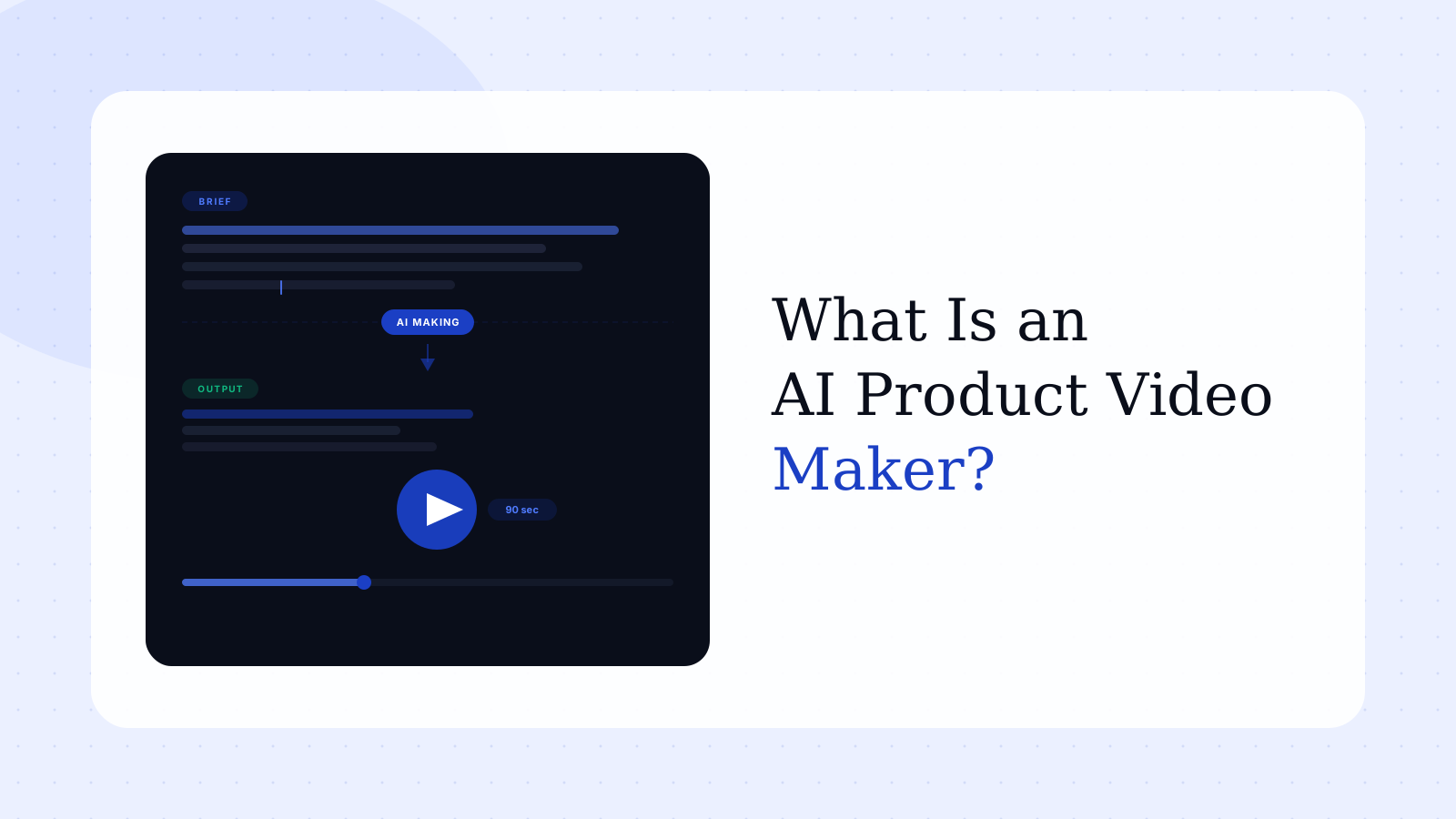
An AI product video maker is a software platform that uses artificial intelligence to generate product-focused videos — demos, walkthroughs, feature explainers, onboarding clips — from structured inputs rather than from live screen recordings or manual editing workflows.
The key word is "product." General AI video tools can produce marketing content, social clips, or avatar-led presentations. An AI product video maker is built specifically for showing software: its interface, its workflows, its outcomes. The inputs are typically a written brief, product screenshots or design assets, and branding guidelines. The output is a complete, branded video — voiceover, captions, callouts, and CTA included.
This distinguishes the category from four other things that are often confused with it:
- Screen recorders with AI editing (Loom, Descript): These tools start with a recording and apply AI in post-production. They still require someone to sit down, navigate the product, and capture footage. The AI speeds up editing; it does not replace the recording step.
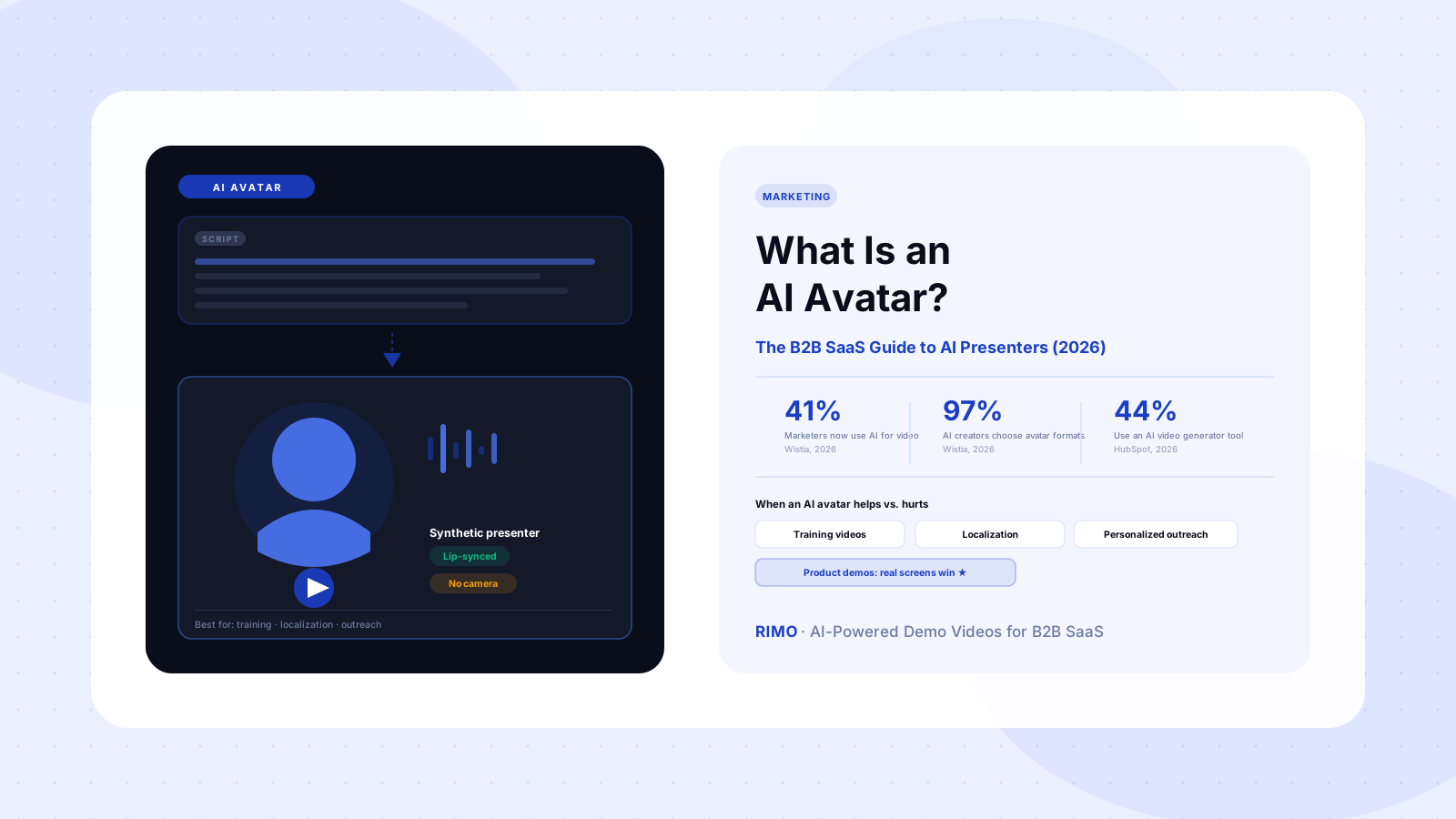
- Avatar-based video generators (Synthesia, HeyGen): These produce a synthetic presenter reading a script. They do not show a real product interface and are not suited to demos where buyers need to evaluate actual software.
- Text-to-video models (Sora, Runway): These generate synthetic visuals from a text prompt. Useful for marketing content — not appropriate when buyers need to see a real product.
- Interactive demo platforms (Navattic, Storylane): These create clickable product replicas. They are tours, not videos, and serve a different purpose in the buyer journey.
An AI product video maker sits in its own category: it uses real product visuals and a structured brief to generate a watchable, shareable video without a recording session or an editor.
For a broader map of the AI video tool landscape, see what types of AI product video generators exist — it covers all four categories in detail, including which ones are and are not appropriate for B2B SaaS product demos.
According to Wistia's 2025 State of Video report, AI use in video production doubled in a single year — from 18% of companies in 2024 to 41% in 2025, across 14 million videos and 100,000 businesses. The driver is not novelty. It is the realisation that video production volume requirements have outpaced what manual workflows can sustain.
The 5 features that define a real AI product video maker
Not every tool that calls itself an AI product video maker delivers the same capabilities. These five features separate platforms that can genuinely serve a high-volume B2B SaaS team from tools that are better suited for occasional, one-off production.
Feature 1: Brief-to-video generation
The most foundational capability is the ability to take a plain-English brief and produce a complete video — not a template to fill out manually, but a rendered output with voiceover, scene structure, product visuals, and a CTA.
A brief might be 80–150 words. It describes the viewer, their problem, the product actions that demonstrate the solution, and the outcome the video should land. From that brief, the platform generates a scene plan, assigns visuals to each scene, produces voiceover from a script it derives from the brief, and exports a finished video.
This is what collapses the production timeline from weeks to hours. The bottleneck in traditional product demo video creation is not execution — it is the back-and-forth between brief, script, recording, and editing. Brief-to-video generation removes three of those four steps.
Teams that are new to this workflow consistently underestimate how much the brief matters. The output is only as good as the brief. A vague brief ("show our dashboard") produces a generic video. A sharp brief ("show a marketing ops manager how our routing rules sync to Salesforce without manual CSV exports") produces a video that converts.
Feature 2: Multilingual voiceover and captions
For any SaaS company serving more than one geography, localisation is not optional — it is a perpetual production burden. A screen-recorded demo voiced in English requires a complete re-record for every additional language: find a voice talent, schedule the session, re-sync the audio to the existing visuals, export a new file. For ten languages, that is ten separate productions.
An AI product video maker with multilingual capability changes this to a parameter change. You produce one brief in English. You specify the target languages — German, French, Japanese, Brazilian Portuguese. The platform generates language-specific voiceover, auto-adjusts the caption timing, and exports a localised version of the video for each market.
For horizontal SaaS platforms with international partner networks, this single feature can eliminate weeks of localisation production backlog per quarter.
Feature 3: Branded templates and style control
In large B2B SaaS organisations, product videos are created by multiple teams: product marketing, customer success, sales enablement, partner management. Without enforced brand controls, the output varies — different fonts, different colour treatments, different motion pacing, different lower-third styles. The demo library ends up looking like five different companies.
A capable AI product video maker lets brand managers lock design parameters at the platform level. Approved colour palettes, typefaces, logo placement, and animation styles are fixed by template. Individual teams brief the content; the platform enforces the form. Every video that comes out looks like it came from the same company.
This matters more than it appears. Product demo video mistakes that cost conversions are often not strategic — they are consistency failures. A buyer who watches three videos from the same company and sees different visual treatments starts to question whether the company is organised enough to serve them well.
Feature 4: Modular scene editing
B2B SaaS products do not stay still. The UI gets updated. Features get renamed. Workflows get redesigned. A demo video that was accurate in January may show a navigation menu that no longer exists by March.
In a traditional production workflow, this means re-recording the affected scenes, re-editing them into the existing video, and re-exporting. In practice, most teams skip this process because it is too expensive relative to the perceived gain. The outdated video stays live.
Modular scene editing solves this structurally. Each scene in the video is a discrete, editable unit. When a specific workflow changes, you update the brief for that scene, regenerate it, and the platform swaps it into the video. The rest of the video is untouched. An update that would have taken three days takes three hours.
This capability is what makes AI-powered demo creation workflow sustainable rather than a one-off production method. A library of modular demos stays current because individual pieces are cheap to update — not because teams have the discipline to restart full productions every time the product ships.
Brief in. Branded video out.
Rimo generates complete, on-brand product videos from a plain-English brief — scenes, voiceover, captions, and CTA included. Built for B2B SaaS teams who ship continuously.
Feature 5: Bulk variant production
A single horizontal SaaS platform might need the same feature explained to six different personas: an administrator, an end user, a procurement lead, a technical evaluator, an executive sponsor, and a partner reseller. Each persona has a different success metric, a different vocabulary, and a different objection to pre-empt.
Without bulk variant production, creating six persona-specific videos from a single core workflow means six separate production runs. With it, you define the core scene structure once, specify the persona variations in each brief, and the platform produces all six in a single batch.
The same logic applies to use-case variants (show the same product solving three different industry problems), funnel-stage variants (awareness, consideration, and decision-stage versions of the same demo), and channel variants (a 90-second version for LinkedIn, a 3-minute version for the website, a 60-second version for a sales follow-up email).
Bulk variant production is what separates an AI product video maker from an AI video editor. An editor makes one video faster. A maker produces the library a horizontal SaaS team actually needs.
When does a team actually need an AI product video maker?
The tool earns its place when at least one of these conditions is true.
You are shipping faster than your demo library can keep up. If your product ships meaningful changes on a weekly or biweekly cycle, your demo videos are always partially outdated. The AI product video maker closes the gap by making updates fast enough to run alongside the product release cycle, not behind it.
You need the same product explained to more than two audience types. One generic demo video serves nobody precisely. The moment you have more than two meaningful personas — or more than two industries to address — the manual production cost of building persona-specific content becomes prohibitive. Bulk variant production resolves this.
You have a partner or reseller channel. Partners need to understand your product well enough to sell it. They need co-branded or white-labelled content they can send to their own prospects. Producing that content manually for each partner relationship does not scale. An AI product video maker treats partner enablement as a variant production problem — same core content, different brand wrapper and use-case framing per partner.
Your customer success or support team is spending time on repeatable video creation. CS teams frequently record one-off Loom videos to explain the same workflow to different customers. Multiplied across a CS team of 20 handling 200 accounts, that is hundreds of hours of repetitive recording. An AI product video maker lets the team produce a polished, reusable walkthrough once and share it at scale — or personalise it with minimal effort.
You are expanding into new markets and need localised content. A new geography launch needs onboarding videos, training content for local partners, and localised feature announcements. Producing all of that from scratch through traditional recording is a multi-month project. With multilingual generation, it is a parameter change.
Which industries and teams get the most from an AI product video maker
Horizontal B2B SaaS platforms
This is the core use case — the category for which AI product video makers are most clearly the right tool.
Horizontal platforms serve multiple industries from a single product: CRM software used by financial services, manufacturing, healthcare, and professional services simultaneously. Marketing automation platforms adopted by e-commerce companies, B2B enterprises, and agencies. Project management tools deployed across engineering, marketing, operations, and customer success teams.
Each industry has different terminology for the same features. Each persona has different success metrics for the same workflows. Each market has different compliance contexts for the same product. A single generic video library cannot address this breadth without becoming so vague it converts nobody.
The teams at horizontal SaaS companies who feel this most acutely are product marketing (responsible for positioning across all verticals), customer success (onboarding customers who have different use cases from day one), sales enablement (arming reps who sell into different industries with vertically-relevant demo content), and partner management (producing enablement content for resellers who serve industry-specific markets).
The volume and variety of video requests these teams face is not a resource problem — it is a structural one. More headcount on a manual production workflow still cannot keep pace with a product that ships weekly across six industries and twelve personas. An AI product video maker is the structural fix.
Enterprise software with large feature surfaces
Enterprise platforms — ERP systems, HRIS platforms, financial management software, legal tech — have product surfaces that span hundreds of features and configurations. No single video can explain the product. No small team can produce a complete library manually.
The video need at enterprise software companies tends to be segmented by module, configuration, or role: a video for the AP workflow, a video for the month-end close process, a video for the administrator setting up user permissions. Each video is short and specific. The library is large. AI production is the only economical way to build and maintain it.
SaaS companies with partner and reseller networks
Any SaaS company selling through channel partners — VARs, system integrators, managed service providers, or industry-specific resellers — faces a partner enablement problem. Partners need to understand the product well enough to present it credibly. They need content they can co-brand and distribute. They need that content to be updated when the product changes.
A partner network of 50 resellers, each needing co-branded product videos updated quarterly, is not a problem a production agency or an in-house video team can solve economically. It is a problem an AI product video maker solves by treating each partner's content as a brand-variant batch production run.
Customer success and support teams at scale
CS teams are prolific producers of informal video content — Loom recordings explaining a workflow, screen captures walking a customer through a configuration, recorded calls that get shared internally. The problem is that this content is inconsistent, hard to find, and impossible to keep current.
A CS team using an AI product video maker shifts from producing ad-hoc recordings to maintaining a structured library of polished, searchable video answers to the questions customers ask most. When a workflow changes, one person updates one brief. Every customer who visits the help centre gets the current version, not the one recorded six months ago.
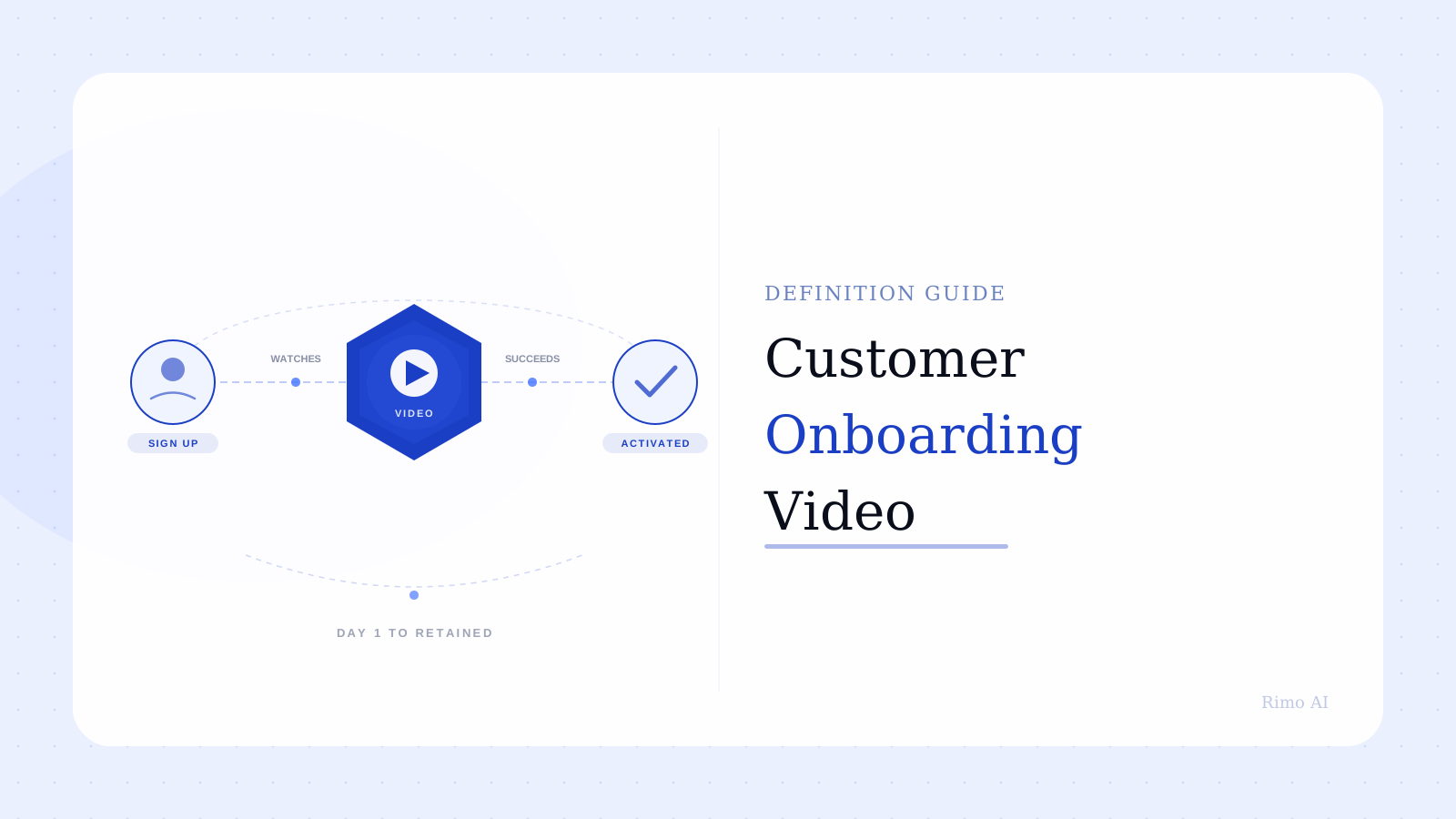
This is also where the foundational understanding of what a product demo video is matters: not every video a CS team produces is a demo. Some are tutorials, some are onboarding walkthroughs, some are troubleshooting guides. An AI product video maker handles all of these from the same brief-to-video workflow — the purpose changes, but the production method does not.
Conclusion
An AI product video maker is not a tool for teams that need to produce one polished video per quarter. It is a tool for teams whose video production requirements outpace what any manual workflow can sustain — which describes most horizontal B2B SaaS platforms operating in 2026.
The five features that matter — brief-to-video generation, multilingual output, brand controls, modular editing, and bulk variant production — collectively solve a structural problem: the gap between how fast a SaaS product ships and how fast the content around it can be updated. No amount of additional headcount on a traditional production workflow closes that gap. The right tool does.
Rimo is built specifically for this: brief in, branded product video out, updated in hours when the product changes.
FAQ
What is an AI product video maker?
An AI product video maker is a software platform that generates product-focused videos — demos, walkthroughs, feature explainers, onboarding clips — from a structured brief and product visual assets, without requiring live screen recording or manual video editing. You describe the audience, the workflow, and the outcome you want the video to land; the platform generates scene structure, voiceover, captions, callouts, and a finished export. The key distinction from general AI video tools is that makers are built specifically to show real software interfaces accurately, not to generate synthetic or avatar-led content.
How is an AI product video maker different from a screen recorder?
A screen recorder captures what happens on a real screen in real time. An AI product video maker generates a video from a brief and product assets without a recording session. The practical difference is production speed and maintainability: a screen-recorded demo takes days to produce and days to update when the UI changes; an AI-made video takes hours to produce and hours to update. For teams that ship continuously, the recording approach cannot keep pace. The AI maker approach can — because the source of truth is the brief, not the footage.
Is an AI product video maker free?
Most AI product video maker platforms offer a free tier or trial with limited output volume, watermarked exports, or restricted features. Paid plans typically tier by the number of videos produced per month, the number of brand templates, or the number of language outputs. For B2B SaaS teams evaluating the tool, the most useful test is not the free tier — it is whether the paid workflow can produce a publishable video faster than your current process. Rimo offers a free start with no credit card required.
Which B2B SaaS teams benefit most from an AI product video maker?
Horizontal B2B SaaS platforms get the highest return, because they face the broadest range of video requirements simultaneously: multiple personas, multiple industries, continuous product releases, partner networks, and customer success at scale. Within those companies, the teams that benefit most are product marketing (persona and vertical video coverage), sales enablement (rep training and demo assets), partner management (co-branded enablement content), and customer success (scalable onboarding and support walkthroughs).
Can an AI product video maker handle multilingual video production?
Yes — multilingual output is one of the five core features that define a capable platform. You produce a brief in your primary language. The platform generates voiceover in each target language, adjusts caption timing, and exports a localised version per market. For teams managing five or more geographies, this collapses a workflow that previously required separate recording sessions per language into a batch production run that takes hours. The quality of the output depends on the platform's voice model for each language — evaluate this specifically in any trial.
How often should a B2B SaaS team update their AI-made product videos?
Any meaningful UI change, feature rename, or workflow redesign warrants an update. For teams using modular scene editing, the update is scoped to only the affected scenes — not the full video. For a fast-shipping SaaS team releasing weekly, this means running a video update alongside every sprint that changes a user-facing workflow. The operational unlock of an AI product video maker is that this cadence is achievable: updating a scene takes hours, not days, so keeping pace with the product release schedule becomes a realistic expectation rather than an aspirational one.
Tags: ai product video maker · AI video · B2B SaaS · product marketing · horizontal SaaS
Related posts:
- What Is an AI Product Video Generator? (The 4 Types Explained)
- How to Automate Demo Video Creation With AI
- What Is a Product Demo Video?
Schema: Article, FAQPage
Akshay Sharma
Product Leader · 10+ years in B2B SaaS
Akshay has spent 10+ years building and marketing B2B SaaS products. He writes about product storytelling, demo production, and the operational side of product marketing.