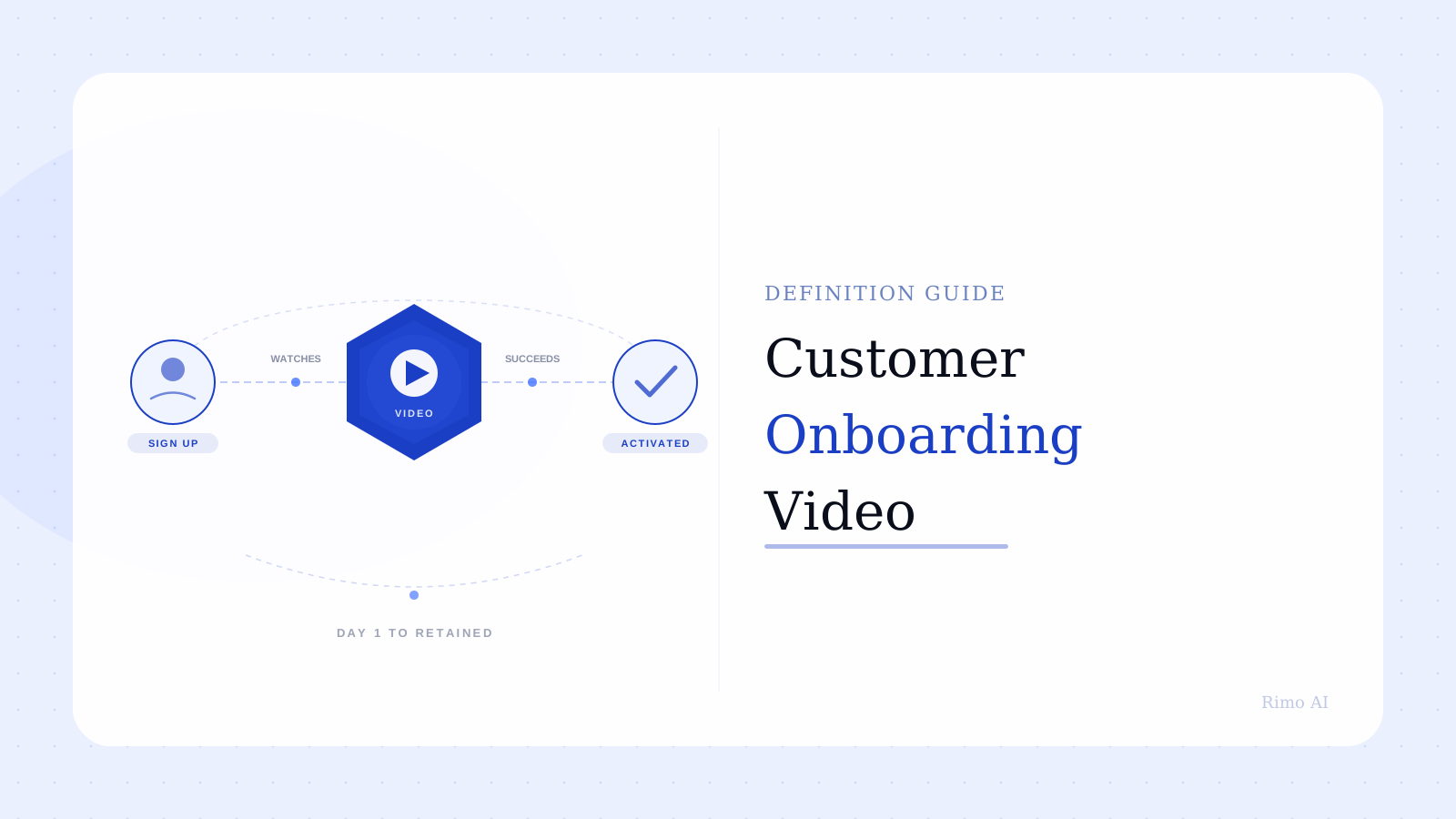
Customer Onboarding Video: The B2B SaaS Guide to Cutting Time-to-Value (2026)
Your CS team has given the same walkthrough call 40 times this quarter. Same five features, same setup steps, same "let me share my screen" opener. Every new customer gets a slightly different version depending on who picked up the calendar invite that week, and half of them forget most of it by the time they're back at their desk trying to actually use the product.
That's not a training problem. It's a format problem. The answer your best CSMs give on call 41 should already exist as a customer onboarding video — something a new user watches on their own schedule, rewatches when they forget, and gets word-for-word consistent every time. Most B2B SaaS teams know this. Very few have actually built the library.
This guide covers what a customer onboarding video actually is, the specific mistakes that show up over and over in G2 reviews of the tools built to make them, and a framework for building a library that doesn't quietly go stale the moment your product ships its next release.
In this guide
- What is a customer onboarding video?
- Why customer onboarding video matters for time-to-value
- The pain points G2 reviewers keep repeating
- The 4 types of customer onboarding video that drive activation
- Building an onboarding video library that doesn't go stale
- The onboarding video script framework
- How to measure customer onboarding video ROI
- Customer onboarding video vs. every other format you already have
- Building your first onboarding video program
- FAQ
What is a customer onboarding video?
A customer onboarding video is a short, structured video that walks a new customer through a specific setup task, workflow, or feature during the first days or weeks after signup — built to be watched on-demand rather than delivered live by a CSM. It's the video equivalent of the first 90 days of a customer relationship, broken into pieces a person can actually retain.
This is distinct from a pre-sale product demo video, which exists to convince someone to buy. An onboarding video exists to help someone who already bought get to value without waiting for a human to be available. Conflating the two is the single most common strategic mistake teams make when they start building a video library — more on that later.
Why customer onboarding video matters for time-to-value
Time-to-value is the metric that decides whether a signup becomes a customer. Amplitude's 2025 benchmark study, drawn from more than 2,600 companies, found that over 98% of new users churn within two weeks if they never reach a core value milestone — and users who go three days without meaningful engagement have a 90% chance of never coming back.
The window is short, and it's shrinking. For self-serve B2B SaaS in 2026, a time-to-value under five minutes is considered excellent — the territory Figma, Linear, and Canva operate in. Anything past twenty minutes starts losing a meaningful share of signups before they ever reach the moment the product was supposed to prove itself.
A live onboarding call cannot fit inside that window. Even a fast-moving CS team needs hours or days to find a slot, and a new user sitting idle for a day is a user Amplitude's data says is already halfway to churned. A customer onboarding video removes the scheduling gap entirely — it's available the second a user hits the exact step where they'd otherwise get stuck.
The compounding effect is the one most teams underweight: according to a 2026 UserGuiding study, customers who reach first value inside 30 days retain at 80% or higher by month 12, while those who don't retain at only 35–50%. An onboarding video's job isn't to be a nice-to-have resource. It's the mechanism that decides which side of that gap a customer lands on.
The pain points G2 reviewers keep repeating
Before building a video onboarding program, it's worth knowing where the tools built for it tend to fail — because the same three complaints show up across every major screen-recording and video-onboarding platform's reviews.
The library becomes unusable within a year. Loom reviewers describe a familiar arc: recordings pile up with no naming convention, and finding "that one video" from six months ago becomes a genuine hunt. This isn't a niche complaint — it's a recurring theme across reviews once a team scales past a handful of videos, and it's exactly the failure mode that turns an onboarding library into a graveyard nobody trusts.
The tool's own onboarding depends on a human who isn't there anymore. In a pattern that should embarrass the category, Vidyard reviewers have specifically wished for a proper onboarding library on how to use Vidyard itself — because the sales rep who walked them through it during the trial isn't around when a new, remote teammate joins six months later. A video onboarding tool that can't onboard its own users without a live rep is a warning sign worth taking seriously.
Production quality hits a ceiling fast. Vidyard reviewers note the editing is thin once you want more than a basic cut — "no real timeline editing or fancy transitions," as one put it. Arcade reviewers report a similar wall: cumbersome step-by-step editing with fiddly cropping, plus a steep pricing jump between the entry tier and the plan that unlocks real branding control.
The pattern across all three: teams invest in a tool, produce a burst of videos in month one, and then watch quality and organization decay because nobody budgeted for the ongoing maintenance a living onboarding library actually requires.
The 4 types of customer onboarding video that drive activation
Not every onboarding moment needs the same video. Teams that treat onboarding video as one undifferentiated bucket tend to produce one 15-minute mega-walkthrough that almost nobody finishes. The four types below map to specific moments in the first 30 days:
- Welcome and orientation videos. 60–90 seconds, delivered within the first 24–48 hours. Sets expectations for the onboarding period and points to where help lives. Not a feature tour — a map.
- Core workflow walkthroughs. 2–4 minutes each, one per workflow required to reach the customer's first meaningful outcome. This is the category with the biggest payoff, and the one most teams under-invest in relative to feature-tour content nobody asked for.
- Feature-specific how-to videos. Under 90 seconds, triggered by behavior rather than pushed on day one — a user who opens a specific settings page gets the video for that page, not a generic library link.
- Renewal and expansion videos. Delivered later in the lifecycle, covering advanced workflows tied to upsell paths or new feature releases relevant to that account's usage pattern.
A four-minute video that covers one workflow and tells the viewer exactly what to do gets watched to the end. A twenty-minute video that "covers everything" gets abandoned at minute three — and the data behind that isn't a guess, it's the same time-to-value math from the section above, applied to the video itself.
Stop rebuilding onboarding videos by hand
Rimo turns a plain-English brief into a screen-accurate onboarding video — script, voiceover, and edit included — so your CS team's library updates as fast as your product ships.
Building an onboarding video library that doesn't go stale
Here's the part most onboarding video guides skip entirely: the hard problem isn't producing the first ten videos. It's keeping fifty of them accurate six months later, after three sprints of UI changes nobody told the CS team about.
Assign an owner, not a committee. Someone on the CS or product marketing team needs explicit responsibility for the library's accuracy — not as a side project, but as a named part of their role. Libraries with no owner are the ones G2 reviewers describe finding cluttered and half-broken a year in.
Tag every video to the product surface it depends on. When a workflow changes, someone needs to know which videos reference it without manually re-watching the whole library. A simple spreadsheet mapping video → feature → last-verified date solves 80% of the staleness problem most teams never solve at all.
Set a review cadence tied to your release cycle, not the calendar. A product shipping every two weeks needs a lighter, faster review loop than one shipping quarterly. Reviewing "whenever someone notices" is how a library quietly becomes untrustworthy — and once a customer catches one outdated video, they stop trusting all of them.
Separate video onboarding software choices by job, not by brand recognition. A tool built for quick internal Loom-style recordings is not the same tool you want producing your customer-facing library at scale — the production ceiling and the maintenance model are different problems with different requirements.
Teams evaluating a full demo automation platform for onboarding often assume it's the same buying decision as picking video onboarding software for CS. It isn't — a demo platform optimizes for pre-sale personalization at volume; onboarding video optimizes for post-sale accuracy over the life of the account. The vendor overlap is real, but the evaluation criteria diverge fast once you get past the demo call.
The onboarding video script framework
An onboarding video script is not a demo script with the pricing slide removed. It has a different job: get one specific person unstuck, fast, with zero ambiguity about what to do next.
Open with the outcome, not the tool. "By the end of this, you'll have your first integration connected" beats "Let's look at the integrations tab" every time. The viewer needs to know the payoff is worth the ninety seconds before they commit to watching.
One workflow, one video, no detours. If explaining a workflow requires mentioning three unrelated settings, that's a sign the workflow itself needs three separate videos, not one video with three tangents. Split points map directly to natural pause points in the actual task.
Narrate the "why," not just the "click here." "Click Save" tells a viewer what to do. "Click Save — this locks the field so your team can't accidentally overwrite it later" tells them why it matters, which is the difference between a video that builds product understanding and one that's just a glorified list of clicks.
End with the next logical step, not a generic CTA. A demo video ends with "book a call." An onboarding video ends by pointing to the next workflow in the sequence — because the goal isn't conversion, it's momentum toward activation.
How to measure customer onboarding video ROI
Most teams can point to a general belief that onboarding videos "help." Very few can put a number on it — and that's usually why the budget for producing more of them stalls after year one.
The calculation is more straightforward than it looks. Start with tickets deflected: if video-based onboarding drives a 35% reduction in first-month support tickets (Loyalty.cx, citing Novoed/UserGuiding data, 2025), multiply that percentage against your current onboarding-period ticket volume and your average cost per resolved ticket. That's a real, defensible number before you even touch retention.
Then layer in retention. If customers who hit first value within 30 days retain at 80%+ by month 12 versus 35–50% for those who don't (UserGuiding, 2026), and your onboarding video library measurably shifts what share of customers land in the first group, the downstream revenue impact dwarfs the ticket-deflection number. The methodology here mirrors how teams already calculate product demo video ROI — attribution tightens as you move from Level 1 (views and completion) to Level 3 (revenue-linked CRM fields), and it's fine to start at Level 1 and build up.
The number most leadership teams actually want isn't "onboarding videos are good." It's payback period: production cost divided by monthly ticket-cost savings plus retained-revenue delta. Once that number exists, the budget conversation stops being a debate.
Customer onboarding video vs. every other format you already have
vs. the live onboarding call. The live call still wins when a deal requires custom configuration or a genuinely unfamiliar workflow — the same reason a live sales demo survives in a world full of self-serve alternatives. Video doesn't replace the call. It replaces the fourth time your CSM explains the exact same setup step this month.
vs. written help docs. Docs are searchable and skimmable in ways video isn't, which makes them better for reference lookup after onboarding is done. But for the specific moment of "I don't know what to click next," a short video showing the actual interface beats a paragraph describing it — new users read screenshots faster than they read instructions.
vs. the interactive product tour. An interactive product tour built for pre-sale marketing and a customer onboarding video look similar on the surface — both walk through the product step by step. The difference is audience and stakes: a tour is trying to convince a stranger the product is worth buying, and an onboarding video is trying to get someone who already paid to a specific outcome without frustration. Reusing marketing tour content for onboarding is a shortcut that usually produces videos that sell instead of teach.
Here's the part that surprises most teams building their first library: the videos that get rewatched most aren't the polished welcome videos marketing signs off on. They're the plain, slightly rough workflow videos that answer one specific "how do I..." question — the ones a CSM would have said out loud on a call anyway.
Building your first onboarding video program
Step 1: Audit your CS team's most-repeated explanations. Ask your CSMs what they explain on every single onboarding call. That list — not a feature inventory — is your first ten video topics, ranked by how often a human currently has to say it out loud.
Step 2: Map videos to your activation milestones, not your feature list. Identify the two or three actions that define "activated" for your product, then build the video sequence that gets a new user to each one. Everything else is optional content, not core library.
Step 3: Produce short, and produce fast. A rough four-minute video published this week beats a polished twelve-minute video that's still in review next month. Onboarding video decays the moment the workflow it shows changes — speed to publish matters more than production polish here.
Step 4: Assign ownership and a review cadence before you scale past ten videos. Revisit the staleness problem from earlier — this step is where most libraries either compound in value or start quietly rotting.
Step 5: Instrument view and completion data from day one. Even basic play-rate data from your hosting platform lets you catch which videos aren't getting watched — often a sign the workflow itself is confusing, not just the video.
If your team is producing pre-sale demo content and post-sale onboarding content through two completely separate workflows, reviewing SaaS demo video best practices alongside this guide is worth the hour — the production discipline transfers even though the audience and goal don't.
Conclusion
A customer onboarding video isn't a nice-to-have addition to your CS motion — it's the asset standing between a signup and the 90-day churn cliff Amplitude's data describes. The teams that get this right treat it the way they'd treat any other product surface: owned, versioned, and reviewed on a cadence tied to how fast the product actually ships.
Building that library by hand — recording, scripting, editing, and re-recording every time a workflow changes — is exactly the maintenance burden that turns most onboarding libraries into the cluttered mess G2 reviewers keep describing. Rimo generates screen-accurate onboarding videos from a plain-English brief, so updating a video takes minutes instead of a full re-shoot.
Start free with Rimo → or book a demo to see how fast your first onboarding video library comes together.
FAQ
What is a customer onboarding video?
A customer onboarding video is a short, on-demand video that walks a new customer through a specific setup task or workflow after they've already signed up or purchased. It's built to replace the repetitive parts of live onboarding calls, giving new users a consistent, rewatchable resource instead of a scheduling-dependent explanation from a CSM.
How long should a customer onboarding video be?
Most core workflow videos should run 2–4 minutes; welcome videos should stay under 90 seconds, and feature-specific how-to videos work best under a minute. If a single workflow needs more than 5–7 minutes to explain, split it into separate videos at the natural pause points rather than producing one long recording few people finish.
What's the difference between a customer onboarding video and a product demo video?
A product demo video is pre-sale — its job is to convince someone to buy. A customer onboarding video is post-sale — its job is to help someone who already bought reach value without waiting on a live call. They can share production tooling, but reusing demo content for onboarding usually produces videos that sell rather than teach.
What software should I use to create onboarding videos?
It depends on volume and maintenance needs. Simple screen-recording tools work for a handful of internal or ad hoc videos. Teams building a customer-facing library at scale need something built for ongoing accuracy as the product changes, since G2 reviews consistently show screen-recording libraries becoming disorganized and outdated within a year without a dedicated maintenance process.
How do I measure the ROI of onboarding videos?
Start with support ticket deflection — video-based onboarding is linked to a 35% reduction in first-month tickets (Loyalty.cx, citing Novoed/UserGuiding data, 2025) — multiplied against your cost per ticket. Then add the retention delta between customers who hit first value quickly versus those who don't, since that gap is typically the larger financial impact over a 12-month period.
Should onboarding videos be personalized per customer?
For core workflow videos, no — a well-built generic video covering a universal workflow serves every customer efficiently. For feature-specific videos, personalization by plan tier, industry, or behavior (triggering the right video based on what a user just clicked) meaningfully improves relevance without requiring a fully custom video per account.
Akshay Sharma
Product Leader · 10+ years in B2B SaaS
Akshay has spent 10+ years building and marketing B2B SaaS products. He writes about product storytelling, demo production, and the operational side of product marketing.