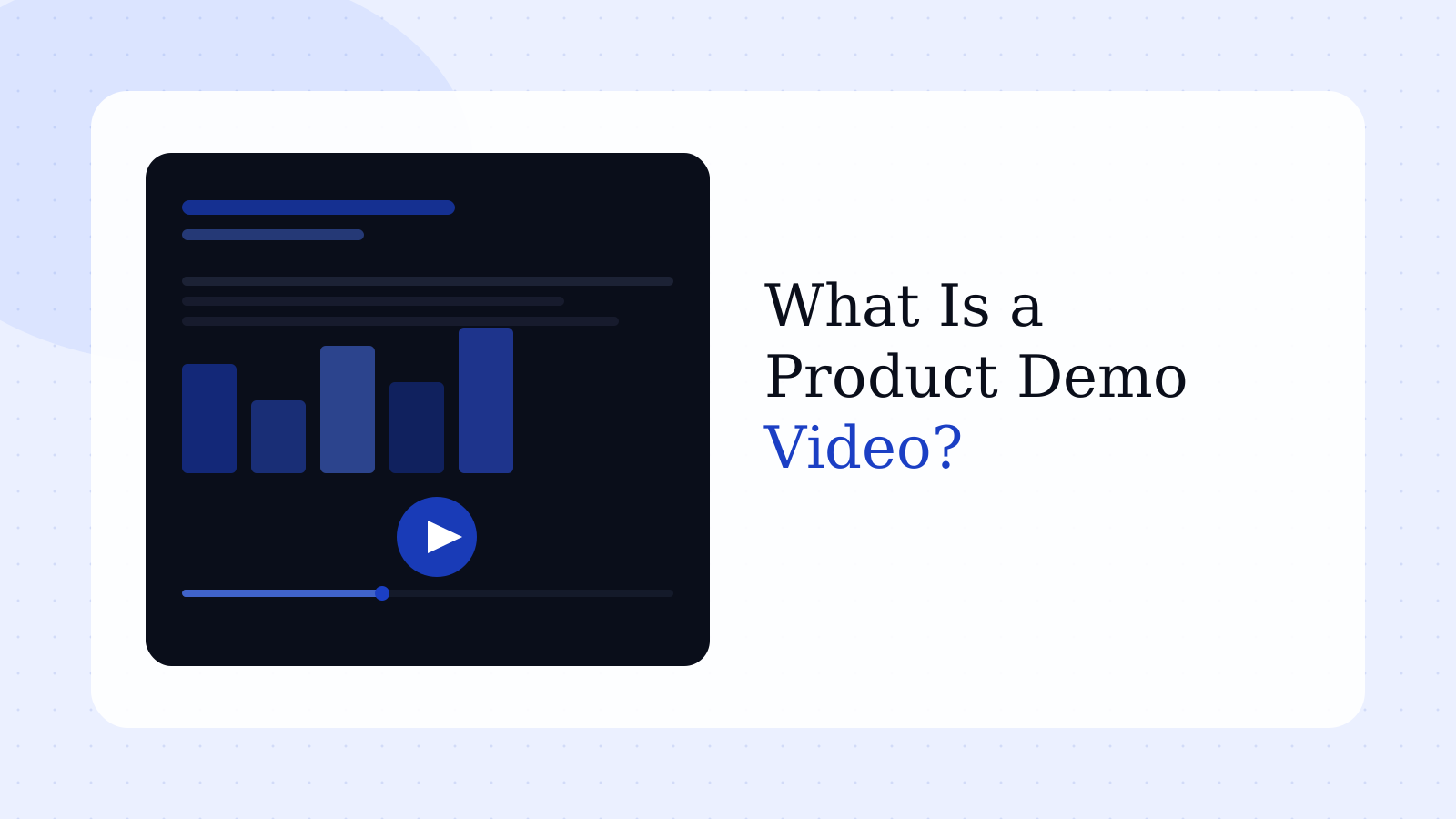
What Is a Product Demo Video?
Someone just asked for a demo. Your sales rep sends a Calendly link. The prospect ghosts.
This is one of the most common failure modes in B2B SaaS — not because the product is bad, but because "book a demo" puts all the friction on the buyer. They already know what they want to understand. They don't want a 45-minute call. They want 90 seconds of proof that your product does what you say it does.
A product demo video solves that problem. But only if it's the right kind, built for the right moment in the buyer's journey, and honest about what it can and can't show. This guide covers what actually separates effective demo videos from forgettable ones — including a few things the standard advice gets wrong.
In this guide
- What is a product demo video?
- The 4 types of product demo video in B2B SaaS
- What separates a good demo video from a forgettable one
- Product demo video vs. explainer video vs. interactive tour
- When to use a product demo video — and when not to
- The shelf-life problem: why demo videos go stale
- How to make a product demo video without a full team
- FAQ
What is a product demo video?
A product demo video is a short video that shows how real software works — what it does, what problem it solves, and what the workflow actually looks like for the user.
It is not an animated explainer. It is not a brand film. It is not a feature tour disguised as marketing content. A product demo video shows the product working in a realistic context, ideally for a specific buyer persona, with a recognizable outcome at the end.
That last part — recognizable outcome — is what most demo videos miss. Showing features is easy. Showing the result of using those features, in a way the buyer can map directly to their own job, is what makes a demo video persuade someone.
73% of B2B decision-makers say they prefer to watch a product demo video rather than read a whitepaper or product brochure (Gitnux, 2025). And yet most product marketing teams still spend more time producing PDFs than video. The mismatch is real — and expensive.
The gap usually comes down to two things: not knowing exactly what a demo video should contain for a specific buyer moment, and not having a repeatable process to produce demo videos without a full production team.
The 4 types of product demo video in B2B SaaS
Not all product demo videos serve the same purpose. There are four distinct types used across the buying journey, and confusing them is the most common mistake B2B marketing teams make.
1. The awareness-stage demo (overview video)
This lives on your homepage or primary landing page. It runs 60–90 seconds. Its only job is to make the product feel real and the outcome feel achievable. It does not need to show every feature — it needs to show the single most impressive thing your product does, as fast as possible.
This is the video most teams over-engineer. They try to show everything because they're afraid of leaving something out. The result is a 4-minute homepage video that no one finishes. Wistia's 2025 State of Video report found that videos under one minute hold a 50% average engagement rate, while longer videos see a steep drop-off. Shorter is not laziness — it's strategy.
2. The consideration-stage demo (persona or use-case video)
This is a deeper dive — typically 2–3 minutes — built for a specific role or workflow. A product marketing manager wants to see how your product handles launch assets. A sales engineer wants to see how it integrates with their CRM stack. Same product, different story, different buyer.
This is where most B2B SaaS teams underinvest. They produce one "generic" demo and expect it to convert every persona. It rarely does. The generic demo answers every question loosely and no question precisely.
3. The sales demo video (personalized or async outreach)
This is created using a sales demo video maker by a sales rep or sales engineer for a specific prospect. It might reference the prospect's company by name, use their industry's data, or address a specific objection raised in discovery. It typically runs 2–4 minutes and gets sent after a discovery call as a leave-behind, or to re-engage a quiet deal.
Personalized sales videos see significantly higher engagement than generic outreach — but the tooling barrier is real. Teams using demo video software like Loom or Vidyard for this frequently hit the same problems: recordings cut off mid-take, browser extensions that freeze during critical moments, and pricing that escalates quickly as the team scales (G2, 2025–2026). The tools were built for async messaging, not systematic demo production.
4. The post-sale demo (onboarding and expansion video)
This is the most overlooked category. Customers who have already bought still need to understand how to get value from your product. A well-made onboarding demo video reduces support tickets, improves activation rates, and surfaces features users haven't discovered yet — creating natural expansion opportunities.
Most teams treat video as a sales-only tool. Post-sale demo videos are one of the highest-leverage investments a customer success team can make, and almost nobody makes them intentionally.
See Rimo build your next demo video
Rimo turns a plain-English brief into a production-grade product demo video — real product screens, no editor required.
What separates a good demo video from a forgettable one
Most product demo videos are built around what the vendor wants to show, not what the buyer needs to understand. Watch ten B2B SaaS demo videos and you'll see the same pattern: feature, click, feature, click, logo, CTA.
Three things consistently separate the ones that actually convert:
A buyer-specific problem framed before the first screen appears
Before a single UI element shows up, the viewer should hear their specific situation described back to them — not "our platform helps teams collaborate better," but something like "if your product marketing team is spending two weeks per demo video and still shipping content that's already out of date, here's what changes." That specificity is what makes a buyer lean forward instead of click away.
Real product screens, not animated mockups
B2B buyers are skeptical. They've been burned by polished demos that didn't reflect how the product actually worked in practice. Real screens — even imperfect ones — build more trust than smooth animations. Gartner's research (2024) found that B2B buyers spend 80% of their buying journey without direct contact with a vendor. Your demo video is often the closest they'll get to a real product evaluation before making a purchase decision. Fake screens undermine exactly the moment that matters most.
An outcome the viewer can hold, not a feature list
End with something specific: "This is what your report looks like when it generates automatically, so your team isn't building it manually every Monday morning." Or: "This is what your onboarding flow looks like for the next customer, after you set this up once." The outcome has to be concrete enough that the buyer thinks that's my problem, and that's what solved it. Vague claims like "save time" don't work. Specific ones do.
The best demo videos don't sell the product. They help the buyer sell it internally. If a VP of Marketing can forward your 90-second demo to their CMO and it does the explaining for them, you've built the right thing.
Product demo video vs. explainer video vs. interactive tour
These three formats get used interchangeably. They aren't the same thing — and choosing the wrong one for a given moment costs conversions.
| Format | What it shows | Best for | Typical length |
|---|---|---|---|
| Product demo video | Real product, real workflow | Mid-funnel buyers evaluating fit | 1–3 minutes |
| Explainer video | Animated concept or problem/solution | Top-of-funnel awareness | 60–90 seconds |
| Interactive product tour | Clickable prototype experience | High-intent self-serve buyers | Self-paced |
The critical distinction is evidence. An explainer video tells a buyer what your product does. A product demo video shows them. An interactive tour lets them experience it. Each has its role. None fully replaces the others.
One nuance most marketing guides skip: a product demo video vs interactive product tour comparison reveals different buyer anxieties each format resolves. The demo video answers "does this product work the way they claim?" The interactive tour answers "can I actually use this product?" Both are legitimate anxieties. Buyers often need both resolved before starting a trial or requesting a commercial conversation.
Using an explainer video when a buyer needs proof — or sending a full demo when a buyer needs to click around — is a silent conversion killer. Map the format to the anxiety, not to what's easiest to produce.
When to use a product demo video — and when not to
Use a product demo video when:
- You need to qualify inbound interest before buyers reach a sales rep
- Your product has a learning curve that words alone can't bridge
- You're launching a new feature and need to explain what it does immediately
- You're running paid campaigns and need a high-converting landing page asset
- A prospect has gone quiet and you want to re-engage them with specific context
- You want to support your product marketing team with launch assets that don't require a full production crew
Don't use a product demo video when:
- You're trying to explain a concept rather than a product (use an explainer instead)
- The workflow is so complex it requires guided interaction (use an interactive tour or live demo)
- The buyer is already in procurement and just needs a contract (more proof is not what they need)
A common mistake: using a 3-minute awareness-stage demo as a post-discovery leave-behind. The buyer who already sat through a discovery call doesn't need the overview — they need something that addresses the specific objection raised in that conversation. Sending the wrong demo at the wrong stage signals you weren't listening. That kills deals quietly.
The shelf-life problem: why demo videos go stale
Here's something the top-ranking posts on this topic consistently skip: most B2B SaaS product demo videos are out of date within three months of being made.
SaaS products ship fast. Navigation changes. UI gets redesigned. Features get renamed, moved, or replaced. A demo video recorded in January shows a workflow that no longer exists in April. Most teams respond to this by... not updating the video. They let outdated content represent the product to thousands of buyers because the production process is too slow to keep pace with the roadmap.
This is the real production problem — not quality, not length, not even script. It's velocity.
Teams that solve it do two things differently.
First, they keep demo videos short and modular. A 90-second video showing one specific workflow is far easier to update than a 5-minute tour of the entire product. When that workflow changes, you swap one clip — you don't rebuild the whole asset.
Second, they treat demo video production like a sprint, not a project. Instead of a six-week production cycle every time the product changes, they build a repeatable system: a brief format, a recording checklist, and a production workflow that can turn a new feature into a finished video in 24–48 hours.
This shift in how teams think about creating product demo videos is what separates marketing teams that ship consistently from ones that perpetually have "demo video update" sitting in the backlog.
Wistia's State of Video (2025) found that AI use in video production jumped from 18% to 41% in a single year — the largest adoption spike in the report's history. Teams aren't replacing video with AI. They're using AI to make production fast enough to keep pace with their products. The shelf-life problem is finally getting solved at scale.
How to make a product demo video without a full team
The traditional production process looks like this: brief a contractor, wait two weeks, receive a draft, revise three times, wait another week, publish something that's already slightly out of date.
The repeatable in-house process looks like this:
1. Write a buyer-specific brief before touching the product
Define who this video is for, what problem they're aware of, what they need to see to believe the product solves it, and what one action you want them to take afterward. A good brief takes 20 minutes to write and saves hours of revision later.
2. Script the voiceover before recording a single screen
The script should be 150–250 words for a 90-second video. Write the words first. Then map each sentence to a specific screen or action in the product. This prevents the most common recording mistake: capturing everything and trying to write the story afterward.
3. Set up a clean demo environment
Use consistent demo data. Remove anything that would confuse a first-time viewer: irrelevant notifications, empty states, internal usernames, broken seeded data. Real screens build trust — but only if they're clean. G2 reviews across Loom and Vidyard consistently surface the same complaint from marketing teams: tools built for async messaging weren't designed for the controlled, repeatable recording environments that demo video production requires. The recording setup matters as much as the editing.
4. Record each scene separately with a clear plan
Know exactly which part of the UI you'll show before you hit record. Consistent pacing and controlled cursor movement matter more than most teams expect — erratic mouse movement is one of the top things that makes a demo video feel unpolished to a professional buyer.
5. Templatize production conventions so they don't slow you down
Captions, transitions, lower thirds, and CTAs should be templates — not reinvention points on every project. The story changes per video. The production conventions don't. When teams conflate story decisions with production decisions, every new video becomes a ground-up effort.
For sales engineers who need to create personalized demo videos at volume, and for product marketing teams managing multiple concurrent launches, the goal is the same: a process that produces a finished video faster than the product changes. That's what makes demo video a sustainable program, not a one-off project.
FAQ
What is a product demo video?
A product demo video is a short video that shows how a real software product works in a realistic use case. It demonstrates a specific workflow, outcome, or capability to help a buyer understand what the product does and whether it fits their needs. Unlike animated explainer videos, product demo videos use real product screens to build credibility with buyers evaluating software.
How long should a product demo video be?
For homepage and awareness-stage use, 60–90 seconds is the target. For persona or use-case videos aimed at buyers in active evaluation, 2–3 minutes is appropriate. Beyond 3 minutes, engagement drops sharply — Wistia's 2025 data shows videos under one minute hold a 50% average engagement rate, with longer formats declining significantly from there.
What is the difference between a product demo video and an explainer video?
An explainer video uses animation or narration to describe what a product does conceptually. A product demo video shows the actual product in action — real screens, real workflows, real outcomes. Explainer videos are better for top-of-funnel awareness where buyers don't yet know the product exists. Demo videos are better for mid-funnel evaluation where buyers are comparing options and want proof.
How often should a B2B SaaS company update its product demo video?
Any major UI change, feature rename, or workflow update warrants an update. For fast-shipping teams, this can mean quarterly or even monthly updates. Keeping videos short and modular — one workflow per video — is what makes this manageable. A single 5-minute product tour is almost impossible to keep current. A library of 90-second use-case clips is much easier to maintain.
What makes a product demo video actually convert?
Three things: a buyer-specific problem framed before the first product screen, real product screens (not mockups or animations), and an outcome the viewer can recognize from their own job. The video should end with a specific next step — a CTA to start a trial, request a conversation, or watch another relevant use case.
Can I create a product demo video without hiring a video editor?
Yes — but only if the three parts of production are systematized separately: the brief (what the video needs to say), the recording (capturing the right screens in the right order), and the production layer (captions, transitions, branding). When those three are handled as a workflow rather than a single custom project, a dedicated editor is no longer required. Rimo is built around exactly this model. For the full in-house production workflow, see how to create product demo videos without a video editor.
Akshay Sharma
Product Leader · 10+ years in B2B SaaS
Akshay has spent 10+ years building and marketing B2B SaaS products. He writes about product storytelling, demo production, and the operational side of product marketing.