What Is a Product Walkthrough Video? (And When It Converts Better Than a Demo)
You launch a new feature. Someone on the team records a walkthrough. It takes two hours, ships the same week, and gets embedded on the feature announcement page. Three months later, the navigation has changed. The settings panel is now a sidebar. The workflow you recorded has three new steps.
The walkthrough video is still live. It's still getting plays. And it's teaching prospects — and new customers — the wrong thing about your product.
This is the specific situation product walkthrough videos create that almost no one prepares for. This guide covers what a product walkthrough video actually is, how it differs from a product demo video and an interactive product tour, which of the four types to use at which moment in the buyer journey, and how to build a production process that keeps your walkthroughs current without rebuilding them from scratch every quarter.
In this guide
- What is a product walkthrough video?
- Product walkthrough video vs. demo video vs. interactive tour
- The 4 types of product walkthrough video in B2B SaaS
- When to use a product walkthrough video — and when not to
- The staleness problem: why most product walkthrough videos are already wrong
- How to create a product walkthrough video that stays current
- FAQ
What is a product walkthrough video?
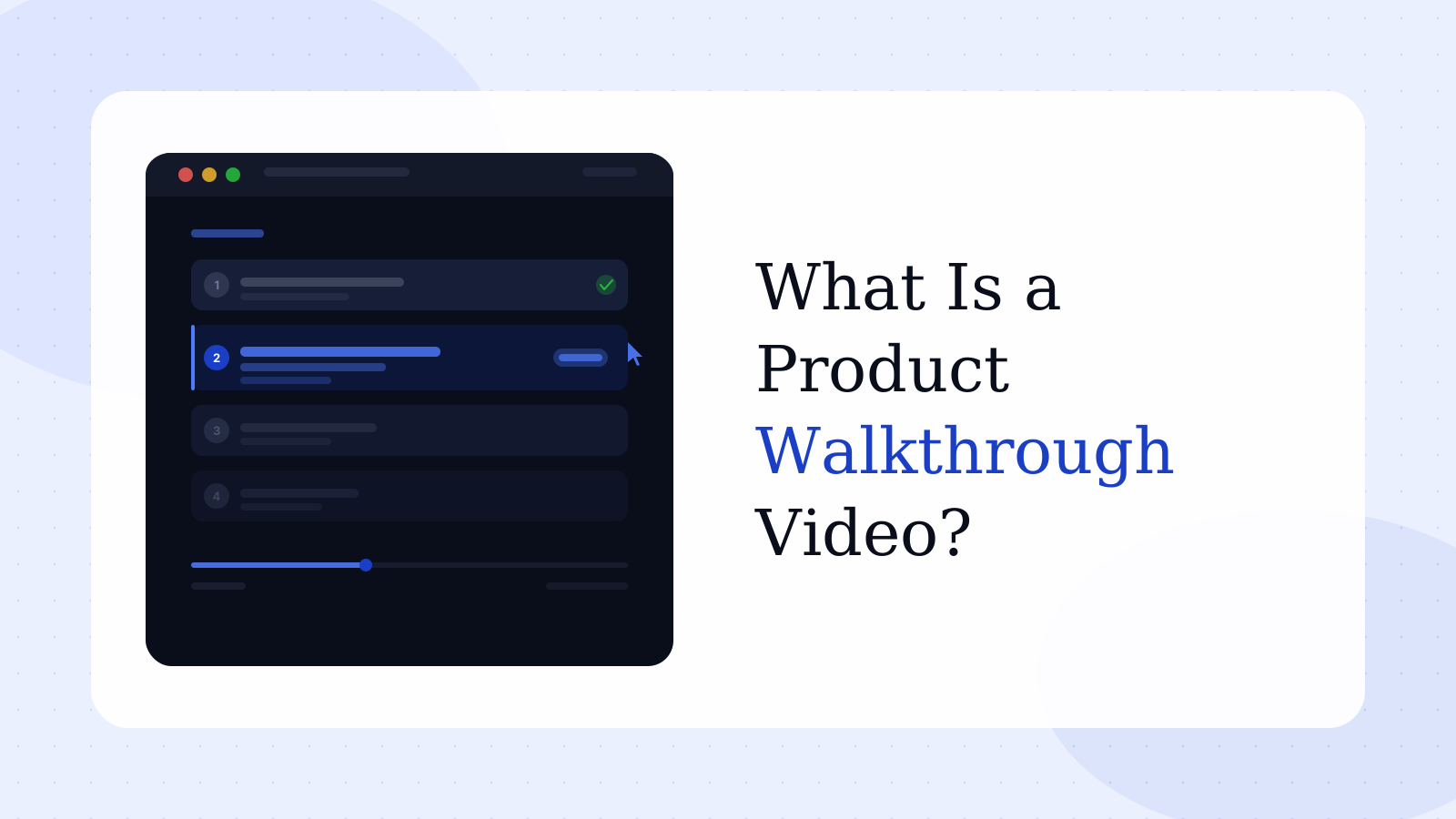
A product walkthrough video is a recorded video that guides a viewer through a specific workflow or feature in real software, step by step. It shows exactly where to click, what happens at each step, and what the result looks like at the end.
Unlike a product demo video, which shows what a product does and why it matters, a walkthrough shows how to do a specific thing inside the product. That distinction is important. A demo answers: "does this product solve my problem?" A walkthrough answers: "can I actually use this product to solve my problem?"
Both questions matter. They matter at different points in the buyer's journey, and using the wrong format to answer the wrong question is one of the most quietly damaging content mistakes in B2B SaaS marketing.
The format stays consistent regardless of context: a screen recording of the real product, a voiceover or on-screen captions guiding the viewer through each step, and a clear endpoint that shows what the completed workflow looks like. What changes is the depth of the workflow, the audience being addressed, and the moment in the journey it's designed for.
Product walkthrough video vs. demo video vs. interactive tour
These three formats get treated as interchangeable in most B2B SaaS marketing discussions. They aren't the same thing — and choosing the wrong one for a given buyer moment costs conversions quietly.
| Format | Primary question it answers | Best buyer moment | Typical length |
|---|---|---|---|
| Product walkthrough video | "Can I do this specific thing?" | Mid-to-late evaluation | 2–4 minutes |
| Product demo video | "Does this product solve my problem?" | Awareness to mid-funnel | 60 sec–3 min |
| Interactive product tour | "What is it like to use this product?" | High-intent self-serve | Self-paced |
The critical distinction is depth vs. breadth. A demo video shows the product working at a high level — enough to establish that it solves the buyer's problem. A walkthrough goes deep into one specific workflow. An interactive product tour lets the buyer explore freely, but requires significantly more effort to build and maintain than either.
Here's a nuance most comparison guides miss: a product walkthrough video and an interactive product tour address different buyer anxieties. The tour answers "can I navigate this?" The walkthrough answers "will this handle my specific use case?" Buyers often need both resolved before they'll commit to a trial or a commercial conversation — just not at the same time, and not from the same format.
Using a demo where a buyer needs a walkthrough, or sending a broad overview when a buyer has one specific question, is a conversion killer that never shows up in your analytics. Map the format to the anxiety, not to what's easiest to produce.
The 4 types of product walkthrough video in B2B SaaS
Not every product walkthrough video serves the same buyer at the same moment. There are four distinct types used across the buying journey and the post-sale lifecycle.
1. The sales-stage walkthrough
This runs 2–3 minutes and shows a prospect exactly how the product handles a workflow they mentioned during discovery. If they told your sales rep they care about automated reporting, the sales-stage walkthrough shows what that reporting setup looks like — start to finish, in real screens, with realistic data.
This format converts better than a generic overview in late-stage evaluation because it answers a specific question the buyer already has. It doesn't try to impress broadly; it tries to prove one thing precisely. Vidyard's 2025 Video in Business Benchmark Report, which analyzed over 940,000 B2B videos, found that videos in the 3–7 minute range perform strongest in mid-to-late-funnel contexts — longer than the typical awareness video, shorter than a full product tour session.
2. The onboarding walkthrough
This is for customers who have already bought. It shows a new user how to complete their first workflow inside the product — not why the product is valuable, just how to get the first task done.
Most B2B SaaS teams treat video as a purely pre-sale tool. That's a mistake with a measurable cost. Onboarding walkthrough videos reduce support ticket volume, accelerate time to first value, and surface expansion opportunities by showing users features they didn't know existed. Customer success teams almost never own this format — and that gap is exactly why it's underused.
3. The feature walkthrough
This lives in your product changelog, help center, or release announcement. It runs 60–90 seconds and shows one thing: what the new feature does and how to use it, immediately.
This is the format most likely to go stale — and the one most teams neglect to update. A feature walkthrough that still shows the old version of a settings panel redesigned six months ago isn't helping users. It's actively undermining the trust your support team has spent months building.
4. The persona-specific walkthrough
Same product. Same workflow. Narrated and framed for a specific role. A walkthrough for a sales operations manager sounds different from the same walkthrough for a marketing analyst — even if the underlying steps are identical.
Persona-specific walkthroughs require more production effort upfront, but they convert better at the mid-funnel where buyers are comparing products and evaluating role-specific fit. "Does this work for someone in my role?" is a question a single generic walkthrough can't reliably answer. Most teams know this and still ship one video for everyone, because producing four persona variants feels expensive. With the right production process, it doesn't have to be.
Build a walkthrough video library that keeps pace with your product
Rimo turns a plain-English brief into a polished walkthrough video — real product screens, no editor, no production backlog.
When to use a product walkthrough video — and when not to
Use a product walkthrough video when:
- A prospect asked a specific "how does your product handle X?" question during a sales conversation
- You're launching a feature and need to explain it immediately across help docs, release notes, and announcement emails
- Your onboarding sequences have low activation rates and users aren't completing their first workflow
- A help article is generating support tickets despite high traffic — usually a signal that words alone aren't enough
- You're sending a post-discovery follow-up and want to address a specific objection without scheduling another call
Don't use a product walkthrough video when:
- The buyer hasn't established product fit yet (they need a demo, not a walkthrough)
- The workflow is so complex that a 3-minute video can't honestly represent it (use a live call)
- The product is changing faster than you can produce walkthroughs (fix the process problem first — the next section covers this)
Here's an observation that goes against the standard advice: a product walkthrough video is often more persuasive in late-stage evaluation than scheduling another discovery call. A buyer who's already decided your product might work is trying to confirm they can actually use it. Sending a 2-minute walkthrough that answers their specific question — instead of booking a 45-minute call — answers it faster, with less friction, and signals that you understand exactly what they're trying to evaluate. Most teams default to "more calls." A well-timed walkthrough would close more of them.
The staleness problem: why most product walkthrough videos are already wrong
Here's something the top-ranking posts on this topic consistently skip: a product walkthrough video goes out of date faster than any other type of B2B video.
A product explainer video format describing your value proposition can stay relevant for 18–24 months. A walkthrough showing the exact steps to complete a workflow can become misleading within weeks if navigation changes or a feature gets renamed. And yet most teams treat their walkthrough library the same way they treat evergreen content — publish once, maintain rarely.
Most B2B SaaS teams respond to staleness in one of three ways: they don't update the walkthroughs at all, they delete and rebuild periodically (losing SEO equity and engagement data in the process), or they try to rebuild from scratch whenever the product ships a major update. None of these scale.
The teams that solve it do it through modularity. Instead of one 8-minute "full product walkthrough," they build a library of 90-second workflow-specific clips. When one workflow changes, they update that clip. The rest of the library stays intact. What would have been a two-week rebuild becomes a 24-hour update.
This is also why AI demo video creation automation has moved from optional to genuinely useful for product marketing teams — not as a replacement for production quality, but as a way to make production fast enough to keep pace with the product roadmap. Wistia's 2025 State of Video Report found that AI adoption in video production jumped from 18% to 41% in a single year — the largest single-year spike the report has ever recorded. Teams aren't replacing video with AI. They're using it to close the gap between how fast products ship and how fast content can follow.
The teams that win at walkthrough video aren't the ones with the best production values. They're the ones with the shortest gap between "we shipped a change" and "our walkthrough reflects it."
How to create a product walkthrough video that stays current
The production workflow for a walkthrough video that will actually stay current looks different from a one-off project. Here's how teams that ship walkthroughs consistently approach it.
Step 1: Scope it to one workflow
Resist the temptation to cover the entire product in one video. Define one workflow with a clear start and end state. "How to create a custom report" is a product walkthrough. "How our platform works" is not — that's a product demo video, and it needs to be structured differently, with a broader lens and a shorter runtime.
Step 2: Write the script before touching the product
Map each step in the workflow to a line of narration before opening the recording tool. This takes 20–30 minutes and prevents the most common mistake: capturing everything and trying to construct the story afterward. The same script-first approach that works for demo videos applies here — map each sentence to a specific screen, keep narration slightly ahead of cursor movement so the viewer knows what's about to happen before it does.
Step 3: Record each step separately
Scene-by-scene recording — rather than a single continuous take — is what makes future updates surgical. When step 3 changes because the UI was redesigned, you re-record step 3 and slot it back in. You don't rebuild the entire walkthrough. G2 reviewers of Loom consistently cite a core frustration here: the tool wasn't built for controlled, repeatable recording environments. Failed uploads, frozen recordings, and audio sync problems are Loom's top complaint category on G2, with over 147 mentions — symptoms of using an async messaging tool for a structured production workflow. The recording infrastructure matters as much as the script.
Step 4: Keep it under 3 minutes — or split it
Vidyard's 2025 benchmark data (940,000+ videos analyzed) shows B2B video completion rates declining sharply past the 5-minute mark. A product walkthrough doesn't need to show every edge case — it shows the happy path clearly. If the workflow genuinely requires more than 4 minutes, split it: Part 1 covers setup, Part 2 covers the output. Two 2-minute videos will always out-complete one 5-minute video.
For a broader look at how length affects engagement across video types, the same framework from how long a product demo video should be applies directly to walkthroughs.
Step 5: Use a clean demo environment every time
Set up a dedicated environment for recording with consistent, realistic demo data. Remove irrelevant notifications, personal account details, and anything that would confuse a first-time viewer. Real screens build trust — but only if they look like a real-world scenario, not a developer sandbox. G2 reviews of screen recording tools surface the same frustration repeatedly: recordings that capture the right workflow but with the wrong data context fail to build the credibility they were designed for.
For sales engineers producing walkthroughs at volume for individual prospects, the clean-environment principle applies with even more precision — a recording that reflects a prospect's industry and data context will consistently outperform a generic one.
FAQ
What is a product walkthrough video?
A product walkthrough video is a screen-recorded video that guides a viewer through a specific workflow or feature inside real software, step by step. Unlike a product demo video — which shows what the product does and why it matters — a walkthrough shows exactly how to accomplish a specific task: where to click, what happens at each step, and what the result looks like at the end. It's proof of usability, not just proof of value.
What is the difference between a product walkthrough video and a product demo video?
A product demo video shows buyers what your product does and why it solves their problem — it's persuasion content built for early-to-mid-funnel evaluation. A product walkthrough video goes deep on a specific workflow and shows exactly how to accomplish something inside the product. Buyers need demos to establish fit and walkthroughs to confirm they can actually operate the product. Both matter; they answer different questions at different points in the buying journey.
How long should a product walkthrough video be?
For sales-stage and feature walkthroughs, 2–3 minutes is the target. Onboarding walkthroughs can extend to 4 minutes if the workflow genuinely requires it. Vidyard's 2025 benchmark data, drawn from over 940,000 B2B videos, shows completion rates declining sharply past the 5-minute mark. If a workflow can't be shown clearly in under 4 minutes, split it into two sequential videos rather than extending one.
When should I use a product walkthrough video instead of scheduling a live demo call?
Use a walkthrough video when a buyer has a specific "how does your product handle X?" question and you already know the answer. A 2-minute walkthrough answers that question faster, without scheduling friction, and signals that you understood what they were actually asking. Reserve live demo calls for buyers whose situations are complex enough that a scripted walkthrough can't honestly represent them, or for buyers who need to ask follow-up questions in real time.
How do I stop product walkthrough videos from going out of date?
Build a library of short, workflow-specific clips rather than one long full-product walkthrough. Record each step as a separate scene so future edits are surgical — when one step changes, re-record that scene and slot it in without touching the rest. Teams using AI-assisted production workflows can turn a product change into an updated walkthrough in hours rather than weeks. The goal is a production cadence that's faster than the product's own update cycle.
Can I create a product walkthrough video without a video editor?
Yes — if the three phases of production are handled as a repeatable workflow rather than a custom project each time. The brief defines what the video needs to show. The recording captures the right screens in the right order. The production layer handles captions, transitions, and branding. When those three are systematized separately, a dedicated editor is no longer the bottleneck. Rimo is built around exactly this model — for the underlying production approach, see how to create product demo videos without a full team.
Akshay Sharma
Product Leader · 10+ years in B2B SaaS
Akshay has spent 10+ years building and marketing B2B SaaS products. He writes about product storytelling, demo production, and the operational side of product marketing.