What Is SEO? The B2B SaaS Marketer's Complete Guide (2026)
Your competitor is not running more ads than you. They are not out-spending you on outbound. They wrote twelve blog posts eighteen months ago, optimised them properly, and now three of them rank on the first page of Google for the exact terms your buyers type before they ever talk to a sales rep. Every month, those posts send qualified traffic to their demo page — quietly, automatically, while your team is in meetings.
That is what search engine optimisation does when it works. And it is why every B2B SaaS team needs to understand it — not just the people with "SEO" in their job title.
SEO is often treated as a specialist's domain: handed off to an agency, buried in a backlog, or confused with simply writing a lot of blog posts. None of those approaches work reliably. This guide explains what SEO actually is, why it behaves differently for B2B SaaS companies, and what a practical strategy looks like in 2026 — when search engines are no longer the only discovery channel your buyers use.
In this guide
- What is SEO?
- How search engines work
- The four pillars of SEO
- SEO for B2B SaaS: what's different
- Keyword research for B2B SaaS
- Why SEO in 2026 means optimising for AI too
- Video SEO: the B2B SaaS multiplier
- How to measure SEO ROI
- FAQ
What is SEO?
Search engine optimisation (SEO) is the practice of improving your website and its content so that search engines like Google rank it higher in organic (non-paid) search results — bringing in visitors who are actively searching for what you offer.
The goal is not to game an algorithm. The goal is to make sure that when a buyer types a question relevant to your product into a search bar, your answer appears before your competitor's does.
SEO produces two core outcomes:
- Visibility — appearing in search results at all (many pages never do)
- Relevance — appearing for the right searches, at the right stage of buyer intent
Most B2B SaaS teams over-index on visibility and under-index on relevance. A page ranking position one for a term no buyer searches is worth nothing. A page ranking position four for a high-intent term like "best project management software for remote engineering teams" is worth a great deal.
SEO is frequently contrasted with paid search (PPC), where you pay for placement per click. The fundamental difference: SEO traffic compounds over time. A page that earns authority in year one keeps delivering in year three. Paid traffic stops the moment your budget does.
How search engines work
Understanding SEO starts with understanding what search engines actually do. Google runs three continuous processes:
Crawling — Google sends automated bots (called crawlers or spiders) to discover pages on the web. They follow links from page to page, mapping what exists online.
Indexing — Pages crawlers discover get evaluated and stored in Google's index — a massive database of content. Not every page gets indexed. Pages with thin content, blocked crawl directives, or no inbound links may never appear in search results at all.
Ranking — When a user submits a query, Google's algorithm scores indexed pages across hundreds of signals to determine which pages most accurately and authoritatively answer that query. Pages are returned in ranked order.
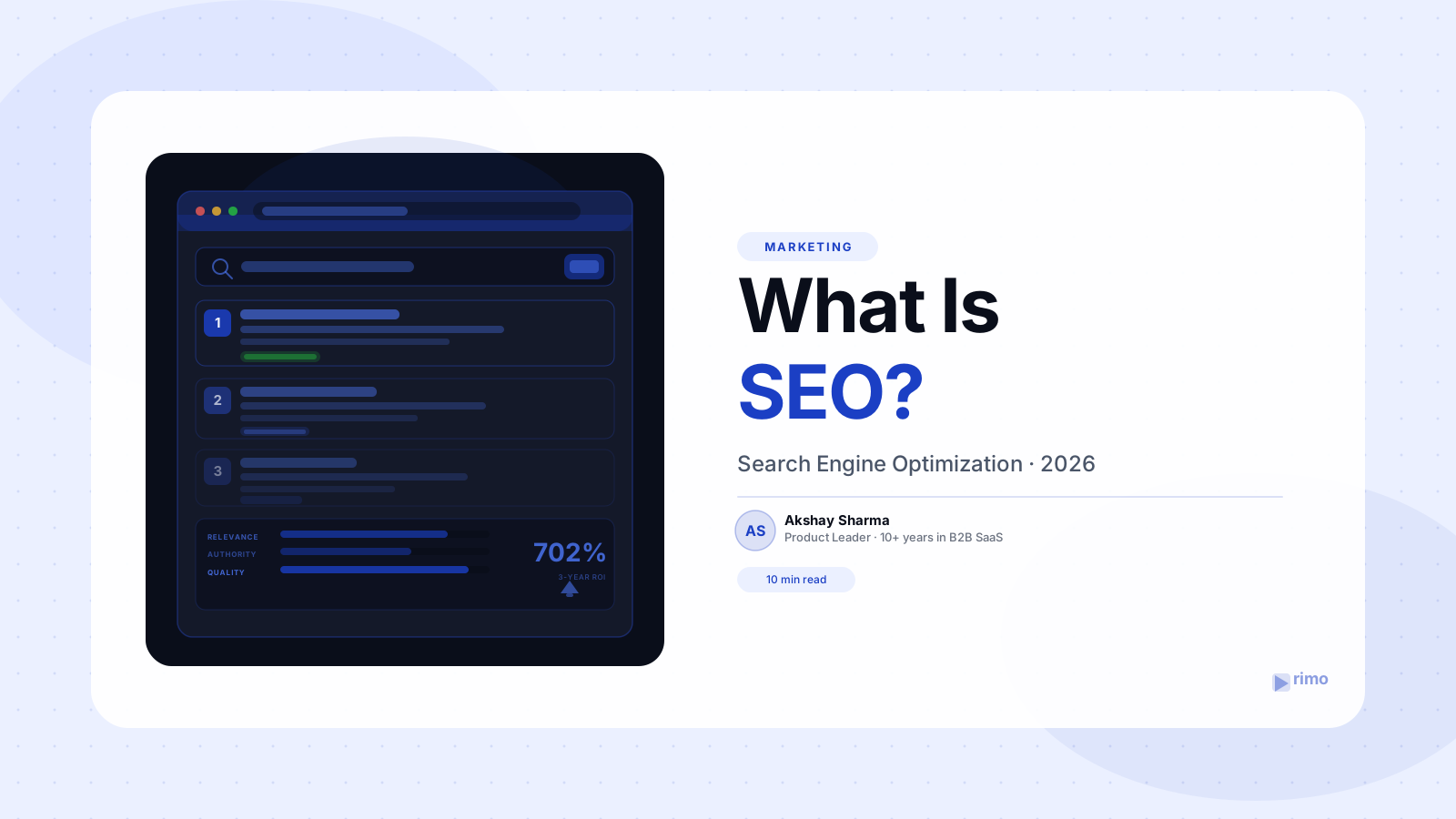
The ranking algorithm weighs three broad categories of signal: relevance (does this page match the query's topic and intent?), authority (do other credible sites link to this page, indicating trust?), and quality (is the page fast, secure, and genuinely useful to the reader?). SEO is the discipline of optimising for all three simultaneously.
The four pillars of SEO
1. Technical SEO
The foundation. Ensuring Google can actually find, crawl, and index your site without friction. This includes page speed, mobile responsiveness, HTTPS, structured data markup (schema), clean URL architecture, and avoiding duplicate content. Poor technical SEO quietly suppresses even excellent content — if Google can't read your pages cleanly, it won't rank them regardless of how well-written they are.
2. On-page SEO
Optimising individual pages for specific search queries. This means placing keywords in strategic locations — title tags, H1 headings, meta descriptions, the opening paragraph — and writing content that fully satisfies the query. On-page SEO also covers image optimisation, internal linking, and ensuring a page treats its topic with enough depth that Google considers it the authoritative source.
3. Off-page SEO
Building trust signals that exist outside your own website, primarily backlinks. When a credible publication links to your page, Google treats it as a vote of confidence for that content. Quality matters far more than quantity: one link from a respected industry outlet outweighs fifty links from low-authority directories. Off-page SEO also includes brand mentions, digital PR, and third-party review profiles.
4. Content SEO
Creating content that matches what buyers are actually searching for. This is where keyword research, content strategy, and editorial quality converge. Google rewards content that comprehensively answers a question, cites credible sources, demonstrates genuine expertise, and keeps readers engaged. Content SEO is typically the highest-impact pillar for B2B SaaS teams — it is the one you have the most direct control over.
SEO for B2B SaaS: what's different
Generic SEO advice is mostly built around e-commerce and consumer content. B2B SaaS behaves differently in several ways that matter.
Long sales cycles change everything about keyword intent. A buyer evaluating an enterprise data platform might spend eight to fourteen weeks researching before speaking to sales. They move through distinct intent stages — awareness ("what is a data warehouse"), consideration ("Snowflake vs BigQuery"), decision ("Snowflake enterprise pricing") — and each stage requires completely different content. B2B SaaS SEO must map content to intent stage, not just to search volume.
Multiple decision-makers create multiple keyword clusters. The product champion (an analyst), the economic buyer (a VP of Engineering), and the security evaluator each search different things about the same product. A complete B2B SaaS SEO strategy addresses each persona. This dramatically expands the viable keyword surface area — and explains why large SaaS companies publish hundreds of targeted pages.
Organic traffic converts at a higher rate than most other channels. Organic search leads close at 1.5 to 3x the rate of paid leads in B2B SaaS. The reason is intent: someone who finds your site because they searched a specific question is already in the right mindset. B2B SaaS companies that invest consistently in SEO see median three-year returns of 702% (First Page Sage, 2024). That number is not an outlier — it reflects the compound nature of organic traffic that paid channels can't replicate.
Head terms are out of reach for most companies. "CRM software" is dominated by Salesforce, HubSpot, and Pipedrive. "Project management tool" is owned by Asana, Monday, and Notion. Early-stage B2B SaaS companies will not displace those players on head terms in the near term. The winning approach is to own a cluster of specific, lower-competition terms — use-case pages, feature comparison pages, integration guides — and build domain authority before targeting broader terms.
According to Forrester Research (2024), 67% of the B2B buyer's journey now occurs digitally, with search driving the majority of that discovery. B2B companies with active blogs generate 67% more leads per month than those without (HubSpot, 2024). The compounding return on SEO investment is real — but only for teams that commit to it as a programme, not a project.
Keyword research for B2B SaaS
Keyword research for B2B SaaS is not about finding the highest-volume keywords. It is about finding the keywords your buyers use at each stage of their journey, in segments where competition is actually beatable.
Start with your ICP's language, not marketing terminology. The phrases your buyers use in sales calls, in support tickets, in community Slack channels — those are better starting points than any keyword tool. People search in natural, specific language: "how to run a product demo for an enterprise procurement team" rather than "enterprise product demo strategy."
Map keywords to funnel stages:
- Awareness — definitional and educational queries ("what is [category]", "how does [process] work", "why do teams use [solution type]")
- Consideration — comparison and evaluation queries ("best [category] software for [use case]", "[tool A] vs [tool B]", "[category] alternatives")
- Decision — high-intent and branded queries ("[product name] pricing", "[product name] reviews", "[product name] vs [competitor]", "alternatives to [competitor]")
Prioritise low-competition, high-intent terms first. A keyword with 300 monthly searches and a difficulty score of 18 is more valuable to an early-stage site than a keyword with 30,000 searches and a difficulty of 78. You will not rank for the second one in any meaningful timeframe. You will rank for the first — and the buyer searching it is likely closer to a buying decision.
Validate with Search Console, not just keyword tools. This is a genuine pain point that SEO practitioners flag consistently: 30–50% variance between keyword volume estimates in tools like SEMrush and actual traffic data in Google Search Console for lower-volume terms. Treat tool data as directional guidance, not precise forecasts. Once you start ranking, GSC becomes the most reliable signal you have.
See how Rimo creates product demo videos optimised for Google video search — no video team required. See how it works → Start free with Rimo
Why SEO in 2026 means optimising for AI too
Here is the piece most "what is SEO" guides miss — and it matters significantly right now.
Search has fractured. A growing share of your buyers' research no longer happens in Google at all. It happens in AI chatbots and answer engines. According to Forrester's 2025 Buyers' Journey Survey, 94% of B2B buyers are already using AI in their purchasing process. Over 92% of marketers now use SEO techniques for both traditional and AI-powered search channels (HubSpot State of Marketing Report, 2026).
Two disciplines have emerged to address this shift:
Answer Engine Optimization (AEO) focuses on systems like Google AI Overviews, Siri, and Alexa that return a single direct answer rather than a list of links. The content that wins here is structured, specific, and answers the exact question asked.
Generative Engine Optimization (GEO) focuses specifically on LLM platforms — ChatGPT, Perplexity, Claude — that synthesise their own responses from source material. Your content needs to be structured not just to answer a question, but to be extractable by a model generating a paragraph-length answer in its own words.
The important point about all three: traditional SEO and AI-era optimisation are not in conflict. The content signals that make a page rank well in Google — clear structure, cited data, comprehensive answers, demonstrated expertise — are exactly the same signals that make content citable by AI systems. Strong on-page SEO is also strong AEO preparation. A well-executed content strategy earns visibility in Google and gets your brand cited when a buyer asks ChatGPT about your category.
The teams that fall behind are those who optimise for one channel and ignore the other. The teams that win treat all three as a unified discipline with overlapping requirements.
To go deeper on the AI-side of discovery, the full guides on AEO and GEO cover the specific content tactics in detail.
Video SEO: the B2B SaaS multiplier
Most B2B SaaS SEO strategies treat video as a distribution channel — something you publish on YouTube, separate from your "real" SEO work. That is leaving meaningful traffic on the table. Understanding video SEO as a distinct discipline is one of the highest-leverage unlocks available to B2B content teams.
Video is a search ranking asset. Websites that include video content see 41% more organic search traffic than those without it (Wistia, 2025). More than 25% of Google search results now display a video snippet — a thumbnail with duration, title, and source that appears above many organic text results. In competitive B2B SaaS categories, ranking a product demo video in that video snippet can drive more qualified clicks than ranking a blog post at position two.
The mechanics of video SEO are not complicated:
- Host video on your own domain (or embed with proper schema markup), not only on YouTube
- Write a full transcript and surface it as on-page text — Google reads and indexes it
- Use keyword-aligned video titles and descriptions that match search queries
- Add
VideoObjectschema markup so Google understands the content type and surfaces rich snippets
For B2B video marketing teams specifically, product demo videos are the highest-value asset here. A well-structured demo video — with a keyword-matched title, searchable transcript, and schema markup — can rank for high-intent comparison queries like "how does [product] work" or "demo of [product] vs [competitor]" that a text page struggles to win.
The missed opportunity is consistent. Most B2B SaaS teams produce demo videos, post them to YouTube, and stop there. The same video, properly hosted, transcribed, and marked up, would generate a compounding stream of qualified search traffic. It only requires treating video as an SEO asset, not just a sales enablement tool.
How to measure SEO ROI
SEO ROI is genuinely hard to measure cleanly, and that difficulty is often used as an excuse to avoid measuring it at all. That is a mistake — incomplete measurement is not the same as unmeasurable.
Core metrics to track:
- Organic sessions — total visits from organic search, tracked in Google Analytics or an equivalent
- Keyword rankings — position tracking for your target clusters, tracked in Google Search Console, SEMrush, or Ahrefs
- Organic-attributed leads — demo requests, free trial signups, and form completions where the first-touch or last-touch source is organic search
- Organic-attributed pipeline — the ARR value of deals where organic search was part of the acquisition path
The attribution challenge. Most B2B SaaS buyers encounter multiple touchpoints before converting: they find you via a blog post, leave, see a retargeting ad two weeks later, then respond to an SDR email a month after that. First-touch attribution overstates organic's impact on closed revenue; last-touch attribution understates it. A simple multi-touch model that assigns partial credit across touchpoints produces a more honest picture — even a rough one is better than ignoring SEO's contribution entirely.
The lag problem. SEO is slow at the beginning and fast later. A new domain should expect six to twelve months before meaningful organic traffic appears. Leadership teams expecting SEO to demonstrate ROI in Q1 will always be disappointed. Set expectations clearly upfront: this is a twelve-month investment with compounding returns, not a quarterly campaign. The 702% median three-year ROI figure comes with an implied caveat — year one will look flat, and that is normal.
Conclusion
SEO is not a channel you outsource and check quarterly. For B2B SaaS teams, it is one of the highest-ROI acquisition levers available — but only when treated as a sustained, strategic programme rather than a one-time project.
Start with your buyers' actual language. Map content to funnel stages. Fix the technical foundation before publishing new content. Measure what you can, and set honest timeline expectations with leadership. Build toward the cluster that covers your buyers' full journey — awareness through decision — before chasing head terms that will take years to crack.
And if you produce product videos — demo videos, walkthrough videos, explainer videos — make sure they are working as search assets too. The SaaS demo video best practices guide covers what makes a demo video rank alongside convert.
If you want a faster path to product demo videos that are structured for both organic search and AI discovery, Rimo generates professional-quality SaaS demo videos from your product in minutes — with transcripts, structured copy, and search-ready output built in.
FAQ
What is SEO in simple terms? SEO (search engine optimisation) is the practice of making your website appear higher in Google's non-paid search results. The goal is to attract visitors who are actively searching for something your product solves — people who have already identified a problem and are looking for a solution — before they ever speak to your sales team.
What is the difference between SEO and paid search? Paid search (PPC or Google Ads) places your site at the top of results for a fee — you pay per click, and traffic stops the moment your budget does. SEO builds organic rankings that persist over time without ongoing payment. Both have a role in a B2B SaaS growth strategy, but SEO consistently delivers a higher long-term return because the traffic compounds as domain authority builds.
How long does SEO take to work for B2B SaaS? Most B2B SaaS teams see meaningful organic traffic growth between six and twelve months after beginning a consistent SEO programme. Lower-competition keywords can rank faster — sometimes within eight to twelve weeks. Highly competitive head terms may take eighteen to twenty-four months. The compounding nature of SEO means returns accelerate significantly in years two and three, which is why the median three-year ROI figure for B2B SaaS is 702%.
What is the difference between SEO, AEO, and GEO? SEO optimises for ranked link lists in traditional search engines like Google. AEO (Answer Engine Optimization) optimises for systems that return a single direct answer — Google AI Overviews, featured snippets, voice search. GEO (Generative Engine Optimization) optimises specifically for LLM-powered platforms like ChatGPT and Perplexity that synthesise their own responses citing sources. In 2026, all three matter and the content practices overlap significantly.
Is video content good for SEO?
Yes, significantly. Websites that include video generate 41% more organic search traffic than those without it (Wistia, 2025). Over 25% of Google results now display a video snippet that appears above many standard organic results. For B2B SaaS teams, product demo videos optimised with transcripts, keyword-aligned titles, and VideoObject schema markup can rank for high-intent queries that text pages struggle to win.
What are the most important SEO metrics for B2B SaaS? The metrics that map most directly to business impact are: organic sessions (total search traffic), keyword rankings for your target clusters, organic-attributed leads (demo requests and free trial signups), and organic-attributed pipeline value. Proxy metrics like domain authority and total keywords indexed are less useful for demonstrating SEO's business contribution to leadership.
Akshay Sharma
Product Leader · 10+ years in B2B SaaS
Akshay has spent 10+ years building and marketing B2B SaaS products. He writes about product storytelling, demo production, and the operational side of product marketing.