What Is an AI Avatar? The B2B SaaS Guide to AI Presenters in Demo Videos (2026)
Your VP of Marketing just watched a competitor's demo video and asked why your team doesn't have "one of those AI presenter things." You know roughly what she means — a synthetic person on screen, reading a script, no camera crew involved. What you don't know is whether it's a gimmick, a genuine production shortcut, or a fast way to make your product look like everyone else's.
That question is worth answering properly, because the honest answer is "it depends on what you're making." An AI avatar can save a training team weeks of reshoots. The same avatar, dropped into a top-of-funnel product demo, can quietly tank the trust a skeptical enterprise buyer needs to feel before they'll sign.
This guide covers what an AI avatar actually is, how the underlying technology works, the pain points G2 reviewers keep repeating about the leading tools, and — the part most explainers skip — a clear framework for when an AI avatar helps a B2B SaaS demo and when it works against you.
In this guide
What is an AI avatar?
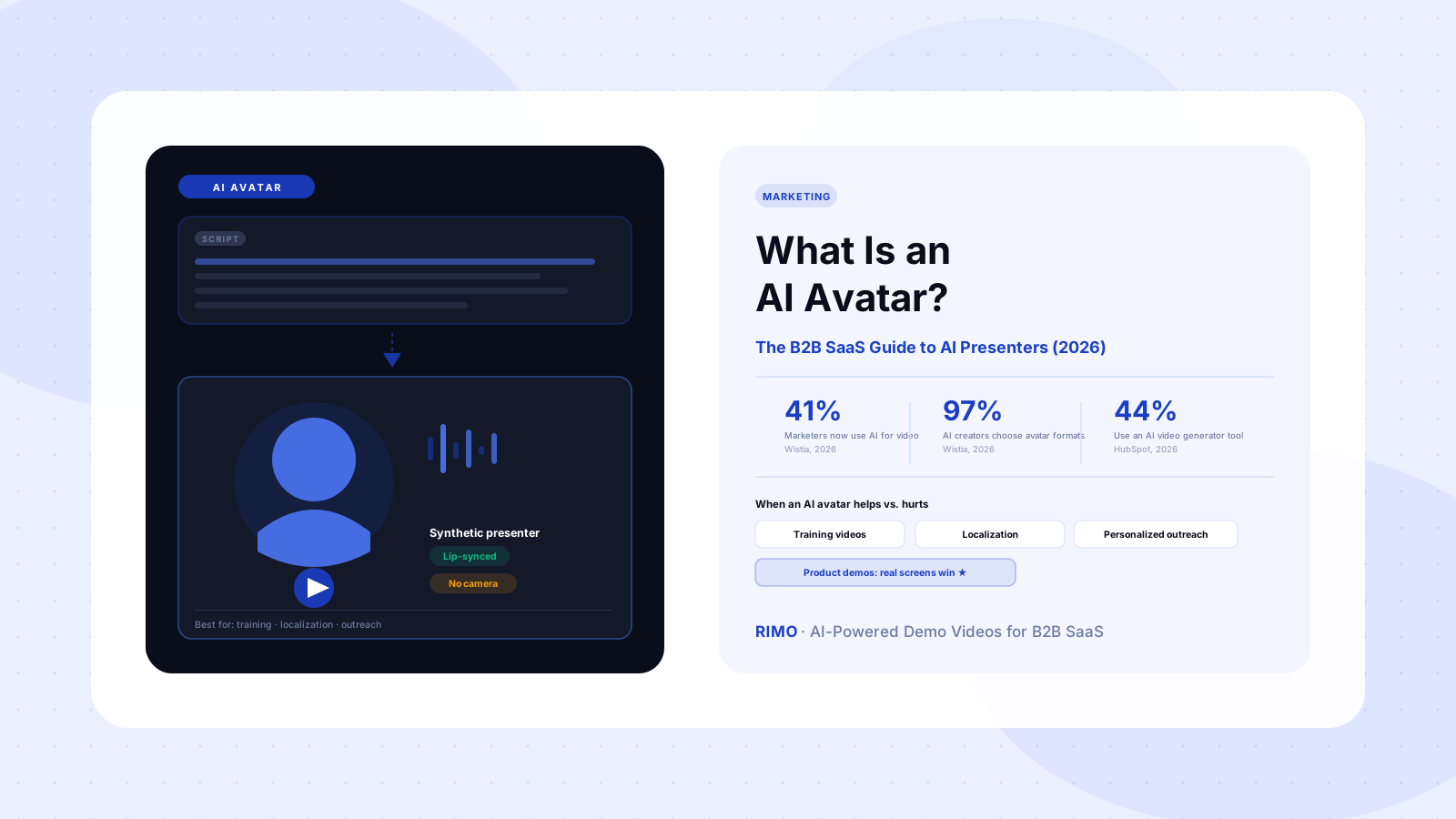
An AI avatar is a synthetic on-screen presenter — either a fully AI-generated digital human or an AI-trained likeness of a real person — that can be made to speak any script with lip-synced audio, gestures, and facial expression, without a camera, studio, or filming session.
Two distinct types exist, and mixing them up is the first mistake buyers make. A generated avatar is built entirely by the platform: a stock digital presenter with no real human source. A cloned avatar is trained on video footage of an actual person — often a founder, CSM, or sales lead — so that person's likeness can deliver new scripts without ever sitting in front of a camera again.
The pitch is straightforward: record a few minutes of source video once, then generate unlimited scripted videos from text afterward. For a marketing team producing dozens of narrated videos a quarter, that's a genuinely different cost structure than booking a presenter for every new script — which is why avatar tools sit inside the broader AI video maker category rather than as a category of their own.
How AI avatar video generation works
Every AI avatar platform runs roughly the same pipeline underneath very different interfaces. Understanding the four steps makes it much easier to evaluate what you're actually being sold.
Generated avatars vs. cloned avatars
A generated avatar comes from the platform's own library — pick a face, a voice, a wardrobe, done. A cloned avatar requires a training step: you upload several minutes of video of the real presenter reading varied, unscripted content, and the model learns their facial movement, gesture patterns, and (separately) their voice.
Cloned avatars cost more in setup time and typically require the subject's explicit consent on file — a compliance step that's easy to skip early and expensive to fix later, once a video has already shipped with a former employee's likeness on it.
The avatar production pipeline
Once an avatar exists, four things happen behind the scenes for every new video: the script is converted to speech using text-to-speech or voice-cloning audio, the audio is mapped to lip and jaw movement frame by frame, a motion model layers in blinking, head tilt, and hand gesture, and the render engine composites it all against a background or product screen.
The realism gap between platforms shows up almost entirely in that third step. Audio-to-lip-sync is largely solved industry-wide in 2026. Natural, non-repetitive body language is where the leading platforms still separate from the pack — and where most of the G2 complaints below actually originate.
The G2 pain points every AI avatar buyer runs into
We looked at G2 reviews across the three most-referenced AI avatar platforms — Synthesia, HeyGen, and Colossyan — and the same five complaints surface repeatedly, often in nearly identical language across unrelated reviewers.
- Minutes disappear faster than expected. Reviewers on all three platforms describe "unlimited" plans that function more like a hard credit cap once monthly minutes are used — a 3–5 minute training video can burn through an entry-tier plan in a single production session.
- Rendering is slow and occasionally fails outright. Multiple reviewers report short videos stuck mid-render for 30–60 minutes, and in a few documented cases, credits were still deducted for renders that never completed.
- Body language still reads as slightly synthetic. Even on well-reviewed platforms, users consistently flag avatar gestures as "exaggerated" or "not quite natural" — the uncanny-valley gap has narrowed, not closed.
- Content moderation delays ship dates. Standard business scripts get flagged for manual review with 12–24 hour turnaround on some platforms, which is a hard blocker when a video is due for a campaign launch.
- Support is inconsistent once something breaks. Review scores for product quality and review scores for support frequently diverge sharply on the same platform — strong marks for the avatar technology, weak marks for getting a billing or render issue resolved.
Three or more of these show up on every platform we checked, which suggests they're category-wide limitations of current AI avatar technology — not a reason to avoid one vendor in favor of another.
AI avatar vs. screen recording vs. human presenter
This is the decision most buying guides skip entirely, and it's the one that actually determines whether an AI avatar helps your team or just adds a new production step nobody asked for.
| Format | Best for | Weak for |
|---|---|---|
| AI avatar | Training, onboarding, multilingual rollouts, personalized outreach at scale | Top-of-funnel product demos where buyer trust is the goal |
| Screen recording | Fast, authentic product walkthroughs; support and how-to content | Consistency across a large video library; requires re-recording on every UI change |
| Human presenter (filmed) | High-stakes exec communications, testimonials, brand storytelling | Speed and scale — every new script means a new shoot |
Here's the part that surprises most marketing teams: a synthetic presenter reading a polished script about your product can perform worse than a screen recording with a real (if imperfect) human voice, specifically in a pre-sale demo. B2B buyers evaluating a five- or six-figure contract are primed to distrust anything that smells like marketing gloss, and an avatar — no matter how well-rendered — reads as gloss to a skeptical evaluator. Authenticity outperforms polish at the exact moment a prospect is deciding whether to trust what they're being shown, which is why the strongest demo videos B2B SaaS teams ship usually lean on real product screens over synthetic presenters.
See what a real product demo looks like, no avatar required
Rimo turns a plain-English brief into a finished demo using your real product screens and natural AI narration — the format B2B buyers actually trust.
Where AI avatars actually help B2B SaaS teams
Outside the pre-sale demo, AI avatars solve a genuinely different problem: producing a large volume of narrated video content without booking a person's calendar for every version.
Onboarding and training video libraries
A customer onboarding video library or an internal training course often needs dozens of short, structured videos — and needs them updated every time a workflow changes. An avatar-led format means updating one video doesn't require re-booking the original presenter; you edit the script and regenerate. Teams building out an AI training course generator workflow lean on exactly this advantage.
Multilingual and localized demo videos
Cloning a presenter's voice and face once, then generating the same delivery in a dozen languages, is one of the clearest wins for AI avatars. It sidesteps the cost of hiring separate voice talent per market — a problem covered in more depth in our guide to product video software for regional languages — and keeps the on-screen presenter visually consistent across every localized version.
Personalized outreach at scale
Sales teams generating one-to-one or one-to-few outreach videos — "Hi [name], here's how [product] solves [their specific problem]" — use avatars to insert personalization variables into a base script without re-filming for every prospect. This is closer to what a sales AI demo agent does at the outreach stage than to a polished top-of-funnel brand asset.
Where an AI avatar hurts more than it helps
Here's the contrarian take most vendor content won't say out loud: the more your buyer is evaluating trust rather than information, the worse an AI avatar tends to perform.
A support library, an internal onboarding module, or a personalized outreach clip is judged on clarity and speed — an avatar excels there. A homepage demo video, a champion-enablement asset meant to get forwarded to a VP, or anything positioned as proof that your product works as advertised is judged on credibility — and that's exactly where synthetic presenters introduce doubt a real screen recording wouldn't.
Undisclosed avatar use compounds the problem. Buyers who later realize a "team member" in a video was synthetic — even innocuously, in a training context — tend to generalize that skepticism to the rest of your marketing. Disclosing AI-generated presenters upfront costs you nothing and preserves the trust you're trying to build everywhere else.
How to choose an AI avatar tool for B2B SaaS
If avatar-led content fits your use case — training, localization, or personalized outreach — five criteria separate tools worth paying for from ones you'll cancel by month three.
- Realism under your actual content, not the demo reel. Test a paragraph containing your product's real terminology and integration names. Vendor demo scripts are tuned for the avatar's strengths; your content isn't.
- Consent and rights management for cloned avatars. If you're cloning a real employee, confirm the platform has a documented consent workflow and lets you revoke access when that person leaves the company.
- Render speed and reliability at your volume. G2 reviews consistently flag render delays as a top complaint — ask for a trial period long enough to test this under a realistic production load, not a single sample video.
- Multilingual coverage that matches your actual markets. Language count on a pricing page and usable quality in your specific target languages are two different things — test the languages you need, not the ones on the homepage.
- Pricing that matches your production cadence. Credit-based "unlimited" plans are the single most-repeated G2 complaint across this category — model your actual monthly output before committing to a tier.
An AI avatar is a production tool, not a trust signal. Use it where speed and scale matter more than authenticity — training, localization, personalized outreach — and keep your actual product on screen everywhere a buyer is deciding whether to believe you.
The AI avatar is a production shortcut, not a demo strategy
An AI avatar earns its place in a B2B SaaS video stack — but almost never as the presenter of the video meant to close a deal. Use one where it's genuinely built to win: onboarding libraries, multilingual rollouts, and personalized outreach that would otherwise require rebooking a person's calendar every time a script changes.
For the video that actually needs to convince a skeptical buyer — your core product demo video — the format that wins is the one built from your real product, not a synthetic presenter standing in front of it.
Build demos buyers actually trust
Rimo produces finished product demos from real screens and natural AI narration — no avatar, no studio, no editor. From brief to finished video in under two hours.
FAQ
What is an AI avatar?
An AI avatar is a synthetic on-screen presenter — either a fully AI-generated digital human or an AI-trained likeness of a real person — that can deliver any script with lip-synced audio, gesture, and expression, without a camera or filming session. Platforms like Synthesia, HeyGen, and Colossyan generate these from a short text script.
How does an AI avatar video actually work?
The platform converts a text script to speech, maps that audio to frame-by-frame lip and jaw movement, layers in a motion model for blinking and gesture, and composites the result against a background. Cloned avatars add an upfront training step using several minutes of real video footage of the source person.
Is an AI avatar good for B2B sales demos?
Generally, no — not for the top-of-funnel demo meant to build buyer trust. AI avatars perform best in training, onboarding, localization, and personalized outreach, where speed and scale matter more than authenticity. A screen recording or product-first video typically converts better for a pre-sale demo, because B2B buyers apply more scrutiny to anything that reads as polished marketing.
What's the difference between a generated avatar and a cloned avatar?
A generated avatar is a stock digital presenter built entirely by the platform, with no real human source. A cloned avatar is trained on video footage of an actual person, so that individual's likeness can deliver new scripts without appearing on camera again. Cloned avatars require the subject's explicit consent and typically cost more in setup time.
Do AI avatars require consent from the person being cloned?
Yes. Any platform generating a cloned avatar of a real person — an employee, a founder, a customer — should require documented consent before training the model, and should let that consent be revoked if the person leaves the company or withdraws permission. Undisclosed use of someone's likeness carries both an ethical and legal risk.
How much does an AI avatar video tool cost?
Entry-tier AI avatar platforms typically start around $20–30/month for a limited number of minutes, with professional tiers in the $60–180/month range depending on avatar count, languages, and render volume. The most common cost trap, according to G2 reviews across multiple platforms, is credit-based "unlimited" plans where unused minutes don't roll over and renders that fail still consume credits.
Akshay Sharma
Product Leader · 10+ years in B2B SaaS
Akshay has spent 10+ years building and marketing B2B SaaS products. He writes about product storytelling, demo production, and the operational side of product marketing.