AI Video Courses: 9 Best Picks for B2B Marketers in 2026
Your team just got told to "figure out video" — not hire an agency, not wait for headcount, just start producing it, and AI is supposed to make that possible. So you do what anyone does: you search for a course. Thirty minutes later you have eleven browser tabs open, half of them teaching cinematic filmmaking with Midjourney and Runway, none of them mentioning a product demo, a sales enablement clip, or anything that looks like your actual job.
That gap is the whole problem with how AI video courses are currently marketed. Most were built for indie creators and hobbyist filmmakers, not for a product marketer who needs a persona-specific demo shipped by Friday. The skills overlap, but the curriculum, the examples, and the definition of "done" do not.
This guide ranks the AI video courses actually worth a B2B marketer's time, tells you what to look for before you pay for one, and — because not every course is worth the weeks it costs — shows you where skipping the classroom entirely is the faster path to the same outcome.
In this guide
- What "AI video courses" actually cover
- Why B2B marketing teams are searching for AI video courses right now
- How to evaluate an AI video course before you enroll
- The 9 best AI video courses for B2B marketing teams
- Descript University, HubSpot Academy, and 7 others
- What G2 reviewers wish these courses actually taught
- Course vs. AI-native tool: the real ROI question
- FAQ
What "AI video courses" actually cover (and what they leave out)
Search "AI video courses" today and you'll land in one of three buckets. Generative-filmmaking courses teach tools like Runway, Kling, and Sora to build cinematic shorts — impressive, and almost entirely irrelevant to a B2B SaaS marketing calendar. Prompt-engineering courses teach you to talk to AI video models more precisely, which is useful but assumes you already know what you're trying to produce. Tool-specific certifications — Descript's own tutorials, Synthesia Academy — teach one platform deeply, which is genuinely useful but narrow.
None of the three buckets is built around the actual job: turning a product update, a feature launch, or a sales objection into a finished video without a production team. That's a different curriculum, and almost nobody is teaching it as one.
The distinction matters because course marketing rarely tells you which bucket you're buying into. A course titled "AI Video Mastery" could mean six hours on cinematic transitions or six hours on voiceover pacing for a demo script — and you won't know which until you've already paid.
Why B2B marketing teams are searching for AI video courses right now
The search volume isn't random. Marketing leadership is pushing AI adoption faster than most individual contributors can absorb it, and video is where that pressure shows up hardest — it's the one format that used to require a specialist team and now, in theory, doesn't.
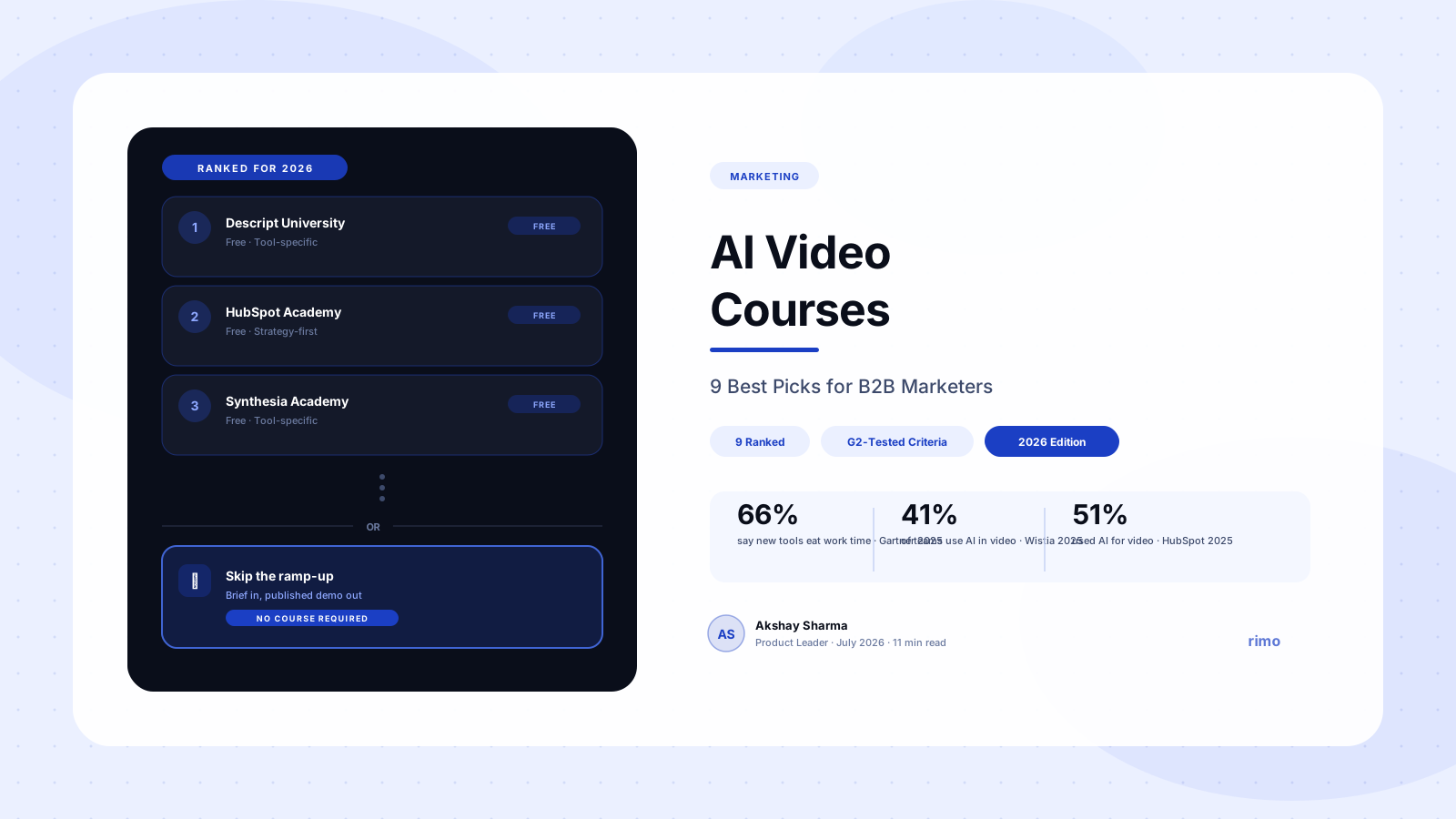
Gartner's 2025 research on AI skills in marketing found that 66% of marketers say learning new technologies takes significant time away from their day-to-day work — and only 15% of CEOs currently believe their marketing leaders are AI-savvy. That gap is exactly why courses feel urgent: the pressure to look competent is outrunning the time available to actually build the skill.
Video specifically is absorbing more of that pressure than any other channel. Wistia's 2025 State of Video report found that AI use in video production more than doubled in a single year — from 18% to 41% of teams — while 71% of companies now produce video in-house rather than through agencies. The people learning these tools are marketers, not editors.
HubSpot's 2025 State of Marketing report puts a finer point on it: 51% of marketers have already used AI tools for video creation or editing, and the top current use case — auto-captioning, at 59% — is the shallowest possible application of the technology. Most teams have dipped a toe in. Almost none have restructured their workflow around it. A course is how a lot of marketers are trying to close that gap on their own time, since product marketing managers are rarely handed a training budget for this specific skill.
Here's the part that's easy to miss: the skills gap isn't really about the AI. It's about knowing what a good demo video needs to say before you ask an AI tool to help you say it. No course fixes that — it's a marketing skill, not a software skill — and the best courses on this list are the ones that at least acknowledge it.
How to evaluate an AI video course before you enroll
Before you hand over a card number, run the course description against the pain points that actually show up in tool reviews. G2 reviewers of the exact platforms these courses claim to teach — Descript, Synthesia, InVideo — repeat the same complaints often enough that they double as a checklist, the same way reviews of AI video editing tools surface which platforms are actually beginner-friendly versus just marketed that way.
- Does it address the learning curve honestly, or pretend it doesn't exist? Descript reviewers on G2 consistently flag onboarding as unstructured, with AI credits running out before new users feel comfortable — a course that skips straight to advanced features without a ramp-up plan will leave you in the same spot.
- Does it cover template and asset discovery, not just generation? InVideo reviewers frequently call template search frustrating and the avatar builder confusing — if a course doesn't cover finding and organizing assets, you'll hit that wall on your own.
- Does it explain plan tiers and gating? Synthesia reviewers repeatedly note confusion over which features are actually unlocked at their subscription level versus just visible — a good course tells you this upfront instead of assuming you'll figure it out mid-project.
- Is there a human to ask when you're stuck, or just a support bot? Several Descript reviewers mention getting stuck with only an AI chatbot for support, which is precisely the moment a course community or instructor should be filling the gap.
- Does the final project resemble your actual output? A cinematic short film and a two-minute product demo require different pacing, different narration style, and different editing discipline — check the capstone project before you check the syllabus.
If a course fails two or more of these, assume you're paying for content built around the tool's marketing page, not its actual failure points.
The 9 best AI video courses for B2B marketing teams in 2026
These are ranked by relevance to B2B marketing output, not by review count or production polish. A few are free. None require a film school background.
1. Descript University (Descript, free)
Descript's own in-app tutorial library is the fastest way to get past the onboarding gap that G2 reviewers complain about most. It's tool-specific, so it won't teach you video strategy — but if your team has already picked Descript, this closes the skill gap for free before it costs you a support ticket.
2. HubSpot Academy — Video Marketing courses (free)
HubSpot Academy isn't AI-specific, but it's the closest thing to a B2B marketing-native curriculum on this list, and it's free with certification. It teaches video as a demand-gen and sales-enablement asset first, which is the framing most AI-tool courses skip entirely.
3. LinkedIn Learning — AI video and generative content tracks (subscription)
LinkedIn Learning's AI video content sits inside a broader subscription, which makes it a reasonable pick if your team already has seats. The content moves fast and assumes some marketing context already, so it's a better fit for a PMM brushing up than a true beginner.
4. Synthesia Academy (free, tool-specific)
Synthesia's own academy addresses the plan-gating confusion that shows up constantly in its G2 reviews — worth doing before you commit budget to a subscription tier you don't need. Like Descript University, it's narrow by design: one tool, done properly.
5. Coursera — Generative AI for video production tracks (free to audit, paid certificate)
Coursera's video-focused generative AI courses, often built with major tech partners, go deeper on the underlying models than any tool-specific tutorial will. Useful if you want to understand why the output looks the way it does — overkill if you just need to ship a demo by Friday.
Or skip the course entirely
Rimo turns a product brief straight into a polished, persona-specific demo video — no editing timeline, no template hunting, no six-week ramp-up.
6. Udemy — AI Video Creation marketplace courses (one-time purchase)
Udemy's catalog is inconsistent by nature — anyone can publish a course — but the best-reviewed AI video listings are cheap, practical, and skip the theory in favor of screen-recorded walkthroughs. Read the syllabus before buying; quality varies more here than anywhere else on this list.
7. LearnPrompting.org — AI video prompting courses (paid)
If your actual bottleneck is getting a generative video model to produce usable output on the first or second try, this is the most direct fix. It's prompt-engineering-first, not marketing-first, so pair it with something further up this list if you also need the strategy side.
8. Runway Academy (free and paid tiers)
Runway Academy teaches genuinely powerful generative video tools, and the skills transfer well to anything visually ambitious — a launch teaser, an animated concept video. It leans toward filmmaking sensibility, so expect to translate the lessons yourself for a standard product demo.
9. Curious Refuge — AI filmmaking courses (paid, premium-priced)
Curious Refuge is the most polished, most expensive option on this list, and it's built for creative and film professionals, not B2B marketers. Include it only if your team is producing brand or launch films where cinematic quality genuinely matters more than production speed.
What G2 reviewers wish these courses actually taught
Here's the pattern that shows up once you actually read enough G2 reviews of the tools these courses are built around: the complaint is almost never "the AI output is bad." It's "I didn't know how long this would take me to get good at."
That's a course problem as much as a tool problem, and it's the one thing missing from every course on this list except the free tool-specific ones. Nobody tells you upfront how many hours of practice sit between "watched the tutorial" and "can produce a demo I'd actually publish." Vendors have no incentive to be honest about that gap — a longer time-to-competence number doesn't sell a $19.99 course. It's the same gap that shows up on the other side of this problem, where teams building internal onboarding content reach for an AI training course generator instead of writing a syllabus from scratch — the honest time-to-competence number is exactly what that category exists to shrink.
The uncomfortable version of this: most AI video courses are optimized to make you feel like you've learned something, not to make you fast. A syllabus with twelve modules feels more thorough than a syllabus with four. It usually isn't. The modules that matter are the ones that map directly to your output — script structure, pacing for a demo, when to cut — and everything else is padding that a marketer with a deadline doesn't need.
Course vs. AI-native tool: the real ROI question
This is the calculation almost nobody runs before enrolling: how many hours of course time does it take before the tool you learned actually saves you time, versus just briefing an AI-native platform and getting the same output without the ramp-up at all?
If a course runs four to six hours and a paid tier costs $200–$400, and it takes another ten to twenty hours of hands-on practice before you're producing publishable video, you've spent close to a full work week before your first real demo ships. Compare that to teams that skip the tool-learning step entirely and go straight to briefing an AI video generation platform with a script and a product walkthrough — the ramp-up disappears because there's no interface to master, just an outcome to describe.
That's not an argument against ever taking a course. If your team is committing to a specific editing tool as permanent infrastructure, the investment pays off over years. But if the actual goal is "ship more demo videos this quarter," the AI video creation shortcut usually beats the classroom — you learn the tool by using it on a real brief, not a practice project nobody will ever publish.
The teams that get this right treat courses as optional deepening, not a prerequisite. They ship the first real video using an AI-native tool, learn what they actually need to know from that one project, and only then decide if a course is worth the remaining gap.
Conclusion
If you're choosing among the nine courses above, start with the free, tool-specific ones — Descript University or Synthesia Academy — and only pay for a broader course if your team is standardizing on a manual editing workflow long-term. Most B2B marketing teams aren't, and shouldn't be.
The faster path for most teams isn't a better course. It's skipping the tool-mastery step altogether and briefing a platform that produces the finished video directly from a product walkthrough and a script — no editing timeline to learn, no template library to search, no six-week ramp-up before the first demo ships. That's the entire premise behind Rimo.
FAQ
Are AI video courses worth it for marketers?
For most B2B marketers, only selectively. Free, tool-specific courses like Descript University are worth an afternoon. Paid, multi-week courses make sense mainly if your team is committing to a specific manual editing tool as long-term infrastructure — otherwise the time investment rarely beats briefing an AI-native video platform directly.
What is the best free AI video course?
Descript University and Synthesia Academy are the strongest free options because they're tied directly to a tool you may already use, with no theoretical padding. HubSpot Academy's video marketing courses are the best free option for strategy rather than software mechanics.
How long does it take to learn AI video creation?
Most courses run four to twelve hours of instruction, but reviewers consistently report another ten to twenty hours of hands-on practice before output is publication-ready. That gap is rarely disclosed in course marketing, which is why time-to-competence matters more than syllabus length when comparing options.
Do I need an AI video course to make a product demo video?
No. The core skill a product demo needs — a clear before-and-after narrative — is a marketing skill, not a software skill. Many teams skip courses entirely and learn an AI-native tool by producing a real demo on their first attempt, since the platform handles the technical execution.
What's the difference between an AI video course and an AI video generator?
A course teaches you to operate software over several hours or weeks. An AI video generator produces the finished video directly from a brief, script, or product walkthrough, with no tool mastery required first. They solve the same underlying problem — producing video without a full production team — through opposite methods.
Which AI video courses are best for B2B SaaS teams specifically?
None of the nine courses on this list are built exclusively for B2B SaaS marketing, which is itself the gap this guide identifies. HubSpot Academy comes closest on strategy; Descript University and Synthesia Academy come closest on tool mechanics. For output that's actually persona-specific and demo-ready, most teams pair a short free course with an AI-native generation tool rather than relying on either alone.
Akshay Sharma
Product Leader · 10+ years in B2B SaaS
Akshay has spent 10+ years building and marketing B2B SaaS products. He writes about product storytelling, demo production, and the operational side of product marketing.