The 7 Best Demo Video Software Tools for B2B SaaS Teams (2026)
Your product launches in six days. The PMM needs three demo videos by Monday. The AE wants a persona-specific version for the enterprise prospect. Product just shipped a UI update that makes last quarter's recordings look outdated.
This is the situation most B2B SaaS marketing teams face — and the reason picking the best demo video software isn't just a tooling decision. It's a production capacity decision.
Most comparison guides will hand you a feature checklist and a G2 star rating. That's not wrong — it's just incomplete. The tools that look similar on a feature grid perform completely differently when your product ships a UI change the week before a launch, when the one person who knows your editing tool is out sick, or when you need eight persona-specific demos and have two days to produce them. This guide covers what those situations actually require — and which tools are built to handle them.
In this guide
- What "best" actually means for demo video software
- The 7 best demo video software tools for 2026
- Best demo video software: head-to-head comparison
- The hidden costs no pricing page shows
- How to choose the right tool for your team
- FAQ
What "best" actually means for demo video software
Star ratings and feature counts don't capture the metric that actually matters for B2B SaaS marketing teams: cycle time. How long does it take to go from "we need a demo video of this workflow" to a published, distributable video?
For teams producing demos at the pace a B2B SaaS product ships, the bottleneck is almost never recording quality. It's everything that happens between pressing record and getting the video in front of buyers — editing, revisions, re-recording when the UI changes, reformatting for different channels, getting approval, and updating the whole library when the product ships again next sprint.
Three criteria matter more than any feature comparison:
Production speed — Can a non-video-specialist on your team ship a polished demo in under two hours?
Update efficiency — When the product UI changes, how much of your demo library becomes immediately wrong — and how fast can you fix it?
Output flexibility — Does it produce the formats your buyers actually watch: horizontal for website embeds, vertical for LinkedIn, square for email?
The best demo video software for your team is the one that scores highest on the criteria relevant to your production situation — not the one with the longest feature list.
The 7 best demo video software tools for 2026
These tools cover every B2B SaaS demo video use case — from quick async walkthroughs to AI-native production at scale. Each profile includes the primary use case, honest G2 pain points, and the specific situation where it outperforms everything else on the list.
1. Rimo AI — Best for B2B SaaS marketing teams producing at velocity
Rimo is the only tool on this list purpose-built for B2B SaaS marketing teams who need to produce polished product demo videos at the pace their product ships. You describe what the video needs to show in plain English. Rimo builds the demo using your real product screens — voiceover, captions, transitions, and branding included. No screen recording session. No editing queue. No waiting for a video producer to be available.
Best for: B2B SaaS marketing teams with frequently-updating products, PMMs who can't run a weeks-long production cycle, and teams producing multiple persona-specific demos simultaneously.
Strengths:
- Brief-first workflow — the video is structured before any production starts, which eliminates re-recording caused by script changes
- Real product screens, not AI avatars, so demos are accurate and credible to technical buyers
- Complete production cycle in hours, not days
- No dedicated video editor required at any point
Limitations: Rimo is optimised for structured product demo videos. If you need a spontaneous async message to a specific prospect or a quick screen capture for documentation, a lightweight recorder is still faster for that single job. Rimo solves the marketing production problem, not the one-to-one async communication problem.
Pricing: Try Rimo free →
When it wins: "I need five persona-specific demo videos published before our product launch on Tuesday."
2. Loom — Best for quick async walkthroughs
Loom built the async video category and still defines it. At its best, it's the fastest way to record your screen, add your face, and share a link. Nothing else on this list comes close for single-use, spontaneous product walkthroughs — a sales follow-up, a feature explanation for a specific prospect, an internal handoff video.
Best for: Individual reps and CS managers who need to share quick walkthroughs with specific people, not broad marketing audiences.
Strengths: Zero-friction record-to-share workflow; fast; everyone on the receiving end already knows how to watch a Loom.
Limitations: G2 reviewers flag recording reliability as Loom's single biggest complaint — 147 separate mentions covering frozen recordings, failed uploads, and audio sync failures. That's a structural problem for a tool whose primary job is recording. The Atlassian acquisition in 2023 also changed Loom's pricing in ways that surprised a large number of teams. Several B2B SaaS companies reported per-user costs jumping 10–15x after free collaborators were automatically converted to paid seats. Check the seat count carefully before scaling Loom across a team.
Pricing: Creator Lite (limited free tier); Creator at $12.50/user/month; Business plans above.
When it wins: "I need to show this specific prospect exactly how the API works, and I want them to watch it tonight."
3. Descript — Best for teams with a dedicated video producer
Descript's approach to editing is genuinely clever: record your screen, get a transcript automatically, then edit the transcript and watch the video update to match. For someone who produces video regularly, this workflow meaningfully compresses clean-up time compared to scrubbing a timeline.
Best for: Teams that have at least one person dedicated to video production and can afford several weeks of ramp time.
Strengths: Text-based editing is faster than timeline scrubbing for dialogue-heavy demos; AI tools (filler word removal, voice overdub) are genuinely capable; multitrack editing handles complex compositions well.
Limitations: The learning curve is real and front-loaded. Teams that commit to Descript produce better content, but the path to proficiency takes time most marketing teams don't have. Descript is also maintenance-heavy by design: every time your product's UI updates, any clip showing the old screen needs to be re-recorded and re-edited through the same multi-step workflow. For teams shipping product updates frequently, this compounds into demo video debt faster than most marketing leaders anticipate.
Pricing: Free plan (limited); Creator at $24/user/month; Business plans above.
When it wins: "We have a dedicated video producer, a quarterly product release cycle, and we're investing in a premium demo library."
4. Vidyard — Best for revenue teams who need per-prospect video analytics
Vidyard is fundamentally a video intelligence platform for sales. Its core differentiator isn't recording or editing — it's analytics at the individual contact level. You can see exactly who watched your video, how far they got, which timestamps they replayed, and whether they clicked through to a calendar link.
Best for: Sales-led B2B SaaS teams who treat video as a prospecting and follow-up tool and need to track engagement at the individual prospect level.
Strengths: Deep CRM integrations with Salesforce, HubSpot, and Salesloft; per-viewer engagement heatmaps; built-in video CTAs and calendaring integrations; strong reporting for SDR and AE workflows.
Limitations: G2 reviewers consistently flag Chrome extension reliability as a core issue — crashes during recording, audio capture failures, and corrupted output files. At $59/user/month on the Teams plan, Vidyard also becomes the most expensive tool in many stacks quickly. Several reviewers noted that justifying the per-seat cost for reps who only send a handful of videos per week is difficult in practice. If your use case is marketing distribution rather than per-prospect tracking, Vidyard's primary strength doesn't translate.
Pricing: Free plan (limited); Pro at $29/user/month; Teams at $59/user/month; Enterprise above.
When it wins: "I need to know which of my 200 outbound prospects watched the demo, how long they watched, and whether they rewatched the pricing section."
5. Synthesia — Best for enterprise teams needing multilingual AI avatar video
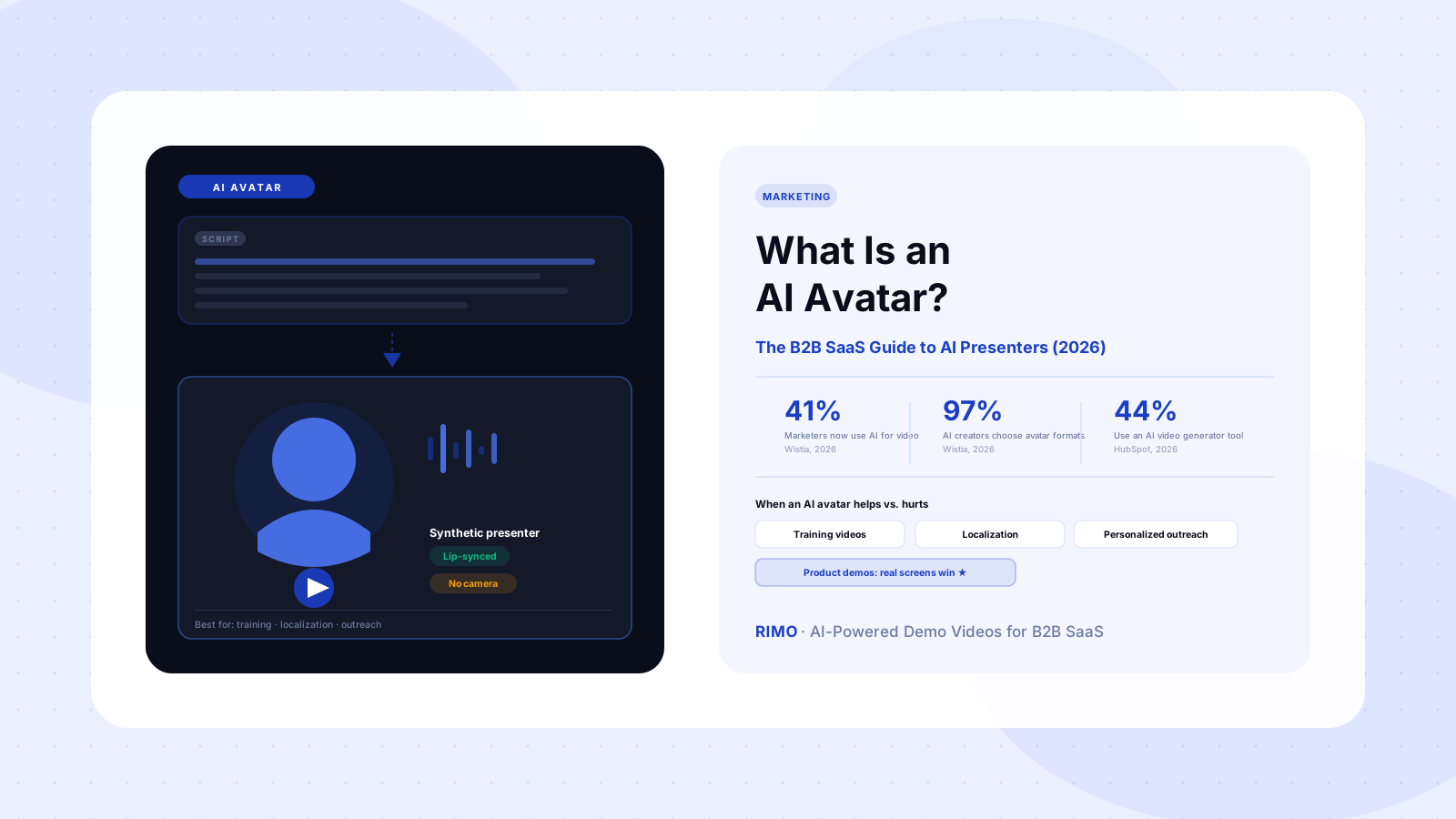
Synthesia is the market leader in AI avatar video. You write a script, choose from 160+ AI presenters across 120+ languages, and get a polished presenter-led video with no camera, no studio, no recording setup. It serves over 90% of the Fortune 100 — primarily for training and onboarding content, but increasingly for product overviews and feature explanations.
Best for: Enterprise teams producing the same content in multiple languages, or organisations that need a consistent AI presenter persona across a large video library.
Strengths: Language scale that no human production team can match; consistent, polished presenter delivery across every video; no recording logistics required.
Limitations: For B2B SaaS product demos where the actual product UI is the story, AI avatars introduce a credibility gap that technical buyers notice. The presenter is demonstrating workflows in a product they cannot actually use. Synthesia is powerful for content that doesn't require live product interaction — HR onboarding, compliance training, marketing explainers at scale. For demos where the product screens need to be real and accurate, it's a weaker fit.
Pricing: Starter at $22/seat/month; Creator at $67/seat/month; Enterprise plans above.
When it wins: "I need this product overview localised in 14 languages for our global partner network by end of quarter."
6. Camtasia — Best for professional screen recording with full editorial control
Camtasia is the most capable screen recording and editing combination available without crossing into professional non-linear editor territory. It captures screen activity, webcam, and audio, then gives you a full suite: annotations, zoom effects, chapter markers, transitions, interactive quizzes, and callout overlays. The output quality ceiling is genuinely high.
Best for: Teams building a long-form demo or training library where production quality is the primary investment and a dedicated editor is available.
Strengths: Professional-grade output; extensive annotation and callout tools; perpetual licence option (pay once, no subscription); capable of handling complex educational demo formats.
Limitations: Requires a dedicated editor — Camtasia is not self-serve for most marketing teams. Every UI change means a full re-recording and re-editing cycle through a deep toolset. No collaborative editing or cloud-based workflow. Ramp time is significant.
Pricing: One-time licence around $299; annual subscription plans also available.
When it wins: "We're building a product training library with zoom-ins, chapter navigation, and quiz interactions — and we have a video producer on staff."
7. Zight (formerly CloudApp) — Best for lightweight team screen sharing
Zight is a screen capture and short-form video tool designed for fast visual communication inside teams. It handles screenshots, GIFs, and short video clips with instantly shareable links. It's not a demo video production platform in the same sense as the other tools here — it's a communication utility that includes video as one of its formats.
Best for: CS teams, technical support, and sales engineers who need to share quick screen captures with customers or internally.
Strengths: Extremely fast capture-to-share cycle; strong screenshot annotation; integrates cleanly with Slack and email; lightweight install with minimal overhead.
Limitations: Not designed for polished marketing demos. No production workflow, no branding controls, no editing suite worth mentioning. Output quality doesn't hold up for anything a buyer would watch at marketing scale.
Pricing: Free plan (limited); Pro at $9.95/user/month; Teams plans above.
When it wins: "I need to show a customer where to find this setting in three annotated screenshots."
Produce polished demos at the pace your product ships
Rimo turns a plain-English brief into a complete B2B SaaS demo video — real product screens, AI voiceover, branded output, no editor required. Teams go from brief to published video in hours.
Best demo video software: head-to-head comparison
The table below maps each tool to the criteria that determine whether it will actually work for your production situation — not just whether its features look good in a side-by-side screenshot.
| Tool | Best for | AI production | Editing depth | Typical price | Cycle time |
|---|---|---|---|---|---|
| Rimo AI | Marketing teams at velocity | Native, brief-first | Automated | Free trial | Hours |
| Loom | Quick async walkthroughs | Basic cleanup | Minimal | $12.50/user/mo | Minutes |
| Descript | Teams with a video producer | Strong text-edit AI | Deep | $24/user/mo | Hours–days |
| Vidyard | Sales analytics | Minimal | Minimal | $29+/user/mo | Minutes |
| Synthesia | Multilingual avatar content | Native avatar AI | Minimal | $22+/seat/mo | Hours |
| Camtasia | Professional editing, long-form | Limited | Maximum | ~$299 one-time | Days |
| Zight | Quick screen captures | None | None | $9.95/user/mo | Minutes |
One thing this table doesn't capture: the cost of your product shipping a UI update. For tools in the "minutes" cycle-time row, that update means re-recording from scratch. For brief-first AI production, it means re-running the brief with updated screenshots. That asymmetry compounds over 12 months of a fast-shipping product.
The hidden costs no pricing page shows
The subscription fee is the smallest cost of demo video software for most B2B SaaS teams. Three costs show up after signing that nobody warns you about.
Re-recording debt. Every time your product ships a UI change — and in B2B SaaS, that's every sprint — any existing recording showing the old interface becomes inaccurate. A library of 40 demo videos is potentially 40 re-recordings. Tools with brief-first, AI-native workflows eliminate most of this debt because production re-runs without a human recording session. Tools built on raw screen capture make it compound. If you're tracking demo video ROI, stale demos are one of the highest-drag variables most teams never isolate as a separate cost line.
Per-seat billing creep. Loom's post-Atlassian pricing change is the most documented example, but it's not unique to Loom. Most demo video software that charges per seat counts editors, viewers, and admins differently across plans. Before signing, map every person who will need access: video producers, reviewers, approvers, sales reps who share videos, and anyone who needs to view private recordings. That headcount is almost always 2–3x the initial estimate.
Editing hours per video. Screen recording tools are not free — they just don't invoice you for the editing hours that follow every recording session. A raw recording typically needs silence removal, caption generation, brand overlays, and an intro/outro sequence at minimum. If that takes three hours per video, your "free" screen recorder is one of the most expensive tools in your stack. The full cost of a product demo video almost always has post-production hours as the largest single line item, and it's the cost teams are least likely to track formally.
A practical benchmark: if your team can't ship a polished demo in under two hours without a professional editor, the tool is creating work, not removing it.
How to choose the right tool for your team
The decision comes down to one ratio: your production demand relative to your production capacity.
| Your situation | Best fit |
|---|---|
| Need 5+ demos per month, no dedicated editor | Rimo AI |
| Occasional async walkthroughs for sales or CS | Loom |
| Have a video producer, moderate production volume | Descript |
| Need individual viewer analytics for sales outbound | Vidyard |
| Need the same content in many languages at scale | Synthesia |
| High-polish, long-form training content, editor on staff | Camtasia |
| Quick screen captures for support and documentation | Zight |
One observation most comparison guides miss: this isn't a company-size question. A 500-person company with one PMM and a fast-shipping roadmap has lower production capacity relative to demand than a 20-person startup where the founder has a video production background. The right tool matches your actual production capacity — not the tier your company is marketed to.
If you're unsure which category fits, answer one question: how many demo videos did your team intend to produce last quarter, and how many actually shipped? The gap between those two numbers is the production bottleneck. The right tool is the one that closes it.
AI Approach to Demo Video Production covers the operational workflow for teams moving from manual production to brief-first AI production — worth reading before you commit to a tool that keeps you in the manual loop.
The best screen recording tools are genuinely useful for what they do. The issue is that most B2B SaaS marketing teams don't actually have a screen recording problem — they have a production volume and maintenance problem. Pick the category that matches the problem you actually have.
Rimo is built for the team that knows exactly what demos it needs but can't ship them fast enough. Brief in. Polished video out. Try Rimo free →
FAQ
What is the best demo video software for B2B SaaS in 2026?
The best demo video software for most B2B SaaS marketing teams in 2026 is one that supports a brief-first, AI-native production workflow — specifically because B2B SaaS products ship constantly and most teams don't have a dedicated video editor. Rimo is built for this use case: describe the demo in plain English, and Rimo produces a polished video using your real product screens. For teams that primarily need quick async walkthroughs, Loom remains the fastest record-to-share option. For sales teams tracking individual prospect engagement, Vidyard's analytics are unmatched.
How much does demo video software cost?
Pricing varies significantly by tool type. Screen recorders like Loom start at $12.50/user/month. Text-based editing platforms like Descript run $24/user/month. Analytics platforms like Vidyard start at $29/user/month. AI avatar tools like Synthesia start at $22/seat/month. One-time purchases like Camtasia run around $299. The subscription price is rarely the full cost — editing hours, re-recording time when the product updates, and per-seat fees for reviewers are the most consistently underestimated line items. Calculate total cost of ownership, not just the monthly fee.
Can I create product demo videos without screen recording?
Yes. AI-powered demo video generators like Rimo produce complete product demo videos without requiring a manual screen recording session. You provide a brief and Rimo handles production using your real product screens — voiceover, transitions, captions, and branding included. This is particularly useful for teams who need to update demos frequently when the product changes, since there's no re-recording step. The product demo video without screen recording guide covers five methods in detail.
What is the difference between demo video software and interactive demo platforms?
Demo video software produces video files — distributable, embeddable, playable on any channel. Interactive demo platforms like Storylane, Arcade, and Navattic produce click-through product simulations that prospects navigate at their own pace. Video performs better at the top and middle of the funnel, where buyers are establishing fit. Interactive tours perform better at the bottom, where high-intent buyers want to simulate product use before committing. They're not substitutes — most high-performing B2B SaaS go-to-market teams use both formats for different moments in the buying journey.
How long does it take to produce a demo video?
With Loom you can record in minutes, but editing typically adds 1–4 hours. With Descript, polished production takes several hours once proficient — more during the learning phase. With Camtasia and a skilled editor, a high-polish demo takes a full day. With an AI-native generator like Rimo, the complete cycle — brief, production, output — runs in under two hours for most B2B SaaS demo formats. That cycle-time difference compounds across a full demo library: 20 demos at two hours is 40 hours of work; 20 demos at one day is 20 days.
What should I look for when evaluating demo video software?
Three criteria matter most. Production speed: can a non-editor on your team ship a polished demo in under two hours? Update efficiency: when the product UI changes next sprint, how fast can you update existing demos without re-recording from scratch? Output format flexibility: does it produce horizontal, vertical, and square formats for the channels your buyers actually watch? Most pricing pages emphasise features. Most G2 reviews emphasise ease of use on first impression. Neither captures the criterion that determines whether your demo library stays current — and current demos are what SaaS demo video best practices are actually built around.
Akshay Sharma
Product Leader · 10+ years in B2B SaaS
Akshay has spent 10+ years building and marketing B2B SaaS products. He writes about product storytelling, demo production, and the operational side of product marketing.