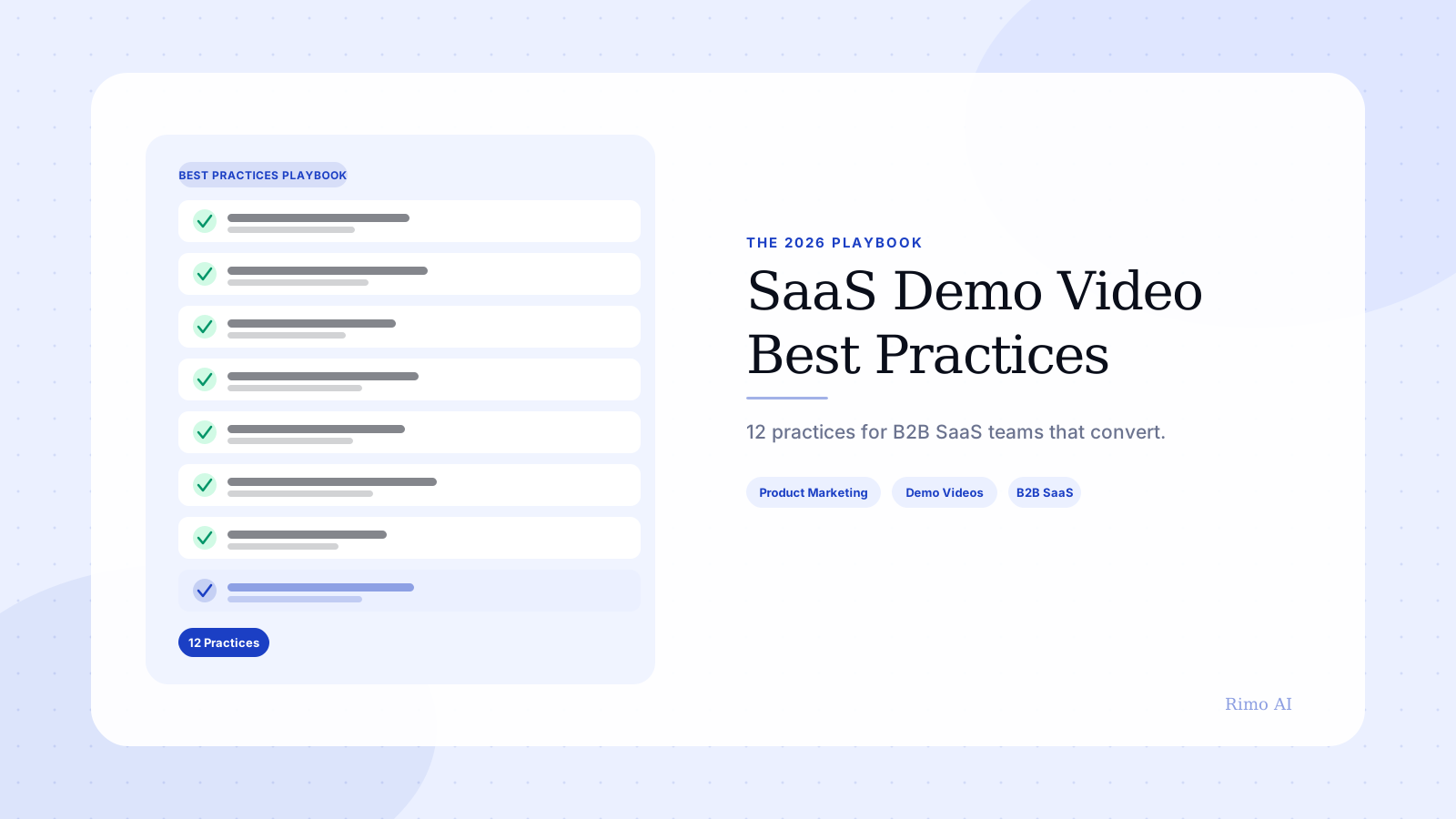
SaaS Demo Video Best Practices: The 2026 Playbook
You know something is wrong with your demo video. Not broken — just not working. Play rate is fine. Completion rate is not. The video covers everything, and yet buyers finish it no closer to saying yes than when they started.
The problem is rarely one obvious thing. It is a cluster of small decisions that each seem reasonable — a slightly too-long runtime, a vague opening line, a CTA that asks for too much too soon — and together produce a video that technically demonstrates the product without actually selling it.
These twelve SaaS demo video best practices come from patterns across B2B SaaS marketing teams, G2 review feedback from users of Loom and Vidyard, and data from Wistia, Forrester, and Gartner on how modern buyers actually consume product content. There is one practice at the end that almost nobody writes about — and it is probably the one costing you the most.
In this guide
- Why most SaaS demo videos quietly fail
- The 12 SaaS demo video best practices
- 1. Write the script before you record
- 2. Frame the buyer's problem first
- 3. Match length to funnel stage
- 4. Design for sound-off viewing
- 5. Prepare a clean demo environment
- 6. Build persona-specific variants
- 7. Make the first 8 seconds earn the next 60
- 8. Give every video one job and one CTA
- 9. Distribute beyond your website
- 10. Track completion rate, not play count
- 11. Build a modular demo library
- 12. Kill demo debt before it kills deals
- The SaaS demo video best practices health check
- FAQ
Why most SaaS demo videos quietly fail
Demo video failure is invisible. The prospect doesn't complain — they just don't convert. They watch 45 seconds, close the tab, and schedule a call with a competitor. Your CRM logs a touchpoint. It doesn't show where attention collapsed, or why.
Forrester's 2025 research found that 58% of B2B buyers now expect detailed product demonstrations before their first conversation with a vendor, and 80% of the entire buying journey happens without any vendor contact. Your demo video is not a supplement to your sales process — for a large share of your pipeline, it is the sales process.
When a demo video fails, it rarely fails for one dramatic reason. It fails because it does enough things adequately that no single problem stands out — but never does the specific things that earn a buying decision. The twelve practices below fix the most frequent causes.
The 12 SaaS demo video best practices
1. Write the script before you record
The default production sequence at most B2B SaaS teams: open the product, hit record, narrate as you click, send to an editor, realise the story doesn't hold, write a script based on what was recorded, revise twice more.
The fix is simple but requires discipline: script first, recording second.
A demo video script does not need to be long. 150 to 250 words covers a 90-second video completely. What it needs to do is name the buyer's problem in the opening sentence, map each line to a specific product screen, and end on a concrete outcome the viewer can picture in their own context. Writing that script takes 20–30 minutes. Skipping it costs hours in revision cycles later.
The B2B SaaS demo video script templates that teams actually use — a 90-second awareness format, a 2-minute use-case format, and a 60-second sales follow-up — all share this structure regardless of length. The discipline is the same.
2. Frame the buyer's problem first
Most demo videos open with: logo animation, product name, feature overview, demo begins. Nothing in the first 10 seconds tells the viewer why they should keep watching.
B2B buyers are not watching your demo for entertainment. They are trying to answer one question: does this product solve the problem I actually have? If your opening doesn't name their problem back to them — specifically, not generally — they assume the answer is no. They don't say that. They just leave.
The rule: the opening sentence should describe the buyer's situation, not your product. "If your product marketing team spends two weeks on one demo video and it's outdated by launch day, here's what fixed looks like" earns the next 90 seconds. "Welcome to [Product Name]" does not.
This is also the most common root cause behind the product demo video mistakes that quietly kill B2B pipeline — opening with the product instead of the problem is the mistake that appears most consistently across failing demos.
3. Match length to funnel stage
"Keep it short" is technically correct and practically useless without context.
Here is a framework that holds across most B2B SaaS situations:
- Awareness (website, ads, social): 60–90 seconds. The buyer doesn't know you. Earn the next click — not explain the whole product.
- Consideration (email follow-up, use-case pages): 90 seconds to 3 minutes. The buyer knows the category. Show how you handle their specific workflow.
- Decision (post-discovery follow-up, sales enablement): 2–4 minutes. The buyer is shortlisting. Address their exact requirement or objection.
Vidyard's 2025 benchmark data from nearly one million B2B videos confirms that videos under one minute achieve a 65% completion rate — and completion drops sharply above 3 minutes. The sweet spot for use-case demos is 90 seconds to 2 minutes.
For a detailed breakdown by platform and persona, the full guide on how long a product demo video should be covers this with specific targets.
4. Design for sound-off viewing
A significant share of B2B video gets watched without audio: on mobile in a public space, on a second monitor during a meeting, in a browser tab opened at work between tasks. If your demo only makes sense with the voiceover, you are losing those viewers entirely.
Every key point your voiceover makes should also appear as visible on-screen text. Captions are the baseline. On-screen callouts — brief labels that appear when a specific feature is shown — go further. They make the demo navigable without audio and reinforce the message for viewers who are watching with sound on.
This is also a scripting principle. When building the scene plan, ask: if a viewer saw only the visuals, would they understand what this product does and why it matters? If the answer is no, the visuals need work — not just a transcript overlay on top.
5. Prepare a clean demo environment
G2 reviews of Loom and Vidyard in 2025–2026 consistently surface the same operational failure: teams record in real product environments without preparation. The output contains placeholder data, notification popups mid-recording, empty states where populated data should be, and developer-context UI that signals the product is not ready for serious buyers.
B2B buyers judge your product's quality through the demo recording. A messy environment doesn't just look unprofessional — it creates doubt about whether the product actually works as described.
The fix: treat every session like a set. Seed the demo environment with believable sample data before recording. Silence system notifications. Use a dedicated browser profile stripped of extensions and history. Check every screen at the current product version. Record each scene separately so one bad take doesn't corrupt the whole session.
Teams exploring product demo video without screen recording often do so partly to eliminate this operational overhead — there are five methods that remove the environment problem entirely.
6. Build persona-specific variants
A VP of Marketing and a Sales Operations Manager both evaluate your platform. They have different success metrics, different workflows they want to see, and different objections. Most B2B SaaS teams send both of them the same demo video.
The generic demo answers every question loosely and no question precisely. The VP wants to see how the product affects launch velocity. The Sales Ops Manager wants to see Salesforce integration and reporting depth. One video cannot do both jobs without diluting both.
The counterintuitive truth: persona variants don't require entirely separate productions. The base recording is often the same. What changes is the script — the opening problem statement, the workflow highlighted, and the CTA. Two 90-second videos with different framing will outperform one 3-minute video trying to serve both audiences.
This is where teams using AI to automate demo video creation gain a compounding advantage. Four persona variants from one brief takes minutes, not weeks. Teams on manual workflows often skip persona targeting entirely because the production cost feels too high.
One brief. Multiple persona demos, instantly.
Rimo generates persona-specific demo videos from a single brief — no re-recording, no manual editing required.
7. Make the first 8 seconds earn the next 60
This is more specific than "start with the problem." It is about the single frame — the visual, the text on screen, or the spoken sentence — that appears in the first 8 seconds.
Wistia's research shows that 40% of viewers who click play drop off in the first 10 seconds. That pattern is consistent across B2B video types. The first 8 seconds are not the introduction — they are the decision point.
What works in the first 8 seconds:
- A statement that names the exact situation the viewer is in
- A concrete outcome visible on screen before any explanation
- A number that creates surprise and earns the next few seconds of attention
What doesn't work:
- Logo animations and title cards
- "Hi, welcome to [Company]"
- A feature list before any context
The first 8 seconds should feel like the viewer is already in the middle of something useful — not waiting for it to begin.
8. Give every video one job and one CTA
The most common CTA mistake in demo videos is not a weak call to action — it's a menu. "Sign up, book a demo, contact sales, or learn more." Four options at the end of a video do not help the buyer. They create decision paralysis at the moment a buyer is most primed to act.
Every demo video should end with one specific, visible CTA matched to the buyer's stage:
- Awareness: "Start free — no credit card, live in five minutes"
- Consideration: "See how this works for [specific use case] — book a 20-minute call"
- Decision: "Here's the workflow we discussed — reply with any questions"
The CTA must appear on screen as text, not just as spoken audio. A significant share of viewers never hear the verbal CTA. Show it visually, every time.
For building the measurement framework around whether CTAs are actually driving pipeline, the guide on product demo video ROI covers how to connect video engagement data to revenue outcomes.
9. Distribute beyond your website
The default for most B2B SaaS teams: produce a demo video, embed it on the product page, add it to the homepage. Done.
Wistia's 2026 State of Video report found that LinkedIn is now the #1 B2B video channel, with 8 in 10 teams citing it as their primary distribution platform — above YouTube. Most teams still treat demo videos as website assets, not distribution assets.
A single demo can reach buyers across five or more channels without any additional production:
- LinkedIn: 60-second clips with captions, posted organically by product marketing
- Email sequences: A video thumbnail linked in a sales follow-up email measurably lifts click-through rates
- Help documentation: Short use-case demos embedded in onboarding docs reduce support load for new users
- G2 listing: Demo videos on your G2 profile reach buyers in active evaluation mode — among the highest-intent contexts that exist
- Sales follow-up: A persona-specific clip referenced by name in an AE's post-discovery email
10. Track completion rate, not play count
Play count is a vanity metric. It tells you someone clicked play. It does not tell you whether they watched to the point where your key message landed, where attention dropped, or whether they reached the CTA at all.
The metrics that indicate whether a SaaS demo video is actually working:
- Completion rate: What percentage of viewers watch to the end? Above 50% for a 90-second video is a healthy benchmark (Vidyard, 2025).
- Drop-off timestamp: Where exactly do viewers stop watching? If 60% of your audience drops at the 45-second mark, something specific happens at that point that breaks engagement.
- CTA click-through rate: Of viewers who reach the end, what percentage click the CTA?
- Re-watch rate: Sections that get replayed signal that content was important to the viewer — useful qualitative signal that rarely gets used.
Check completion rate and drop-off timestamps within 48 hours of launch, before the video is distributed across multiple channels. A 10-minute analysis right after publish is worth more than a quarterly review after the video has been embedded everywhere.
11. Build a modular demo library
A five-minute product tour is the hardest demo video to keep useful. It covers everything loosely, serves no specific persona well, and becomes partially outdated every time the product ships. When one feature changes, the whole video is wrong.
A modular demo library inverts this. Instead of one long video covering the full product, build a library of focused, short videos — one per use case, one per key workflow, one per buyer persona. Each runs 60–120 seconds and does one specific job.
Three structural advantages:
- Updateability: When one workflow changes, you update one 90-second clip — not an entire product tour.
- Personalisation at scale: A Sales Engineer sends the three clips that match a buyer's specific use case, not a generic overview.
- Discoverability: Short clips embedded in help docs, email sequences, and landing pages consistently outperform links to a long tour.
The product walkthrough video format is the natural building block for a modular library. A walkthrough focuses on one workflow or one outcome — which makes it both faster to produce and far easier to keep current as the product evolves.
12. Kill demo debt before it kills deals
This is the SaaS demo video best practice that almost nobody writes about — and it is probably the most expensive item on this list.
Demo debt is the accumulation of outdated, stale demo videos that builds silently as a SaaS product ships. A demo recorded in January may show navigation, features, or UI elements that no longer exist in April. If that video is still live on your product page or in your AE's follow-up sequence, every buyer watching it is evaluating a product that doesn't exist.
G2 reviews of Loom and Vidyard point to exactly this: the most frustrating thing about existing demo video tools, from a marketing team's perspective, is the update lifecycle. Once recorded and published, updating a video means restarting the same slow production process that created it. Most teams leave outdated demos live because the cost of updating feels higher than the cost of inaccuracy.
The cost of inaccuracy is not low. A buyer who watches a demo showing a workflow that no longer matches the live product loses trust before the deal has had any real chance.
The fix requires two things. First, keep demos short and modular — as covered in practice 11. Second, build a refresh cadence: after every significant UI change, audit active demos against the current product and update before the next buyer sees them.
Wistia's 2025 report found that AI adoption in video production jumped from 18% to 41% in a single year — the largest single-year spike in the report's history. The primary driver wasn't creative ambition. It was velocity. Teams using AI product video tools are solving the demo debt problem that manual production can never sustainably solve.
The SaaS demo video best practices health check
Before your next product launch or quarterly review, run this 10-minute audit on your active demo library.
Story
- Does the opening 10 seconds name a specific buyer problem — not a product feature?
- Is there a concrete outcome promised before the demo begins?
- Does the video end with one specific, visually present CTA matched to the buyer's stage?
Audience
- Is this video built for one persona at one funnel stage — or is it trying to serve everyone?
- If sent to a prospect who just completed a discovery call, would it feel relevant to their specific situation?
Production
- Is the demo environment clean — no test data, no notifications, no empty states?
- Was the script written before the recording session?
- Does every voiceover point also appear as visible on-screen text?
Operations
- When was this video last updated? Does it still accurately reflect the current product?
- If one workflow in this video changed today, how long would it take your team to publish an updated version?
- Do you know the completion rate and primary drop-off timestamp for this video?
If any of these questions make you uncomfortable, address the operational ones first. Story problems are usually solved by doing them once, correctly. Operational problems compound — every product ship makes them worse.
Start with your worst-performing demo. Apply the health check. Fix what fails. The teams who build great demo video programmes don't produce better videos once — they build a system that makes good videos reproducible. That system starts with these twelve practices, not with a bigger production budget. For reference on what high-performing demos look like in practice, the best SaaS product demo video examples breaks down 10 real demos with one structural insight from each.
Try Rimo free — or book a demo to see how Rimo fits into your current demo production workflow.
FAQ
What are the most important SaaS demo video best practices?
The five practices with the highest direct impact on conversion are: scripting before recording, opening with the buyer's specific problem, matching length to funnel stage, designing for sound-off viewing, and ending with one clear CTA matched to the buyer's stage. The operational practices — modular library structure and a demo refresh cadence — have the largest impact on long-term quality. Most teams focus on production best practices and skip the operational ones. The operational ones are where demo video quality either compounds or quietly collapses.
How long should a SaaS demo video be?
It depends on funnel stage. Awareness demos (homepage, ads, social) should be 60–90 seconds. Consideration demos (email follow-up, use-case pages) work best at 90 seconds to 3 minutes. Decision-stage demos (post-discovery follow-up, sales enablement) can run 2–4 minutes when they address a specific buyer requirement. Vidyard's 2025 benchmark from nearly one million B2B videos confirms 65% completion for videos under one minute, dropping sharply above 3 minutes. The practical rule: as long as the specific argument requires — and no longer.
How do I know if my SaaS demo video is actually working?
Play count alone is not enough. The metrics that matter are: completion rate (what percentage watch to the end), drop-off timestamp (where attention collapses), CTA click-through rate (of completers, how many take the next step), and downstream pipeline influence (whether contacts who watched the demo convert at a higher rate). Most video hosting platforms provide these at the video level. For a framework that connects these metrics to pipeline and revenue, the product demo video ROI guide covers how to build and present this to leadership.
Should different B2B buyer personas get different demo videos?
Yes. A VP of Marketing and a Head of Sales Operations both evaluating the same platform need to see different workflows and hear different problem statements. One generic demo rarely converts both well, because it uses language broad enough to apply to everyone — which means it speaks precisely to no one. Persona-specific variants can often share the same base recording with different scripting and framing, which makes them faster to produce than entirely separate videos. The production efficiency case for persona targeting is much stronger than most teams realise once they measure conversion differences.
What is demo debt and why does it matter for SaaS teams?
Demo debt is the accumulation of outdated demo videos that haven't been updated as the product has evolved. It builds silently: a video recorded in January may show navigation, features, or UI elements that no longer exist by April. Most teams leave stale demos live because updating them means restarting the slow production process that created them. The cost is invisible but real — buyers who watch a demo that doesn't match the current product lose trust before the deal has had a real chance. Solving demo debt requires shorter modular demos (easier to update individually) combined with a faster production workflow, usually AI-assisted.
How often should B2B SaaS teams update their demo videos?
Any significant UI change, feature rename, or workflow redesign warrants an update to demos showing that workflow. For fast-shipping teams, this may mean monthly or even bi-weekly updates to specific clips. The practical approach is to build a production system that makes updates fast — not to rely on a fixed calendar. A modular demo library means that when one workflow changes, only one clip needs updating. Teams relying on a single long product tour face a much harder update problem: any product change may invalidate the entire video.
Akshay Sharma
Product Leader · 10+ years in B2B SaaS
Akshay has spent 10+ years building and marketing B2B SaaS products. He writes about product storytelling, demo production, and the operational side of product marketing.