What Is Generative Engine Optimization (GEO)? The B2B SaaS Guide
Your prospect is evaluating five product demo tools. They don't open Google. They open ChatGPT and type: "What's the best AI tool for creating SaaS product demo videos?" An answer appears in four seconds — two products named with confidence, with reasons, with tradeoffs. One of them is your competitor.
Your product isn't mentioned.
Not because your product is worse. Not because you don't have case studies or blog posts or G2 reviews. Because nothing in your content gave the AI model enough signal to extract, evaluate, and cite you. By the time that prospect runs a Google search, they already have a shortlist — formed entirely inside an AI conversation you were invisible in. That's not a content problem. That's a generative engine optimization problem.
In this guide
- What is generative engine optimization?
- GEO vs. SEO vs. AEO: what each does
- Why generative engine optimization matters for B2B SaaS
- How AI engines decide what to cite
- Five generative engine optimization tactics that work
- Platform-specific GEO: ChatGPT vs Perplexity vs Gemini
- How video fits into a GEO strategy
- The 30-day GEO sprint
- FAQ
What is generative engine optimization?
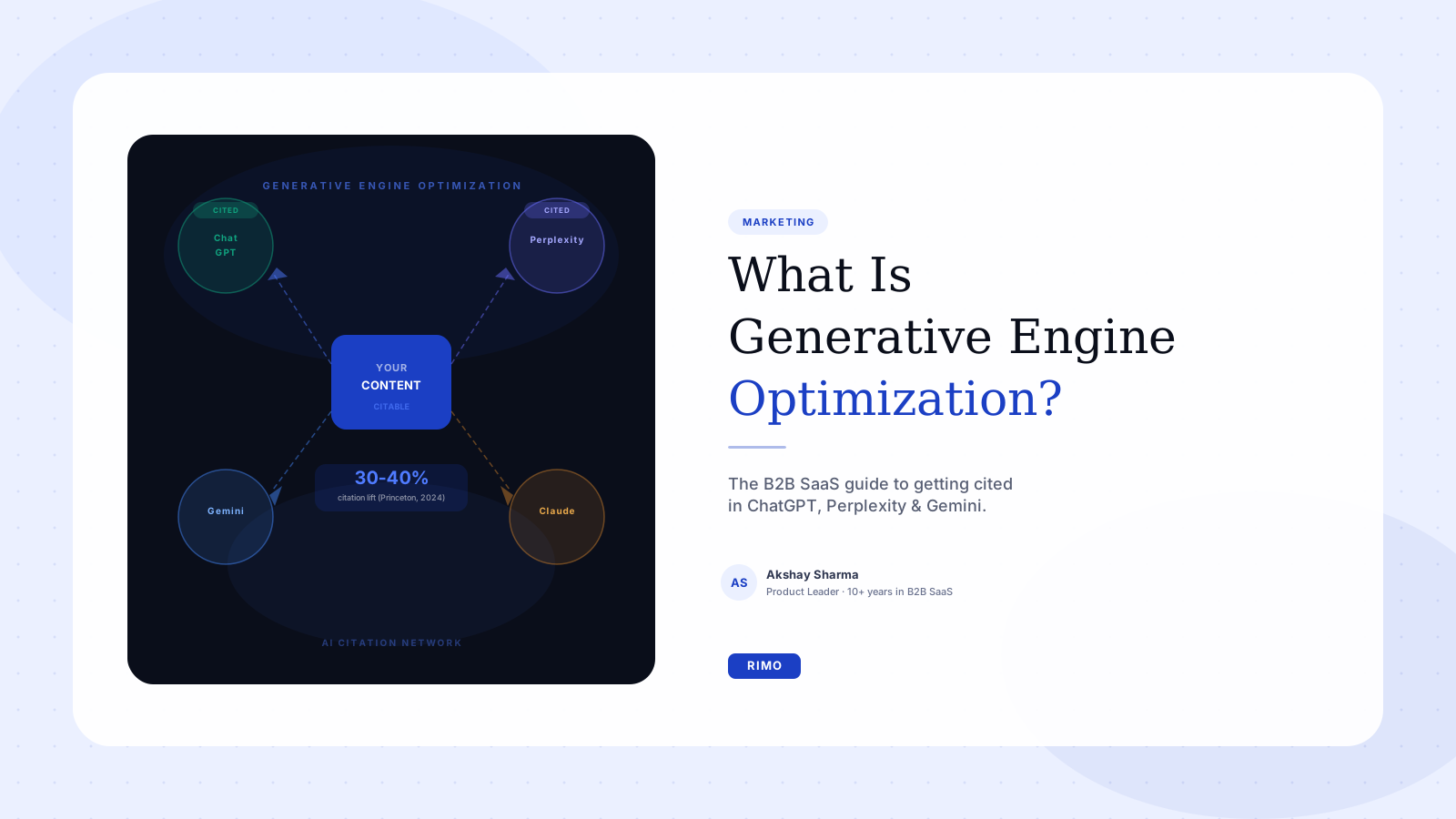
Generative engine optimization (GEO) is the practice of structuring your content and digital presence so that large language model (LLM) platforms — ChatGPT, Perplexity, Gemini, Claude, and Microsoft Copilot — retrieve, extract, and cite your brand when generating answers to user queries.
The term emerged from academic research at Princeton, Georgia Tech, IIT Delhi, and The University of Texas at Austin, with foundational studies publishing in 2024. The core finding: content that includes citations, statistics, expert quotations, and clear factual claims appears in AI-generated responses 30–40% more often than content without those signals (Princeton et al., 2024).
Traditional SEO asks: "How do I rank on page one of Google?" GEO asks: "How do I become the answer the AI cites when my buyer asks a relevant question?" The first question is about position. The second is about authority.
GEO is sometimes used interchangeably with Answer Engine Optimization (AEO), but there is a meaningful distinction. AEO is the broader discipline — optimizing for any system that delivers direct answers, including voice assistants, featured snippets, and AI Overviews. GEO is specifically focused on large language models that generate conversational responses from scratch. For most B2B SaaS marketing teams, the practical work overlaps significantly. But GEO matters as its own concept because the mechanics of how LLMs select sources are different from how Google ranks pages.
GEO vs. SEO vs. AEO: what each does
These three disciplines are related but they are not the same. Treating them interchangeably is where most content strategies go wrong.
SEO (Search Engine Optimization) optimizes for ranked link lists. The goal is to appear in the top organic results when someone searches Google, Bing, or another traditional search engine. Success is measured by position, impressions, and click-through rate. SEO has been the dominant digital marketing discipline for 25 years.
AEO (Answer Engine Optimization) optimizes for direct answers — featured snippets, Google AI Overviews, voice search results, and structured responses across any system that returns one answer instead of a list. AEO is a layer on top of SEO, not a replacement. You learn more about the AEO playbook in our full AEO guide for B2B SaaS.
GEO (Generative Engine Optimization) optimizes for citation in AI-generated conversational responses from LLMs. The key difference from AEO: LLMs don't retrieve pages and return them — they synthesize a new response using retrieved content as source material. Your content needs to be structured not just to answer a question, but to be extractable by a model generating a paragraph-length answer in its own voice.
The table below captures the distinction plainly:
| SEO | AEO | GEO | |
|---|---|---|---|
| Target system | Google / Bing | Featured snippets, AI Overviews | ChatGPT, Perplexity, Gemini, Claude |
| Output format | Ranked link list | Single direct answer | Synthesized AI-generated response |
| Success metric | Position, CTR | Featured snippet ownership | Citation rate in AI outputs |
| Core content signal | Backlinks, authority, relevance | Clear direct answers, schema markup | Citations, stats, expert signals, freshness |
The practical implication: you need all three. SEO is still the foundation — AI systems that use real-time retrieval (Perplexity, ChatGPT with search) pull from the web, which means Bing and Google indexing still matters. AEO and GEO are additional layers you build on top of that foundation.
Why generative engine optimization matters for B2B SaaS
The number that matters most to B2B SaaS marketers: 73% of buyers now use AI tools during vendor research, with 51% saying they start their research in an AI chatbot more often than Google. This isn't a future prediction. It's a current reality. Your buyers are already asking AI systems about your category, your competitors, and whether your product is worth evaluating.
Here's what most GEO guides don't tell you: AI isn't the final decision-maker. A May 2026 Gartner survey found that 69% of B2B buyers turn to sales reps specifically to validate AI-generated insights before purchase. Buyers use AI for the initial research, then seek human confirmation. This creates a specific opportunity: GEO shapes the shortlist, and your demo closes the deal.
If you're not being cited in the AI research phase, you never make the shortlist. You're not present for the conversation where first impressions form. Your SDRs and AEs are fighting to be heard by buyers who already think they know which three tools are worth evaluating — and you're not one of them.
The standard growth marketing framework focuses on measurable channels: paid search, content, email, social. GEO sits in what researchers call the "AI dark funnel" — influence that happens before the buyer ever reaches your website, in AI conversations your analytics can't track. Only 22% of marketers currently measure AI search visibility. The other 78% are operating blind in a channel where more than half their buyers spend the early part of their evaluation.
How AI engines decide what to cite
Understanding this changes how you write. AI models don't rank pages. They retrieve potentially relevant content and then synthesize a response, using retrieved material as supporting evidence. The citation decision happens at the synthesis stage, not the retrieval stage — which is why optimizing purely for "getting retrieved" is only half the job.
AirOps analyzed over 548,000 pages retrieved by ChatGPT and found that only 15% of retrieved pages made it into the final cited response. Retrieval is necessary but not sufficient.
The factors that drive citation after retrieval:
Factual density. AI models prefer content that makes specific, verifiable claims. A paragraph that says "our customers see significant improvement" is not citable. A paragraph that says "customers reduce demo production time by 80%" is. Specificity creates extractable claims.
Source credibility signals. Named authors with stated credentials, publication dates, institutional affiliations, and outbound citations to reputable sources all increase the probability of being cited. Anonymous content with no publication date gets deprioritized.
Answer completeness. If a user asks "What is GEO?", content that directly and completely defines the term in the first paragraph is more likely to be cited than content that buries the definition in the fourth paragraph after three paragraphs of preamble.
Recency. AI systems weigh freshness when selecting between competing sources on the same topic. A guide published in 2024 with no updates competes poorly against a 2026 guide. Publishing cadence and updating existing content both matter.
The contrarian observation: high-authority domains don't automatically win. A newer, well-structured post from a B2B SaaS blog that leads with a precise definition, includes three cited statistics, and uses clear question-format headings can outperform a vague 3,000-word article from a major tech publication. Authority helps, but structure and specificity matter more than most SEO practitioners expect.
Five generative engine optimization tactics that work
1. Lead with the answer
AI systems scan the opening of your content first. The first 200 words of any article need to directly answer the primary query — no preamble, no "In this article, we'll cover…" the definition has to come first.
Rewrite every major page on your site using the inverted-pyramid structure: conclusion first, supporting evidence after. For product pages, that means your value proposition and key use case in the first sentence, not the third paragraph.
2. Cite your data
Original research and third-party citations are the highest-signal content type for AI. If you publish proprietary data — a benchmark study, a customer outcome analysis, a usage pattern report — AI engines have a specific reason to cite you that doesn't apply to your competitors.
Third-party citations work in both directions: citing reputable sources in your own content (Gartner, Forrester, academic papers, industry reports) signals that your content is factual and verified. It also increases the probability that AI systems treat your content as a trusted node in the broader knowledge graph.
For a full breakdown of which source types LLMs cite most frequently, read our guide to the top sources for LLM citations.
3. Structure for extraction
Question-format H2 and H3 headings outperform generic descriptive headings. "What is generative engine optimization?" is more likely to be retrieved for that exact query than "GEO Overview" or "Understanding GEO." AI systems pattern-match headings to queries.
Add explicit TL;DR summaries at the top of long-form posts. Create FAQ sections at the end of every article with the exact questions that appear in People Also Ask for your target keywords. Use schema markup (FAQPage, HowTo, Article) to give AI crawlers clean structured signals about content type.
4. Build third-party mentions
Your own website is one signal. What other authoritative sites say about you is a stronger one. AI models treat third-party mentions — analyst reports, journalist coverage, review platforms, partner blogs, expert commentary — as corroborating evidence for claims your site makes.
G2 is the most cited B2B software review platform in AI-generated vendor comparisons. A product with recent, specific G2 reviews that describe concrete outcomes appears in AI responses more reliably than a product with five stars and generic praise. "It saved our team 10 hours per week on demo preparation" is citable. "Great tool, highly recommend" is not.
5. Update your top 20 pages
Identify the 20 pages on your site most likely to be retrieved for high-intent queries in your category. For each, add: an explicit TL;DR summary at the top, at least two cited statistics, a question-format FAQ section, and a clearly visible author with credentials and publication date. Don't rewrite the content — add the structural signals that AI models use to evaluate citation-worthiness.
Your buyers are researching in AI. Is Rimo showing up?
Rimo turns a plain-English brief into a production-grade demo video your team can deploy across every channel — including the AI-cited content library your marketing team needs in 2026.
Platform-specific GEO: ChatGPT vs Perplexity vs Gemini
This is the section most GEO guides skip. Treating all AI platforms as identical is a significant strategic mistake — each retrieves and cites content differently.
ChatGPT (with search)
ChatGPT's real-time web search is powered by Bing. If your pages are not indexed in Bing, they cannot appear in ChatGPT's cited sources, regardless of how well you rank on Google. Check Bing Webmaster Tools. Ensure Bingbot is not blocked in your robots.txt. For B2B SaaS companies that have only ever focused on Google, this is a common and easily corrected blind spot.
ChatGPT also uses its training data for queries that don't trigger web search. This means older, well-established content that was part of pre-cutoff training has a persistent advantage. Publishing consistently over time — not just publishing a lot in one sprint — compounds in ChatGPT's training updates.
Perplexity
Perplexity rewards recency and factual precision more heavily than any other major AI platform. A post published last week with three cited statistics and a clear date stamp will often outrank a three-year-old definitive guide for the same query. Publishing cadence matters here more than anywhere else.
Perplexity also tends to cite primary sources — research papers, government data, analyst reports — more aggressively than secondary content. If your post cites a Gartner report directly (with the year and finding), it's more citable than a post that paraphrases the same data without attribution.
Gemini
Gemini integrates tightly with Google's Knowledge Graph and favors content from established domains with strong Google authority signals. The connection between traditional SEO and GEO is strongest on Gemini. If you rank well for a keyword in organic Google search, you have a meaningful head start in Gemini for that same query.
Gemini also has a stronger bias toward visual content signals — structured page design, schema markup, and clear authorship metadata all influence citation behavior in ways less visible on ChatGPT and Perplexity.
The practical implication: audit your current AI visibility across all four major platforms (ChatGPT, Perplexity, Gemini, Claude) before deciding where to focus first. Run your top 20 intent queries through each and document where competitors are cited and you are not. The gap tells you exactly where to prioritize.
How video fits into a GEO strategy
Most GEO guides treat video as irrelevant — it's hard for AI to extract text from a video, so skip it. This is wrong for B2B SaaS teams, and it misses one of the highest-leverage opportunities in the category.
Demo videos, explainer videos, and product walkthrough videos create citable content when they are paired with text. A demo video paired with a detailed video description, a timestamped transcript, and a written summary of the key findings becomes extractable by AI systems. The video itself drives engagement and trust on your site. The text layer around it drives AI citation.
B2B video marketing research consistently shows that buyers who watch a demo video convert at higher rates than those who don't. The GEO angle adds a second reason to invest in video: a well-written accompanying post or landing page — describing what the demo shows, which use cases it covers, what outcomes customers typically see — becomes a rich, factual, citeable asset.
The product demo video that sits on your homepage is not doing GEO work on its own. The 800-word page around it — with specific stats, explicit claims, named customer examples, and clear author attribution — is the GEO asset. The video is proof. The text is citation material.
If you use an AI video platform like Rimo to create demo videos, you can generate the supporting text layer as part of the same workflow — the script that feeds the video is also the structured content that gets cited. The script-to-video workflow becomes a content production pipeline, not just a video production pipeline.
For teams applying GEO principles specifically to demo content, our SaaS demo video best practices guide covers how to structure demo content for maximum distribution and visibility.
The 30-day GEO sprint
Most GEO guides end with tactics. Here is a concrete timeline that produces measurable results within 30 days — something you will not find in most guides on this topic.
Week 1: Baseline and audit
Run your 20 most important buyer queries through ChatGPT, Perplexity, Gemini, and Claude. Document every instance where a competitor is cited and you are not. This is your gap list. Prioritize the queries where competitors are named and you are absent — these represent active buyer moments where your brand is invisible.
Check Bing Webmaster Tools and verify all priority pages are indexed. Check that Bingbot, ClaudeBot, GPTBot, and PerplexityBot are not blocked in robots.txt.
Week 2: Structural upgrades
Take the top 10 pages from your gap list and apply the structural changes: add a TL;DR summary paragraph at the top of each, reformat at least two headings as direct questions, add a FAQ section at the bottom, add cited statistics (with source and year) to replace any vague claims, and ensure author name, role, and publication date are visible on the page.
Week 3: Content creation and third-party signals
Create two new posts targeting the highest-gap queries from Week 1 — one definitional post and one how-to post. Each should follow GEO-optimized structure from the first sentence. Submit expert commentary to two industry publications that AI platforms cite frequently. Respond to open G2 reviews with specific, data-rich responses that reference concrete outcomes.
Week 4: Re-audit and iteration
Re-run the 20 baseline queries. Document the delta. Any query where you've gained a citation is a validation of the tactic that drove it — double down there. Any query where no change occurred likely needs third-party signal building rather than on-page optimization.
The honest truth about timeline: citation improvements in ChatGPT and Claude take longer than Perplexity (which indexes in near real-time) because LLM training cycles run on their own schedule. Week 4 is not the end of the sprint — it's the first data point. Expect material citation gains in ChatGPT over 60–90 days, and in Perplexity within 2–3 weeks of publishing.
Generative engine optimization is not a replacement for SEO. It's not a shortcut. It's the next layer of content strategy that your buyers have already adopted faster than most marketing teams realize. The companies that build GEO into their content workflow now — while most competitors are still treating it as optional — will have a structural citation advantage that compounds over time.
The practical starting point is simpler than most guides suggest: pick your 10 highest-intent pages, add a TL;DR, cite your data, reformat your headings as questions, and re-run your baseline queries in four weeks. You'll see which changes moved the needle. Build from there.
If you're building a demo video library and want your product to appear in AI-generated vendor comparisons, try Rimo free and start creating the citation-grade content that puts you on the shortlist.
FAQ
What is generative engine optimization?
Generative engine optimization (GEO) is the practice of structuring your content so that AI platforms — ChatGPT, Perplexity, Gemini, and Claude — extract and cite your brand in their generated responses. Unlike SEO, which optimizes for ranked link lists, GEO optimizes for being the source an AI cites when synthesizing an answer. Key tactics include leading with direct answers, citing data with attribution, using question-format headings, and building third-party mentions on sites AI platforms trust.
What is the difference between GEO and SEO?
SEO (Search Engine Optimization) targets ranked positions in Google and Bing. GEO (Generative Engine Optimization) targets citation in AI-generated conversational responses from LLMs like ChatGPT, Perplexity, and Gemini. SEO measures success by position and click-through rate. GEO measures success by citation rate — whether your brand is named when AI answers relevant queries. The two disciplines share foundational signals (domain authority, quality content, indexing) but GEO adds specific requirements around answer structure, data density, and source credibility signals that SEO alone doesn't address.
How is GEO different from AEO?
AEO (Answer Engine Optimization) is the broader discipline of optimizing for any system that returns direct answers — including featured snippets, voice assistants, and Google AI Overviews. GEO is specifically focused on large language models that generate full conversational responses, like ChatGPT, Perplexity, and Claude. Both disciplines share many tactics, but GEO adds a specific focus on the signals LLMs use to select citations during synthesis: factual density, source credibility markers, recency, and content completeness.
How long does it take for GEO changes to show results?
Timeline varies by platform. Perplexity indexes new content in near real-time — structural improvements to existing pages can show citation gains within two to three weeks. ChatGPT and Claude improve over training cycles, so expect meaningful gains over 60–90 days for changes made to existing content. For newly published content, appearance in training data takes longer, but real-time search integrations (ChatGPT Search, Perplexity) can index and cite new content within days of publication. Run a structured 30-day audit — re-running your baseline queries after four weeks gives you directional data even before full gains are visible.
Do AI platforms cite video content?
AI platforms cannot directly extract content from video files. However, video pages that include text-based content — detailed page descriptions, structured transcripts, key claims summarized in writing, timestamped show notes — are citable. A product demo video paired with a well-written, data-rich page description is a GEO asset. The video drives trust and engagement; the surrounding text drives AI citation. For B2B SaaS teams, pairing video production with structured text content is the highest-ROI approach to video-driven GEO.
Which AI platform should B2B SaaS companies prioritize for GEO?
Prioritize based on where your buyers actually research. For software-category queries, Perplexity and ChatGPT (with search enabled) are the most common starting points for B2B buyers. Perplexity rewards recency and factual precision and shows citation gains fastest. ChatGPT requires Bing indexing as a prerequisite. Gemini favors established domains with strong Google authority. Start by auditing all four platforms against your top 20 buyer queries to identify the largest citation gaps, then prioritize the platform where you have the most competitor citations but no presence of your own.
Akshay Sharma
Product Leader · 10+ years in B2B SaaS
Akshay has spent 10+ years building and marketing B2B SaaS products. He writes about product storytelling, demo production, and the operational side of product marketing.