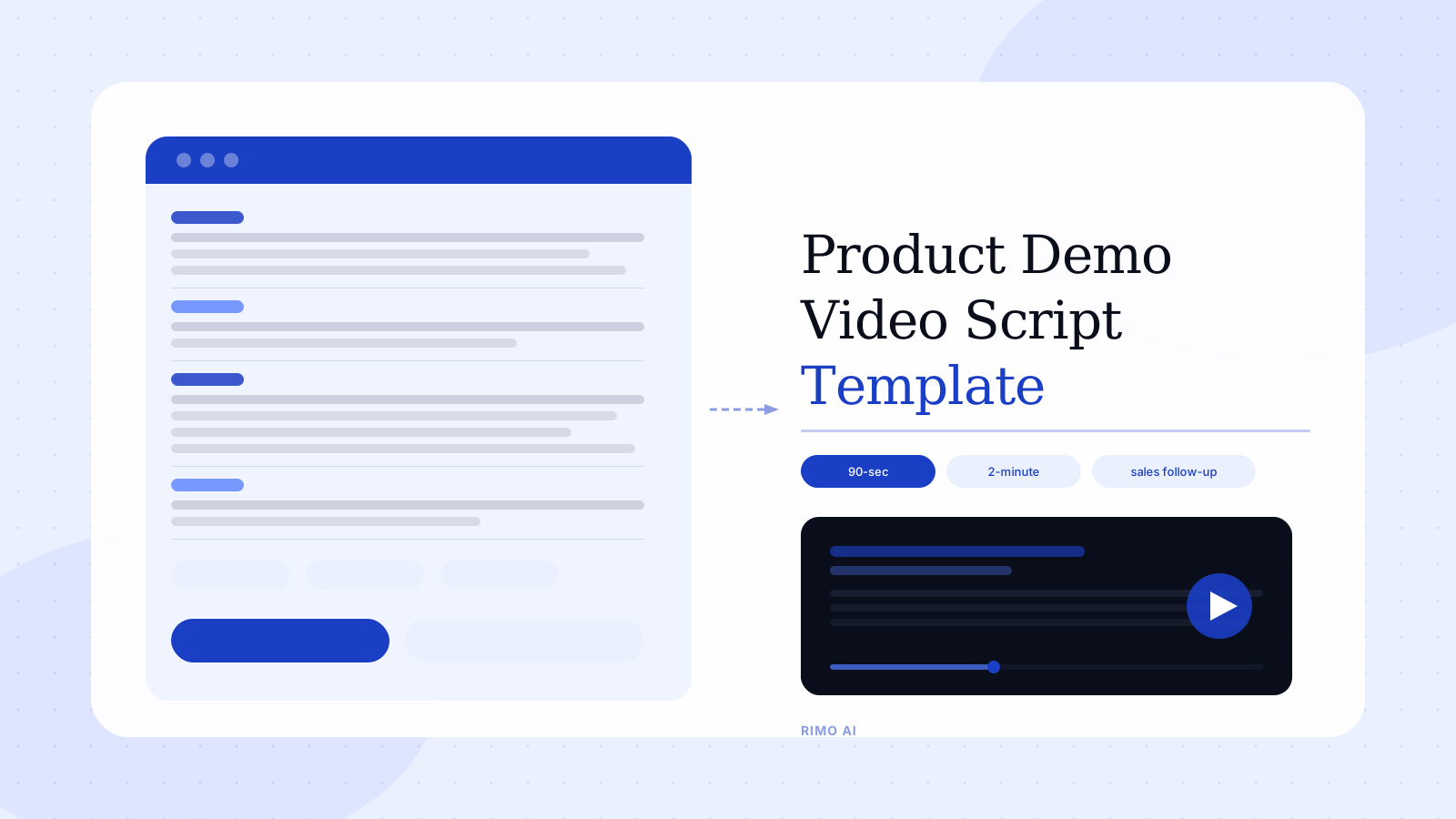
The Product Demo Video Script Template B2B SaaS Teams Actually Use
The instinct when making a demo video is to open the product and start clicking. You know the product better than anyone. You'll figure out what to say as you go.
That instinct is the source of almost every demo video revision cycle. The voiceover chases the visuals. The narrative drifts between features without a clear throughline. By the third round of feedback, the reviewer can't name what's wrong — they just know something is off. What's off is that the script came after the product.
This guide gives you three product demo video script templates you can use immediately — built for the three most common demo types in B2B SaaS: the 90-second awareness demo, the 2-minute use-case walkthrough, and the 60-second sales follow-up. Each template includes a word count target, a scene-by-scene structure, and a worked example. Before the templates, there's one pre-production step most guides skip entirely — and it's the reason scripts keep needing rewriting.
In this guide
- Why demo video scripts usually get written twice
- The brief that comes before the script
- Product demo video script template: the 90-second awareness version
- Product demo video script template: the 2-minute use-case version
- The sales follow-up script
- How to map your script to real product screens
- Script word count reference guide
- Five script mistakes that cost demo conversions
Why demo video scripts usually get written twice
Most teams write a script once before recording, then rewrite it during editing because the words don't match the footage they captured. The second draft is reactive — shaped by what was filmed rather than by what the buyer needs to understand.
The fix is not better writing. It's sequencing: brief first, script second, recording third.
Two things consistently separate the demo scripts that get approved in one round from those that circulate for weeks:
Specificity to one buyer. The moment a script tries to address a broad audience — "for teams of all sizes, across all industries" — it stops feeling relevant to anyone. The most effective demo scripts assume one role, watching one workflow, for one reason.
Problem-first framing. The product should not appear in the first 15 seconds. The viewer's specific situation should. What are they dealing with right now, before your product enters the picture? That's what earns the right to show the product at all.
According to Vidyard's benchmark data, product demos represent 47% of all B2B videos — making demo scripts the most-produced type of video content in B2B SaaS. And yet most teams treat script writing as an afterthought, something to figure out during or after recording. That's what creates the revision cycle.
The brief that comes before the script
A brief is not a spec doc. It fits in four sentences and answers four questions:
- Who is watching this? One role, specific. Not "marketing teams" — "a product marketing manager at a 100–300 person SaaS company who owns launch assets and reports to the VP of Marketing."
- What problem are they aware of? The specific friction they feel in a specific workflow, not a category-level problem.
- What does the product enable that the status quo doesn't? One thing. Not a bullet list of features — one outcome that the buyer currently can't achieve without your product.
- What should the viewer do after watching? Start a trial, book a call, share with their manager — one action.
Without this brief, a product demo video script template is just a structural exercise. With it, you can fill in a template in 30 minutes and know that every word is earning its place.
This is also why G2 reviews of tools like Loom and Vidyard consistently surface the same complaint: recording issues. Loom's "recording issues" tag has over 147 mentions on G2 (2025–2026) — the single most-cited con on the platform. Most of those incidents trace back to teams jumping straight to recording without a clear scene plan. The brief and the screen map prevent re-records before they happen.
For the full pre-production workflow that connects brief, script, and recording, see the complete in-house demo video production guide. This post assumes you have a brief and picks up at the script.
Product demo video script template: the 90-second awareness version
Use this for: Homepage demos, campaign landing pages, top-of-funnel video ads.
Target length: 75–90 seconds.
Word count: 150–175 words.
Scene-by-scene structure:
Scene 1 — Problem context (0:00–0:12) Screen: No product yet. A blank state, an overloaded spreadsheet, or a plain title card. Voiceover: "[Role] at [company type] spend [X hours/days] every [time period] doing [specific painful task]. The result is [specific bad outcome]."
Scene 2 — Solution entry (0:12–0:25) Screen: The product, at the entry point most relevant to that task. Voiceover: "With [product name], you [brief action]. Here's what that looks like."
Scene 3 — Core workflow (0:25–1:00) Screen: 2–3 product screens showing the workflow in motion, one per key step. Voiceover: "You [action 1]. [Product] automatically [result 1]. Then you [action 2] — and the [key output] is ready."
Scene 4 — Outcome + CTA (1:00–1:20) Screen: The final result — a completed report, a published asset, a finalized dashboard. Voiceover: "No more [old way]. [Role] can [new outcome] in [timeframe]. [CTA: Start free / Request a demo.]"
Worked example — product marketing use case:
"Product marketers at fast-shipping SaaS companies spend hours every release writing the internal brief, pulling data from three different tools, and chasing sign-off. The demo goes out late — if it goes out at all.
With Rimo, you describe the demo in plain English. Here's what that looks like.
You write the brief — who it's for, what problem it solves, what to show. Rimo records the real product screens in the background and assembles the video draft. You review, approve, and publish the same day the feature ships.
No more video bottleneck on launch day. Product marketing teams can ship a production-grade demo in under an hour — from brief to final cut. Start free."
Word count: 153 words. At a measured voiceover pace of 110 words per minute with natural pauses between scene transitions, this runs approximately 83 seconds — comfortably within the 75–90 second target.
One test to run on every line: if you removed the product name from the sentence, could a competitor make the same claim? If yes, the line is too generic. Replace it with something only your product can say.
Product demo video script template: the 2-minute use-case version
Use this for: Persona-specific landing pages, email nurture campaigns, mid-funnel evaluation content.
Target length: 90 seconds–2 minutes.
Word count: 220–260 words.
This format expands Scene 3 to show two or three sequential workflow steps, and adds a differentiation beat — a single sentence naming what the buyer can't do with their current tool.
Scene 1 — Problem context (0:00–0:15) Screen: No product, or a problem-framing title card. Voiceover: "[Role] have a [specific problem] that most teams solve by [status quo workaround]. It works — but it takes [time/cost], and [specific limitation that your product removes]."
Scene 2 — Solution entry (0:15–0:25) Screen: Product home screen or the entry point for this specific use case. Voiceover: "[Product name] is built for [use case]. The workflow starts here."
Scene 3 — Step-by-step walkthrough (0:25–1:30) Screen: 3–4 sequential product screens, one per workflow step. Voiceover: "First, you [action 1]. The system [automatic result]. From there, you [action 2] — [product feature] handles [repetitive subtask] so you don't have to. Finally, you [action 3], and the output is [specific deliverable]."
Scene 4 — Differentiation beat (1:30–1:45) Screen: A comparison output, exported file, or before/after visual. Voiceover: "Most teams using [common tool] still have to [manual step] every time this changes. With [product], that step is gone."
Scene 5 — Outcome + CTA (1:45–2:00) Screen: Final output, a real metric, or a satisfied-user moment. Voiceover: "[Specific role] at [company type] get [specific outcome]. [CTA]."
Turn your brief into a demo video
Describe the demo in plain English. Rimo records the real product screens and produces a production-ready video — no editor, no six-week timeline.
This structure gives you 220–260 words of voiceover across five clearly mapped scenes. When a feature changes, you update one scene and re-record one section — not the whole video. That modularity isn't just a writing convention. It's a maintenance strategy.
According to Wistia's 2025 State of Video report, videos under one minute hold a 50% average engagement rate, while the 1–3 minute range holds 46%. The gap is smaller than most teams expect — a well-structured 2-minute video that earns every second performs nearly as well as a shorter one. The word count ceiling keeps you honest about whether each scene is earning its place.
The sales follow-up script
Use this for: Post-discovery leave-behinds, re-engagement after a prospect goes quiet.
Target length: 60–75 seconds.
Word count: 120–140 words.
The critical difference from the templates above: remove the problem context section entirely. The buyer described their problem in discovery. Restating it wastes the first 15 seconds of their attention. Start with the workflow.
Template:
"[First name], based on our conversation about [specific use case or objection raised], I wanted to show you exactly what that looks like in the product.
[Brief transition — e.g., 'Here's the workflow you asked about.']
You [action 1]. [Product] automatically [result]. Then [action 2] — and you get [specific outcome the prospect mentioned caring about].
The [specific feature or differentiator] is what separates this from [tool they currently use or competitor they mentioned].
If this matches what you're looking for, [CTA: here's a link to start a trial / here's how we'd set this up for your team]."
The sales follow-up is the one template where personalization is worth the production effort. Vidyard's 2025 data shows personalized sales videos see meaningfully higher watch rates than generic product overviews — the template handles the structure, and one sentence referencing a specific detail from discovery is what makes it feel relevant rather than mass-produced.
Sales engineers using this template typically produce three to five personalized follow-up videos per week without a dedicated production workflow. The template is what makes that volume sustainable — not willpower or extra hours.
How to map your script to real product screens
A script is only half the template. The other half is the screen map — the document that connects each voiceover line to the specific UI state visible when it's spoken.
| Line # | First 6–8 words of voiceover | Screen / UI state visible | Duration |
|---|---|---|---|
| 1 | "Product marketers at fast-shipping..." | Title card / blank | 0:00–0:12 |
| 2 | "With Rimo, you describe..." | Home screen, brief input | 0:12–0:22 |
| 3 | "Rimo records the real product..." | Recording in progress | 0:22–0:45 |
| 4 | "Review, approve, and publish..." | Draft review screen | 0:45–1:05 |
| 5 | "No more video bottleneck..." | Published video + CTA card | 1:05–1:20 |
Complete this table before recording a single screen. If you can't fill in the UI state for a line — if the script describes something that doesn't have a corresponding screen — that's a script problem, not a recording problem. Fix it before you open the product.
This mapping is what makes recording fast and editing clean. When you know exactly which screen follows which, you record with precision instead of over-capturing and hoping the story appears in editing. It's the core discipline behind automating demo video creation with AI: structured input produces predictable, fast output.
The script is not the thing you write before you record. It's the thing you write before you know what you're recording. Those are different documents solving different problems.
Script word count reference guide
| Video type | Target length | Word count | Pacing |
|---|---|---|---|
| Homepage hero | 60–75 sec | 110–130 words | Slow, deliberate |
| Awareness demo | 75–90 sec | 150–175 words | Measured |
| Use-case walkthrough | 90 sec–2 min | 175–260 words | Measured |
| Persona deep-dive | 2–3 min | 260–360 words | Natural |
| Sales follow-up | 60–75 sec | 120–140 words | Conversational |
| Documentation embed | 30–45 sec | 60–90 words | Slow, clear |
Standard voiceover advice quotes 130 words per minute. In practice, a scripted demo video lands at 100–120 wpm once you account for scene transitions, pause beats, and any on-screen text the viewer needs a moment to read. Budget for that gap.
Here is the observation that most script guides miss entirely: most B2B SaaS demo videos are too short in their scripts and too long in their videos. Teams cut the voiceover to 60 words and then let the recording run two minutes because they're covering "just one more thing" on screen. The script is the contract. If the recording goes longer than the script plans for, there's no story — just footage with music over it. Stick to the word count. Cut from the walkthrough section first. The problem setup and the CTA are non-negotiable.
Five script mistakes that cost demo conversions
1. Starting with the product name. "[Product] is a platform that helps teams..." Every B2B buyer has heard this sentence dozens of times. It signals that this video is about the vendor, not about their problem. Lead with the problem. The product earns its appearance by the end of Scene 2.
2. Listing features instead of showing outcomes. Scripts that narrate clicks — "you can see here on the left panel, there's the dashboard, and if you click on projects..." — give buyers information without meaning. Every scene needs to close on a result, not a feature name. "The report is ready" is a result. "This is the reporting tab" is a feature.
3. Voiceover that races ahead of the screen. If the script describes something before it appears on screen, the viewer's attention splits between what they're hearing and what they're looking for visually. Write so the UI action always precedes or matches the voiceover. If you describe it before you show it, you've created a distraction at the exact moment you need the viewer focused.
4. A CTA that's vague. "Learn more about [product]" is not a call to action — it's a deferral. "Start your free trial" or "Book a 20-minute call" is. One specific action. The best CTAs for 90-second awareness demos are "Start free" or a link to the next video in a persona-specific series. Give the viewer somewhere specific to go.
5. Writing the script before reading the brief. This is the root cause of most demo script revision cycles. It's exactly what makes a product demo video effective: buyer specificity before product coverage. When the brief is solid, a first-draft script that needs one round of polish takes under 30 minutes to write. When the brief is missing, even an experienced writer produces a script that circulates for weeks because nobody can articulate what's actually wrong with it — only that it doesn't feel right.
A product demo video script template solves the blank-page problem. It doesn't replace judgment — it gives your judgment somewhere to land.
The three templates above cover the core demo scenarios in B2B SaaS. Use the 90-second version to convert cold traffic fast. Use the 2-minute version when buyers are actively evaluating options. Use the sales follow-up when a specific conversation has already happened and the prospect needs one more reason to move.
The brief still comes first. The script still comes before the recording. For product marketing teams managing launch content at scale, this sequence is what makes demo video a predictable output rather than a recurring fire drill.
Try Rimo free — describe the demo in plain English, and Rimo generates the scene structure, the voiceover script, and a production-ready video. No blank page, no contractor, no six-week wait.
FAQ
What is a product demo video script?
A product demo video script is the written voiceover for every line spoken in the video, paired with a scene-by-scene description of what appears on screen when each line is delivered. It is distinct from a storyboard (which covers only visuals) and from a brief (which defines purpose without specifying words). The script bridges the buyer problem you've identified and the product footage you're about to record. Without it, you record first and hope the story appears afterward — which is exactly how revision cycles begin. For the broader context on what an effective demo video needs to accomplish, see what is a product demo video.
How long should a product demo video script be?
Target 150–175 words for a 90-second awareness demo, 220–260 words for a 2-minute use-case video, and 120–140 words for a 60–75 second sales follow-up. These counts assume 100–120 words per minute of comfortable voiceover pace, accounting for natural pauses and any moment where on-screen text needs reading time. If your script reads longer than these targets at a natural speaking pace, cut from the walkthrough section first — the problem setup and the CTA are the sections that can't be shortened without losing conversion.
Should I write the script before or after recording the demo?
Always before. Scripts written after recording are reactive — they narrate footage rather than directing it. When you write the script first against a clear brief, it tells you exactly which screens to capture and in what order. That makes recording faster, editing cleaner, and revision less likely. The full sequence is: brief → script → screen map → recording. If any step is skipped, the step after it takes longer.
What is the best structure for a product demo video script?
The most reliable five-part structure is: (1) problem context before the product appears, (2) solution entry — the product showing up for the first time, (3) core workflow walkthrough with 2–4 sequential steps, each closing on a specific result, (4) an optional differentiation beat that names what the status quo can't do, and (5) outcome plus CTA. Each section maps to one or two product screens. This structure works from 90-second awareness demos through 3-minute persona deep-dives.
How do I adapt a product demo script template for a sales follow-up video?
Remove the problem context section — the buyer described their problem in discovery. Start immediately with the workflow that addresses what they brought up in the call. Keep it under 75 seconds. Reference one specific thing they said: a use case, a concern, a competitor they mentioned comparing you to. End with a direct next step — a trial link, a calendar link, or a specific question you want them to answer. The structural template is the same as the awareness version. What changes is the tone: less "here's the problem you might have" and more "here's what you asked me to show you."
Akshay Sharma
Product Leader · 10+ years in B2B SaaS
Akshay has spent 10+ years building and marketing B2B SaaS products. He writes about product storytelling, demo production, and the operational side of product marketing.