What Is a Solutions Engineer? The B2B SaaS Guide (2026)
You've just been handed a job title that didn't exist when most VPs of Sales started their careers, and the job description three companies posted for it last week all describe slightly different jobs. One wants someone who can write Python and configure a Kubernetes demo cluster. Another wants someone who can run a sixty-minute call with a CFO and never touch a terminal. A third just wants "a sales engineer, but we're calling it solutions engineer this year."
That confusion is the job. A solutions engineer sits at the exact point where a buyer stops asking "what does this do" and starts asking "can this actually work for us" — and the title means something slightly different at every company that uses it.
This guide untangles what a solutions engineer actually does, how the role differs from a sales engineer or solutions consultant in practice (not just in title), what the best ones do differently, and why the role's biggest hidden constraint — producing demo content fast enough to keep up with pipeline — is now something AI can meaningfully fix.
In this guide
- What is a solutions engineer?
- What does a solutions engineer do day to day?
- Solutions engineer vs. sales engineer vs. solutions consultant
- What makes a great solutions engineer in 2026
- How solutions engineers are measured
- The bottleneck no one puts in the job description
- Solutions engineer salary and career path
- In conclusion
- FAQ
What is a solutions engineer?
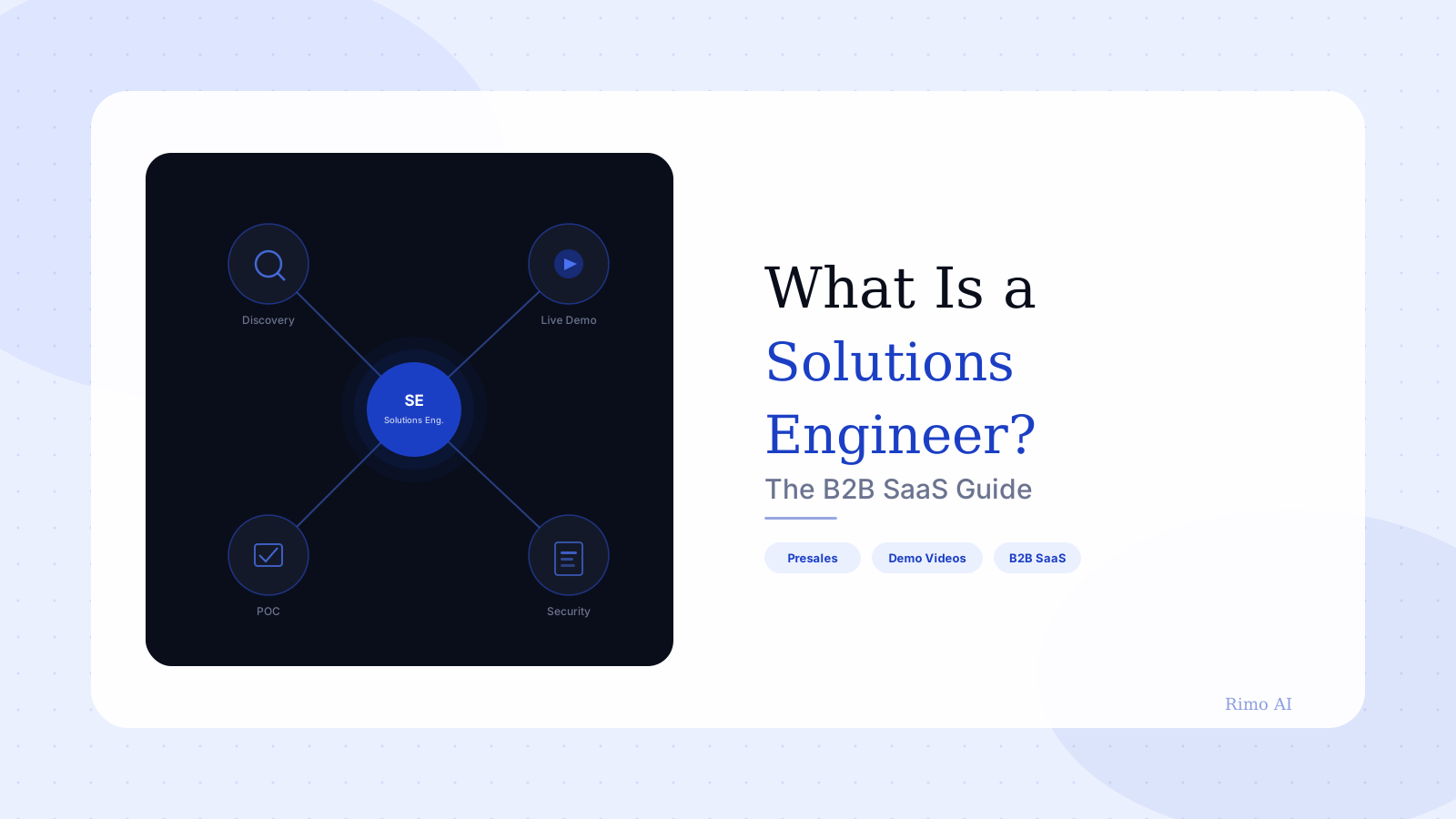
A solutions engineer (SE) is the technical counterpart to an account executive in a B2B SaaS sales cycle — the person responsible for proving, with the actual product and the buyer's actual use case, that a deal is technically viable before it can move toward a signature. The title overlaps heavily with sales engineer and presales engineer; most job boards and most companies use them interchangeably, even though some organizations draw a sharper line (more on that below).
The clearest way to describe the role: an account executive sells the outcome. A solutions engineer proves the mechanism. Buyers in 2026 don't take that proof on faith — Gartner found that 77% of B2B buyers describe their most recent purchase as "very complex or difficult" (Gartner, 2024), and complexity is exactly where technical credibility decides outcomes.
Solutions engineers show up once a deal moves past initial interest. They run technical discovery, lead live product demonstrations, scope and support proof-of-concept (POC) evaluations, and answer the security and architecture questions that determine whether procurement will let a deal proceed at all.
The role exists because of a structural gap in B2B SaaS selling: account executives are trained and compensated to manage relationships and negotiate commercial terms, not to defend an architecture diagram against a skeptical staff engineer. Without a solutions engineer, that gap gets filled badly — either by an AE bluffing through technical questions, or by pulling a product manager into back-to-back sales calls they were never meant to carry.
What does a solutions engineer do day to day?
The scope shifts with company stage and product complexity, but five things show up in almost every solutions engineering role.
Technical discovery
Before any demo happens, the SE needs to know what the buyer's environment actually looks like — current tooling, data flows, integration requirements, and the specific workflow the buyer is trying to replace or improve. Skipping this step is the single most common reason a demo falls flat: it shows capabilities nobody in the room asked about.
Live product demonstrations
This is the most visible part of the job, and the one most people picture when they hear "solutions engineer." A strong demo isn't a feature tour — it's the buyer's own workflow, recreated inside the product, in front of an audience that includes both skeptical engineers and business stakeholders who don't care about the API. Holding both audiences in the same hour, without losing either one, is the actual skill being tested.
POC scoping and support
Most enterprise deals don't close on a demo alone. The buyer wants to run the product against their own data, inside their own environment, under their own constraints. The SE scopes what "success" means for that evaluation, configures the environment, and stays available while the buyer's team pokes at it. A POC with no clear success criteria almost always ends in an inconclusive "we'll get back to you" — which, in practice, means the deal is dying quietly.
Security and architecture review
Enterprise procurement runs on paperwork: architecture diagrams, data handling policies, SOC 2 documentation, integration specs. This work is invisible outside the deal record and can eat two to three full days per enterprise opportunity. Nobody mentions it in a win announcement. Skipping it kills deals that the SE never even sees coming.
Leave-behind content
The live call ends, but the buying decision doesn't get made by the one person who was on it. Whoever attended needs to convince colleagues who weren't in the room — and the materials the SE leaves behind (a product demo video, a recorded walkthrough, a one-pager mapped to the buyer's use case) are what does that convincing. This is the part of the job most consistently dropped when the week gets busy, and it's also the part with the clearest ROI per hour invested.
Solutions engineer vs. sales engineer vs. solutions consultant
Here's the honest answer most job descriptions won't give you: at the majority of B2B SaaS companies, solutions engineer, sales engineer, and presales engineer are the same job with a different label, chosen based on whatever the VP of Sales liked when the req went out. There is no industry-wide standard that consistently separates them.
That said, where companies do draw a distinction, it tends to follow this pattern:
| Solutions Engineer | Sales Engineer | Solutions Consultant | |
|---|---|---|---|
| Typical emphasis | End-to-end deal ownership, architecture-level conversations | Demo and POC execution, narrower technical scope | Business-process fit, less hands-on configuration |
| Common at | Infrastructure, platform, and developer-tooling companies | Mid-market SaaS with high deal volume | Enterprise software with long, consultative cycles |
| Hands-on coding | Often, especially for integration work | Sometimes | Rarely |
| Customer-facing | Always | Always | Always |
Don't over-index on the title when evaluating a role or hiring for one. Read the actual responsibilities. A "solutions consultant" req that lists API troubleshooting and POC environment configuration is describing a solutions engineer, regardless of what the title says.
What does separate cleanly from all three is the demo engineer — an internal, non-customer-facing role that builds and maintains the demo environments and content library the SE depends on. At companies large enough to split the function, the demo engineer builds the infrastructure; the solutions engineer is the one in the room with the buyer. Some organizations also distinguish the solutions engineer from a forward deployed engineer, who embeds with the customer after the contract is signed to manage implementation — a presales-to-postsales handoff that only exists at companies with genuinely complex deployments.
Stop losing leave-behind content to a busy week
Rimo turns a brief into a polished, branded product demo video in under an hour — built for SE teams who need a content library, not just a calendar full of live calls.
What makes a great solutions engineer in 2026
Technical depth and clear communication are the baseline. What separates the SEs who consistently win deals from the ones who merely survive them is more specific.
Calibrating the room, not the script
The best SEs change direction mid-demo without making it look like a deviation. A CISO asks an unscheduled data-residency question; a great SE answers fully, then returns to exactly where they left off. This looks like improvisation. It's actually the result of knowing the product deeply enough that the script becomes optional.
Treating the demo as reusable architecture, not a one-off build
High-performing SEs maintain a set of modular demo flows that can be recombined for a new vertical or persona in under an hour, rather than rebuilding from scratch every time discovery surfaces a new use case. This is the same instinct that makes a demo video script template useful: structure speeds up customization, it doesn't replace it.
Knowing when "no" is the right answer
An unpopular truth in presales: the SEs who win the most long-term trust are the ones willing to tell a prospect the product isn't a fit for a specific use case, in the room, instead of stretching the demo to imply otherwise. It costs a deal occasionally. It builds the kind of credibility that gets an SE invited back into the next conversation at the same account, under a different title, a year later.
Using AI as a production layer, not a substitute for judgment
Wistia's State of Video Report found AI use in video production jumped from 18% to 41% in a single year — the largest single-year adoption spike the report has recorded (Wistia, 2025). SEs who use AI to handle the production mechanics of leave-behind videos reclaim hours that go back into live deal support, which is where SE judgment actually moves revenue. AI doesn't run the discovery call. It removes the excuse for not having a follow-up video ready by the next morning.
How solutions engineers are measured
Metrics vary by company, but four signals show up almost everywhere.
Demo-to-POC conversion rate. The share of qualified demos that advance to a formal evaluation. A persistently low number is rarely a product problem — it's almost always a demo problem, often traceable back to skipped discovery.
POC win rate. Of every POC the SE runs, what share closes? This is the cleanest individual-contribution metric most presales orgs have.
Time-to-POC. The gap between the first technical demo and the start of evaluation. Shorter is usually a sign of tighter discovery and a demo that didn't leave the buyer needing to "go check a few more options" before committing to next steps.
Revenue influenced. Most SE teams track total pipeline value touched. As a function, SEs typically influence the large majority of enterprise revenue without their name appearing anywhere in the closed-won announcement.
The bottleneck no one puts in the job description
According to Navattic's State of Demo Automation Platform 2026 survey of more than 70 presales professionals via the Presales Collective, solutions engineers spend 11 to 25 hours a week preparing and running demos — averaging roughly seven demos a week at about 3.6 hours each, including prep. At a 1:4 SE-to-AE ratio (Gartner, 2024), that workload is sitting on top of POC support, RFP responses, and whatever leave-behind content the deal calendar hasn't already crowded out.
G2 reviews of the interactive demo tools SEs lean on show the same tension from a different angle. Storylane users praise how fast a demo gets shipped — often under thirty minutes with no engineering involvement — but repeatedly flag that the AI auto-build features "don't always understand the flow," leaving heavy manual cleanup before a demo is buyer-ready. Walnut reviewers describe a powerful, highly customizable editor that comes with a real ramp-up cost — what should be a one-week onboarding stretching into a multi-month adoption curve for less technical team members. Consensus users like the time saved distributing personalized demo videos at scale, but call the actual creation process "clunky and time-consuming," with too many steps required just to get a video uploaded and live.
The pattern across all three: every tool in the category trades speed for customization, or customization for speed. None of them solve the actual constraint, which is that the SE's calendar — not the tooling — is the limiting resource.
That's where most advice about presales tooling stops short. It treats demo creation as a software problem to be solved with a better editor, when it's really a capacity problem. The SE's highest-value hours are the ones spent live, adapting to a buyer in real time — work that genuinely cannot be automated. The leave-behind video, the POC recap, the persona-specific walkthrough for the stakeholder who missed the call — that's production work wearing a presales costume, and it's exactly the part of the job that AI video generation is built to absorb.
AI-powered demo creation automation doesn't touch the live call. It removes the gap between "we should send a follow-up video" and the video actually existing — the gap where most leave-behind content currently dies. Teams that close that gap see it show up directly in product demo video ROI: a deal with a strong leave-behind converts at a measurably higher rate than one where the internal champion is selling upward from memory alone.
Solutions engineer salary and career path
As of 2026, solutions engineers in the United States earn an average base salary of $134,000 (Indeed, May 2026, based on roughly 3,500 postings), with total compensation commonly cited in the $135,000–$209,000 range once bonus and equity are included (Coursera, 2026). Figures skew higher at enterprise infrastructure and platform companies, where the technical bar — and the deal sizes — are both steeper.
The typical progression:
- Associate / Solutions Engineer I — demo delivery on smaller deals, close mentorship from senior SEs
- Solutions Engineer II / Senior SE — independent ownership of complex enterprise evaluations and POCs
- Principal / Staff Solutions Engineer — strategic accounts, direct input into the product feedback loop
- Manager / Director of Solutions Engineering — team leadership, hiring, cross-functional alignment with product and the product marketing manager function
- VP, Solutions Engineering — executive ownership of the entire presales function and its measurable revenue contribution
Common entry points: software engineering (technical depth first, commercial skill comes second), customer success (deep product knowledge, needs a presales orientation), and technical account management, which naturally bridges pre- and post-sales work. The SEs whose careers compound fastest are the ones who never let either side atrophy — staying technical enough to be trusted by engineers, and commercially sharp enough to be trusted by the people signing the contract.
In conclusion
A solutions engineer's job is to make the product's promise hold up under scrutiny — live, in real time, in front of people actively looking for reasons not to buy. That work cannot be templated and shouldn't be. But the leave-behind content that determines whether a deal survives the week after the call is a production problem, not a presales problem, and it's the one part of the job most teams leave to chance.
If your SE team is running strong demos and still losing deals after the call ends, the leave-behind is almost always where to look first. Fix that, and the rest of the SE function gets measurably more value out of every hour already on the calendar.
Try Rimo free → and turn your next demo brief into a polished, branded video before the buyer's enthusiasm cools off.
FAQ
What is a solutions engineer?
A solutions engineer is a B2B SaaS professional who owns the technical proof layer of the sales process — running discovery, leading live product demonstrations, scoping and supporting proof-of-concept evaluations, and handling the security and architecture questions enterprise buyers require answered before signing. The title is largely interchangeable with sales engineer and presales engineer at most companies.
What is the difference between a solutions engineer and a sales engineer?
In most B2B SaaS companies, there isn't one — the titles describe the same job, and which one a company uses often comes down to convention rather than a defined scope difference. Where companies do separate them, "solutions engineer" tends to lean toward broader, architecture-level deal ownership, while "sales engineer" tends to describe a narrower demo-and-POC execution role. Always read the actual job responsibilities rather than relying on the title alone.
What does a solutions engineer do day to day?
A typical day includes preparing for or running a live product demo, supporting an active POC evaluation, responding to security or architecture questions from a technical buyer, and producing or requesting leave-behind content for deals further along in the pipeline. Industry survey data puts demo prep and delivery alone at 11–25 hours per week for a typical SE (Navattic, 2026).
What skills does a solutions engineer need?
The core skill set spans technical depth (product architecture, integrations, comfort with APIs and infrastructure concepts) and commercial fluency (discovery questioning, translating features into business outcomes, reading a room of mixed technical and business stakeholders). Increasingly, comfort using AI tools to produce leave-behind demo content is becoming a differentiating skill rather than a nice-to-have — see SaaS demo video best practices for a practical framework.
How much does a solutions engineer earn?
In the United States, solutions engineers earn an average base salary of around $134,000 as of May 2026 (Indeed), with total compensation commonly falling between $135,000 and $209,000 once bonus and equity are factored in (Coursera, 2026). Compensation skews higher at enterprise infrastructure and platform companies with longer, more technical sales cycles.
Is a solutions engineer a good career path?
Yes, particularly for people who want to stay close to both product and revenue without choosing one exclusively. The role offers a clear progression into senior IC, management, or VP-level presales leadership, and the underlying skill set — technical credibility combined with commercial instinct — transfers well into product management, customer success leadership, or founding roles at technical startups.
Akshay Sharma
Product Leader · 10+ years in B2B SaaS
Akshay has spent 10+ years building and marketing B2B SaaS products. He writes about product storytelling, demo production, and the operational side of product marketing.