What Is a Product Marketing Manager (PMM)? The B2B SaaS Guide
It's 9am and the product marketing manager already has six browser tabs open: a Figma file for next week's launch one-pager, a Notion doc for a battle card she's been asked to "quickly update" for the third time this month, a sales Slack thread asking why a demo made in February still shows the old UI, a product spec she's turning into customer-friendly copy, an email draft for a launch announcement, and a blank slide deck labeled "Q3 positioning refresh."
This is a typical Tuesday for a PMM. Not the polished, strategic-influencer job the title implies — the full-contact, multi-front reality of being one of the few people in a B2B SaaS company who understands the product deeply and can explain it to a room of skeptical enterprise buyers.
The role is widely misunderstood — even by the people who hold it. Ask five PMMs what their job is and you'll get five different answers. This guide gives the real one: what a product marketing manager actually does, how they're measured, and why the job is harder than it looks from the outside.
In this guide
- What is a product marketing manager?
- What does a product marketing manager do?
- PMM vs. product manager: the real difference
- How a product marketing manager is measured
- The deliverable most PMMs spend the most time on
- What makes a great PMM in 2026
- Product marketing manager salary and career path
- FAQ
What is a product marketing manager?
A product marketing manager (PMM) is the person responsible for bringing a product to market — defining who it's for, what problem it solves, why it's better than the alternatives, and how every revenue-facing team should talk about it.
The PMM is not the person who builds the product. They're not the person writing the ads. They are the connective tissue between product reality and market perception — translating what engineering built into stories that buyers understand and sales teams can actually use.
In a B2B SaaS company, that translation work spans an enormous range: customer interviews, competitive battle cards, launch plans, product demo videos, persona-specific messaging, analyst briefings, pricing strategy input, and the ongoing work of keeping all of it current as the product evolves.
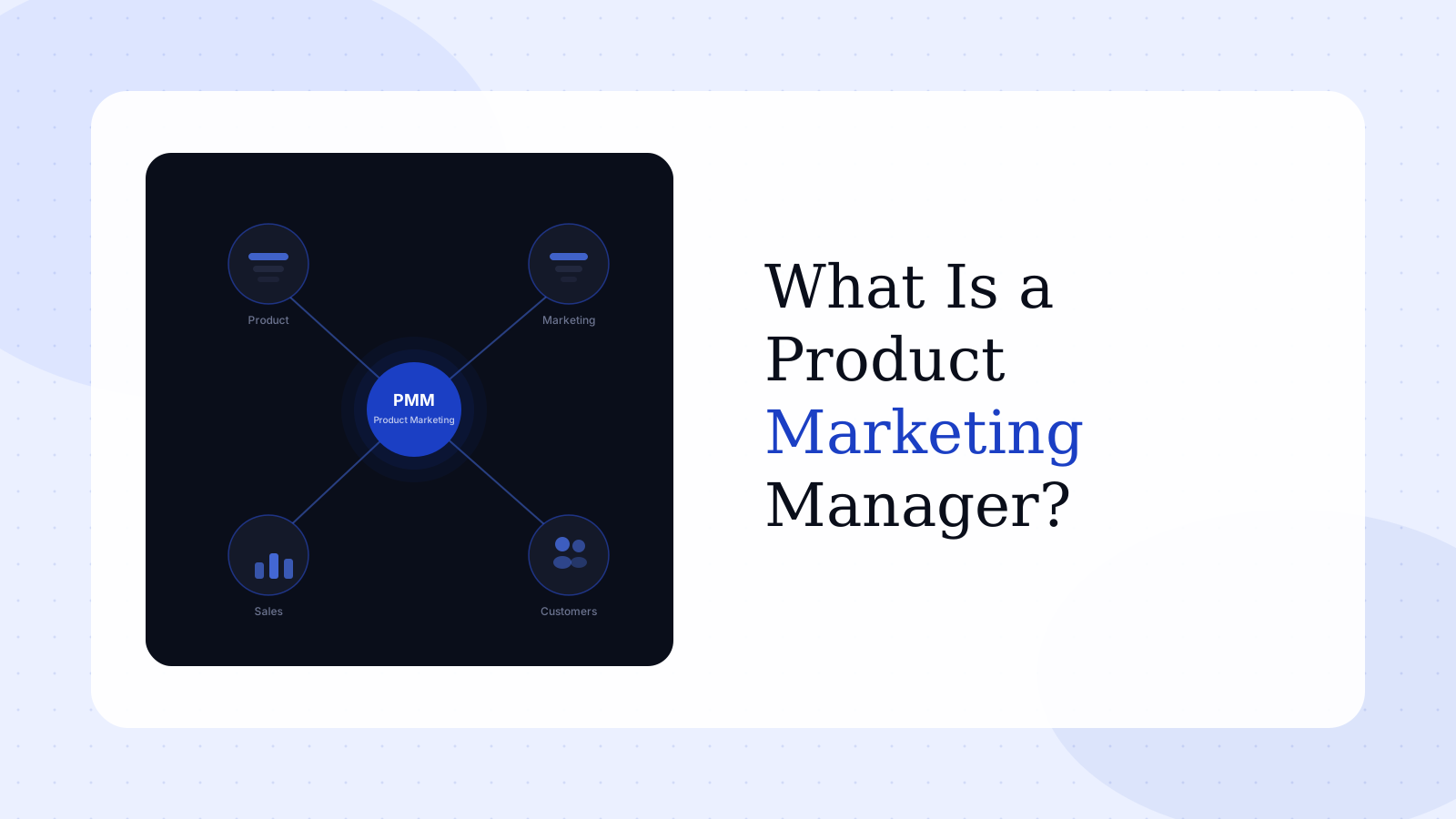
The Product Marketing Alliance's State of Product Marketing Report 2025 found that 88.8% of PMMs work closely with product, and 81% with marketing — making it one of the most cross-functional roles in the modern SaaS organization.
What does a product marketing manager do?
This question gets a lot of generic answers: "they bridge product and marketing," "they define positioning," "they do go-to-market strategy." All of that is true and none of it is useful.
Here's what the work actually looks like, broken into its five core functions.
Positioning and messaging
Positioning is the answer to "why should a specific buyer, in a specific situation, choose this product over any alternative?" Messaging is how that answer gets expressed across every channel — homepage copy, sales decks, email sequences, demo scripts, product announcements.
Most teams conflate positioning (a strategic decision) with copy (an output). PMMs own the positioning work first: the interviews, the competitive research, the frameworks that codify how different personas think about the problem. The copy comes after. Skipping the positioning work and going straight to copy is the most common reason SaaS messaging sounds indistinguishable from every competitor in the market.
Go-to-market strategy
A go-to-market (GTM) strategy is the plan for taking a product or feature to market — covering target audience, pricing, channels, sales motion, and launch sequence. PMMs typically own or co-own this work for every launch, from major platform releases down to the quarterly feature roundup.
Gartner's 2025 research found that 50% of tech CMO and product marketing leaders report that a lack of effective collaboration with revenue functions is a top barrier to reaching customer expansion goals. The GTM work — getting product, sales, marketing, and customer success aligned before a launch — is exactly what PMMs are supposed to solve. The fact that half still report it as broken is an honest signal of how hard the coordination is.
Sales enablement
Sales teams can't sell what they don't understand. PMMs build the tools that close that gap: one-pagers, battle cards, objection-handling guides, competitive positioning docs, and product demo videos that show the product working for a specific buyer persona.
Sales enablement is now a core duty for 78.7% of PMMs, up from 66.9% in 2023 (PMA, 2025). The job has shifted from occasional support to sustained production — a PMM at a growing SaaS company might ship two or three new sales assets per week.
The production burden is real. Teams using screen recorders for sales demo videos regularly surface the same cluster of problems: tools crashing mid-recording, audio falling out of sync, and uploads that fail without warning. On G2, recording reliability is the most-cited complaint category for tools like Loom — with over 147 separate mentions. When the PMM is a team of one or two, that kind of friction doesn't just slow down one video. It delays the entire sales enablement calendar.
Launch management
Every significant product update needs a launch plan: timing, audience segments, messaging by persona, internal enablement, and a suite of content assets explaining the update to customers, prospects, and sales. PMMs own or coordinate that plan.
At a company shipping features weekly — which is most modern SaaS companies — launch management is essentially continuous. The PMM is always either preparing for the next launch, running the current one, or doing the post-launch work of updating assets to reflect what actually shipped versus what was planned.
This is where the 1–2-person PMM team reality hits hardest. One person managing positioning, messaging, sales enablement, launch plans, and market research simultaneously isn't a strategy — it's triage.
Market and competitive research
PMMs are the people inside the company who are supposed to know the market: who the buyers are, what they actually care about, how competitors position themselves, and how the product's value proposition maps to current buyer needs.
In practice, this work often gets compressed or skipped when launch deadlines hit. The teams that do it consistently — structured win/loss interviews, quarterly competitive sweeps, regular customer conversations — develop a compounding advantage. The ones that don't are constantly rebuilding the same positioning from scratch after every lost deal.
Build product marketing assets that actually ship
Rimo turns a brief into a polished product demo video — real screens, no editor, in under an hour. Built for PMMs who need to move fast.
PMM vs. product manager: the real difference
The confusion is understandable — both roles have "product" in the name and both work closely with engineering. But they answer fundamentally different questions.
| Product Manager (PM) | Product Marketing Manager (PMM) | |
|---|---|---|
| Core question | What should we build? | How do we take it to market? |
| Primary output | Product roadmap, feature specs | Messaging, positioning, GTM plan |
| Works closest with | Engineering, design, data | Sales, demand gen, customer success |
| Success metric | Feature adoption, usage | Pipeline influence, win rate |
| Feedback loop | User research, product analytics | Win/loss, customer interviews, sales calls |
The PM looks inward at the product and asks what the next right thing to build is. The PMM looks outward at the market and asks how the product currently maps to buyer needs — and where the gaps are.
They need each other. A PM without a PMM builds features no one knows how to explain. A PMM without a strong PM relationship builds messaging that outpaces what the product can actually deliver. When this partnership works, it's one of the highest-leverage relationships in the company.
One nuance most job descriptions miss: in early-stage B2B SaaS, the same person often holds both roles implicitly — even if only one title exists. The founder does the market positioning. The product manager writes the launch email. When the company grows, the split becomes necessary. The PMM exists to own the market relationship with the same depth that the PM owns the product relationship.
A PM and a PMM share the same customer — but they never share the same job. One asks "what should exist?" The other asks "who needs to know it exists, and why should they care?" Getting both questions answered well is how products actually win markets.
How a product marketing manager is measured
PMM metrics are evolving fast. Revenue generation is now tracked as a KPI by 53.2% of PMMs — up from 50.9% the year before (Product Marketing Alliance, 2025). The days of measuring PMMs only on content volume or web traffic are ending.
The clearer metrics clusters:
Pipeline metrics. How much of the sales pipeline has PMM-sourced content touched? At what stages is it converting, and where does it stall?
Competitive win rate. Companies that track win/loss rigorously can measure the direct impact of PMM assets — deals that used specific battle cards or personalized demo videos versus deals that didn't. This is where PMM influence becomes visible in revenue data, not just marketing dashboards.
Product adoption. Feature adoption rates after a PMM-led launch — measured 30, 60, and 90 days out — show whether the launch actually reached the right users with the right explanation.
Sales enablement utilization. Creating assets isn't enough. If a battle card exists but no sales rep opens it, the PMM's work had zero impact. Measuring asset utilization ties the production effort to the outcome.
The hard truth: many PMMs still get measured on outputs (number of pieces of content shipped, number of launches owned) rather than outcomes (pipeline influenced, win rate change, adoption lift). This shift from output to outcome accountability is one of the defining organizational challenges for the function right now — and one of the reasons PMM layoffs in 2024 hit hard. Teams that couldn't show pipeline impact lost headcount. Teams that could didn't.
The deliverable most PMMs spend the most time on
It's demo content. And it's usually the most painful part of the job.
A product marketing manager at a growing B2B SaaS company will regularly produce: homepage demo videos, persona-specific use-case videos, sales follow-up videos, feature release videos, webinar demo segments, and occasional custom demos for strategic accounts. Each one requires coordinating a demo environment, capturing screens, adding narration, applying branding, and shipping something that accurately represents the current product.
The problem is velocity. Modern SaaS products ship changes weekly. A demo video recorded in January shows a UI that may no longer exist in March. Most teams respond to this by not updating the video — which means the demo a prospect watches doesn't match the product they'll actually see in a trial. That gap erodes trust at exactly the moment trust matters most.
G2 reviewers of screen recording tools surface this as a structural limitation, not a user error: the tools were built for spontaneous async messaging, not for the systematic, repeatable demo video production that needs to be maintained over time. Recording reliability failures, audio sync problems, and per-seat pricing that escalates quickly are the most-cited frustrations across categories.
The good news: demo automation using AI tools is now the single biggest leverage point for a resource-constrained PMM team. Not because it replaces the strategic work — positioning, messaging, the GTM plan — but because it reclaims the hours spent on production mechanics that shouldn't require a PMM's attention at all.
When a PMM can go from brief to published video in under an hour, the demo content library stays current. When it takes two weeks per video, it doesn't. And an outdated demo library is invisible damage — you never see the deals it quietly costs.
What makes a great PMM in 2026
The foundational skills haven't changed: clear writing, customer empathy, analytical thinking, and the ability to synthesize complex product information into sharp, persona-specific stories. Those are table stakes everywhere.
What separates strong PMMs now is different.
Fluency in the revenue conversation. The PMMs adding the most value right now are the ones who can sit in a pipeline review, look at a stage conversion problem, and map it back to a specific positioning gap or missing asset. They're not just content producers — they're revenue analysts who happen to make content.
Comfort with distributed influence. The average B2B buying cycle spans 4.6 months and crosses up to seven channels (Gartner, 2025). PMMs don't control most of those channels or touchpoints. They have to be comfortable with influence over a long, distributed, often invisible process — and comfortable proving it retroactively through data.
Speed as a competitive advantage. In a market where products change weekly and buyer attention is finite, the PMM who can ship an accurate, compelling product walkthrough video the same week a feature ships is a materially better asset to the business than the one who takes three weeks to produce the same thing.
AI as a production layer, not a threat. Wistia's 2025 data showed AI use in video production jumped from 18% to 41% in a single year — the largest adoption spike in the report's history. PMMs who treat AI tools as a way to reclaim time for strategic work are compounding that advantage. The ones who are worried about AI replacing PMMs are usually the ones still defining the job by its outputs rather than its strategy.
The PMMs who will matter most are the ones who can articulate "here's how our product solves this problem for this buyer" in thirty seconds of video — and who can do it again next Tuesday when the product ships an update.
Product marketing manager salary and career path
As of 2026, the average product marketing manager salary in the United States is approximately $141,000–$148,000 per year, with senior PMMs reaching $160,000+ at larger companies (Glassdoor, ZipRecruiter, 2026 data).
The typical career path:
- Associate PMM / PMM I — focused on execution: content production, competitive research, launch coordination
- PMM II / Senior PMM — owns full positioning and GTM for a product line or audience segment
- Principal PMM / Group PMM — strategic influence across the portfolio, deep partnership with product leadership
- Director of Product Marketing / VP PMM — team leadership, cross-functional executive alignment, direct revenue ownership
The most common lateral entry routes: content marketing (writing fluency), product management (product depth), sales engineering (technical customer empathy), and field marketing (customer relationship foundation).
The rarest and most valuable combination: deep product intuition plus buyer-facing communication skills. Product managers who move into PMM often struggle to shift from feature language to buyer outcome language. Content marketers who move in often struggle with the technical depth required to understand what they're explaining. The people who can hold both at once are the ones who compound fastest in the role.
One more practical observation: the job satisfaction data in PMA's 2025 report shows 30.7% of companies increased investment in PMM headcount this year — a sign the function is maturing from "nice to have" to "directly accountable for revenue." The PMMs who made that case by showing pipeline influence were the ones whose headcount got protected.
FAQ
What is a product marketing manager?
A product marketing manager (PMM) is the person responsible for bringing a software product to market — defining who it's for, what problem it solves, why it's better than alternatives, and how every revenue-facing team should communicate about it. In B2B SaaS, PMMs own positioning, messaging, go-to-market strategy, sales enablement content, and launch execution.
What is the difference between a PMM and a product manager?
A product manager (PM) owns what gets built — the roadmap, features, and product specs. A product marketing manager (PMM) owns how the product gets taken to market — positioning, messaging, launch plans, and sales enablement. The PM looks inward at product development; the PMM looks outward at buyers and the market. Both roles are essential and must work closely together, but they own distinct parts of the product lifecycle.
What are the key responsibilities of a product marketing manager?
The five core PMM responsibilities are: positioning and messaging (defining how the product is differentiated for specific buyers); go-to-market strategy (planning how features and products launch to market); sales enablement (creating battle cards, demo videos, and objection-handling content); launch management (coordinating timing, content, and internal readiness for every release); and market and competitive research (keeping the team grounded in what buyers actually care about).
What metrics does a product marketing manager own?
As of 2025, 53.2% of PMMs are measured on revenue generation (Product Marketing Alliance, 2025) — a clear signal the role is moving toward outcome-based accountability. Common metrics include pipeline influence (PMM-touched deals versus unassisted), competitive win rate, feature adoption after launch, and sales asset utilization rates.
How much does a product marketing manager earn?
In the United States, product marketing managers earn an average of $141,000–$148,000 per year as of 2026, according to Glassdoor and ZipRecruiter data. Senior PMMs at established B2B SaaS companies typically earn $155,000–$175,000, with total compensation (equity and bonus included) pushing higher at growth-stage companies.
What tools does a product marketing manager use?
The modern PMM stack typically includes: a documentation tool (Notion, Confluence) for messaging frameworks and battle cards; Figma for sales collateral; a competitive intelligence tool (Crayon, Klue) for market research; a CRM for tracking sales asset utilization; and a demo video tool for creating and maintaining product video content. Demo video is one of the highest-production-cost deliverables in the PMM stack — which is why AI-powered tools that reduce production time are becoming central to how resource-constrained teams operate. For a full breakdown, see the in-house demo video production guide.
Akshay Sharma
Product Leader · 10+ years in B2B SaaS
Akshay has spent 10+ years building and marketing B2B SaaS products. He writes about product storytelling, demo production, and the operational side of product marketing.