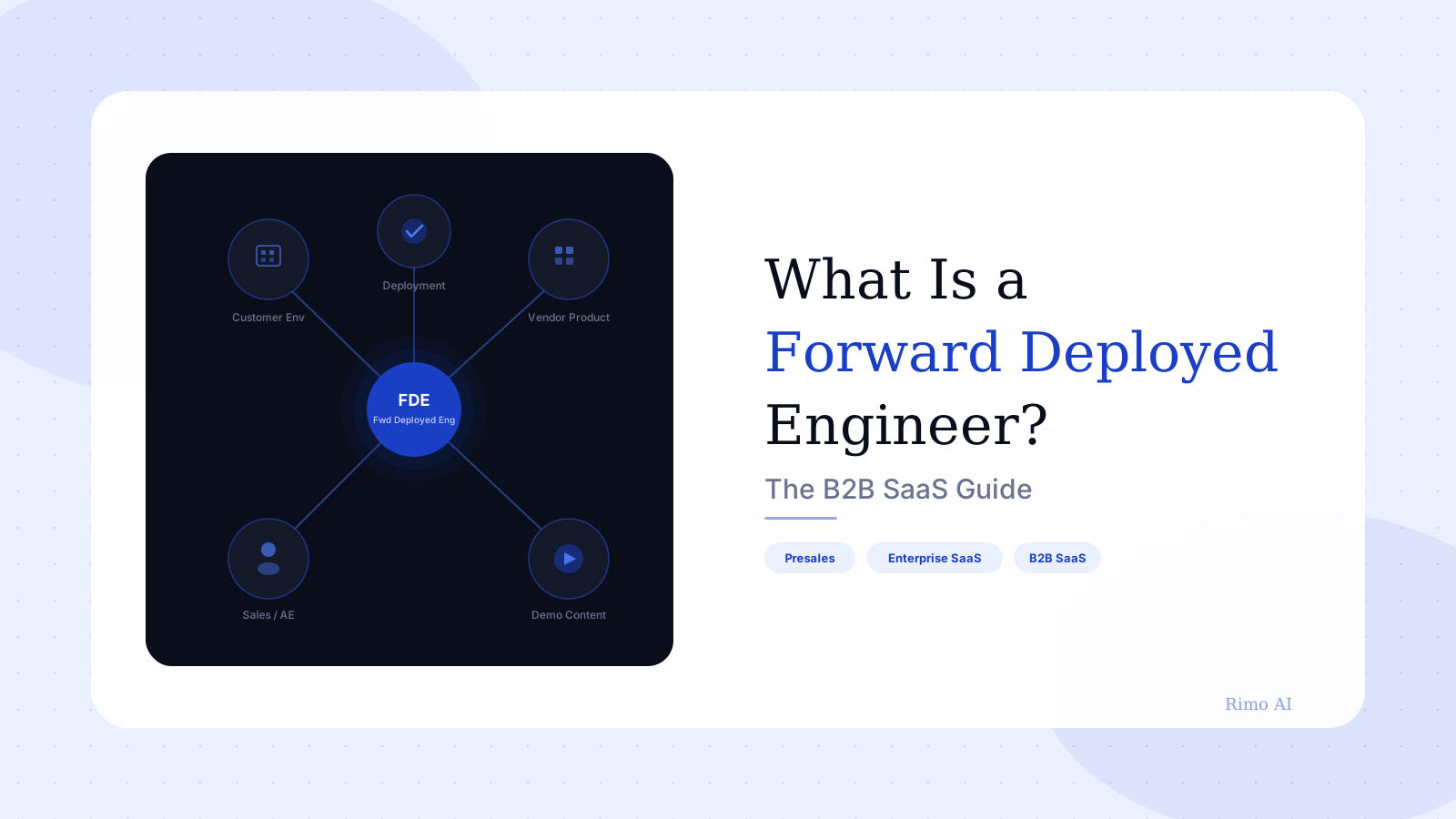
What Is a Forward Deployed Engineer? The B2B SaaS Guide
You closed the enterprise deal. Your sales engineer ran an impressive demo, the proof of concept passed technical review, and procurement signed off. Then the real work started — and nobody on your team had built anything like this before.
The customer's environment has four legacy integrations. Their security team won't provide credentials until week three. The workflow your SE demoed in the sandbox doesn't map to how this customer's operations actually run.
This is the deployment gap — the space between a winning demo and a working product. The forward deployed engineer is the role built to close it. This guide covers what that role actually is, how it differs from a sales engineer or solutions architect, what forward deployed engineers do day-to-day, and how AI is changing the tools they depend on.
In this guide
- What is a forward deployed engineer?
- Forward deployed engineer vs. sales engineer vs. solutions architect
- What does a forward deployed engineer do?
- 5 skills every forward deployed engineer needs
- Which companies hire forward deployed engineers?
- Forward deployed engineer salary and career path
- How AI is changing the forward deployed engineer's toolkit
- FAQ
What is a forward deployed engineer?
A forward deployed engineer (FDE) is a technical specialist who embeds directly with enterprise customers to bridge the gap between a vendor's product and the customer's production environment. Where a sales engineer demonstrates what the product can do in a controlled setting, the forward deployed engineer makes the product actually work inside a customer's real environment — navigating legacy systems, integration complexity, security constraints, and organizational friction that no sandbox demo can anticipate.
The term originated at Palantir, which pioneered the model of sending software engineers directly into client organizations to deploy data platforms in real operational environments. The reasoning was straightforward: Palantir's software was complex enough that no amount of pre-built configuration could cover enterprise-scale deployment variation. You needed to send someone who could build, not just explain.
That model has since spread beyond Palantir. Today, AI companies like OpenAI, Anthropic, and Databricks; vertical SaaS platforms; enterprise data infrastructure companies; and an expanding cohort of B2B SaaS businesses with technically complex products all hire forward deployed engineers. FDE job listings have grown by more than 800% in recent years, reflecting a structural recognition that the deployment gap is real and that solving it requires engineers who can build inside customer environments — not just design for them.
Forward deployed engineer vs. sales engineer vs. solutions architect
The three roles share surface-level similarity — all involve technical people helping enterprise customers successfully use the product — but they operate at completely different stages and with completely different definitions of success.
The sales engineer lives in the pre-sale. Their job is to create technical confidence in a buying committee that hasn't yet committed. A great SE can adapt a demo mid-call, field integration questions from a skeptical IT director, and run a proof-of-concept that de-risks the purchase. Their primary output is a decision — they move a deal forward or close it. Once the contract is signed, the SE moves on.
The solutions architect enters after the sale. Their job is to design how the product will be implemented — mapping vendor capabilities to the customer's existing systems, defining the integration architecture, and handing off a blueprint to implementation teams. Solutions architects design at the system level. They don't typically write the production code that makes the design real.
The forward deployed engineer inherits the environment after the design is complete — and then builds inside it. They write production code. They configure live systems. They handle the integration edge cases that the solutions architect documented but couldn't pre-solve. They're the person in the customer's Slack, on their VPN, navigating procurement policies and security reviews. Getting a demo working in a sandbox is 20% of the FDE's job. The other 80% is navigating the specific, unscripted complexity of this particular customer's actual environment.
| Sales Engineer | Solutions Architect | Forward Deployed Engineer | |
|---|---|---|---|
| Stage | Pre-sale | Post-sale design | Post-sale build |
| Primary output | Technical win / purchase decision | Implementation design | Working production deployment |
| Customer-facing | Always | Design reviews | Embedded continuously |
| Writes production code | Rarely | No | Yes |
| Success metric | Demo-to-POC conversion, win rate | Architecture sign-off | Time-to-value, deployment success |
The clearest indicator of when you need an FDE versus a solutions architect: if the gap between "design complete" and "product working" consistently causes delays, customer churn, or expansion deals that stall because the initial deployment underdelivered, you need engineers who can build inside customer environments — not just design for them.
What does a forward deployed engineer do?
The scope varies by company, product, and customer size, but four responsibilities appear in nearly every FDE function.
Custom integration development
FDEs build the integrations between the vendor's product and the customer's existing stack. This isn't configuration work — it's engineering. The customer's data lives in a proprietary warehouse. Their authentication layer runs on a legacy SSO implementation. Their API returns non-standard responses that the vendor's product was never designed to handle. The FDE writes the code that makes these systems work together without requiring either side to change their production architecture.
Technical deployment and environment configuration
FDEs set up and configure the product in the customer's actual environment, which is almost always more constrained than any sandbox the vendor has seen. Security policies, network restrictions, compliance requirements, and IT governance processes all create friction that someone has to navigate. The FDE is the person who turns "we can't open that port" from a blocker into a solved problem — typically by finding the workaround that the vendor's standard deployment documentation never considered.
Deployment walkthrough content — for the stakeholders who weren't in the room
Here's where most FDE guides stop short. FDEs are also among the heaviest users of demo and walkthrough video content. When they're embedded with a customer, they regularly need to produce walkthroughs of what they've built — for the customer's internal stakeholders who weren't in the technical sessions, for the executive sponsor who approved the project budget but hasn't seen the deployed version, for training teams who need a reference for onboarding new users.
A forward deployed engineer who can produce a polished product demo video of the deployment they've built turns a successful technical implementation into a documented win — one that customers can share internally and vendors can use as a case study. FDEs who can't produce that asset are leaving value on the table at the exact moment it matters most: when the build is done but the renewal decision is twelve months away.
Customer advocacy and product feedback
Because FDEs live inside customer environments, they develop precise insight into the product's real-world limitations — the features that fail in edge cases, the integrations that require workarounds every single time, the UI patterns that confuse users despite clear documentation. FDEs who systematize this feedback back to product and engineering create a direct feedback loop from production deployment to roadmap. That second layer of value shows up in retention metrics, not just initial deployment speed.
FDEs need demo content that moves as fast as they do
Rimo generates polished deployment walkthrough videos from a brief — real product screens, branded, ready to share with a customer's exec sponsor or internal champions. No recording setup. No editing queue. Built for the pace of embedded technical work.
5 skills every forward deployed engineer needs
1. Full-stack engineering depth
FDEs write production code in customer environments without the safety net of internal tooling or colleagues down the hall. Python, TypeScript, and SQL are the most common languages in FDE job postings. Systems knowledge — cloud infrastructure (AWS, GCP, Azure), containerization (Docker, Kubernetes), and API design — is essential for the integration work that defines the role. Unlike a product engineer, FDEs work with whatever the customer has, often without documentation.
2. Data engineering and pipeline fluency
Most enterprise deployments involve moving data. FDEs build and configure the pipelines that connect customer data sources to the vendor's platform. Familiarity with ETL tooling, data warehouses, and transformation frameworks is consistently required. This is the skill that separates FDE work from typical solutions engineering — the ability to move and reshape data in a production environment, not just model it in a demo.
3. High-empathy communication
The people-skill requirement for the FDE is often underestimated in job descriptions. FDEs are embedded in customer organizations, managing million-dollar relationships, often without a manager nearby to escalate to. They need to translate technical progress into business language for executive stakeholders, navigate organizational politics around technical decisions, and maintain customer confidence during the inevitable rough patches of complex deployment. One practitioner described the skill profile as "part engineer, part consultant, part operator" — which is accurate and demanding.
4. Demo and deployment video production
FDEs regularly need to produce documentation and walkthrough content for what they've built. The ability to create a clear product walkthrough video of a custom integration or configured platform is now a meaningful productivity differentiator. Teams that have adopted AI video tools report producing these assets in under an hour; teams still relying on screen recording and manual editing report it taking half a day or more. At an FDE's billing rate, that delta compounds quickly across a portfolio of accounts.
Here's the surprising thing: Gartner's research shows that 33% of all B2B buyers prefer a seller-free sales experience — a number that rises to 44% for millennials. The FDE's internal video content is actually serving that preference for the renewal audience. The exec sponsor reviewing a polished deployment walkthrough before the QBR is getting the "show me proof it worked" experience they wanted all along.
5. Adaptability under constraint
No two enterprise customer environments are identical. An FDE who can only operate within a clean, well-defined tech stack is a solutions architect, not an FDE. The defining FDE skill is building in conditions that weren't anticipated — with the constraints that were given, not the constraints that would be convenient. This requires engineering judgment that no certification or training program reliably produces. It accumulates through deployments, not classrooms.
Which companies hire forward deployed engineers?
FDEs are most common at companies with three shared characteristics: technically complex products, enterprise customers, and high deployment variability across accounts.
AI-native companies lead FDE hiring volume. OpenAI, Anthropic, Databricks, Scale AI, and Cohere all run substantial FDE functions because enterprise AI deployment is inherently custom — different data environments, different compliance requirements, different use cases baked into the same platform. Google has publicly announced FDE hiring for its AI product line.
Data and infrastructure platforms — Palantir (which originated the category), Snowflake, Databricks, and similar companies — have embedded FDE models because their products require deep integration into existing data stacks that no two customers have configured identically.
Vertical SaaS companies with enterprise motions are increasingly building FDE functions. Any product that serves industries with non-standard tech environments — healthcare, financial services, defense, manufacturing — benefits from engineers who can deploy in those environments directly rather than handing off to a customer's internal IT team with a documentation packet.
The common thread across all three: the product is complex enough that a solutions architect blueprint plus a standard implementation team leaves a meaningful deployment gap. The FDE fills that gap by engineering inside it.
Forward deployed engineer salary and career path
As of 2026, FDE total compensation in the United States spans a wide range depending on company and seniority. At Palantir — the benchmark employer for the category — average total compensation is approximately $238,000, with senior-level packages reaching $415,000 and above (Levels.fyi, 2026). At OpenAI and Anthropic, mid-to-senior FDE packages have stabilized at $350,000–$550,000 in total compensation.
Enterprise SaaS companies without the AI sector premium typically offer $150,000–$220,000 total compensation for FDE roles, with compensation skewing higher at companies where enterprise contract values are larger and FDE work is directly tied to renewal and expansion revenue.
The typical career progression from the FDE track:
- Forward Deployed Engineer — direct customer deployment; builds integrations, configures environments, produces POC walkthrough content
- Senior FDE / Staff FDE — owns high-complexity deployments; mentors junior FDEs; begins abstracting common patterns into reusable tooling
- FDE Lead / Manager — team leadership; partners with VP of Solutions Engineering or VP of Customer Success on deployment strategy
- Head of Forward Deployment / VP of Solutions Engineering — executive function; owns deployment velocity, customer time-to-value metrics, and the reusable-pattern roadmap that reduces FDE hours-per-deployment over time
The most common entry paths into the role: software engineering (strongest technical foundation, requires commercial orientation toward customers), sales engineering (deal context and customer-facing skills already present, requires a mindset shift from demo to deployment), and technical consulting or implementation roles (customer-embedded experience, requires engineering depth to build in production rather than just configure).
How AI is changing the forward deployed engineer's toolkit
Two shifts are underway that every FDE and FDE manager should understand.
The first is AI-assisted development. FDEs are early and enthusiastic adopters of LLM-based coding tools because their work involves writing unfamiliar code in unfamiliar environments — exactly the use case where AI code generation adds the most value. An FDE navigating a legacy Python codebase they didn't write, in a customer environment they've been in for two weeks, benefits significantly from tools that can explain undocumented code, generate integration scaffolding, and surface likely failure patterns.
The second shift is AI-assisted deployment documentation. FDEs spend meaningful time producing content that communicates what they've built to customer stakeholders who weren't in the room. This is where the automation of demo video creation with AI is having the most direct practical impact on FDE workflows.
The tools FDEs have historically reached for — screen recording software and async video platforms — weren't designed for this pace or this use case. Loom's top complaint by volume on G2 is recording failures: frozen captures, failed uploads, corrupted files, with 147 reviews citing it. Vidyard's most repeated G2 complaint is Chrome extension instability, with users describing recordings that crash mid-session or produce audio without video. Both were built for casual async updates, not the polished deployment walkthroughs that serve as evidence in a renewal conversation.
Consider the use case: an FDE has just completed a custom integration between a vendor's analytics platform and a hospital system's EHR. The technical work is done. Now they need a walkthrough video of the integration for the hospital's IT steering committee — fourteen people who approved the budget but haven't seen the deployed system. Previously, this content took half a day: screen record the flow, edit out the mistakes, add voiceover, go through a review cycle, finalize. With AI video tools, the same FDE can go from a brief and screen capture to a polished, branded walkthrough in under an hour.
What this unlocks is the internal champion-building that determines renewal outcomes. A customer whose executive sponsor has seen the deployed integration demonstrated clearly — not described in a status update email — is measurably more likely to expand the contract. The FDE's technical work is the foundation. The video walkthrough is what gets that work in front of the people who control the renewal decision.
The SaaS demo video best practices that PMMs use for outbound content apply equally to FDE deployment walkthroughs: specificity wins, brevity wins, and content that shows proof beats content that claims it. An FDE who internalizes this creates a library of deployment wins that compound in commercial value over the life of the customer relationship.
The broader implication: the FDE role is evolving from purely technical deployment toward a technical operator model that includes content production as a core output. Wistia's 2026 State of Video report found that 41% of professionals now incorporate AI into their video creation process, up from 18% the previous year. FDEs are part of that adoption curve — and the ones ahead of it are producing better-documented customer outcomes and stronger product demo video ROI on the assets they create.
FAQ
What is a forward deployed engineer?
A forward deployed engineer (FDE) is a technical specialist who embeds directly with enterprise customers to deploy a vendor's product within the customer's production environment. Unlike a sales engineer who demonstrates the product in a controlled demo, or a solutions architect who designs the implementation blueprint, the FDE writes production code, builds custom integrations, and navigates the specific technical and organizational constraints of each customer's real environment. The role originated at Palantir and has since spread to AI-native companies, data platforms, and enterprise SaaS businesses with technically complex products.
How is a forward deployed engineer different from a sales engineer?
A sales engineer operates pre-sale: their job is to create technical confidence in a buying committee and move the deal to close. A forward deployed engineer operates post-sale: their job is to make the product actually work inside the customer's production environment. The SE moves on after contract signature. The FDE embeds for the deployment. Both require strong technical depth and customer-facing skills, but they optimize for entirely different outcomes — the SE for purchase decisions, the FDE for working deployments.
What skills does a forward deployed engineer need?
Core FDE skills include full-stack engineering (Python, TypeScript, SQL are most common), data engineering and pipeline knowledge, systems integration experience (APIs, cloud infrastructure, containerization), and high-empathy communication for managing executive stakeholders during complex deployments. Increasingly, deployment video production — the ability to create clear walkthrough videos of what's been built — is a practical FDE skill that compounds in customer value over time.
How much does a forward deployed engineer earn?
FDE total compensation varies significantly by company and sector. At Palantir, average TC is approximately $238,000 in 2026, with senior packages reaching $415,000 and above. At AI-native companies like OpenAI and Anthropic, mid-to-senior FDE packages typically fall between $350,000 and $550,000 in total compensation. Enterprise SaaS companies outside the AI sector premium generally offer $150,000–$220,000 total compensation.
When should a B2B SaaS company hire a forward deployed engineer?
The clearest signal is a persistent deployment gap: deals that close and then stall on implementation, customer time-to-value metrics that lag contract expectations, or expansion opportunities lost because the initial deployment underdelivered. If your solutions architect and customer success team cannot reliably get complex enterprise customers to a working, adopted deployment within the committed timeline, an FDE function is the structural fix — not better documentation or more customer success headcount.
What is the difference between a forward deployed engineer and a demo engineer?
A demo engineer builds the demo environments and content library that enable sales and marketing teams to demonstrate the product at scale. Their output is internal: the demo infrastructure that SEs, PMMs, and SDRs depend on. A forward deployed engineer works externally, inside customer environments, deploying the actual product in production. The two roles can produce similar-looking outputs — both create walkthrough video content — but serve completely different functions. The demo engineer's content lives in the sales library. The FDE's content lives in the customer's internal systems, serving renewal and expansion audiences.
Akshay Sharma
Product Leader · 10+ years in B2B SaaS
Akshay has spent 10+ years building and marketing B2B SaaS products. He writes about product storytelling, demo production, and the operational side of product marketing.