What Is a Sales Engineer? The B2B SaaS Guide
The deal has been in the pipeline for three weeks. The account executive ran two discovery calls. The VP of Sales is checking the CRM. And this afternoon there's a sixty-minute video call with eight people — three technical leads, two business stakeholders, one CISO, and two attendees whose roles haven't been confirmed yet.
One person on the vendor side has to walk into that room and make the product real for all eight of them at once.
That person is the sales engineer. The sales demo they run this afternoon isn't just a product walkthrough — it's the single highest-stakes hour in the entire sales cycle. Whether this deal advances to a proof-of-concept, goes dark, or fast-tracks to legal review depends mostly on what happens in that sixty minutes. Everything the marketing team built, everything the AE sold, gets tested right here.
This guide covers what a sales engineer actually is, what they do every day, how they differ from an account executive, what separates the best SEs in 2026, and why SE capacity — specifically, the ability to produce and maintain compelling demo content — is increasingly the hidden ceiling on B2B SaaS revenue.
In this guide
- What is a sales engineer?
- What does a sales engineer do?
- Sales engineer vs. account executive: the real difference
- What makes a great sales engineer in 2026
- How sales engineers are measured
- The demo problem every sales engineer team faces
- Sales engineer salary and career path
- FAQ
What is a sales engineer?
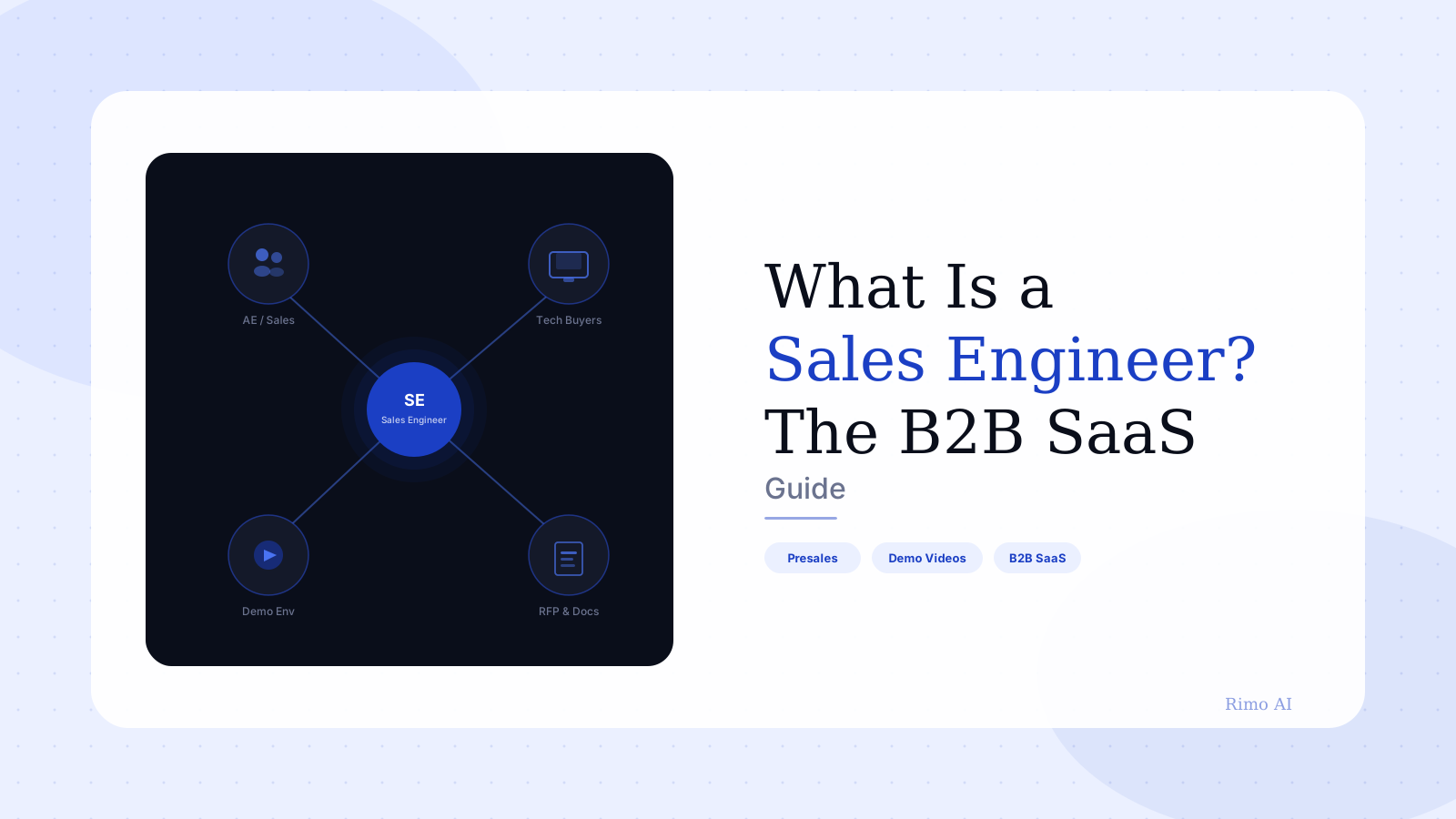
A sales engineer (SE) — also called a presales engineer, solutions engineer, or technical sales engineer — is the person in a B2B software company responsible for the technical layer of the sales process. Their job is to translate complex product capabilities into buyer-specific demonstrations, manage proof-of-concept (POC) evaluations, and provide the technical credibility that enterprise buyers require before committing to a purchasing decision.
The clearest way to understand the role: a sales engineer knows the product deeply enough to configure it, and understands buyers well enough to sell to them. Neither capability alone qualifies someone. The software engineer who can build anything but can't explain why it matters to a VP of Operations is not a sales engineer. The account executive who can explain why it matters but can't answer a detailed security questionnaire is not one either.
Sales engineers live in that overlap. They are the technical layer of a commercial conversation — providing the proof that the product actually does what the pitch claimed.
In B2B SaaS specifically, SEs are present at the inflection points: the first technical deep-dive, the live product demo, the POC evaluation, the security review. They are not typically involved in prospecting or contract negotiation. They are brought in when the conversation shifts from "are you interested?" to "can this actually work for us?"
That distinction matters. The SE's job isn't to generate interest. It's to convert interest into technical conviction.
What does a sales engineer do?
The specific scope of an SE role varies with company stage, deal size, and product complexity. But five responsibilities show up consistently across every presales function.
Technical discovery
Before a live demo, the SE runs — or contributes to — a technical discovery conversation. This differs from the business discovery the AE handles. The SE is asking different questions: What does your current infrastructure look like? How does data flow between your existing tools? What would integration with your stack require?
This discovery shapes every demo that follows. An SE who skips it often ends up demonstrating features the buyer doesn't care about, and missing the capabilities that would close the deal. In enterprise sales, a misaligned demo is worse than no demo — it signals that the vendor didn't listen.
Live product demonstrations
The demo is the SE's most visible deliverable. Think of it as a product demo video in live form — real product, real data, real-time responses to questions from people who are actively skeptical.
A great SE demo doesn't just show the product. It shows the product solving a specific problem the buyer described in discovery, in the sequence that mirrors their workflow, with enough technical depth to satisfy the engineering leads and enough clarity to satisfy the business stakeholders who don't need to see API calls. Calibrating both audiences simultaneously — in the same call — is where most SEs either earn their keep or lose the deal.
Proof-of-concept (POC) management
Enterprise deals rarely close on demos alone. Buyers want to test the product in their own environment, against their own data, under their own security and compliance constraints. SEs scope the POC, configure the environment, support the buyer during the evaluation period, and document outcomes that connect back to the original business case.
POC management is where deals are most often won or lost — and almost never written up in job descriptions with the weight it deserves. A poorly scoped POC leaves the buyer uncertain about whether they tested what they needed. A well-run one gives them a documented proof point they can take to the executive sponsor.
RFP and security questionnaire response
Enterprise procurement requires formal written evaluations. SEs own the technical sections: architecture documentation, integration specifications, security and compliance responses, data handling policies. This work is largely invisible to anyone outside the deal — and can consume two to three full days per enterprise opportunity. It never appears in win announcements, but losing it costs deals.
Leave-behind content
After the demo, the buyer returns to their organization and needs to build internal consensus. Six people who weren't on the call need to understand why this product matters. The SE's job doesn't end when the screen share closes.
The materials the SE produces — custom product walkthrough videos, technical one-pagers, use-case breakdowns, ROI documentation — are what the internal champion uses to sell the decision upward. This is the most underutilized part of the SE toolkit. The live demo gets the champion excited. The leave-behind content is what closes deals with the stakeholders who weren't in the room.
Sales engineer vs. account executive: the real difference
The confusion between SE and AE roles is understandable — both are present at the same customer meetings, both care about closing deals, and both show up in the same Salesforce opportunity record. The differences are in ownership, skills, and accountability.
| Sales Engineer (SE) | Account Executive (AE) | |
|---|---|---|
| Core question | Can this product technically do what you need? | Should you buy this product? |
| Primary deliverable | Demo, POC, technical documentation | Commercial proposal, contract |
| Works closest with | Product, engineering, implementation | Marketing, SDR/BDR, legal |
| Success metric | POC win rate, demo-to-POC conversion | Quota attainment, deal size, cycle length |
| Skills emphasis | Technical depth, product expertise | Relationship management, negotiation |
The AE owns the customer relationship and the commercial outcome. The SE owns the technical validation layer. In a functioning presales team, the AE manages the deal and the SE handles every moment where technical credibility is required — which, in enterprise SaaS, is most moments after the first discovery call.
One thing most org charts don't show: SEs often have more influence on a deal outcome than the AE. A buyer who trusts the technical evaluation will accept a slightly less favourable commercial deal. A buyer who doesn't trust it will reject even a competitive one.
It's also worth distinguishing the SE from the product marketing manager, who creates the messaging, positioning, and content that supports the broader revenue function. PMMs build the assets that reach the market; SEs use those assets in live deals — and generate new, deal-specific ones on demand for individual buyers.
Build demo content that works after the call ends
Rimo turns a brief into a polished product demo video — real product screens, branded, shareable in under an hour. Built for SE teams who need leave-behind content without the production overhead.
What makes a great sales engineer in 2026
The fundamentals haven't changed: strong product knowledge, clear communication, good discovery instincts, and the ability to translate technical features into buyer outcomes. Those are table stakes.
What separates the consistently outstanding SEs from the average is different.
Reading the room in real time
The best SEs change direction mid-demo without the buyer noticing. When the CISO asks a data residency question, a great SE doesn't finish the workflow they're mid-way through — they pause, answer fully, and return. When a business stakeholder looks lost during a technical explanation, they pivot to the outcome instead of the mechanism.
This looks like improvisation but is really preparation. The SE who has internalized the product deeply doesn't need to follow a script. The script is a fallback.
Demo repeatability without rigidity
High-performing SEs develop a demo architecture — a set of core flows that can be mixed, extended, or shortened depending on what discovery revealed. This differs from a fixed demo script and from improvising every time. It is a structured toolkit that makes customization fast without making every demo a from-scratch rebuild.
For leave-behind content, this translates directly: SEs who maintain a library of modular demo recordings can assemble a custom post-call package using an existing product demo script template in under an hour rather than building from scratch per deal.
Technical credibility without condescension
Enterprise buying groups include people at very different technical baselines. A great SE adapts vocabulary and depth in real time — deeper for the engineering lead, lighter for the CFO, security-focused for the CISO. This is not dumbing down. It is meeting each person at the level that makes them feel heard and capable of making a decision.
AI fluency as a production layer
Wistia's State of Video Report (2025) found AI use in video production jumped from 18% to 41% in a single year — the largest adoption spike in the report's history. SEs who use AI tools to produce leave-behind demo recordings, walkthrough videos, and post-POC documentation reclaim hours that previously went to production mechanics. That time returns to active deal support — which is where SE leverage actually lives.
How sales engineers are measured
SE metrics vary by company, but the core performance signals are consistent.
Demo-to-POC conversion rate. How many qualified demos advance to a POC evaluation? This is the most direct measure of demo quality. A consistently low rate is rarely a product problem — it is almost always a demo problem.
POC win rate. Of all POC evaluations the SE manages, what percentage result in a closed deal? This is the closest proxy for SE individual contribution to revenue.
Time-to-POC. How long between the first technical demo and the start of the POC? Shorter cycles typically reflect better discovery and tighter demo execution — the buyer felt less need to evaluate alternatives.
Revenue influenced. SE teams track total pipeline value touched — every deal where an SE ran a demo or managed an evaluation. As a function, SEs typically influence 70–90% of enterprise revenue without appearing in headline close numbers.
Technical win rate vs. commercial win rate. Some organizations track these separately: deals where the SE certified technical fit versus those controlled commercially by the AE. When these diverge significantly, it isolates whether the problem lives in technical validation or commercial execution — a distinction that changes which team gets investment.
The demo problem every sales engineer team faces
Here's the operational reality most SE leaders won't say in a pipeline review: SE teams are a structural bottleneck in most B2B SaaS revenue organizations — and the bottleneck is getting tighter as product complexity increases.
At a 1:4 SE-to-AE ratio — the median at mid-market SaaS companies (Sales Engineering Society, 2024) — one SE is simultaneously supporting four active pipeline streams. Each stream needs discovery, a customized live demo, potentially a POC, and a set of post-call leave-behind materials. That's before accounting for RFP responses, internal enablement requests, and keeping demo environments functional after weekly product updates.
Something always gets deprioritized. In practice, it is almost always the leave-behind content. The SE runs a strong live demo, the buyer is engaged, and then the week fills up before a follow-up recording gets made. The internal champion is left to sell the deal upward with their memory of what they saw and whatever slides the AE emailed over.
This is where establishing a repeatable demo video production process becomes a direct SE efficiency strategy — not just a marketing concern. The live demo cannot be automated. It must be human, adaptive, and technically responsive in real time. But the recorded leave-behind, the post-POC summary video, the persona-specific walkthrough for a secondary stakeholder — those can be systematized.
AI Demo Video Creation Workflow is how high-performing SE teams are solving this now. Not because it replaces SE expertise — it doesn't come close — but because it removes the production overhead that currently sits between "we should make a follow-up video" and "the video actually exists." When an SE can go from a brief to a polished, branded leave-behind in under an hour, the leave-behind gets made. When it takes a half-day, it usually doesn't.
The deals that include a strong leave-behind close at a materially higher rate than the ones that don't. That's the demo problem in one sentence. And it's entirely solvable.
Sales engineer salary and career path
As of 2026, sales engineers in the United States earn an average base salary of $130,000–$160,000, with total on-target earnings (OTE) ranging from $160,000 to $220,000+ at enterprise SaaS companies, depending on variable compensation structure (Glassdoor, LinkedIn Salary, 2026).
The typical SE career progression:
- Associate SE / SE I — demo delivery for small and mid-market deals, close support from senior SEs
- SE II / Senior SE — end-to-end ownership of complex enterprise evaluations; independent POC management
- Principal SE / Staff SE — technical advisory on strategic accounts; contributes product feedback loop
- SE Manager / Director of Sales Engineering — team leadership, SE enablement, cross-functional alignment with product and marketing
- VP of Sales Engineering — executive accountability for the entire presales function and its revenue contribution
The most common entry routes: software engineering (product depth, requires commercial skill development), solutions consulting (client management foundation), customer success (deep product knowledge, requires presales orientation), and technical account management (naturally bridges post-sales and pre-sales). At companies with high deployment complexity, SEs sometimes transition into forward deployed engineering roles that embed directly inside enterprise customer environments.
The rarest and most valuable combination: genuine technical depth plus genuine buyer empathy. Engineers who learn to sell tend to over-emphasize technical correctness. Sales professionals who learn technical depth tend to deploy it indiscriminately. The SEs who can calibrate both — in real time, in front of eight different people with eight different contexts — are the ones who compound their career fastest.
FAQ
What is a sales engineer?
A sales engineer (SE) is a B2B SaaS professional responsible for the technical layer of the sales process — including live product demonstrations, proof-of-concept evaluations, technical documentation, and post-demo leave-behind content. SEs bridge a product's technical capabilities and a buyer's need to understand how those capabilities solve their specific problem. The role is also titled presales engineer, solutions engineer, or technical sales engineer depending on the company.
What is the difference between a sales engineer and an account executive?
An account executive (AE) owns the customer relationship and the commercial outcome — qualification, negotiation, and closing the contract. A sales engineer owns the technical validation layer — demonstrating the product, managing POC evaluations, and producing the documentation that supports the buyer's decision-making process. Both are essential to enterprise SaaS deals; the SE is typically introduced once a deal has cleared business qualification and enters technical evaluation.
What does a sales engineer do day to day?
A typical SE week includes: preparing for and running product demonstrations, managing active POC evaluations, responding to RFPs and security questionnaires, producing leave-behind content for deals in later stages, and maintaining demo environments to reflect current product state. At a 1:4 SE-to-AE ratio — the median at mid-market SaaS companies — one SE is often managing 15–20 active opportunities simultaneously.
What skills does a sales engineer need?
The core SE skill set spans two domains: technical depth (strong product knowledge, ability to handle integration and security questions, comfort with APIs and infrastructure concepts) and commercial fluency (clear communication with non-technical buyers, discovery questioning, ability to connect features to buyer business outcomes). In 2026, AI fluency — specifically using AI tools to produce leave-behind demo content at scale — is an increasingly differentiating skill. For a practical framework on demo content production, see the guide to SaaS demo video best practices.
How is a sales engineer measured?
Sales engineers are typically measured on demo-to-POC conversion rate, POC win rate, time-to-POC, and total revenue influenced. Some organizations also track SE utilization (percentage of qualified demos that include SE coverage) and POC satisfaction scores. The shift from measuring SE activity to measuring SE revenue impact has accelerated as SE teams have gained executive visibility in the revenue planning process.
How much does a sales engineer earn?
In the United States, sales engineers earn an average base salary of $130,000–$160,000, with total on-target earnings of $160,000–$220,000+ at enterprise SaaS companies, based on 2026 data from Glassdoor and LinkedIn Salary. Variable compensation typically ties to team quota attainment or deal-stage metrics rather than individual close rates, reflecting the SE's supporting role in the commercial process rather than direct ownership of the close.
Akshay Sharma
Product Leader · 10+ years in B2B SaaS
Akshay has spent 10+ years building and marketing B2B SaaS products. He writes about product storytelling, demo production, and the operational side of product marketing.