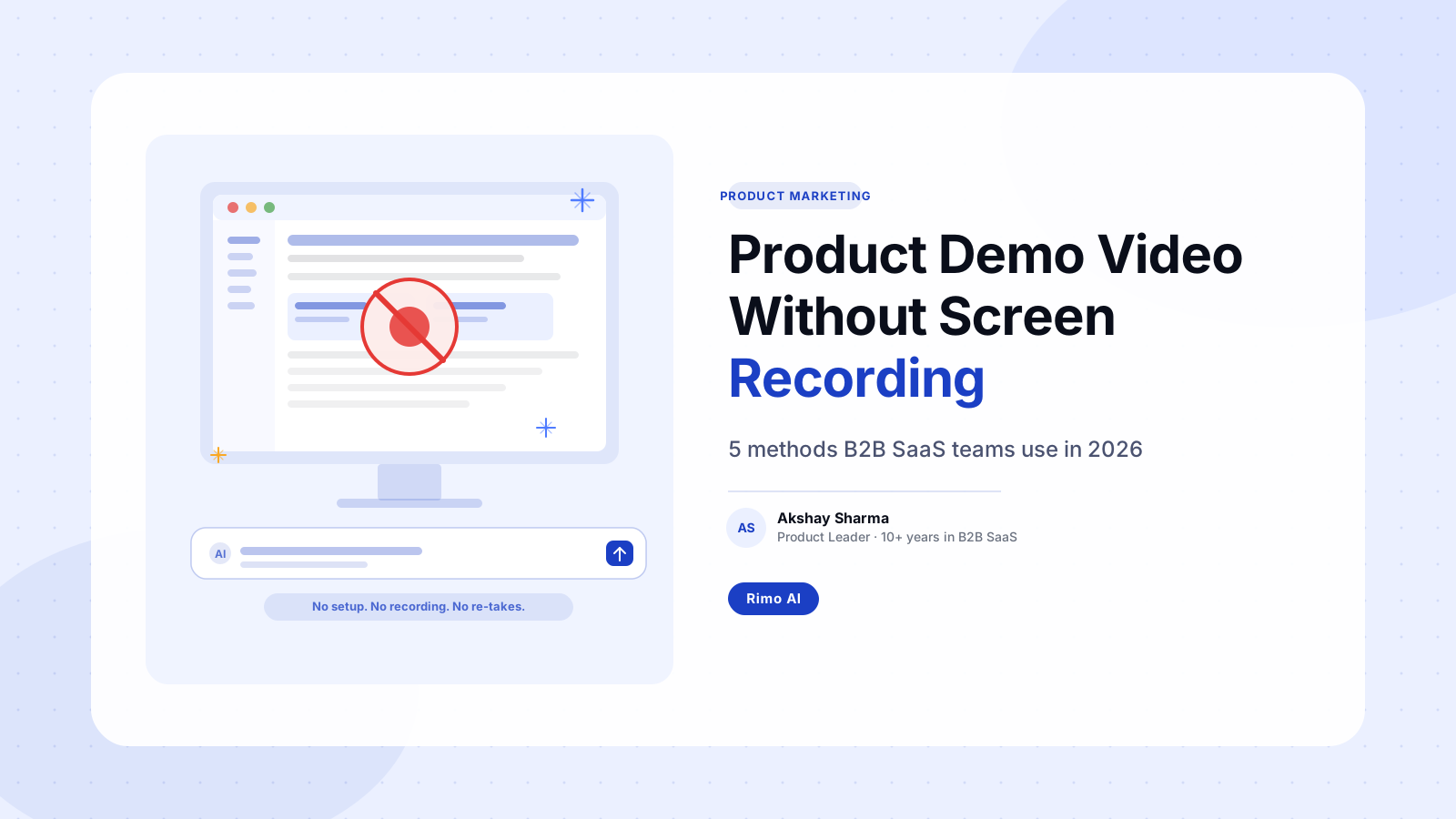
Product Demo Video Without Screen Recording: 5 Methods That Work
Your product shipped a new feature last week. By Friday, you need a product demo video without screen recording eating three days of your sprint. You open the recorder anyway and immediately start the mental checklist: seed the staging environment, clear test data, silence every notification, configure the demo account, do a dry run — and that's before pressing record.
The case for creating a product demo video without screen recording isn't about cutting corners. It's about recognising that screen recording was designed for async communication, not for the repeatable, persona-specific, always-current demo library a B2B SaaS marketing team actually needs to maintain. When your product ships every two weeks and you need separate demos for a VP of Sales, a product marketing manager, and an IT administrator — screen recording becomes the bottleneck, not the solution.
The best teams in 2026 aren't choosing between screen recording and something worse. They're choosing the right method for each job. This post covers five specific approaches to building a product demo video without screen recording — what each costs, what it produces, and exactly when it makes sense.
In this guide
- Why screen recording breaks down at scale
- 5 ways to create a product demo video without screen recording
- What you gain — and what you give up
- When a product demo video without screen recording is the right call
- FAQ
Why screen recording breaks down at scale
The most consistent complaint in G2 reviews of Loom and Vidyard from B2B marketing teams isn't about the tools themselves — it's about what the tools require before pressing record (G2, 2025–2026). Preparing a clean, believable demo environment takes time. Sometimes more time than the recording itself.
This is the operational problem: screen recording frontloads significant invisible effort. Before a single frame is captured, someone has to set up a staging environment, seed it with data that looks like a real customer account, strip out test artifacts, silence notifications across every visible surface, and get the product into the exact UI state the video needs. Do any of those wrong, and you spend three hours editing around mistakes.
The second problem is version drift. B2B SaaS products ship continuously. A screen recording captures a specific version of the UI at a specific moment. When a navigation item moves, a label changes, or a feature gets redesigned — which happens every sprint in most companies — the recording becomes a liability. It shows buyers a product that no longer exists. Most teams respond to this by leaving the outdated video live, because restarting the production cycle costs two days they don't have.
The third problem is scale. Every additional persona variant, every new use case, every regional adaptation multiplies the recording burden. A PMM who needs six persona-specific demos can't realistically run six separate recording sessions — with six staged environments, six editing passes, and six rounds of review — while also managing a launch. The production cost caps how many variants the team can actually ship.
None of these are complaints about recording quality. Screen recordings can look excellent. The friction is operational, not aesthetic. That distinction matters when choosing which method to use and when.
5 ways to create a product demo video without screen recording
Method 1: UI mockups and illustrated screens
This approach replaces live recordings with designed representations of your product UI — high-fidelity Figma mockups or illustrated screen composites that capture the look and flow of the product without requiring a staged environment. The marketing team adds voiceover, pans, and transitions on top, then exports as a video.
The primary advantage is control. Every screen is exactly what you intend the buyer to see — no test data, no unexpected UI state, no version mismatch. When the product changes, a designer updates the mockup and the video asset follows. There's no "re-record and re-edit" cycle.
The limitation is that it requires a designer with time to build and maintain the screens. For a two-person marketing team without dedicated design support, building Figma mockups for every workflow in the demo library is not realistic. This method works best at companies where design and marketing already share a component library and a regular collaboration cadence.
Use this method when your product hasn't publicly launched yet, when the real UI contains sensitive customer data that can't appear in public-facing content, or when your design team actively maintains a Figma system your team can pull from.
One practical note: the demo video narration script template matters more here than in screen-recorded video. The script determines which screens need to be built. A script gap discovered after mockups are complete means a design revision cycle before production can continue.
Method 2: Motion graphics from design files
Motion graphics demos animate design system exports directly — using After Effects, Rive, or Jitter — to produce smooth, deliberate product demonstrations where every interaction is intentional. The result looks like a premium animated demo: fluid transitions, clean UI states, no cursor jitter, no notification popups.
This approach produces the highest-quality visual output of any no-recording method. Premium SaaS companies with dedicated video teams use motion graphics for their homepage hero demos because the output looks better than any screen recording could. Every frame is choreographed. Every state is correct.
The cost is significant. A professional motion graphics demo from a video agency typically runs $5,000–$15,000 and takes four to six weeks. An in-house version using Rive or Jitter is faster and cheaper, but still requires someone who understands keyframing and animation principles — not just video editing. For most lean B2B marketing teams, this approach is only viable for high-stakes, high-budget flagship launches.
Use this method when you're building the hero demo for a major product launch, when you have a dedicated video production budget, or when your product's value is better communicated through carefully staged visual storytelling than through a real workflow demonstration.
Method 3: Screenshot sequences with narration
This is the most accessible approach for teams without design resources. Take a series of product screenshots, clean them up in Figma or Preview, arrange them in logical order, add transitions and a voiceover using Canva, Keynote, or PowerPoint, and export as a video. Many B2B teams already do this for sales decks — converting those decks into videos is a small production step, not a new one.
The production cost is low. Total time for a 90-second video, once the screenshots are ready: three to four hours for someone doing it for the first time, less than two hours with any familiarity. No staging environment, no recording session, no editing of cursor movements.
The visual output is the limitation. Screenshot sequences look like slideshows, because that's what they are. For internal training content, awareness-stage social posts, or quick explainers sent by a sales rep, this is often sufficient. For a homepage hero demo or a sales follow-up video sent to a senior decision-maker evaluating three competitors — it can feel underbuilt.
Use this method when you need something fast, when your team has no video production skills, when the content is explanation-focused rather than workflow-focused, or when the audience isn't yet in an active evaluation stage.
Method 4: Interactive prototype recordings
Figma's Prototype mode, Framer, and Maze allow you to build clickable product simulations and then record the interaction as if it were the live product. The recording captures hover states, click-throughs, and form fills — without any of the staging environment risk.
The key difference from live screen recording: every state is controlled. There's no risk of a loading spinner appearing at the wrong moment, no chance of a notification interrupting a take. If the workflow needs to show a specific data state, you set it in the prototype. The output is deterministic in a way that recording a live product never is.
The production cost sits between a screenshot slideshow and a full motion graphics build. A designer familiar with Figma prototyping can produce a 90-second interactive demo in four to eight hours. Non-designers can learn the basics, but quality depends heavily on how closely the prototype matches the real product's visual states.
Use this method when you have a designer or design-literate team member available, when the product has complex multi-step interactions worth showing in exact detail, and when you need higher fidelity than screenshots can provide but can't justify a full motion graphics production.
From brief to demo video — without a recording session
Rimo turns a plain-English product brief into a structured, voiced, branded demo video. No staging environment. No recording sessions. No editing lag when the product ships.
Method 5: AI-native demo video generation
This is the newest approach and the one most lean B2B marketing teams are evaluating in 2026. Instead of recording or designing, you describe the product, the persona, the workflow, and the key outcome in plain prose — and an AI system builds the demo video from that brief. Rimo was built specifically for this: B2B SaaS marketing teams that need to produce demo content faster than any screen-recording workflow allows.
The operational difference is meaningful. A Rimo brief takes 15–20 minutes to write. It produces a structured, voiced, branded demo video without requiring a staging environment, a Figma file, or a recording session. When the product ships new UI, you update the brief and regenerate — you don't re-record, re-edit, and re-export.
This method directly solves all three of the operational problems screen recording creates. There's no environment setup cost. There's no version drift, because the video isn't tied to a real product state — it's generated from a description. There's no production ceiling on persona variants, because each variant is a brief, not a production cycle.
Teams that have explored AI-assisted demo video production understand the pattern. AI-native generation takes that idea further: rather than automating the editing steps after recording, it replaces the recording entirely.
For teams skeptical of output quality, the useful test isn't comparing an AI-generated demo to a professional motion graphics production. It's comparing it to what your team actually ships when it doesn't have a production budget — usually a four-minute screen recording with a mediocre voiceover and a missing CTA. Against that baseline, a 90-second AI-generated demo with a clear persona narrative and a specific CTA is not a compromise. It's an upgrade.
The reason AI use in video production jumped from 18% to 41% in a single year (Wistia, 2025) wasn't creative ambition. It was operational relief. Teams weren't experimenting with AI because they wanted to. They were using it because it was the only way to keep demo content current at the pace their products were shipping.
For a broader look at what AI product video generators can and can't do for B2B demo content, that's worth reading before committing to a production workflow.
What you gain — and what you give up
None of these five methods is strictly better than screen recording. Every choice has a real tradeoff. The teams that make the wrong choice usually do so because they evaluated output quality in isolation — without accounting for the operational cost of maintaining what they produce.
What you gain when you skip screen recording:
- Zero environment prep. No staging setup, no seeded data, no notification clearing. The production cycle starts immediately after the brief is written.
- No version drift. Your demo assets are decoupled from the live product state. When the UI changes, you update a file or regenerate a brief — not an entire recording session.
- Persona variants at low marginal cost. Producing five persona-specific demos costs five brief-writing sessions, not five recording-and-editing cycles.
- Consistent visual output. No cursor wobble, no accidental clicks, no UI states that don't reflect the buyer's experience.
What you give up:
- Pixel-perfect fidelity. Late-stage enterprise buyers doing a serious evaluation will notice that an illustrated or AI-generated demo isn't the live product. For hands-on proof-of-concept evaluations, this matters.
- Proof that the product works. A screen recording proves the product works by showing it working. A generated or illustrated demo asserts that it works. For buyers who are technically sophisticated or risk-averse, that distinction changes the level of trust the video builds.
- Familiarity for your team. Most marketing teams know how to record a screen. Learning a different method — even a faster one — has a ramp-up cost that's real, if short.
One of the most common product demo video mistakes is treating format as a binary — screen recording or nothing. The strongest demo libraries use multiple methods: AI-generated videos for awareness and persona content, interactive prototype demos for mid-funnel evaluation support, and actual screen recordings only for late-stage enterprise validation. Each method has the job it's actually suited for.
When a product demo video without screen recording is the right call
The right method depends on two variables: how much visual fidelity the demo needs, and how fast it needs to ship. Most decisions become clearer once you answer both.
High fidelity + sufficient lead time: Use motion graphics or interactive prototype recording. These are for flagship product launch assets and high-stakes enterprise demos where budget and timeline support the production cost.
High fidelity + tight deadline: If the environment can be prepared in under 30 minutes and one take is realistic, screen record it. If it can't — and it usually can't — this is the scenario where teams most often ship bad content under time pressure.
Moderate fidelity + tight deadline: Use AI-native generation. A 15-minute brief produces a video in hours. For awareness-stage and persona-specific content, the output quality is appropriate for the job. This is where Rimo fits: fast, repeatable, persona-specific demo content that doesn't require a staging environment.
Low fidelity + immediate turnaround: Screenshot sequences. A 90-second slideshow with a clear narrative and a specific CTA outperforms a polished recording that ships three weeks after the decision window closes.
There's also a video length dimension to consider. Knowing how long a product demo video should be for your specific funnel stage shapes the method choice. Very short demos — 60 to 90 seconds — are well-suited to AI generation and screenshot methods, because the format already constrains scope. Complex, long-form demos showing intricate multi-step workflows are harder to abstract without fidelity loss, which is where prototype recording or motion graphics earn their higher production cost.
The most expensive demo video mistake isn't choosing the wrong format. It's defaulting to screen recording because it's familiar, then spending two days per video for content that's outdated before it publishes.
The team that ships a clear 90-second AI-generated demo on launch day will always outperform the team that ships a polished screen recording two weeks after the window of relevance closes. Format is a means, not an end.
Make the switch before your next launch
If your team has ever delayed a product launch video because the screen recording environment wasn't ready, or shipped an outdated demo because updating it would take three days — you already know the cost of treating screen recording as the only option.
The demo video production workflow guide covers everything for building a repeatable demo library. The method you choose is one decision inside that workflow. The more important decision is committing to a process that doesn't break every time the product ships.
Try Rimo free and generate your first AI-native demo video in under an hour — no staging environment, no recording session, no revision cycles when the product changes.
FAQ
Can a product demo video without screen recording actually convince real buyers?
Yes — for most funnel stages. Awareness and consideration-stage buyers are evaluating whether the product solves a problem they have, not verifying pixel-level UI accuracy. An AI-generated or illustrated demo that clearly shows the workflow and outcome does that job. The exception is late-stage enterprise evaluation, where buyers often need to see the live product in a proof-of-concept context. Screen recording or a live demo call is more appropriate there.
What is the fastest way to make a product demo video without screen recording?
Writing a plain-English brief and generating the video using an AI-native tool is the fastest available method. A brief takes 15–20 minutes. The generated video can be reviewed and published in the same working session. Screenshot sequences assembled in Canva or Keynote are the next fastest, typically taking three to four hours for a 90-second video once the screenshots exist.
Do I need a designer to create a product demo video without screen recording?
Only for Method 1 (UI mockups) and Method 2 (motion graphics). Screenshot sequences, interactive prototype recordings, and AI-native generation are all accessible to non-designers. AI-native generation requires only the ability to describe your product in clear prose. The most common failure mode in no-recording methods is strategic — a weak problem statement or mismatched audience — not technical.
How do I keep a no-recording demo video current when the product changes?
This is where no-recording methods have a genuine advantage over screen recording. AI-native demos are the easiest to update: change the brief, regenerate. Screenshot sequences require new screenshots and a quick reassembly. Motion graphics and UI mockups require a designer update. Interactive prototypes require a Figma file update. Screen recordings are actually the hardest to maintain — they require a complete re-recording of every changed scene, which is the primary reason teams are moving away from them for high-velocity demo libraries.
Is AI-generated demo video quality good enough for B2B SaaS marketing?
For top-of-funnel and persona-specific content: yes, consistently. For late-stage enterprise evaluation: use it as context-setting content alongside, not as a replacement for, a live demo. Enterprise buyers expect a live call at the evaluation stage; the AI-generated video works as pre-meeting context and post-meeting follow-up. The right question isn't whether AI-generated quality is "good enough" in the abstract — it's whether the quality matches the job the video needs to do at that specific funnel stage.
How many demo videos does a B2B SaaS team actually need?
More than most teams produce, fewer than most teams think they need. At minimum: one awareness-stage overview video (60–90 seconds), one or two persona-specific demos, and one post-demo follow-up video for sales to send after discovery calls. Teams that can produce persona variants at low marginal cost — as AI-native methods enable — tend to ship more variants and see better conversion, because buyers see something that reflects their specific context rather than a generic product tour.
Akshay Sharma
Product Leader · 10+ years in B2B SaaS
Akshay has spent 10+ years building and marketing B2B SaaS products. He writes about product storytelling, demo production, and the operational side of product marketing.