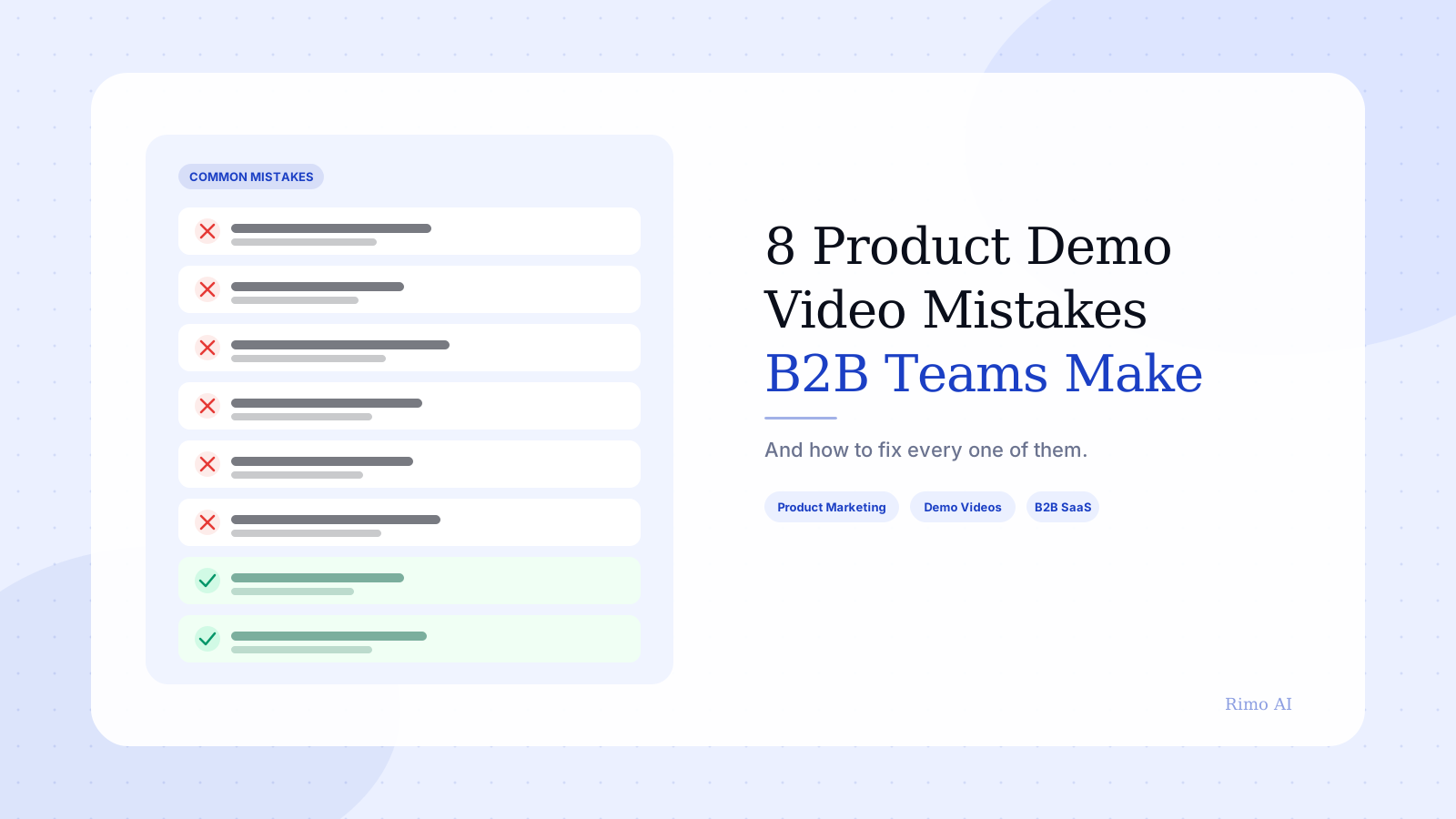
8 Product Demo Video Mistakes B2B SaaS Teams Keep Making
You recorded the demo video. You published it. Weeks later, the pipeline numbers haven't moved. You re-watch it and immediately see the problem — but you can't quite name it. Something about it feels off. Too long. Too generic. Too proud of features nobody asked about.
Most product demo videos fail quietly. They don't get complaints — they get ignored. A prospect watches 40 seconds, clicks away, and schedules a competitor's live demo instead. Your analytics show a play count. They don't show where attention collapsed and why.
This post names the eight product demo video mistakes that show up most consistently across B2B SaaS — drawn from G2 user reviews, watch-time research, and what actually changes when teams fix them. If your demo video has been live for more than a month without meaningfully moving conversion, at least three of these probably apply.
In this guide
- Why product demo video mistakes cost more than you think
- The 8 product demo video mistakes (and how to fix each one)
- Mistake 1: Opening with the product, not the problem
- Mistake 2: Building one demo for every persona
- Mistake 3: Making it too long
- Mistake 4: Recording a messy demo environment
- Mistake 5: Writing the script after the recording
- Mistake 6: Sending the wrong demo for the wrong funnel stage
- Mistake 7: Treating demo videos as one-off projects
- Mistake 8: No clear next step at the end
- How to audit your existing demo videos before your next launch
- FAQ
Why product demo video mistakes cost more than you think
Gartner's 2025 research found that 61% of B2B buyers now prefer a rep-free buying experience. That number has climbed every year since 2021. It means your demo video isn't a nice-to-have — it's doing the selling job that a human rep used to do.
When your demo is weak, that job goes undone. The buyer self-qualifies out. They move on before your sales team even knows they existed.
Forrester's 2025 B2B predictions reinforce this: more than half of large B2B transactions are now processed through digital self-serve channels. That means the demo video is often the most important touchpoint in a deal — and most teams are producing it with the same care they'd give a quick Loom recording for a teammate.
The good news: these mistakes are fixable. Most require a process change, not a budget change.
The 8 product demo video mistakes (and how to fix each one)
Mistake 1: Opening with the product, not the problem
The most common demo video structure goes: logo animation, product name, list of features, demo begins. The viewer doesn't understand why they should keep watching before the product even appears.
B2B buyers are not watching your demo for entertainment. They are trying to answer a specific question: does this product solve the problem I actually have? If your first 10 seconds don't name their problem back to them — specifically, not generally — they assume the answer is no and move on.
The fix is simple but requires discipline: write the buyer's problem statement before you design a single scene. "If your product marketing team is spending two weeks per demo video and still shipping content that's out of date by launch day, here's what that looks like fixed." That sentence earns the next 90 seconds. A logo animation does not.
The first five seconds of a demo video determine whether someone keeps watching. Not the production quality. Not the voiceover. The relevance of the opening frame to the viewer's situation.
Mistake 2: Building one demo for every persona
A VP of Marketing and a Sales Operations Manager both evaluate your product. They have completely different success metrics, different anxieties, and different workflows they want to see solved. Most B2B SaaS teams send them the same three-minute video.
The generic demo answers every question loosely and no question precisely. The VP of Marketing wants to see how the product affects launch velocity. The Sales Ops manager wants to see how it integrates with Salesforce. One video cannot do both jobs without diluting both.
The fix requires building persona-specific demo variants — not entirely separate productions, but different story layers over the same product. The core recording can often be shared. The script, the framing, and the opening problem statement change per audience.
This is also where teams that automate demo video creation gain a material advantage: producing four persona variants from one brief takes minutes, not weeks. Teams still on manual workflows often skip persona targeting entirely because the production cost is too high.
Mistake 3: Making it too long
Wistia's 2025 State of Video report — analysed across 14 million videos and 100,000 businesses — found that videos under one minute hold a 50% average engagement rate. That drops meaningfully as length increases. The report also noted that overall video engagement hit a four-year low in 2025, with 3-to-5-minute videos seeing the steepest decline.
Most B2B SaaS homepage demos run four to six minutes. The data does not support this.
The instinct behind longer demos is understandable: there's so much to show, and leaving something out feels risky. But a viewer who abandons your video at the 90-second mark has seen nothing useful. A viewer who watches all of a tight 90-second demo has seen exactly what you intended.
For guidance on length by funnel stage, platform, and buyer persona, see how long a product demo video should be. The short answer: 60–90 seconds for awareness-stage videos, 2–3 minutes for persona or use-case demos, never more than 4 minutes without a compelling reason.
The counterintuitive truth: shorter demos are harder to make, not easier. Cutting a six-minute video to 90 seconds requires knowing exactly what the buyer needs to see — and the discipline to leave everything else out.
Mistake 4: Recording a messy demo environment
This one is operational, but it kills credibility faster than any strategic mistake.
A demo video recorded in a real product environment, without preparation, often contains: placeholder data with names like "John Smith" or "test@test.com," notification popups from other tools mid-recording, empty states where populated data should be, error messages visible in the background, and UI states that reflect the developer's configuration rather than a typical buyer's context.
B2B buyers are evaluating your product as a proxy for your company's quality. A messy recording environment signals that the product isn't ready for serious use — even if the underlying product is excellent. This is not a hypothetical concern. G2 reviews of tools like Loom and Vidyard consistently surface the same complaint from marketing teams: recording tools built for async messaging weren't designed for the controlled, repeatable environment that demo video production requires (G2, 2025–2026).
The fix: treat your demo environment like a set. Before recording, seed consistent, believable sample data. Silence all notifications. Set up a dedicated browser profile stripped of personal extensions and history. Check every screen you plan to show at the current product version. Record each scene in isolation so one bad take doesn't corrupt the whole production.
Real product screens build trust. But only when they're clean. A polished animation of a product that doesn't exist builds more trust than a recording of a product that looks broken.
Mistake 5: Writing the script after the recording
The most common production sequence for a demo video: open the product, start recording, narrate as you click, send to editor, realise the voiceover doesn't match the visuals, write a script to match what was recorded, revise three times because the story still doesn't hold.
This is backwards. The script should drive the recording, not the other way around.
When the recording comes first, the story becomes a description of what happened on screen. When the script comes first, the recording becomes an illustration of a pre-defined argument. The difference in output quality is significant — and the difference in revision cycles is even larger.
A well-structured demo video script is 150–250 words for a 90-second video. It defines the buyer's problem, maps each sentence to a specific screen or product action, and ends with a concrete outcome the viewer can visualise in their own context. Writing that script before touching the product takes 20–30 minutes. Not writing it costs hours of revision later.
For three ready-to-use formats — including a 90-second awareness script, a 2-minute use-case template, and a 60-second sales follow-up — see the product demo video script templates that B2B teams actually use.
Stop rewriting demo scripts from scratch
Rimo generates a structured scene plan from a plain-English brief — so your recording captures what the buyer needs to see, in the right order, the first time.
Mistake 6: Sending the wrong demo for the wrong funnel stage
A prospect just completed a 45-minute discovery call. Your AE sends them a follow-up link. The link goes to your homepage overview demo — the same 90-second awareness video that runs for first-time visitors who've never heard of your product.
The buyer already knows what your product is. They sat through a discovery call. What they need now is something that addresses the specific use case they raised in that conversation — or the specific objection they didn't quite say out loud.
Sending an awareness-stage demo as a post-discovery follow-up signals that you weren't listening. It creates friction at exactly the moment a deal should be accelerating.
The fix is mapping demo video types to funnel stages before production. An awareness demo and a use-case demo serve different purposes. A product explainer video and a product demo video are not interchangeable — one tells buyers what the product does, the other shows them. Sending the wrong format at the wrong moment is a silent deal-killer most teams never diagnose because they don't track which demo assets get sent at which stage.
Mistake 7: Treating demo videos as one-off projects
Here's the product demo video mistake that almost never appears in marketing advice, but is probably the most expensive one B2B SaaS teams make: building a polished demo once, publishing it, and then not touching it again until someone complains it's wrong.
B2B SaaS products ship continuously. Navigation changes. Features get renamed or moved. UI gets redesigned. A demo video recorded in January can show workflows that no longer exist in April. Most teams respond to this by leaving the outdated video live — because updating it means restarting the same slow production process.
The result: the most important marketing asset a buyer sees before making a purchase decision is several product versions out of date. This is not a small problem. It's a structural one.
The teams solving it do two things differently. First, they keep demos short and modular — a 90-second video showing one specific workflow is far easier to update than a 5-minute product tour. Second, they build a production workflow that can turn a new feature into a finished demo in 24–48 hours rather than two weeks.
Wistia's 2025 report found that AI use in video production jumped from 18% to 41% in a single year — the fastest adoption spike in the report's history. The driver wasn't creative ambition. It was velocity. Teams that automate demo video creation with AI are solving the update lag problem that manual production can't.
Mistake 8: No clear next step at the end
Your demo video builds to a strong finish. The product looks good. The voiceover lands the key outcome. And then — silence. The video ends. The viewer sits there for a moment and then closes the tab.
Every demo video needs a single, specific CTA at the end. Not a menu of options. Not a generic "learn more." One action, stated clearly, matched to what a buyer at this stage is ready to do.
For awareness-stage demos: "Start a free trial." For use-case demos sent mid-evaluation: "Book a 20-minute call to see this in your environment." For sales follow-up videos: "Here's the workflow we discussed — let me know if this is what you had in mind, or if there's a specific part you want to go deeper on."
The CTA should also tell the viewer what happens next in concrete terms. "Start free" is fine. "Start free — no credit card, up and running in five minutes" is better because it removes the uncertainty that prevents clicks.
One more thing most teams get wrong: the CTA should appear on screen as text, not just as spoken audio. Viewers who watch with sound off — a significant share on mobile — never hear the verbal CTA. Show it visually, always.
How to audit your existing demo videos before your next launch
Before your next product launch, run this quick audit on your existing demo library. Each item should take fewer than five minutes to assess.
Story:
- Does the opening 10 seconds name a specific buyer problem, not a product feature?
- Is there a clear outcome promised before the demo begins?
- Does the video end with one specific, visible CTA?
Audience:
- Is this video built for a specific persona and funnel stage, or is it trying to serve everyone?
- If you sent this video to a prospect who just completed discovery, would it feel relevant to them?
Production:
- Is the demo environment clean — no test data, no visible notifications, no empty states?
- Was the script written before the recording, or chasing it?
Operations:
- When was this video last updated? Does it reflect the current product?
- How long does it take your team to update a demo when the UI changes?
If any of these questions make you uncomfortable, the post on how to create product demo videos walks through the full production workflow that makes audit-level quality repeatable. Building the right process once removes most of these problems permanently.
FAQ
What is the most common product demo video mistake B2B SaaS teams make?
Leading with the product instead of the buyer's problem is the mistake that appears most consistently. Most demo videos open with a logo, a product name, and a feature overview — before establishing any reason for the viewer to care. The first 10 seconds of a demo video determine whether someone keeps watching. If those seconds don't name a specific problem the buyer recognises, attention collapses immediately.
How do I know if my demo video is too long?
If your video runs more than 90 seconds for awareness-stage use, or more than 3 minutes for persona-specific demos, you are likely losing a significant portion of your audience before they reach the key message. Wistia's 2025 State of Video report found that videos under one minute achieve a 50% average engagement rate. Beyond 3 minutes, engagement drops sharply. If you don't have watch-time analytics, assume anything over 2 minutes needs to be reviewed and cut.
Should I have different demo videos for different personas?
Yes. A single generic demo almost never converts as well as a persona-specific one, because different buyers have different problems, different vocabularies, and different success metrics. A VP of Marketing and a Sales Operations Manager both evaluating your product need to see completely different workflows highlighted — even if the underlying product is the same. Persona-specific demo variants can often share the same base recording, with different scripting and framing per audience.
How often should a B2B SaaS team update its demo videos?
Any significant UI change, feature rename, or workflow redesign warrants an update. For fast-shipping teams, this can mean monthly or even bi-weekly updates. The practical answer is to build a production workflow that makes updates fast rather than setting a fixed calendar. A modular demo library — one short video per use case — is far easier to keep current than a single long product tour. When the workflow for one use case changes, you update one clip, not the whole library.
What makes a product demo video CTA actually work?
Three things: specificity about the action, specificity about what happens next, and visual presence (not just spoken audio). "Start free" is weak. "Start free — live product in 5 minutes, no credit card" answers the objections before the viewer can raise them. The CTA should also be matched to the buyer's stage. A prospect at the top of the funnel is not ready to "book a call" — they may be ready to "see a 2-minute walkthrough." Match the ask to where the buyer actually is.
Can a bad demo video hurt my conversion rate even if the product is good?
Yes — and the damage is invisible. A weak demo doesn't generate complaints. Buyers simply disengage, self-qualify out, and move to a competitor whose product story is easier to understand. The product never gets a fair evaluation. This is why Gartner's finding that 61% of B2B buyers prefer a rep-free experience matters so much: your demo video is often the only chance your product gets to make its case before a buying decision is made.
Akshay Sharma
Product Leader · 10+ years in B2B SaaS
Akshay has spent 10+ years building and marketing B2B SaaS products. He writes about product storytelling, demo production, and the operational side of product marketing.