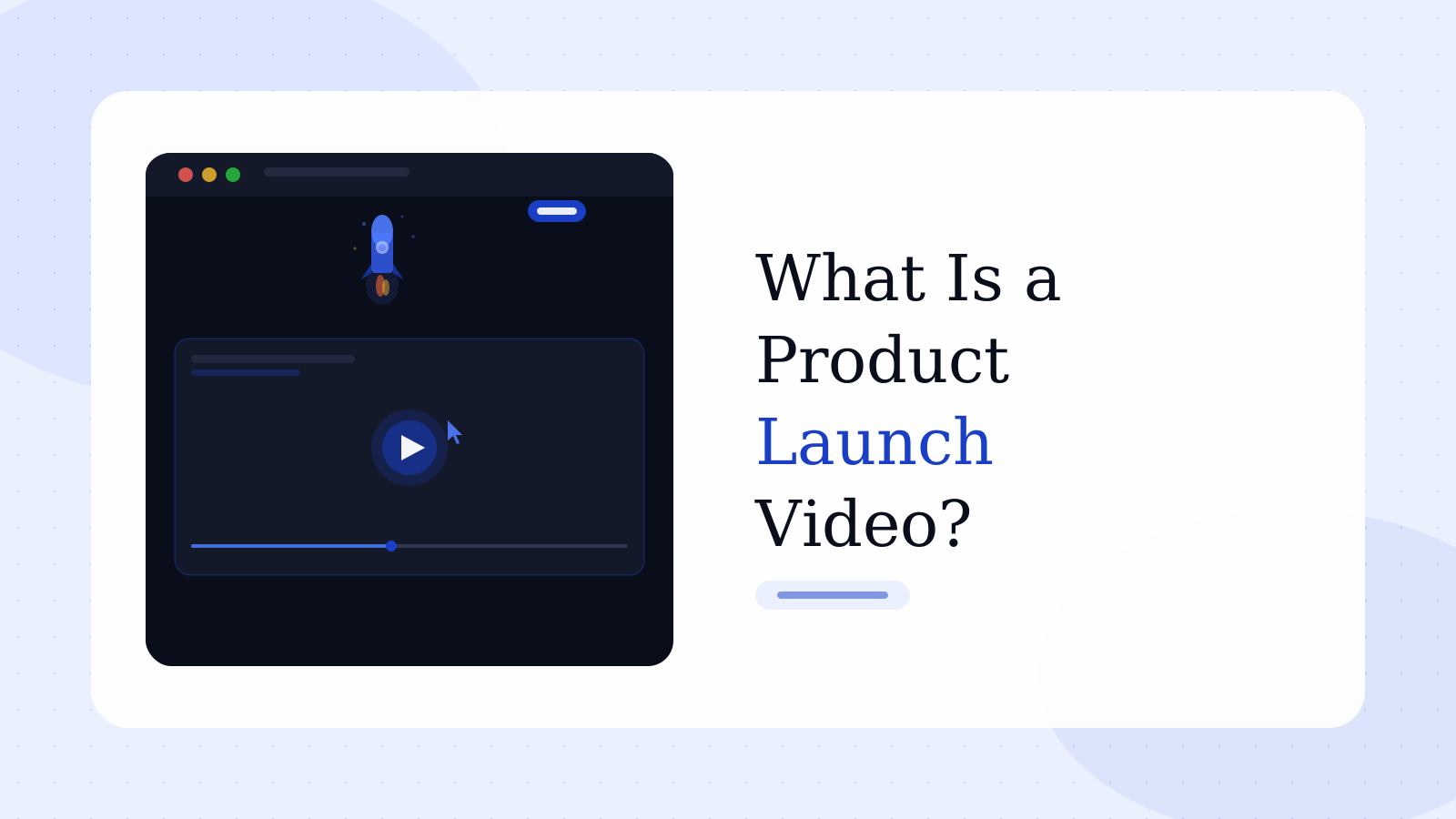
What Is a Product Launch Video? The B2B SaaS Guide
Your team ships a new feature. The product manager posts a changelog entry. Marketing sends an email. Sales gets a Slack message. Then nothing.
This is the product launch video problem in B2B SaaS — not a lack of effort, but a lack of the one format that actually shows buyers and customers what changed. A changelog tells them something shipped. A product launch video shows them why they should care.
Most B2B SaaS teams skip this entirely or cobble together a screen recording at midnight before launch that nobody can find afterward. This guide covers what a product launch video actually is, how it differs from a demo video or walkthrough, the three types every B2B SaaS team needs, and how to build a repeatable process that keeps pace with your shipping cadence.
In this guide
- What is a product launch video?
- Product launch video vs. demo video vs. feature announcement video
- The 3 types of product launch video in B2B SaaS
- When to create a product launch video — and when to skip it
- How to write and produce a product launch video in 5 steps
- The cross-functional coordination problem
- How to keep product launch videos from going stale
- FAQ
What is a product launch video?
A product launch video is a short video created to announce a new product, feature, or major update to a specific audience — typically new buyers, existing customers, or both.
It is not the same as a product demo video. A product demo video is built for mid-funnel buyers who are actively evaluating whether your product solves their problem. A product launch video has a narrower, more specific job: tell a defined audience that something changed, and make them care about the change. The demo evaluates the whole product. The launch video announces a moment.
The narrative structure reflects the difference. A demo video starts with the buyer's pain — it earns attention by naming the problem before showing the solution. A product launch video starts with the change itself and works backward to why it matters: here is what's new, here is who it helps, here is what it looks like in practice.
Most B2B SaaS teams replace this format with a combination of a changelog entry, a product email, and a feature blog post. None of those formats does what video does: show the change in context, in real time, in a way that makes the benefit immediately legible without requiring the viewer to log in or read three paragraphs before they understand what you built.
According to Wistia's State of Video 2025, AI use in video production jumped from 18% to 41% in a single year — teams are compressing the cycle time between shipping and communicating. The teams moving fastest are the ones treating product launch videos as a first-class deliverable in the release process, not an afterthought.
Product launch video vs. demo video vs. feature announcement video
These three formats get used interchangeably inside B2B SaaS teams. They are not the same thing, and confusing them results in producing the wrong content for the wrong moment — which is a silent conversion and retention problem.
| Format | Primary audience | Job to be done | Typical length |
|---|---|---|---|
| Product launch video | New buyers + existing customers | Announce the change and make it matter | 60–120 seconds |
| Product demo video | Mid-funnel buyers in active evaluation | Show the full product and prove it solves their problem | 90 seconds–3 minutes |
| Feature announcement video | Power users + internal teams | Explain exactly how the new feature works | 2–5 minutes |
The launch video is the shortest and most marketing-oriented of the three. It does not show every step of the workflow. It shows the before, the change, and the outcome — think of it as a trailer, not a tutorial.
A product walkthrough video goes even deeper than a feature announcement video: it guides a viewer through a specific workflow step by step. That format belongs in your knowledge base and onboarding sequences, not in a launch campaign.
The failure mode is using one format to do all three jobs. A 4-minute feature deep-dive will not generate awareness among buyers who've never seen your product. A 60-second launch teaser will not convert a buyer who needs to see the full workflow. A launch video is neither a tutorial nor a comprehensive demo — and treating it as either dilutes what it does well.
There is also a buyer-psychology distinction worth holding onto. A product launch video answers "should I pay attention to this product right now?" A demo video answers "does this product solve my specific problem?" Those are different questions, asked at different moments, and they need different answers.
One nuance that almost every guide on this topic misses: the average B2B buying decision now involves 6–10 stakeholders (Gartner, 2024). That means your product launch video is not watched by one person — it gets forwarded to a VP, a procurement lead, a technical evaluator. A single 60-second launch video cannot speak to all of them equally. The teams winning this game build a launch video stack: one teaser video for awareness, one demo for the champion, one business-case video for the economic buyer, and one technical walkthrough for the evaluator. None of the tools designed for async comms support this kind of multi-asset production workflow at the pace B2B SaaS ships.
The 3 types of product launch video in B2B SaaS
1. The acquisition launch video
This lives on a feature landing page, in a paid campaign, or in an outbound sequence targeting buyers who don't yet use your product. Its entire job is to make a prospect who matches your ICP stop and think: I didn't know software could do that.
Keep it under 90 seconds. Show the single most striking before/after you can demonstrate. Don't explain the architecture — show the outcome. The acquisition launch video is not a tutorial; it is evidence.
G2 reviews of Loom and Vidyard consistently surface the same complaint from marketing teams attempting to use async recording tools for polished launch content. Loom accumulates over 147 separate G2 mentions of recording failures alone — frozen uploads, audio sync problems, and sessions that cut out mid-take (G2, 2025–2026). Vidyard's Chrome extension crashes during recording and produces corrupted files so often that teams report abandoning the tool within 90 days because production friction caused reps to stop recording altogether (G2, via MarketBetter, 2026). These tools were designed for async communication, not repeatable launch video production.
2. The customer retention launch video
This targets existing customers. It gets distributed via in-app notification, a product newsletter, or a targeted email. Its job is to tell a paying customer: we shipped something that makes your workflow better — here's exactly what changed.
This is the most underproduced video type in B2B SaaS. Teams spend the majority of their video budget on acquisition and almost nothing on helping existing customers discover new value. A customer who doesn't know about a new feature can't expand their usage, can't advocate for the product internally, and can't tell peers about it.
According to Gartner's 2024 B2B Buying Report, 80% of B2B buying — including expansion buying — happens outside of direct vendor contact. The customer you're trying to expand is not reading your changelog. A 60-second customer retention launch video that shows the new workflow and explains why it matters does more for net revenue retention than most customer success playbooks acknowledge.
3. The internal enablement launch video
This goes to your own sales team, customer success team, and anyone else who talks to buyers or customers about the product. Its job is to make sure every person who represents your product to the market actually understands what just changed — and can talk about it confidently.
Sales reps who don't know about a new feature can't position it. CSMs who haven't seen the new workflow can't walk a customer through it. Most launch communications assume that because something was announced in a Slack channel, everyone absorbed it. They didn't.
A 2–3 minute internal enablement launch video that shows the feature in context, explains the positioning angle, and previews the likely customer objections is more effective than a 400-word internal email. It's also searchable, rewatchable, and available to new reps hired after the launch date — something a Slack thread never is.
Launch your next feature with a video in under a day
Rimo turns a product brief into a polished launch video — real product screens, no editor required. Built for teams that ship fast.
When to create a product launch video — and when to skip it
Create a product launch video when:
- A feature would appear in a competitive evaluation — if a buyer might choose you over a competitor specifically because of this feature, it deserves launch video coverage
- The workflow has visibly changed — existing customers need to see what's different, not read a description of it
- You're running paid or outbound campaigns and need proof-of-product content
- A deal has gone quiet and you just shipped something that directly addresses the objection the prospect raised
- You're onboarding new customers and need to show the current state of the product without scheduling a live call
Skip the product launch video when:
- The release is a bug fix or performance improvement — no viewer needs to watch a video about server response time
- The UI change is cosmetic and doesn't affect any workflow
- The change is internal-only and doesn't affect what buyers see or what customers experience
One thing most guides on this topic miss: before deciding whether to make a launch video, decide whether the launch warrants any external communication at all. Not every sprint release is a launch. Teams that treat minor updates as launches train their audience to ignore their launch content — and then wonder why engagement is low when something genuinely important ships.
For a broader view of how SaaS demo video best practices apply to different launch moments, that guide covers the strategic layer in detail.
How to write and produce a product launch video in 5 steps
Step 1: Pick one audience per video
Don't write a single video that tries to serve new buyers, existing customers, and your internal sales team simultaneously. If you need all three, produce three short videos — not one long one. The acquisition launch video has a different hook than the customer retention video and a different CTA than the internal enablement video. A video trying to serve all three audiences usually serves none cleanly.
Step 2: Write the script before recording anything
The voiceover script for a 90-second launch video should be 150–200 words. Write it word for word before you open the product. Map each sentence to a specific screen or action. This prevents the most common launch video mistake: recording everything first and then trying to construct a story from the footage. The launch demo script template adapts directly to launch videos with minor modifications — the launch version compresses the "problem" setup and spends more time on the "here's what's new" moment.
Step 3: Set up a clean recording environment
Use a demo instance, not your production environment. Seed it with realistic data that matches the persona you're targeting. Remove anything that would confuse a first-time viewer: empty states, placeholder content, internal flags, broken seed data. G2 reviewers of Vidyard and Loom frequently flag the same problem: no built-in way to create a clean, repeatable recording environment separate from their actual product. Descript presents a different version of the same constraint — after its 2025 pricing overhaul, reviewers report that a month's worth of AI credits runs out mid-video: "Started editing one 15-minute video. I can't finish because I'm out of AI credits already" (Trustpilot, 2025). The recording and production environment matters as much as the script.
Step 4: Record in short clips, not one long take
Record the introduction as one clip. The feature demonstration as one or two clips. The CTA as one clip. This makes editing simpler, allows for clean retakes, and makes future updates surgical rather than requiring a full re-record. When the UI changes in three months, you update one clip — not the whole video.
Step 5: Publish with context
A product launch video embedded on a blank page with no surrounding copy performs worse than one embedded in a feature announcement post that explains what's new and links to documentation. The video is the evidence. The surrounding context signals to search engines and to buyers that this is a substantive launch, not just a social clip.
For teams building a repeatable production system, how to automate demo video creation with AI covers the tooling layer in detail.
The cross-functional coordination problem
Here is something almost no product launch video guide covers: the biggest obstacle to producing a launch video is not production — it's coordination.
A good launch video requires accurate product screens, which means engineering needs the feature in a stable state before recording. It requires a script that reflects accurate positioning, which means product marketing needs alignment with product and sales before recording. It requires a clean recording environment, which usually means someone in engineering or DevOps sets up demo data.
Most teams run this process in reverse. They decide to make a video after the feature ships, scramble to record something that afternoon, and publish a launch video that is already slightly out of date by the time it goes live.
The teams that consistently produce effective product launch videos build the video brief into the feature release process — not as an optional extra, but as a required deliverable alongside the changelog and documentation. Before a feature enters QA, the PMM has already written the launch video brief. By the time the feature passes QA, the recording environment is ready. On launch day, the video ships with the feature.
This requires treating video as a first-class output in the product release process, with the same timeline and dependencies as the rest of the launch assets. Teams that do this produce better launch content and produce it faster. Teams that treat video as something marketing handles after engineering finishes will always be playing catch-up.
The best product launch videos get made before the feature ships, not after. The moment you treat video as a post-launch cleanup task, you've already lost the window where it would have had the most impact.
How to keep product launch videos from going stale
Every B2B SaaS team that builds a launch video library runs into the same problem eventually: the product ships faster than the videos can be updated.
The teams that solve this do two things consistently.
First, they keep every launch video short and focused on a single workflow. A 60-second video showing one new capability is far easier to update when the UI changes than a 4-minute product tour. When the navigation moves, you update the 30-second clip showing the navigation — you don't rebuild the whole video.
Second, they build a lightweight update protocol into the release process. Every launch video gets a "last verified" date. When a sprint ships changes to a recorded area of the product, whoever owns the video gets flagged. The update is scoped to the affected clip only. This is not a large process investment — it's a single decision about who owns what. Most teams skip it, and end up serving buyers a product launch video that shows a product that no longer exists.
This shelf-life problem is the main reason teams turn to AI product video tools — not to replace judgment, but to compress the cycle from "the product changed" to "the video reflects the change." When a full re-record takes four hours, teams defer it indefinitely. When it takes twenty minutes, they don't.
FAQ
What is a product launch video?
A product launch video is a short video that announces a new product, feature, or update to a defined audience — typically new buyers, existing customers, or internal go-to-market teams. It shows what changed, explains why it matters, and directs the viewer to a specific next action. Unlike a product demo video, which evaluates the whole product for buyers in active evaluation, a launch video is built around a single moment in the product roadmap.
How long should a product launch video be?
For acquisition-focused launch videos targeting new buyers, 60–90 seconds is the right target. For customer retention videos sent to existing customers, 60–120 seconds works well. For internal enablement videos, 2–3 minutes is acceptable — that audience already knows the product and needs more technical depth. Wistia's 2025 data shows videos under one minute hold a 50% average engagement rate, with longer formats declining sharply from there.
What is the difference between a product launch video and a product demo video?
A product launch video announces a change — it starts with "here's what's new." A product demo video evaluates the full product — it starts with "here's the problem." Both use real product screens, but their narrative structure, target audience, and call to action are different. A launch video is often what creates the awareness that leads a buyer to request a full demo. They are sequential formats, not interchangeable ones.
How do you write a script for a product launch video?
Start with the audience, not the feature. Write one sentence naming the problem the viewer has right now. Write one sentence naming the change you shipped. Write one sentence naming the outcome the viewer will get. Then map the visual sequence to the script, showing only what the script describes. A 90-second launch video script should be no longer than 200 words. The product demo video script template applies directly to launch videos with minor modifications — compress the problem setup, expand the "here's what changed" moment.
Do you need a video production team to make a product launch video?
No — but you need a repeatable process for three separate decisions: the brief (what the video needs to say), the recording environment (a demo instance with realistic data), and the production layer (captions, branding, pacing). When those three are handled as a defined workflow rather than a ground-up effort on every launch, a dedicated editor is no longer required. The bottleneck has shifted from production to coordination — getting the brief aligned before the feature ships is now the harder problem.
How often should B2B SaaS teams produce product launch videos?
For every major feature that would appear in a competitive evaluation, or that meaningfully changes the workflow for existing customers. A useful heuristic: if you'd demo the feature to a serious prospect, it deserves a launch video. If you wouldn't, a changelog entry or in-app tooltip is likely sufficient. Fast-shipping teams producing 2–4 major features per quarter should aim for 2–4 launch videos per quarter — one per meaningful release, not one per sprint.
Akshay Sharma
Product Leader · 10+ years in B2B SaaS
Akshay has spent 10+ years building and marketing B2B SaaS products. He writes about product storytelling, demo production, and the operational side of product marketing.