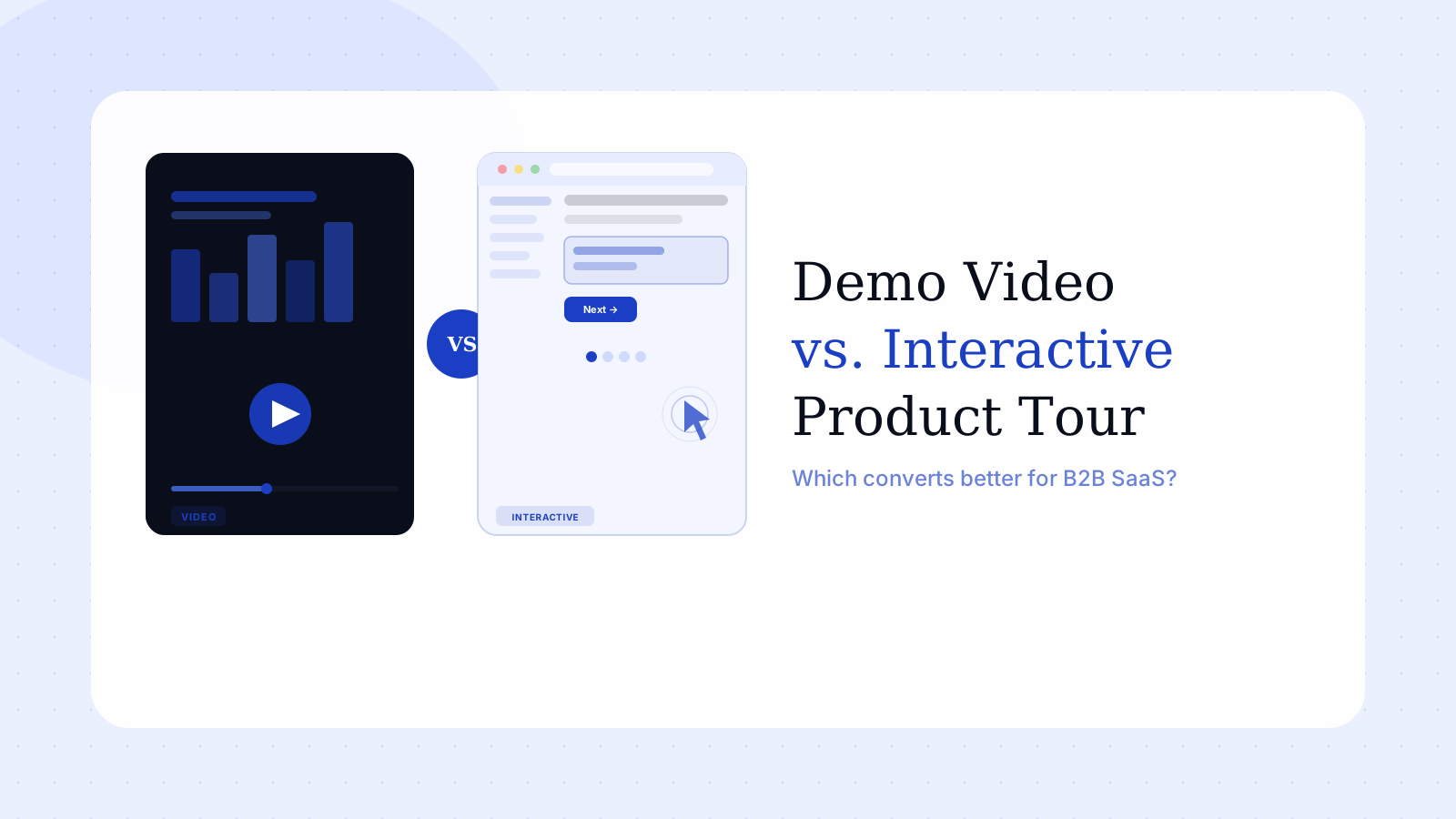
Product Demo Video vs Interactive Product Tour: Which Converts?
Your marketing team just shipped a beautiful product demo video. Ninety seconds. Real product screens. Clean voiceover. It lives on the homepage, drops into sales decks, and gets shared in outreach sequences. Everyone's happy.
Then someone in a leadership meeting says: "We should also build an interactive product tour."
And now you have a meeting about that.
Both formats are real tools with real use cases. The debate rarely ends cleanly — either you stall because nobody can agree, or you build both without a plan for where each one fits in your funnel. This guide cuts through the noise. Here's what actually separates a product demo video from an interactive product tour for B2B SaaS, when each format wins, and when the answer is genuinely both — but in a specific order.
In this guide
- Product demo video vs interactive product tour: the actual difference
- When a product demo video outperforms an interactive product tour
- When an interactive product tour outperforms a demo video
- What the conversion data actually says
- The maintenance cost nobody factors in
- A decision framework: which to build first
- Why the best B2B SaaS teams use both
- FAQ
Product demo video vs interactive product tour: the actual difference
A product demo video is a linear, pre-recorded walkthrough of how your software works. The viewer watches. They cannot click. They have no control over what they see or the sequence they see it in. That constraint is not a flaw — it's a feature. Linear video lets you control the narrative completely, show the product at its best, and guide attention precisely where you want it.
An interactive product tour is a guided, clickable simulation of your product. The prospect moves through a scripted sequence of steps, but they initiate each step themselves. The illusion of control matters psychologically: people who feel they're exploring rather than being shown retain more of what they encounter and stay engaged longer.
Both formats simulate the product experience. Neither replaces a live demo or a real trial. The question is what job each one does best.
The honest version: video tells the story; an interactive tour lets the buyer feel it. Which one you need depends almost entirely on where in the buyer's journey the content will live.
What a product demo video is not
A product demo video is not a feature tour, an onboarding walkthrough, or a brand explainer. Those formats overlap — all use screen recordings or animation — but they serve different purposes. A product walkthrough video goes deeper into specific functionality. A demo video earns the right to have that conversation first.
What an interactive product tour is not
An interactive tour is not a free trial. The prospect is navigating a scripted, sandboxed simulation — they're not creating real data, integrating with real systems, or hitting real limitations. It's a controlled environment. That control is the point, but buyers who mistake it for "trying the product" will occasionally feel misled when the real thing is more complex. This is a positioning problem you need to solve in how you frame the tour, not a reason to avoid building one.
When a product demo video outperforms an interactive product tour
Product demo video is the right default for most top-of-funnel placements. Here's where it consistently wins:
Paid advertising and social channels
LinkedIn, YouTube, and connected TV do not support interactive HTML embeds. Video is the only format that works at scale for cold audiences. If your acquisition budget runs through paid channels — and most B2B SaaS teams' does — you need video. There is no interactive tour equivalent that reaches a cold audience at scale.
Homepage above the fold
You have roughly eight seconds before a first-time visitor decides whether to keep scrolling. A muted video loop communicates what your product does faster than any clickable simulation can. The click-to-explore model requires intent the visitor hasn't formed yet. Video meets them where they are.
Investor pitch decks and conference presentations
Video plays synchronously inside a deck. Interactive tours require a live browser session — which fails during presentations far more often than it should. One frozen browser tab at a board meeting is one too many.
Sales decks and email outreach
When a sales rep wants to set context before a call or re-engage a cold deal, a short video is far easier to consume than a tour that requires the prospect to open a link, wait for it to load, and click through a scripted sequence. According to Wistia's 2025 State of Video Report, videos under one minute hold a 50% average engagement rate. That's real attention a rep cannot recreate with plain text.
Content marketing and SEO
Google indexes video. A product demo video can surface in search results and drive organic traffic. An interactive tour — typically JavaScript-heavy and not crawlable as content — does not create the same SEO surface area. If content marketing is part of your growth engine, video compounds over time in ways interactive tours structurally cannot.
When an interactive product tour outperforms a demo video
Interactive tours earn their place clearly in the funnel. There are specific contexts where they outperform video by a significant margin:
Pricing pages and feature pages
A visitor who has reached your pricing page is already evaluating. They know they have a problem; they're deciding whether your product solves it well enough to justify the cost. An interactive tour gives them evidence on the page — without forcing a calendar invite. This is the highest-leverage placement for an interactive tour.
Sales follow-up after discovery calls
A prospect who has described their exact workflow in a discovery call is the ideal audience for a personalized interactive tour. They know what they're looking for. A tour that mirrors their use case — with their terminology, their process — closes more deals than a generic video. Walnut's 2025 platform data shows that teams personalizing 50% or more of their demos see 40%+ higher conversion rates compared to teams using generic assets.
Self-serve and product-led growth funnels
67% of B2B buyers now prefer a rep-free buying experience for at least part of their evaluation (Gartner, 2026). Interactive tours make self-evaluation possible without opening your full product to unqualified prospects. They let buyers reach a purchase decision without requiring a sales conversation they didn't want to have.
Lead scoring and intent data
Interactive tours generate engagement data: which steps a prospect completed, how long they spent on each feature, where they dropped off. That data qualifies leads in ways that video watch percentage alone cannot. A prospect who completed your pricing workflow in the interactive tour is a materially different sales conversation than one who watched 60% of a video.
Build your next product demo video in minutes
Rimo turns a plain-English brief into a production-grade demo video — real product screens, no editor or video team required.
What the conversion data actually says
The data on this topic exists, but it's almost entirely vendor-sourced — which means it skews toward whichever format the vendor sells. Read it with that in mind.
Interactive demo platforms report significant conversion uplifts. A frequently cited benchmark: website visitors who engaged with a clickable interactive demo converted at 24.35% versus a 3.05% overall website baseline. Forrester's research on interactive content shows a 2× conversion lift over passive content. Walnut's 2025 data shows interactive demos converting at 38% versus screen-share demos.
These numbers are real. But they measure something specific: conversion rate among visitors who engaged with the tour, not among all website visitors. Most interactive tours on B2B SaaS websites are clicked by a fraction of visitors — the high-intent ones who were already leaning toward conversion. The tours look exceptional in the data because they self-select for motivated buyers.
Video has a different profile. Only 10–15% of website visitors play a video that's on the page — but the behavioral profile of who plays it, and how much they watch, is its own quality intent signal. Video reaches a broader slice of your audience. Interactive tours reach a narrower, more motivated slice.
Neither format is universally better. They attract different behavioral segments and measure success against different baselines. Comparing them directly is like comparing email open rate to paid ad click-through rate — both are real metrics, but they don't describe the same buyer at the same moment.
The maintenance cost nobody factors in
Here is what the comparison articles consistently skip: the ongoing cost of keeping each format accurate after your product ships new features.
A product demo video is a finished asset. Once it's made, it plays the same way every time. When your product UI changes, the video doesn't break — it just ages. You can leave it running while you plan an update, replace it with a new one, or add a short intro card acknowledging the change. You control when it becomes obsolete, and you can replace it with a single production run.
An interactive product tour breaks the moment your actual product diverges from the scripted simulation. If engineering ships a navigation redesign, your tour — built to mirror the old UI — suddenly shows a different product than the one prospects will use. Product marketers on G2 consistently flag this as a top frustration with tools like Navattic, Storylane, and Walnut: "keeping demos accurate after product changes can be manual and tedious" is one of the most frequently repeated complaints across all three platforms.
The maintenance calculus breaks down like this:
- High product velocity teams (shipping weekly or biweekly): interactive tours require constant maintenance. That burden typically falls on the same PMM who is supposed to be creating content, not maintaining tooling.
- Stable product teams (quarterly releases): interactive tours are far more manageable. The update cadence is predictable and can be planned.
One thing that meaningfully changes the equation: automating your demo video creation. If you can regenerate a video in hours rather than days, keeping your video assets current becomes a different kind of task — one that's closer to the "always up-to-date" bar of an interactive tour without the fragility.
There's also a pricing dimension that rarely surfaces in the comparison content. G2 reviewers of Navattic have noted licensing barriers before teams have shipped a single demo — the annual-only pricing model with seat limits makes it difficult for smaller or early-stage teams to test before committing. Interactive tour tools typically price at a level that assumes a certain scale of production output. If you're not building tours regularly, that cost-per-asset ratio works against you.
A decision framework: which to build first
If you're starting from zero, build the video first. Here's the reasoning:
Video has fewer distribution constraints. You can put a video on your homepage, run it in LinkedIn ads, drop it into a sales email, embed it in a conference deck, and publish it in a launch blog post. An interactive tour requires a browser, a functional link, and a load time. Its effective distribution channels are narrower by design.
Video establishes your product narrative before anything else. Teams that build interactive tours before they've figured out their product story often end up with tours that are technically impressive but don't convert — because they show everything without communicating anything. Writing a product demo video script is the fastest way to crystallize what your product does and why it matters. That script becomes the strategic brief for everything else you build, including the tour.
Video production is significantly cheaper than it was. AI-assisted demo video tools have changed the cost equation. What used to take a production day — screen recording, editing, voiceover, motion graphics — now takes a fraction of that time for most teams. The actual cost of a product demo video has dropped enough that the "build video first" argument is much easier to make than it was even two years ago.
Here is a placement-level decision matrix for teams mapping out which format to build for each channel:
| Placement | Best format |
|---|---|
| Homepage hero | Video |
| Pricing page | Interactive tour |
| LinkedIn / YouTube ads | Video |
| Post-discovery sales follow-up | Interactive tour (personalized) |
| Investor pitch deck | Video |
| Feature deep-dive pages | Either or both |
| Trial onboarding | Interactive tour |
| Conference / event booth | Video |
| Organic blog / content SEO | Video |
| PQL scoring and intent data | Interactive tour |
Build the video first. Add the interactive product tour software once you have a clear answer to two questions: what specific action do you want the prospect to take, and where in the funnel will this tour live?
Why the best B2B SaaS teams use both
The most effective approach is not choosing one format — it's sequencing them correctly.
A typical high-performing B2B SaaS funnel looks like this:
- Video on the homepage introduces the product in 60–90 seconds. The prospect gets the story.
- Video in paid ads reaches cold audiences who don't yet know the brand.
- Interactive tour on the pricing or features page lets a high-intent visitor self-evaluate.
- Personalized video from a sales rep re-engages a cold deal with specific context.
- Interactive tour in a sales follow-up lets the prospect explore the exact workflow they described in discovery.
- Video in onboarding emails shows new users how to reach their first meaningful outcome in the product.
These formats reinforce each other. The video creates the desire to explore; the tour lets that desire be satisfied on the buyer's terms. Teams that treat them as competing investments miss the compounding value of running them in sequence.
The mistake most teams make is treating the formats as substitutes — as if building an interactive tour means they don't need video, or vice versa. That framing leads to underinvestment in whichever format lost the internal debate, and eventually to gaps in funnel coverage that show up as low conversion rates at specific stages.
The right framing: what does this specific buyer need to experience at this exact moment in their journey? Sometimes that's a story. Sometimes that's control. Often it's both — just not at the same time. Following the SaaS demo video best practices for video assets while investing in interactive tools for mid-funnel coverage gives you strong coverage across the full buying journey.
If you're looking for common product demo mistakes that teams make when choosing between these formats, the biggest one is consistently this: building the tour before the story is figured out.
FAQ
What is the difference between a product demo video and an interactive product tour?
A product demo video is a pre-recorded, linear walkthrough of how your software works — the viewer watches but does not interact. An interactive product tour is a clickable simulation of your product that allows the prospect to navigate through features themselves. Demo videos work best for top-of-funnel awareness and broad distribution; interactive tours work best for mid-funnel evaluation and self-serve buying contexts.
Which converts better — a product demo video or an interactive product tour?
It depends on where in the funnel and what you are measuring. Interactive tours show higher conversion rates among the visitors who engage with them, while videos reach a broader total audience. Forrester's research shows interactive content generates 2× more conversions than passive content — but that advantage is specific to engaged, mid-funnel visitors. For cold audiences and broad distribution channels like LinkedIn and YouTube, video consistently outperforms.
Should I build an interactive product tour or a demo video first?
Build the video first. Video has fewer distribution constraints, works across paid channels, establishes your product narrative, and has gotten significantly cheaper to produce with AI-assisted tools. Once you know what story your product needs to tell — and have validated it through video — the interactive tour has a much sharper brief to work from.
How often do I need to update a demo video versus an interactive tour?
Demo videos need updating when your core UI or product story changes meaningfully — typically aligned to major releases. Interactive tours need updating whenever your actual product diverges from the scripted simulation, which can mean after every sprint for high-velocity teams. This ongoing maintenance burden is one of the most underestimated costs of investing in interactive demo tooling, and it's the factor that most makes the "video first" argument compelling.
Can I use both a product demo video and an interactive tour on the same website?
Yes — and many high-performing B2B SaaS teams do. The standard approach is video above the fold on the homepage for immediate impact with broad audiences, and an interactive tour on pricing or features pages for high-intent visitors who are actively evaluating. Placed correctly, the two formats serve different behavioral segments and reinforce rather than compete with each other.
Do interactive product tours help with SEO?
Generally, no — not in the same way video does. Interactive tours are typically JavaScript-rendered and not indexable as content by search engines. A product demo video embedded on a page can appear in Google's video search results and drive organic traffic. If SEO is part of your growth strategy, video creates compounding returns that interactive tours do not provide on their own.
Akshay Sharma
Product Leader · 10+ years in B2B SaaS
Akshay has spent 10+ years building and marketing B2B SaaS products. He writes about product storytelling, demo production, and the operational side of product marketing.