How Much Does a Product Demo Video Cost? The 2026 B2B SaaS Pricing Guide
Someone in your next planning meeting is going to ask how much the demo video will cost. You'll say a number. It will be wrong — not because you're bad at budgeting, but because "product demo video" covers everything from a $300 screen recording to a $50,000 animated film, and nobody in the room is talking about the same thing.
The bigger problem is that most product demo video cost guides treat this as a one-time production question. For B2B SaaS teams, it isn't. Your product ships every two weeks. Every sprint that renames a feature, redesigns a workflow, or adds a new capability is also a demo video update waiting to happen. The real cost of demo video isn't what you pay to make the first one — it's what you pay to keep it current.
This guide gives you the full picture: production costs by method, hidden costs most teams discover too late, and a framework for picking the approach that actually makes sense for your team size and shipping pace.
In this guide
- Why product demo video cost varies so widely
- The three production models
- Product demo video cost by type and length
- The hidden costs most guides skip
- Total cost of ownership: the metric that matters
- Which approach fits your team
- FAQ
Why product demo video cost varies so widely
Ask three agencies to quote a "product demo video" and you'll get prices ranging from $3,000 to $45,000. All three are quoting something real. They're just quoting different things.
The most important variable is not length — it's production method. A 90-second animated walkthrough with motion-designed UI, voiceover talent, and original sound design sits in a completely different cost bracket than a 90-second screen recording with AI narration and basic editing. Both get called a product demo video. Only one matches what most B2B SaaS teams actually need at most stages of growth.
The second biggest variable is revision cycles. Most agencies build one or two rounds of revision into their quoted price. Beyond that, you're paying hourly. Teams that don't lock their script before the first production draft routinely double their quoted cost before the project closes.
The third variable — the one almost nobody mentions in pricing guides — is update cost. More on that below.
The three production models
Agency production
A professional video production agency delivers the highest-polish output, but the cost range is wide even within this category.
Entry-level agencies (often offshore or small boutique studios) charge $2,000–$8,000 for a 60–90 second product demo. At the top end, tier-one US agencies producing fully animated SaaS demos with custom illustration, motion design, and recorded voiceover talent charge $15,000–$50,000 for the same length.
Most B2B SaaS teams land somewhere between $5,000 and $15,000 per video when working with a credible US-based agency for a one-minute finished product.
What you're paying for at the high end: a strategist who builds the narrative arc, a scriptwriter, an illustrator, a motion designer, a sound designer, and a producer managing it all. That team probably spends 150–300 hours on a single 90-second video.
The drawback isn't price alone — it's timeline. Agency production typically runs six to ten weeks from brief to delivery. For teams shipping product updates every two weeks, that lag makes agency video a poor fit for anything but hero assets: homepage demos and major launch films that will live unchanged for a year or more.
Freelance and contractor production
Hiring a freelance video producer or editor through a platform like Upwork or Toptal, or directly via referral, costs significantly less than agency work. Typical rates run $50–$150/hour for an experienced editor.
A finished 60–90 second demo video — assuming a clean script and recorded screen footage delivered by you to the editor — runs $800–$3,000 depending on how much motion design and polish you need.
The catch: you still need to record the product screens (which requires a clean demo environment for screen recording), write the script, manage at least one revision round, and coordinate the handoff. The freelancer handles the editing. The PMM or SE still owns the strategy, the brief, and the recording setup.
G2 reviews of Loom and Vidyard — two of the most common tools teams use when recording raw footage for freelancers — consistently surface the same pain point: recording reliability. Loom alone has accumulated 147+ G2 mentions citing frozen recordings, failed uploads, and audio sync problems, issues that worsen when you're trying to deliver clean footage to a contractor on a deadline (G2, 2025–2026). Tools built for async communication were not designed for the controlled, repeatable recording environment that systematic demo video production requires.
DIY and AI tools
This is the fastest-growing production model. Teams using AI-powered video platforms pay a monthly subscription — typically $80–$500/month depending on the platform — and produce videos in-house without a dedicated production team.
The old DIY option (screen record in Loom, paste into iMovie, export) still works for low-stakes internal content. But it shows. For buyer-facing demo pages and sales leave-behinds, it rarely clears the quality bar.
AI-powered platforms like Rimo change this equation by automating the production layer — captions, transitions, voiceover, and branding — while you bring the product screens and the brief. The output lands closer to agency quality, at a fraction of the cost and timeline.
Production time: hours, not weeks. Cost per video: effectively included in the subscription once your team is in a production rhythm. For teams shipping four to eight demo videos per month, this model is both faster and cheaper than any alternative.
See what Rimo builds from a plain-English brief
Turn your product walkthrough into a polished demo video — real screens, no editor. No production team required.
Product demo video cost by type and length
Not all demo videos cost the same, even within the same production model. Here's how video type and length shift the numbers:
| Video type | Typical length | Agency cost | Freelance cost | AI tool cost |
|---|---|---|---|---|
| Homepage / hero demo | 60–90 sec | $8,000–$20,000 | $1,500–$4,000 | ~$100–$300/video |
| Persona / use-case demo | 90 sec–2 min | $6,000–$15,000 | $1,200–$3,000 | ~$100–$300/video |
| Feature highlight | 30–60 sec | $4,000–$10,000 | $800–$2,000 | Included |
| Sales personalized video | 1–3 min | Rarely practical | $500–$1,500 | Included |
| Onboarding walkthrough | 2–4 min | $10,000–$25,000 | $2,000–$5,000 | Included |
These ranges assume professional output. "Agency cost" includes strategy, scripting, and at least one revision round. "Freelance cost" assumes you deliver the script and raw footage. "AI tool cost" is a monthly subscription divided by estimated video output volume.
One nuance worth noting: the homepage demo and the sales personalized video have roughly the same length but completely different cost logic. A homepage hero video is worth investing in — it's evergreen content that represents your brand to thousands of buyers. A personalized sales video needs to be created by a rep in 20 minutes for one specific prospect. The right tool for each is not the same tool.
The hidden costs most guides skip
This is where most pricing articles stop. For product marketing teams at fast-shipping SaaS companies, the costs below are often larger than the production line items above.
The update cost
Your product ships every two weeks. Navigation changes. Features get renamed. Workflows get redesigned. The demo video you finished in January shows a product that no longer exists in April.
Most teams don't update their videos on schedule. They let outdated content represent the product to thousands of buyers because fixing a two-minute video through an agency costs $3,000–$8,000 and takes five weeks. So it sits. Outdated. Quietly eroding buyer trust.
The update cost is not a one-time line item. It's a recurring expense that compounds with every product release. For teams using agency or freelance production, the update cost is the single biggest driver of long-term video expense — and the most consistently ignored.
The internal time cost
Whoever manages the vendor relationship, reviews the brief, approves the cut, and coordinates the revision cycle is spending time with a real cost. At a PMM with a $120,000 annual salary, that's roughly $60/hour.
A single agency video project — brief, feedback round one, feedback round two, final approval — typically consumes 8–15 hours of internal PMM time. That adds $480–$900 in invisible cost on top of every quoted production price.
For teams producing six videos per year through agencies, internal time costs alone add $2,900–$5,400 that never appears on any invoice.
The stale-demo deal-kill cost
This one is harder to quantify but worth naming directly.
If a buyer watches your homepage demo and sees a UI that doesn't match what they encounter in a trial, their trust takes a hit. If a sales engineer sends a prospect a leave-behind video that references a workflow no longer in the product, it raises doubt. Doubt kills deals quietly. The cost doesn't show up in your video budget — it shows up in your pipeline as "went with another vendor."
Wistia's 2025 State of Video report found that AI usage in video production jumped from 18% to 41% of professional teams in a single year — the largest adoption spike in the report's history. Teams aren't adopting AI for quality. They're adopting it because the update cost of traditional production was becoming a strategic liability they could no longer ignore.
The most expensive demo video is the one that's three months out of date and still representing your product to every new buyer who lands on your site.
Total cost of ownership: the metric that matters
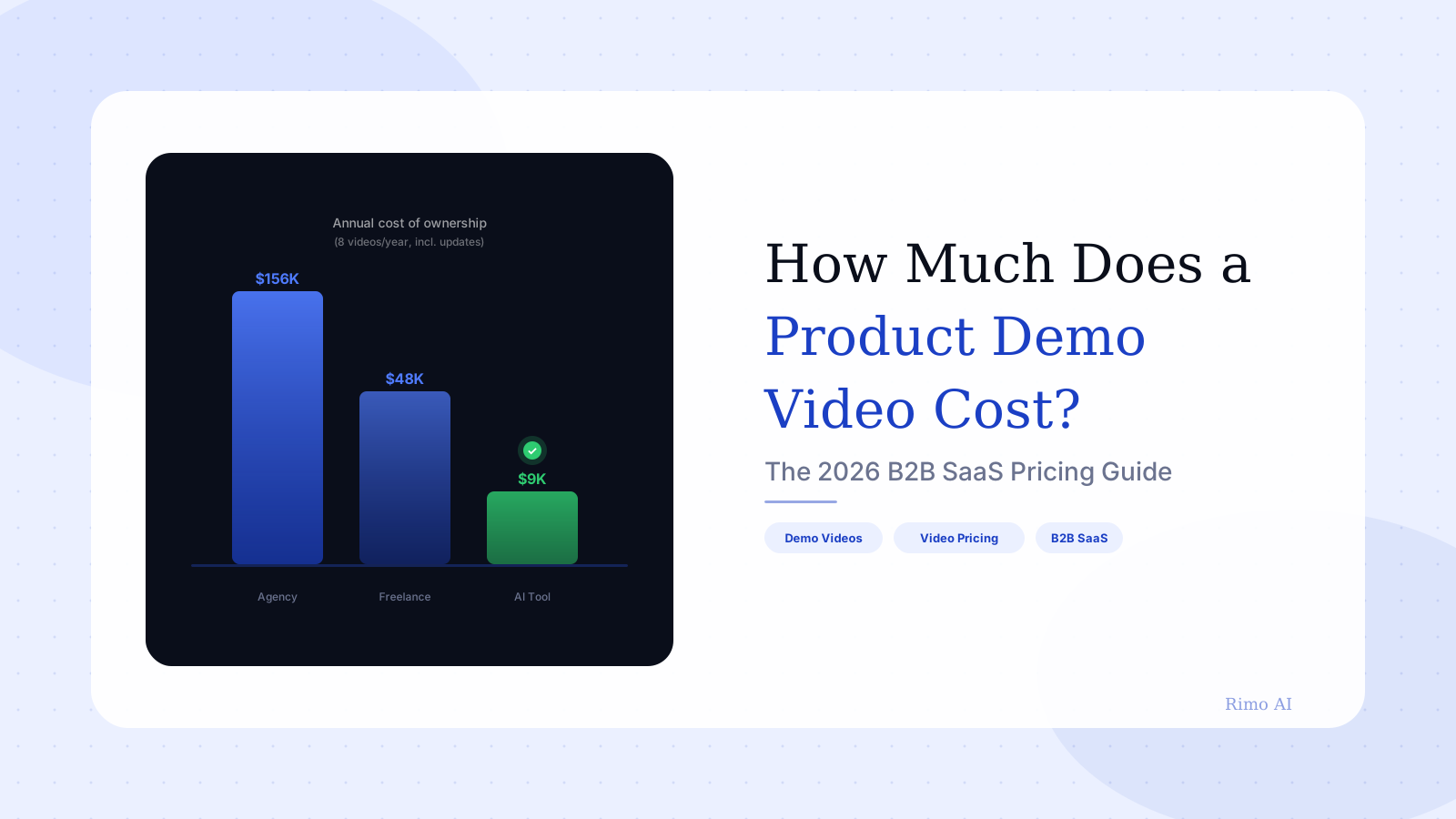
One-time production price is the wrong number to optimize for. For SaaS teams, total annual cost of ownership reveals the real trade-off.
Here's how the math works for a team producing 8 demo videos per year and updating each one twice — a conservative estimate for a team shipping every two weeks:
Agency model:
- Initial production: 8 videos × $10,000 = $80,000
- Update cost: 16 updates × $4,000 = $64,000
- Internal PMM time: 200 hours × $60 = $12,000
- Total: ~$156,000/year
Freelance/contractor model:
- Initial production: 8 videos × $2,500 = $20,000
- Update cost: 16 updates × $1,200 = $19,200
- Internal PMM time: 150 hours × $60 = $9,000
- Total: ~$48,200/year
AI tool model (e.g. Rimo):
- Subscription: ~$500/month = $6,000/year
- Internal time: 50 hours × $60 = $3,000
- Total: ~$9,000/year
These are directional estimates. Your numbers will shift based on team size, production complexity, and shipping pace. But the shape holds: the agency model doesn't cost 5× more than the AI model — it costs 17× more once updates and internal time are included.
The counterpoint worth stating: AI-generated demo videos and agency-produced animated films are not the same product. For a flagship launch video that will run in paid campaigns and live on your homepage for 18 months, agency investment makes sense. For the 90-second use-case video your PMM needs by end of sprint, it doesn't.
Most teams don't have to pick one model. The practical answer is a tiered approach.
Which approach fits your team
Use agency production for:
- Homepage hero demos updated once per major rebrand, not per sprint
- Major product launch films with broad paid and organic distribution
- Customer story or case study videos where production value signals credibility
Use freelance/contractor for:
- Mid-funnel persona videos that need more polish than DIY can provide
- One-off feature videos for a significant new launch with reasonable lead time
- Campaign-specific content with a defined distribution plan
Use AI tools for:
- Everything that needs to stay current with your product — use-case videos, feature highlights, sales leave-behinds, onboarding walkthroughs
- Any video where the update cycle is shorter than eight weeks
- Any video produced by someone who isn't a professional editor — sales engineers, account executives, customer success managers
The decision comes down to two questions: how long will this video stay current, and what does it cost to update it when it doesn't?
If the answer to the first question is "six months or more," agency or freelance investment can make sense. If the answer is "a few weeks," the only sustainable production model is one that lets your own team iterate fast. That's what automated demo creation with artificial intelligence is actually solving for — not the cost of the first video, but the cost of video as an ongoing program.
For the full in-house production workflow — from writing the demo video script through recording and publishing — and for understanding SaaS demo video best practices by funnel stage, those guides cover the execution side once the production model decision is made.
If you're still figuring out what a product demo video should contain before worrying about cost, start there. Getting the format and purpose right is what makes any production investment — at any price point — worth making.
FAQ
How much does a product demo video cost?
A product demo video costs between $800 and $50,000 depending on the production method. Agency-produced animated demos run $5,000–$20,000 for 60–90 seconds. Freelance editing with your own footage costs $800–$3,000. AI-powered platforms reduce the effective per-video cost to $100–$300 on a monthly subscription. For B2B SaaS teams producing videos regularly, total annual cost of ownership — including updates and internal team time — is more useful than any one-time production price.
What factors affect product demo video cost the most?
Production method has the largest impact (agency vs. freelance vs. AI tool), followed by animation complexity, revision cycles, and video length. The frequently missed factor is update cost — what it costs each time your product UI changes and the video needs re-recording or re-editing. For fast-shipping SaaS teams, update cost can exceed initial production cost within six months.
Is it worth hiring an agency for a product demo video?
For hero assets with long shelf lives — a homepage video or a major launch film — agency production can be worth the investment. For use-case videos, feature highlights, and personalized sales videos that need to stay current with your product, agencies are typically too slow and too expensive per update cycle. Most SaaS teams use a tiered approach: agencies for flagship content, AI tools for everything that needs to ship fast and stay accurate.
How much does it cost to update an existing demo video?
Through an agency, updates typically cost $2,000–$8,000 per video and take three to six weeks. Through a freelance editor, $800–$2,000 and two to four weeks. Through an AI tool, updates can be made in hours by the marketing or product team at no additional cost beyond the subscription. This is why update economics — not production price — drives the build-vs.-buy decision for most scaling SaaS teams.
Can I make a professional-quality demo video without a production team?
Yes — with the right tool and a clear workflow. You need three things: a clean demo environment (consistent demo data, no internal usernames or empty states), a tightly scripted brief, and a production layer that handles captions, transitions, and branding automatically. AI tools handle the production layer. The product team or PMM handles the brief and the recording. The output won't replace a full agency film for your homepage, but it is more than adequate for use-case videos, feature highlights, and sales leave-behinds — which is most of what a B2B SaaS team actually needs.
What is the cheapest way to make a product demo video?
DIY with a screen recording tool and basic editing software starts under $50/month. But the hidden cost is time: a non-editor spending 10 hours producing a mediocre video has a real cost, and the output often reflects it. AI-powered platforms like Rimo offer a better tradeoff — subscription pricing in the $100–$500/month range, production time measured in hours, and output quality that works for buyer-facing content. That combination represents the lowest total cost for teams producing videos at scale.
Akshay Sharma
Product Leader · 10+ years in B2B SaaS
Akshay has spent 10+ years building and marketing B2B SaaS products. He writes about product storytelling, demo production, and the operational side of product marketing.