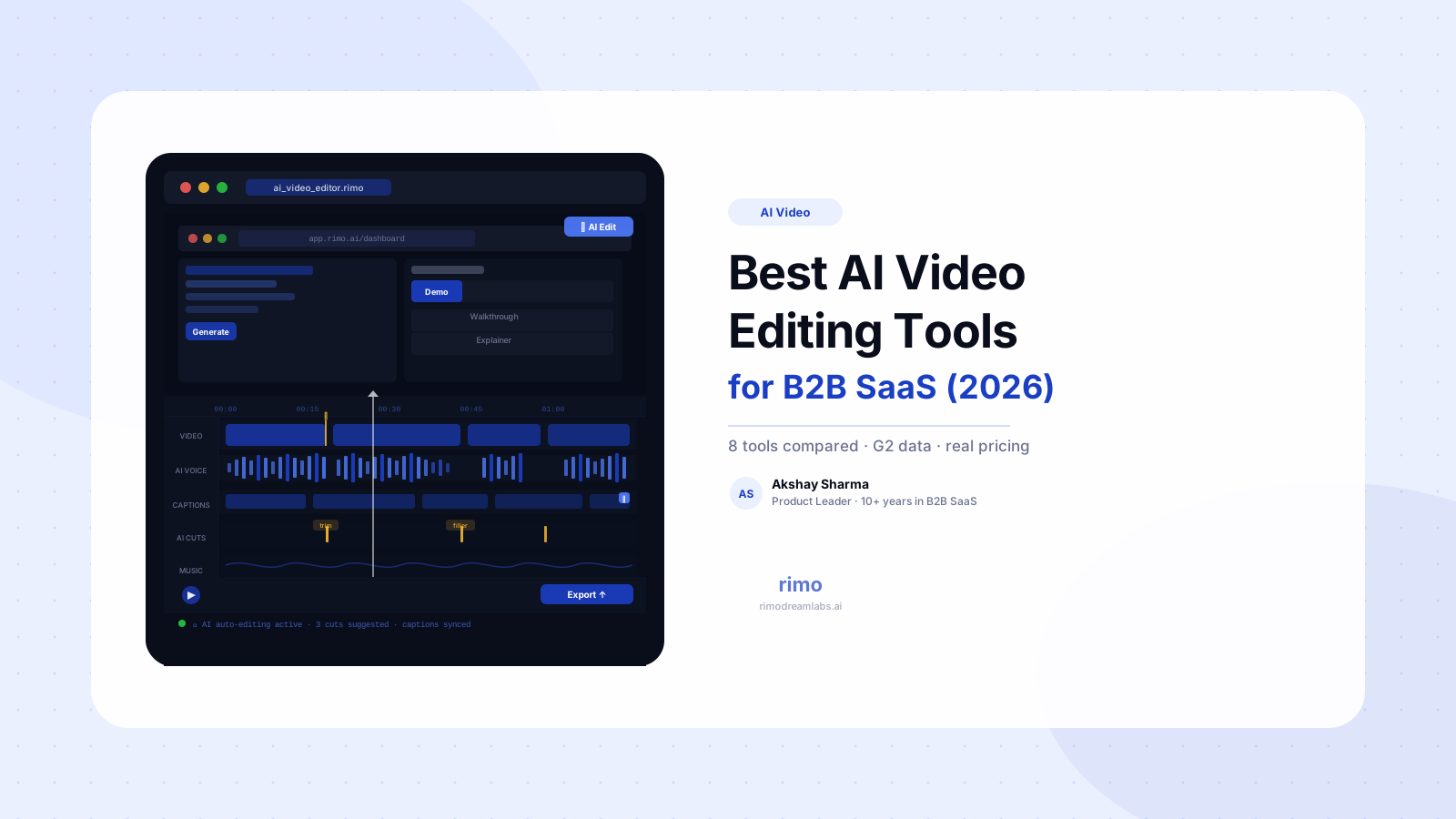
Best AI Video Editing Tools for B2B SaaS Teams (2026)
Your product just shipped a major UI overhaul. The old demo video on your website now shows a workflow that no longer exists. Your product marketing manager has two hours Thursday to fix it, no video editor available, and a board review Friday where the CMO wants to show the new interface.
This is the situation most B2B SaaS marketing teams face every quarter. It's why "best AI video editing tools" has become one of the most-searched phrases in product marketing Slack channels — not because teams want to become video producers, but because waiting for production support or external contractors no longer works at the speed B2B SaaS products ship.
The problem: most AI video editing tool comparisons are built for social media creators, not product marketers. They recommend tools optimized for short-form TikTok content or YouTube vlogs. What a B2B SaaS team actually needs is different — clean screen capture editing, fast narration turnaround, reliable captions for technical vocabulary, and a workflow that doesn't require two hours of timeline work to update one feature walkthrough. This guide covers the tools that actually fit that use case — and the ones that don't, even when they top every other list.
In this guide
- What to look for in AI video editing tools for B2B SaaS
- The 8 best AI video editing tools for B2B SaaS teams (2026)
- What G2 reviewers say about the top AI video editing tools
- The shelf-life problem: why most AI video editing tools leave you stuck
- How to choose the right AI video editing tool for your team
- FAQ
What to look for in AI video editing tools for B2B SaaS
Most AI video editing tool comparisons evaluate the same generic criteria: ease of use, export quality, pricing, template library. For a consumer creator producing lifestyle content, those criteria are reasonable.
For a B2B SaaS product marketing team, they miss the point entirely.
Here's what actually matters when you're producing product demo videos, feature walkthroughs, and sales enablement content at sprint cadence:
Screen recording compatibility. Not all AI video editors handle screen recording footage well. Many tools are optimized for camera footage — noise reduction, color grading, and stabilization built for a face on camera, not a software interface. You need a tool that treats screen capture as a first-class input, not an afterthought.
AI caption quality for technical vocabulary. Generic speech-to-text models make errors on product-specific terms, company names, and feature names outside standard training data. For a B2B SaaS product demo video, a miscaptioned feature name isn't a cosmetic issue — it's a credibility problem. The best AI video editing tools let you correct and override caption vocabulary rather than accepting whatever the model generates.
Team collaboration without version chaos. Most AI video tools are designed for solo creators. B2B SaaS marketing teams typically have at least two or three people reviewing content before publish: a PMM, a stakeholder, sometimes legal. A tool with no shared workspace, review links, or comment functionality kills the speed advantage AI was supposed to create.
Revision speed, not just creation speed. Here's the criterion most reviews skip: how fast can you update a video that's already been edited? AI tools that speed up initial creation but require rebuilding the entire edit when the product changes create a different kind of bottleneck — one that shows up on the third sprint cycle, not the first.
Content durability. When your product interface changes, how much of the previous edit survives? A tool that bakes screen content into a non-editable layer forces a full re-record. A tool that treats narration, captions, and screen content as separate editable layers gives your team a real chance at updating content without starting over.
These criteria are absent from most "best AI video editor" roundups. That's exactly why most of those lists aren't useful for a B2B SaaS team.
The 8 best AI video editing tools for B2B SaaS teams (2026)
Here are the tools worth evaluating — what each one is genuinely good at and where each has a real limitation that matters for product marketing teams.
1. Rimo — Built for product demo video production
Best for: Product marketing teams producing demo videos, feature walkthroughs, and onboarding content at sprint cadence.
Rimo approaches AI video production differently from every other tool on this list. Rather than starting with footage and applying AI to edit it, Rimo generates narrated product demo videos from a plain-English brief. You describe the product, the persona, and the outcome — the platform handles script generation, screen content, narration, and production in a single pipeline.
For teams that spend more time updating stale demo content than creating new content, this is the meaningful difference. Rimo doesn't require a recording session, a screen capture workflow, or a post-production editing step. The product demo video creation process compresses from days to hours.
Pricing: Early access pricing available. Contact for team plans.
Limitation: Purpose-built for product demo content. Not designed for general-purpose video editing use cases like event coverage, social media repurposing, or brand film production.
2. Descript — Transcript-based AI video editing
Best for: Teams that want to edit video by editing a document — cut filler words, remove mistakes, and fix narration by correcting text.
Descript is one of the most practical tools for B2B SaaS content production. The transcript-based editing model means anyone on the team can cut a video by editing words in a document, without learning a timeline editor. Studio Sound cleans audio recorded in home offices. AI-powered filler word removal cuts "um" and "uh" automatically.
The screen recording workflow handles basic captures well. Multi-window recording sessions with precise cursor movement tracking are more reliable in dedicated screen recording tools — Descript is stronger in the edit than in the capture.
Pricing: Free tier (limited). Creator $24/month. Business $40/month per user.
Limitation: Non-English content quality lags. Teams producing multilingual demo content with product video software for regional languages report noticeably lower caption accuracy and overdub quality in non-English languages (G2 reviews, 2025).
3. Runway ML — Generative AI video tools
Best for: Video teams that need generative AI capabilities — background removal, object tracking, inpainting, AI-generated B-roll.
Runway sits at the frontier of what generative AI can do with video. Background removal that works frame-by-frame, AI-powered motion tracking, and text-to-video clip generation. For a video editor working on product marketing content that requires custom visuals — concept visualizations, AI-generated scene transitions, abstract B-roll — Runway is the most capable tool available.
For straightforward demo video editing, it's more capability than most teams need, at a cost and learning curve that doesn't match the use case.
Pricing: Free tier (limited). Standard $15/month. Pro $35/month.
Limitation: Built for creative video production, not optimized for screen recording workflows. Teams producing feature walkthroughs will use roughly 10% of Runway's capability and pay for the other 90%.
4. CapCut for Business — Fast AI editing for short-form content
Best for: Teams that need quick turnaround on short-form content — feature announcement clips, social cuts, 60-second teaser videos.
CapCut for Business has moved well past its consumer-app origins. AI auto-captions are fast and accurate for English content. Background noise removal works. The template library for short-form content is broad. For quick social cuts and brief announcement clips, it handles the job with minimal friction.
What it isn't: a serious tool for multi-scene product demo video production with tight brand control. The template aesthetic skews consumer-social, and brand compliance across a library of product content is harder to enforce than teams expect.
Pricing: Free. Business plan available for teams.
Limitation: Brand control and team workflow features are thin compared to dedicated B2B tools. Fast and cheap for short-form; less appropriate for long-form product demo production.
5. Lumen5 — Text and blog post to video
Best for: Content marketing teams converting written assets — blog posts, case studies, press releases — into short video summaries for social distribution.
Lumen5 pioneered the text-to-video format for marketing teams. Paste a blog post URL, and the tool extracts key sentences, matches them to stock footage, and builds a video summary in minutes. For content teams repurposing written assets into social video, it removes most of the production work.
It is not a product demo video tool. There's no screen recording capability. The output is stock-footage-backed social video, not a demonstration of how software actually works. Teams looking at Lumen5 as an alternative to a product demo workflow are solving a different problem than the one they have.
Pricing: Basic $29/month. Starter $79/month. Professional $199/month.
Limitation: Not designed for software screen recording or product demonstration content. Strong at marketing video from text; weak at anything requiring actual product screens.
6. InVideo AI — Script-to-video generation
Best for: Teams creating template-driven marketing videos — ad content, explainer-style videos, brand awareness content at volume.
InVideo AI has improved substantially in the past year. Its AI script-to-video pipeline generates drafts from written prompts, sourced from a large stock media library. For marketing teams producing high-volume template-driven content without a production team, InVideo AI handles the workload.
The limitation for B2B SaaS product marketing is the same as Lumen5: InVideo AI generates videos from stock footage and templates, not from actual product screens. For awareness-stage content where concept matters more than proof, it works. For any content where showing the real software is the point, it doesn't.
Pricing: Free tier (watermarked). Business $30/month.
Limitation: Stock-footage-based output is inappropriate for product demo content where buyers need to see the actual software interface.
7. Opus Clip — AI video repurposing
Best for: Teams with existing long-form video content — webinars, long demos, launch recordings — who need to extract short highlights automatically.
Opus Clip's AI analyzes long-form video, identifies engaging segments, auto-clips them to 60–90 second highlights, adds captions, and formats for vertical social distribution. For teams sitting on libraries of 30-minute webinar recordings that never get repurposed, Opus Clip produces useful output with minimal manual work.
The contrarian take: Opus Clip is a repurposing tool, not a creation tool. If your bottleneck is "we have too much content we haven't repurposed," it solves that. If your bottleneck is "we don't have enough good demo content in the first place," Opus Clip makes nothing better. Most B2B SaaS teams have the second problem.
Pricing: Free tier (limited). Pro $19/month. Business $49/month.
Limitation: Repurposing-only use case. Requires good source footage to extract good clips. Doesn't solve upstream production bottlenecks.
8. Adobe Premiere Pro with AI — Enterprise-grade editing with AI assistance
Best for: Large marketing teams with dedicated video editors who need enterprise tooling with AI time-saving features.
Adobe Premiere Pro's AI features — Generative Extend, Speech to Text with high accuracy, Auto Reframe for different aspect ratios, and Enhanced Speech audio cleanup — are genuinely useful additions to a professional editing workflow. For teams with dedicated editors already on the Creative Cloud stack, these features meaningfully reduce time on specific tasks.
For a B2B SaaS marketing team without a dedicated editor, Premiere Pro remains the wrong tool regardless of its AI features. The learning curve is steep, the license cost is substantial, and the workflow assumes professional production competence. AI features improve the experience for experts — they don't lower the barrier for non-experts.
Pricing: Premiere Pro $59.99/month. Creative Cloud All Apps $89.99/month.
Limitation: High skill ceiling and cost. AI features add efficiency for professionals; they don't make the tool accessible for teams without editing backgrounds.
Your next product demo — without the editing timeline
Rimo generates narrated product demo videos from a brief — real product screens, AI voice, and production steps handled in one pipeline. No editing workflow required.
What G2 reviewers say about the top AI video editing tools
G2 data from 2025–2026 across the most-reviewed tools in this category surfaces three pain points that appear consistently — across tools and across reviewer types.
AI features are gated behind higher pricing tiers than the product page suggests. This pattern appears in reviews of Descript, Adobe Premiere Pro, and Runway ML: the specific AI capability that made the tool compelling in a demo is available only on a plan tier above what the reviewer signed up for. Teams that budget based on the advertised entry-point pricing frequently discover mid-project that the features they actually need — higher-quality AI voices, advanced caption editing, collaboration — require an upgrade. "The price jumps significantly once you need the features that actually matter" is near-verbatim across multiple Descript and Adobe reviews (G2, 2025).
Auto-captions consistently fail on product-specific vocabulary. B2B SaaS products have terms that generic speech-to-text models don't handle: feature names, company-specific workflows, abbreviations, and technical terms absent from standard training data. G2 reviewers across Descript, CapCut for Business, and InVideo AI note that auto-generated captions require significant manual correction when the content involves software-specific language. The correction workflow in most tools is functional but slow — for longer product demo videos with dozens of caption errors, it adds meaningful time back to the editing process.
"It works great until the product changes." This is the most specific and frustrated category of review in the dataset. Teams describe spending two to three days building a polished product walkthrough in a given tool, shipping a UI redesign the following quarter, and finding that updating the video means effectively rebuilding it from scratch. The AI features that accelerated initial production don't help with rebuilds. Several reviewers across tools summarize this as "fast to build, painful to maintain" (G2, 2025). It's the pain point that rarely surfaces in vendor-produced comparisons, because it only shows up after the third or fourth production cycle.
Team handoff friction is universally underbuilt. In B2B SaaS teams, video content passes through multiple reviewers before it publishes. Stakeholder comments typically arrive in Slack, email, or Google Docs — not inside the editing tool. Most AI video editors have limited in-tool review and commenting features. Teams work around this by exporting drafts, sharing links, collecting feedback across disparate channels, and manually incorporating changes — adding one to several days of delay per review cycle.
The shelf-life problem: why most AI video editing tools leave you stuck
There's a dimension to AI video editing for B2B SaaS that almost no comparison guide addresses.
Most product demo videos in B2B SaaS go out of date within one to three product cycles. Navigation changes, feature names get renamed, UI gets redesigned. A product walkthrough video recorded in January shows a workflow that may not exist by May.
AI video editing tools speed up the creation of that January video. None of them solve what happens when the May update ships.
The conventional answer — "just update the video when the product changes" — sounds reasonable until you've done it three or four times. Updating an already-edited video means re-recording the relevant screens, re-syncing the narration, re-trimming the edits, and re-exporting. On a 4-minute product walkthrough, that's two to four hours of work for what might be a 30-second workflow change in the product.
Teams that AI-powered demo video automation workflow at the workflow level — not just at the editing task level — solve this differently. When the demo is generated from the current state of the product rather than edited from a recording, updating means generating a new version, not rebuilding an existing edit. The source of truth is the product, not the video file.
The most useful question to ask before choosing any AI video editing tool isn't "how fast can I build a video?" It's "how fast can I update it when the product changes?" Teams that get stuck almost never struggled to create the first video. They spent hours building it, then abandoned it the moment it needed updating — because the rebuild cost outweighed the benefit of having current content.
This is also why the best screen recording tools for B2B SaaS are often evaluated in combination with an editing tool rather than independently. The recording setup, the editing pipeline, and the update process form a single workflow — and optimizing only one of the three creates a new bottleneck somewhere else.
How to choose the right AI video editing tool for your team
The right AI video editing tool depends on one question more than any other: what is your actual production bottleneck?
If your bottleneck is editing speed for footage you've already recorded — you have screen captures and need them edited faster — Descript is the most practical choice. The transcript-based editing model removes the need for timeline expertise, and AI audio cleanup handles most imperfect recording environments.
If your bottleneck is short-form social cuts from existing content — Opus Clip or CapCut for Business. Both handle that specific use case quickly and at low cost.
If your bottleneck is producing product demo content without a recording-and-edit cycle — Rimo is built for exactly this. Skipping the screen recording session, the timeline editing, and the narration sync work is a different tool category than most AI video editors occupy.
If your team has dedicated video editors who need AI efficiency on an existing professional workflow — Adobe Premiere Pro with AI features, or Runway ML for teams that need generative capabilities.
One thing worth stating plainly: there is no single AI video editing tool that handles all of these jobs well. The most common mistake B2B SaaS marketing teams make is choosing a tool based on the most impressive AI demo they saw, discovering three months in that it optimizes for the wrong bottleneck, and having to rebuild the workflow at exactly the moment they've developed institutional knowledge around the wrong process.
Pick the tool that solves the bottleneck you actually have.
AI video editing tools won't solve the velocity problem on their own. But the right one — matched to your actual workflow — genuinely changes how fast your team can produce and maintain demo content that keeps pace with a shipping product.
Try Rimo free and see how long your next narrated product demo takes to produce, from brief to finished video, when the editing step is handled for you.
FAQ
What is the best AI video editing tool for B2B SaaS teams?
For teams producing product demo videos and feature walkthroughs, Descript and Rimo are the two most purpose-relevant options in 2026. Descript suits teams that want to edit footage they've already recorded, using a transcript-based workflow that doesn't require timeline editing expertise. Rimo suits teams that want to skip the recording and editing steps entirely — generating narrated product demo videos from a brief. The right choice depends on whether your bottleneck is editing existing footage faster or eliminating the recording-and-edit cycle altogether.
Can AI tools edit videos automatically?
Yes — with important caveats about what "automatically" means in practice. AI video editors can automatically remove filler words, generate captions, reframe clips for different aspect ratios, and extract highlight segments from long-form footage. What they can't do automatically is make editorial decisions about what the video should say, what order the content should appear in, or whether the narrative will resonate with a specific buyer persona. AI handles mechanical editing tasks; the strategic decisions still require human judgment.
Is there a free AI video editor for SaaS marketing?
Descript offers a free tier with limited transcript minutes and export quality. CapCut for Business has a free tier with watermarks removed for business accounts. InVideo AI's free tier adds watermarks. For production at any meaningful volume, most teams find paid tiers necessary within the first few projects — the free tiers are adequate for evaluation, not for a real content program.
How much do AI video editing tools cost for a B2B SaaS marketing team?
Typical mid-tier subscription costs: Descript Business $40/user/month, Runway Pro $35/month, Lumen5 Starter $79/month, Adobe Premiere Pro $59.99/month, InVideo AI Business $30/month. For a three-person product marketing team, total AI video tool spend commonly runs $150–$300/month depending on the stack. Teams frequently underestimate costs from overlapping subscriptions — a screen recording tool, an AI editor, an AI voiceover tool, and a distribution platform each carry individual costs that compound quickly before anyone audits the full stack.
What is the difference between AI video editing and traditional video editing?
Traditional video editing is a manual process: a human editor assembles clips on a timeline, adds transitions, adjusts audio levels, and syncs narration. AI video editing uses machine learning to automate or accelerate specific tasks within that process — auto-transcription and caption generation, filler word removal, automatic highlight identification, AI-generated B-roll, audio noise reduction, and smart crop. AI video editing tools exist on a spectrum from "AI-assisted traditional editing" (Premiere Pro with AI features, Descript) to "AI-generated video with minimal manual editing required" (Rimo, InVideo AI, Lumen5). The second category requires less editing skill but trades off some creative control.
Do AI video editing tools work for technical B2B software demos?
They work for some workflows, not all. AI tools handle narration, captions, transitions, and audio cleanup well for screen-based content. Where they fall short for technical software demos specifically: auto-captions frequently mishandle product-specific vocabulary and require manual correction; AI B-roll suggestions are irrelevant when real product screens are required; and generative AI tools that don't use actual product screens produce output that looks polished but fails the credibility test with technical buyers who want to see the real interface. For authentic technical demo content, tools that work with real screen footage — or generate from real product data — consistently outperform purely generative alternatives.
Akshay Sharma
Product Leader · 10+ years in B2B SaaS
Akshay has spent 10+ years building and marketing B2B SaaS products. He writes about product storytelling, demo production, and the operational side of product marketing.