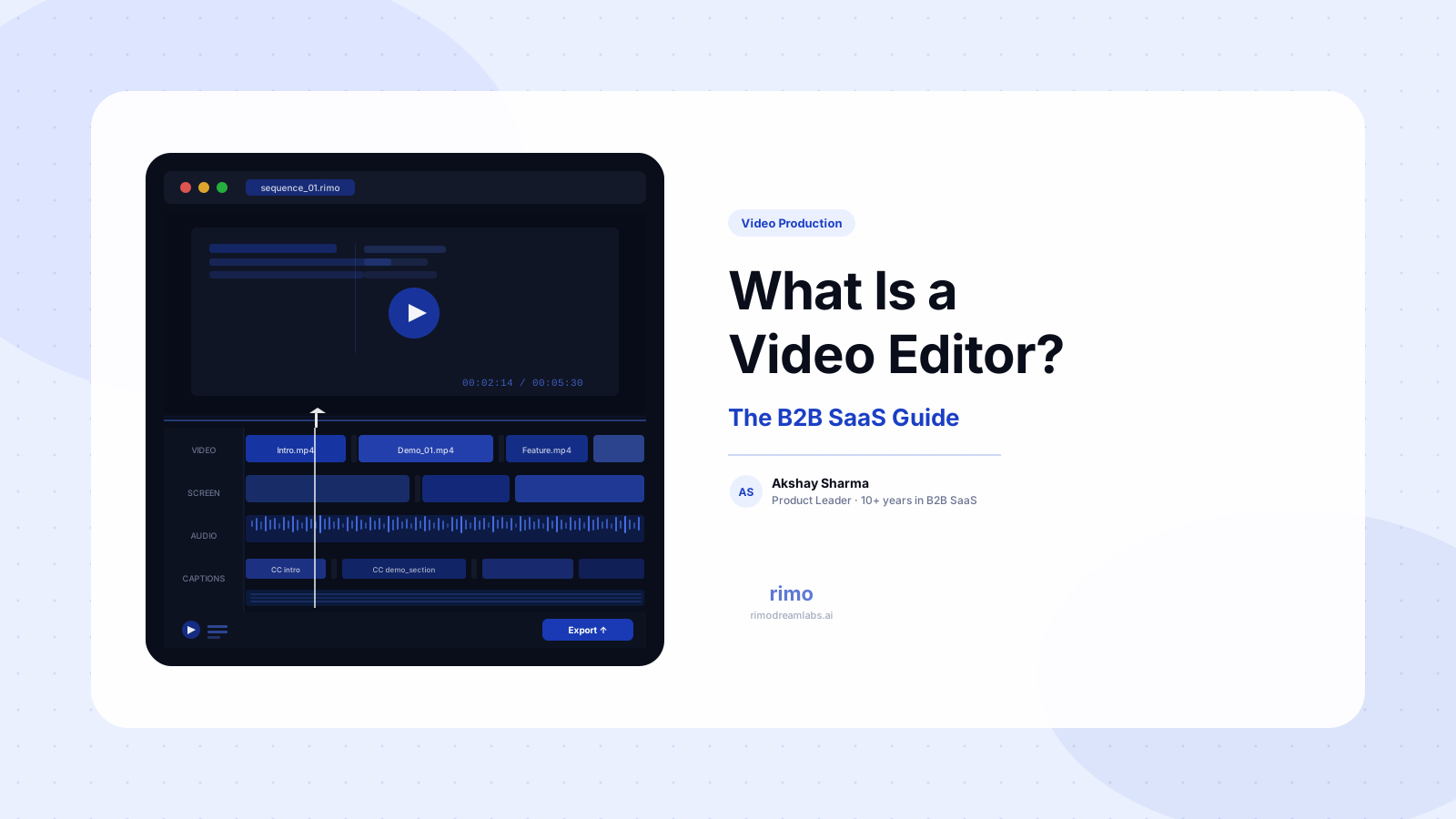
What Is a Video Editor? The B2B SaaS Guide
Your product shipped a new UI on Tuesday. By Thursday, your head of sales has already forwarded the demo video link — to a prospect, in an active deal — and the screens in that video show a navigation bar that no longer exists.
This is the quiet horror of B2B SaaS video production. Not a technical failure. Not a process breakdown. Just the natural consequence of building video content the way it was designed to be built: create once, publish, move on.
A video editor is the professional who shapes raw footage into a finished, polished asset ready for an audience. Understanding what that role actually involves — and where it breaks down for product marketing teams — is more useful than it might first appear. Because the choice of whether to hire a video editor, use an editing tool yourself, or replace that workflow entirely with an AI-native platform is one of the most expensive decisions a B2B SaaS marketing team makes, often without realizing it.
In this guide
- What is a video editor?
- What does a video editor do day-to-day?
- Types of video editors — and which matters for B2B SaaS
- The skills a video editor brings to product marketing
- The real cost of a video editor for B2B SaaS teams
- Why B2B SaaS teams keep outgrowing their video editor setup
- AI video editors vs. traditional video editors
- When to hire, when to use tools, and when to use AI
- FAQ
What is a video editor?
A video editor is a specialist who takes raw footage — screen recordings, camera footage, voiceover audio, b-roll — and assembles it into a finished video asset. They control pacing, cut out errors, add titles and captions, layer in music or sound effects, and export a file ready for distribution.
The role exists because filming and storytelling are two different skills. You can record the most accurate product walkthrough in the world and still produce a video that loses its audience at minute two. The video editor is the person who collapses the gap between what was captured and what the viewer actually experiences.
In B2B SaaS marketing specifically, the video editor most commonly produces three types of content: product demo videos, explainer videos for top-of-funnel awareness, and customer-facing tutorials or onboarding walkthroughs. These are not interchangeable. A product demo video has a shelf life tied directly to your product's release cycle. An awareness explainer might survive two or three years. A tutorial becomes outdated the moment the feature it covers is updated.
That distinction — the shelf life problem — is the one most general writing about video editors ignores. And for B2B SaaS teams, it's the one that matters most.
What does a video editor do day-to-day?
The day-to-day work of a video editor varies significantly depending on the type of content they're producing. For B2B SaaS, the most relevant version looks like this:
Ingesting and organizing raw footage. A screen recording session for a product demo might produce 45 minutes of raw material — mis-clicks, rambling explanations, re-records of the same workflow four times. The video editor starts by reviewing all of it and logging what's usable.
Cutting and sequencing. This is the core craft. Removing dead air, trimming hesitations, deciding what order the feature demos appear in, and making sure each cut serves the story. A skilled video editor makes this feel invisible — the viewer never notices where a cut happened.
Adding visual elements. For product demo content specifically, this means cursor highlights to draw attention to specific UI elements, zoom-ins on key interactions, lower-third text labels identifying features, and transition graphics between workflow sections.
Audio work. Balancing voiceover levels, removing background noise, syncing narration to on-screen actions, and mixing in subtle music if it's used. Poor audio is the single fastest way to lose a B2B viewer — enterprise buyers notice production quality even if they can't articulate why.
Captioning and accessibility. This has moved from nice-to-have to baseline expectation. Videos embedded on product pages, in emails, or shared in LinkedIn messages autoplay muted. If there are no captions, most of your audience sees nothing.
Exporting and versioning. Different destinations require different specs. A homepage video has different dimensions and compression requirements than a Wistia-hosted demo or a LinkedIn organic post. The video editor manages this so the marketing team doesn't have to.
Types of video editors — and which matters for B2B SaaS
Not all video editors work the same way or on the same type of content. There are roughly four categories, and they don't overlap as much as the job title implies.
Narrative and film editors
These are the people who cut commercials, documentary content, and brand films. They think in emotional arcs and cinematic rhythm. If you've ever watched a company "origin story" video that genuinely moved you, a narrative editor built it. For most B2B SaaS marketing teams, this skill set is expensive and rarely needed — a product demo is not a film, and treating it like one is usually a budget problem.
Motion graphics and animation editors
Sometimes called "post-production specialists" or "motion designers," these editors add animated elements — icon animations, data visualizations, animated call-outs — on top of base footage. For product explainer videos, where you're showing a concept rather than live software, motion graphics editors are essential. For screen-recording-based demos, they're a premium addition rather than a necessity.
Screen recording editors
This is the category most directly relevant to B2B SaaS marketing. Screen recording editors work primarily with software footage. They know how to make a cursor path readable, how to zoom and pan within a static screen, how to mask out sensitive data in a product UI, and how to make an interface interaction feel clean and intentional on screen even when the raw recording was messy. This is a specific skill set that generic video editors often underestimate.
AI-assisted editors
The fastest-growing category. Editors who use AI-native tools to accelerate tasks that used to take hours — automatic transcription, noise removal, silence deletion, auto-captions, and smart clip reuse. These editors are not being replaced by AI; they're using AI to move faster. The distinction matters for how you evaluate hiring versus tooling decisions.
The skills a video editor brings to product marketing
Hiring or working with a video editor for the first time reveals how much invisible craft goes into video that works. These are the skills worth understanding before you decide whether to hire, use a tool yourself, or take a different route entirely.
Pacing instinct. Knowing when to cut is not intuitive. Video editors develop a feel for how long a viewer can stay with any single shot before their attention wanders. For product demos, this usually means more cuts than you'd expect — viewers want to see progress, not patience.
Story architecture. A demo that shows features in the order they appear in the product navigation is not a demo. It's a feature tour. A skilled video editor working with good source material can restructure a product walkthrough so it tells a before-and-after story: here's the problem, here's the moment the product solves it, here's what life looks like after.
Tool fluency. The industry standard tools — Adobe Premiere Pro, DaVinci Resolve, Final Cut Pro, and increasingly Descript for text-based editing — each require real skill to use at speed. A video editor who can work quickly in these tools is not interchangeable with someone who "knows how to use iMovie."
Feedback absorption. Product marketing and sales teams give notes on videos in ways that are subjective and sometimes contradictory. "Make it feel faster but also more premium" is a real note that a video editor has to translate into something actionable. This is a soft skill that experienced editors have and first-time freelancers often struggle with.
The real cost of a video editor for B2B SaaS teams
This is where the decision gets complicated.
Professional video production costs have dropped significantly with AI tooling. Median per-minute production costs fell from around $4,200 to approximately $2,500 between 2023 and 2025 (Vidico, 2025). But even at $2,500 per finished minute, a five-minute product demo — which is not an unusual ask — costs $12,500 to produce.
For a team that needs to update that demo every quarter when the product ships new features, that's $50,000 a year on a single video asset.
Freelance video editors are cheaper than agencies but introduce coordination overhead: briefing, revision cycles, turnaround time, and the ongoing challenge of finding someone who actually understands B2B SaaS interfaces and why they matter. G2 reviewers of tools like Vidyard consistently flag cost as the top barrier to using video more frequently — not enthusiasm for the format, but the price of producing it at the quality level that feels appropriate for enterprise prospects.
A separate but related pain point from Loom and Camtasia reviews: reliability. When teams try to handle video editing themselves using consumer-grade tools, they run into recording failures, audio sync issues, and upload problems at the worst possible moments. The video editor role exists partly because the alternative — a PMM wrestling with video software at 10pm before a product launch — produces worse output with more stress.
For more on what video production costs at different quality tiers, the product demo video cost breakdown is worth reviewing before you commit to any workflow.
Stop re-recording every time your product ships
Rimo generates polished product demo videos from a brief — your actual product screens, your brand, ready to share in under an hour. No recording setup, no editing queue, no freelancer coordination. Built for the pace of SaaS product marketing.
Why B2B SaaS teams keep outgrowing their video editor setup
Here's the observation that most writing about video editors misses: the job of a video editor was designed for content you make once.
A brand film is produced, approved, and distributed. It runs for 18 months. The video editor's job is done. Traditional video production economics — and the skill sets of traditional video editors — are built around this model.
B2B SaaS product marketing doesn't work this way. Your product ships every two to four weeks. Feature naming changes in sprint six. The navigation bar gets reorganized. A workflow that your demo video shows in four steps now takes three. None of these changes are dramatic — but they compound. Six months after you publish a product demo video, there's a real chance it's showing your buyers something your product no longer does.
This is the maintenance problem that no general "what is a video editor" guide addresses. And it's why so many B2B SaaS marketing teams cycle through the same pattern: invest in video, publish it, watch it go stale, postpone the update because re-recording is a production project, eventually let it run even though it's outdated because taking it down feels worse.
The answer is not to hire a better video editor. The answer is to rethink what "video production" means for content that has to evolve with the product. For teams exploring this, the guide on how AI automates demo video production covers the structural shift in more detail.
AI video editors vs. traditional video editors
The AI video editing market grew from $614.8M in 2024 to $716.8M in 2025 (Leadde, 2025), and the tools have moved well beyond novelty. Understanding what AI video editors actually change — and what they don't — is useful before making a tooling or hiring decision.
What AI video editors do well:
Transcription-based editing (Descript's core feature) lets you edit video by editing text — delete a sentence in the transcript and the corresponding footage disappears. This is genuinely faster for anyone who thinks in text rather than timelines.
Automatic silence removal, filler word detection, and noise cancellation have compressed the boring parts of the edit process from hours to minutes. A 45-minute raw screen recording session can be cut to a usable 10-minute rough cut in under 20 minutes with the right tools.
Auto-captions are now accurate enough to publish with light editing rather than full correction. This alone saves hours per video.
What AI video editors don't solve:
The fundamental architecture problem — showing features in the wrong order, building a tour instead of a story, missing the buyer persona entirely — is not a tooling problem. AI tools can make a bad video faster to produce, but they can't fix the underlying creative decisions.
More importantly, AI video editing tools still operate on the same assumption as traditional video editors: you start with footage. If your product UI changed and you didn't re-record, no editor — human or AI — can update your video. The footage is the footage.
This is the gap that purpose-built tools like Rimo address differently: generating demo video from a product description or structured brief, rather than editing footage after the fact. It's worth distinguishing between "AI tools that make editing faster" and "AI tools that remove the need for recording in the first place." For teams evaluating options, the best screen recording tools for B2B SaaS guide covers the recording-first workflow in depth.
When to hire, when to use tools, and when to use AI
The decision is not one-size-fits-all. Here's a practical framework based on what actually works at different team sizes and content volumes.
Hire a video editor when:
- You're producing 4+ video assets per month and quality consistency matters across all of them
- Your content includes high-production brand films, customer testimonials, or event coverage — content types where cinematic craft adds real value
- You have a defined brief-to-review process and enough volume to keep a full-time or part-time editor busy
Use a self-service editing tool when:
- You're producing 1–3 videos per month and speed matters more than polish
- The videos are primarily screen-recording-based demos or tutorials where the interface is doing the work, not the production quality
- Your team has some editing comfort level and can absorb the tool learning curve without it slowing everything down
Use an AI-native platform when:
- Your product ships frequently and keeping demo videos current is a recurring bottleneck
- You need to produce persona-specific or use-case-specific demo variations at scale — the kind of versioning that's economically impossible with traditional production
- Your team doesn't have editing skills, recording equipment, or time to manage a production workflow, but still needs professional-quality output
For a broader look at how SaaS demo video best practices are evolving with AI tooling, the 2026 playbook covers the strategic context.
The video editor's place in a modern SaaS stack
The video editor role is not going away. For certain content types — brand campaigns, event highlight reels, executive thought leadership videos — skilled human editors bring creative judgment that AI tools don't replicate.
But for product demo videos in B2B SaaS, the traditional video editor workflow has a structural mismatch with the pace of modern product development. The question isn't whether to value video editing craft. It's whether the person most responsible for your product's market story — your PMM — should be spending their time coordinating production queues rather than shaping that story.
The most effective B2B SaaS marketing teams in 2026 are not choosing between "hire a video editor" and "do it yourself." They're separating the types of video content by shelf life, assigning production workflows accordingly, and using AI tools for the high-velocity, product-tied content that needs to move at sprint speed.
Try Rimo free and see how long your next product demo video actually takes to produce — without a recording session, without an edit queue, and without a freelancer brief.
FAQ
What does a video editor do in B2B SaaS marketing?
A video editor in B2B SaaS marketing takes raw screen recordings, voiceover audio, and supporting assets and assembles them into finished demo videos, product explainers, and tutorial content. They handle pacing, cut errors, add captions and annotations, and export files formatted for each distribution channel. In practice, the role often also includes managing revision cycles with product and sales stakeholders.
How much does it cost to hire a video editor for product demos?
Costs vary significantly. Freelance video editors with B2B SaaS experience typically charge $50–$150/hour, which translates to $500–$2,000 per finished product demo video depending on complexity and revision rounds. Agency rates run higher. AI-assisted production platforms like Rimo produce comparable output at a fraction of the cost, with turnaround measured in hours rather than days.
What's the difference between a video editor and a motion graphics designer?
A video editor works primarily with footage — cutting, pacing, sequencing, color grading, and audio. A motion graphics designer creates animated visual elements — icon animations, data visualizations, animated titles — that are layered on top of footage. Many product explainer videos require both. Product demo videos built on screen recordings typically need a video editor's skills more than a motion designer's, unless the brief calls for animated callouts or branded transitions.
Can I edit a product demo video myself without being a professional?
Yes, but with realistic expectations. Tools like Descript (text-based editing), ScreenFlow (Mac), and Camtasia (Windows) are built for non-professionals and produce usable results. The gap shows most clearly in pacing — knowing when to cut — and in audio quality. If you're producing one or two videos per quarter, self-service editing is viable. At higher volumes or with higher quality bars, the time cost becomes significant. G2 reviewers of self-service tools consistently flag the editing skill gap as a friction point, even for technically comfortable users.
How do AI video tools change what video editors do?
AI video tools handle the repetitive, time-intensive parts of editing — transcription, silence removal, noise reduction, auto-captioning — which frees editors to focus on structure, story, and creative decisions. Editors who use AI tools productively are faster and take on more projects, not fewer. The tools don't replace editorial judgment; they eliminate the work that wasn't requiring it. For teams without any editing resources, AI-native platforms go further — generating demo video from a product brief, bypassing the recording-and-editing workflow entirely.
What's the best video editor for product demo videos?
For teams with editing skills and time, Descript is well-regarded for text-based editing workflows common in screen-recording-based demos. ScreenFlow works well on Mac for simple screen recording edits. For teams that want to skip the recording and editing process entirely and generate polished demo video directly from their product, Rimo is built specifically for that use case — no editing queue, no recording setup required.
Akshay Sharma
Product Leader · 10+ years in B2B SaaS
Akshay has spent 10+ years building and marketing B2B SaaS products. He writes about product storytelling, demo production, and the operational side of product marketing.