AI Product Video: The Complete Guide for B2B SaaS Teams
Every product marketing manager at a B2B SaaS company has the same problem: the product ships faster than the videos that explain it. By the time a new feature demo is finished — scripted, recorded, edited, reviewed, approved — the UI it shows has often already changed.
AI product video tools exist to solve exactly this. But the category has splintered. There are avatar-based generators that put a synthetic presenter in front of an animated screen. There are text-to-video tools that produce stylised clips from prompts. And there are AI-assisted production platforms that record real product screens and assemble them into a structured, narrated video. All three get called "AI product video." They are not the same thing — and for B2B SaaS teams, the distinction matters more than most vendor landing pages let on.
This guide explains what AI product video actually means for teams that sell software to other businesses: what the tools do, which category fits which use case, and what it actually takes to ship a video that makes a buyer more confident, not less.
In this guide
- What is an AI product video?
- Why B2B SaaS teams are switching to AI video production
- The two categories of AI product video tools
- What makes an AI product video work for B2B buyers
- How to choose the right tool for your team
- The mistakes most teams make
- FAQ
What is an AI product video?
An AI product video is a video that demonstrates a software product — for marketing, sales, or customer education — where AI handles some or all of the production work. That production work can include script generation, voiceover synthesis, screen capture orchestration, subtitle creation, or the assembly of scenes into a finished output.
The phrase covers more ground than most people expect when they first search for tools. A Synthesia-generated avatar talking in front of a product screenshot is an AI product video. So is an AI-assembled walkthrough built from real recorded product screens, structured around a buyer brief, with AI-generated narration layered on top. Both meet the technical definition. But for a B2B SaaS team trying to build trust with an enterprise prospect, they produce very different buyer responses.
The critical variable is not whether AI was involved in production. It is whether the video shows the real product working in a real workflow. That distinction — real versus simulated — determines whether an AI product video builds buyer confidence or quietly undermines it.
Why B2B SaaS teams are switching to AI video production
The case for AI product video is not abstract. Product marketing managers, product managers, and sales engineers face three compounding constraints that traditional production cannot handle.
Product changes faster than editing timelines. A feature ships on Tuesday. The walkthrough that explains it needs to exist by Thursday. Traditional production — brief, script, record, edit, review, approve — takes two to three weeks minimum. For teams that ship weekly, that pipeline is structurally broken.
Video demand has outpaced team capacity. According to Wistia's State of Video 2026 report — analysed from over 13 million videos and surveyed across 900+ professionals — 71% of companies now produce videos in-house, and more than 40% are producing at least one video per week. That volume cannot be sustained with a manual workflow.
AI adoption has crossed a meaningful threshold. Wistia's 2025 report found that AI use in video production more than doubled year-over-year, jumping from 18% to 41% of teams. That is not a niche experiment. It is a majority workflow shift happening inside marketing and product teams right now.
Product demo and explainer content is where AI video has the largest practical footprint: product demos account for 31% of all AI video output, making them the single largest category by volume (IntelMarketResearch, 2026).
The two categories of AI product video tools
Understanding the difference between the two main tool categories prevents the most expensive mistake in AI product video: buying the wrong kind of tool for the job.
Avatar-based AI video generators
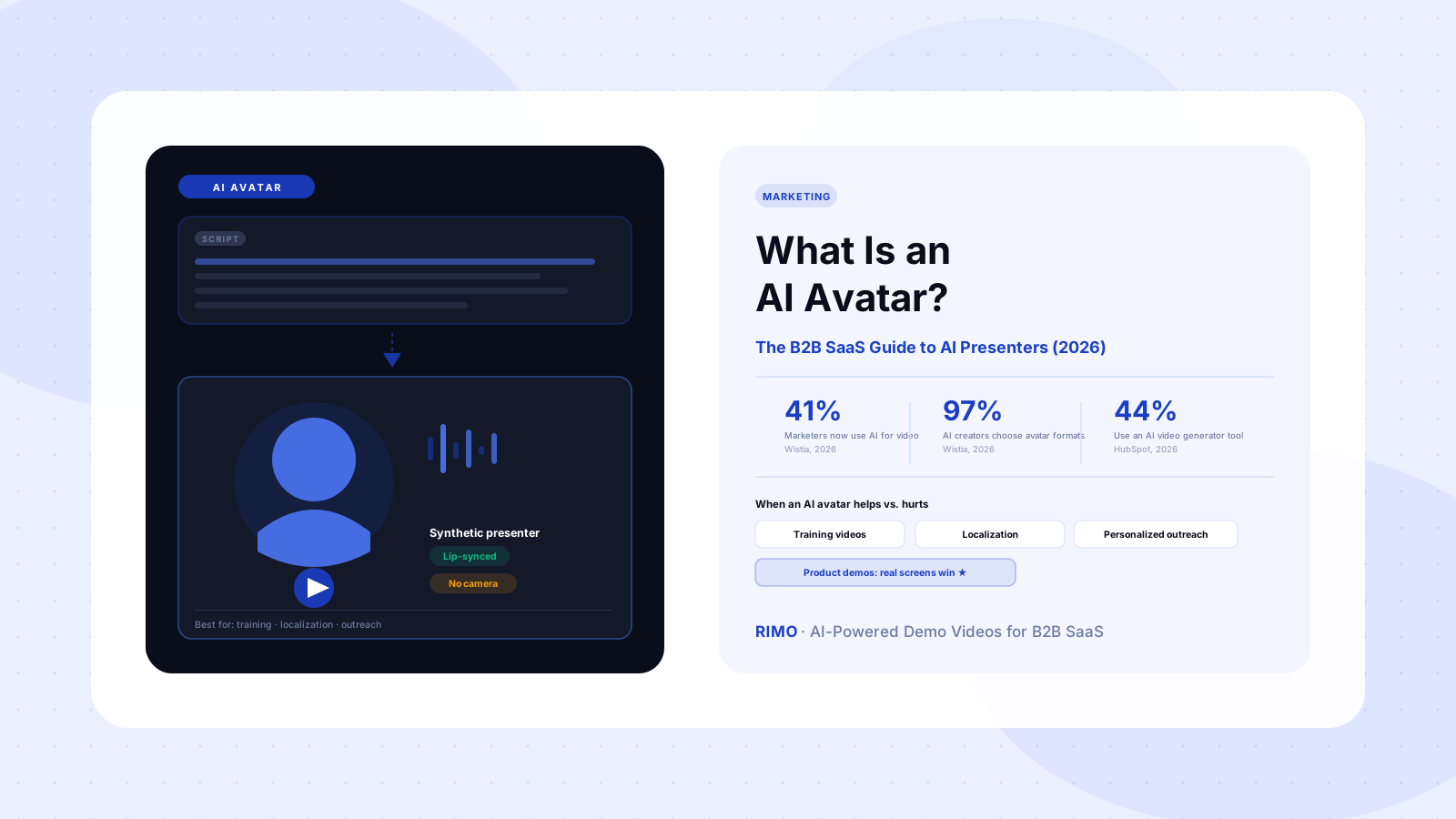
Tools like Synthesia and HeyGen let teams create videos by typing a script and selecting a synthetic presenter. The avatar delivers the narration on screen, often in front of a product screenshot or AI motion animation graphics. Strengths include localisation at scale (HeyGen supports 130+ languages), no recording sessions required, and fast turnaround for high-volume content.
G2 review data for these tools tells a specific story. HeyGen holds a 4.8 rating from over 1,194 reviews — genuinely well-regarded for ease of use. But the recurring complaint across Synthesia and HeyGen reviews is consistent: buyers eventually realise the product screen in the video is a static image or simulated interface, not a real recorded workflow. For B2B software at an enterprise price point, a stylised approximation of the product sends a signal the vendor probably did not intend to send.
G2 reviewers in regulated industries — healthcare, biotech, financial services — also flag a specific operational risk: legitimate product content being flagged by content moderation without explanation or clear appeal process. For teams building demos in sensitive verticals, that is not a corner case.
Best suited for: Training content, HR onboarding, thought leadership, global localisation.
Not suited for: Product demos where the buyer expects to see the real product working.
Screen-capture AI assemblers
This category takes a different approach. Rather than simulating the product, these tools record real product screens against a structured brief and use AI to assemble the captured footage into a finished, narrated video. The brief defines the buyer, the use case, the problem, and the outcome. The AI handles the production layer: sequencing scenes, generating or synthesising narration, applying consistent visual standards across the output.
The output difference is fundamental: the product on screen is the real product. Buyers see the actual interface, the real workflow, the actual outcome. For enterprise B2B software — where a deal may be $50,000 or more — this is not a stylistic preference. It is a trust threshold.
Best suited for: Product demos, feature walkthroughs, sales follow-up assets, persona-specific content.
Not suited for: High-volume content with human presenters on camera or rapid localisation across many languages.
See how Rimo creates AI product videos from a plain-English brief
Describe the buyer, the use case, the outcome. Rimo records real product screens and assembles a production-grade video — automatically.
What makes an AI product video work for B2B buyers
Having an AI tool is not the same as having a working AI product video process. The tool handles production. The team still owns the brief, the story, and the buyer context. Getting those right is what separates an AI product video that moves a prospect from one that fills a content calendar but moves nobody.
The brief comes before the tool. AI can assemble footage efficiently. It cannot decide which problem to solve or which buyer to address. Every effective AI product video starts with a short, specific brief: one buyer, one use case, one problem, one outcome. The brief structure that works best for product and marketing teams follows the same logic whether the production is AI-assisted or manual — the discipline is the same.
Real product screens are non-negotiable for enterprise B2B. Technical evaluators, procurement teams, and department heads are watching product videos specifically to verify that the product does what it claims. A simulated interface immediately signals that the vendor is not confident enough to show the real product. For high-ACV software, that signal costs deals — often before a conversation ever starts.
Length follows format, not output speed. AI tools make it fast to produce long videos. That speed is a trap if teams are not deliberate about format. An overview demo should be 60 to 90 seconds. A feature walkthrough, 2 to 4 minutes. A persona-specific demo, up to 5 minutes for complex products. The question is not what AI can produce quickly — it is what a specific buyer will actually finish watching.
Updating is as important as creating. The G2 pain point that appears least often in reviews but matters most operationally: what happens when the product changes? Teams that treat AI product video as a one-time asset creation task end up with the same problem as traditional production — outdated videos that cost more to update than to rebuild. The teams building durable video libraries treat each video as a live asset with a defined update trigger when the product ships.
How to choose the right AI product video tool
The market is crowded. Choosing a tool based on feature lists misses the more important question: what does your specific output need to prove to the buyer?
Four criteria that matter more than demos and pricing pages:
Does it show real product screens? If the answer is no — if the tool simulates screens or uses placeholder visuals — remove it from consideration for product demo use cases. It can serve other content needs, but it should not be the asset representing your product to an evaluating buyer.
How fast can a new team member ship their first video? If the answer involves specialist training or multi-day ramp-up, that is not a viable cadence for teams shipping features weekly. The right tool should let a PM or PMM produce a video within the same working day as a feature launch.
What happens when the product changes? Can one scene be updated without rebuilding the whole video? Can a screen recording be swapped without re-recording narration? Update speed over six months is a better indicator of long-term value than initial creation speed.
Does it support the formats your funnel needs? Homepage overview, feature launch, sales follow-up, persona-specific walkthrough — each format has different length and narrative requirements. A tool that handles one well but not the others forces a multi-tool stack with no coherent asset library.
The mistakes most teams make with AI product video
Most teams adopt AI video tools because they want to produce more content faster. That instinct is correct. But the implementation often recreates the problems they were trying to solve.
Using avatar tools for product demos. The most common mismatch. Avatar-based tools are well-suited for brand-level content. For product evaluation — where the buyer is deciding whether your software actually solves their problem — they create distance from the product at the exact moment that distance is most costly.
Starting with the tool, not the brief. AI makes it fast to produce a video. That speed creates a temptation to start recording before the story is defined. The result is efficient footage of an unclear narrative — fast to produce, easy to ignore.
Treating each video as a standalone project. The ROI of AI product video is not one video. It is a system that can produce the next ten without a linear increase in effort. Teams that approach each video as a new creative project never capture that system value. Building that system — brief formats, record-ready environments, defined asset types — is what separates teams running at scale from teams perpetually behind.
Not connecting video to the buyer journey. A product video sitting on a YouTube channel without a clear funnel placement is content for its own sake. The videos that move buyers are placed at the right decision moment: homepage overview before a free trial, feature walkthrough after a first call, persona demo before a procurement review.
Your next step
AI product video is not a future capability B2B SaaS teams need to prepare for. It is the operating standard for teams that ship weekly and cannot afford a three-week production cycle every time something changes.
The teams that win at this are not the ones with the most tools. They are the ones who understand which category of AI video tool serves each job, write briefs before touching any production tool, and connect their video library to the specific moments in their buyer journey where a video actually changes a decision.
Start with one video. One buyer. One placement. Write the brief first, then record — in that order. The system builds from there.
Build your AI product video library with Rimo
From a plain-English brief to a production-grade demo video using real product screens. No studio, no editor, no weeks of back-and-forth.
FAQ
What is an AI product video?
An AI product video is a video that showcases a software product — for marketing, sales, or customer education — where AI handles part or all of the production work. This includes script generation, voiceover synthesis, scene assembly, and subtitle creation. The key distinction is whether the video uses real product screens (essential for B2B buyer trust) or simulated visuals.
How is AI product video different from traditional video production?
Traditional video production requires humans to script, record, edit, review, and approve each video — a process that typically takes two to three weeks. AI product video tools compress or automate the production layer, allowing teams to go from a structured brief to a finished video in hours. Story structure and buyer strategy still require human input.
Can AI product videos show real product screens?
Yes — but not all tools do. Avatar-based tools like Synthesia or HeyGen typically show static screenshots or animated mockups rather than real recorded workflows. Screen-capture AI assemblers record the actual product interface and use AI to structure and narrate the footage. For B2B SaaS demos, real screens are significantly more effective than simulated ones for earning buyer trust.
How long does it take to create an AI product video?
With a clear brief and the right tool, a first-draft AI product video can be ready in a few hours. Writing the brief — defining buyer, use case, problem, and outcome — takes 30 minutes if you know your audience. The fastest teams using AI-assisted production are now shipping feature walkthroughs within the same working day as a feature launch.
What is the best AI product video tool for B2B SaaS?
It depends on the use case. For training, global localisation, or thought leadership, avatar-based tools like Synthesia or HeyGen are strong. For product demos, feature walkthroughs, and sales enablement content where real product screens matter to the buyer, AI-assisted production platforms that capture actual product workflows are the better fit.
How do AI product videos affect buyer trust?
Positively, when they show the real product. Negatively, when they substitute a polished simulation for the actual interface. B2B buyers — especially technical evaluators and procurement teams — watch demo videos specifically to verify that the product does what the vendor claims. A video that cannot show the real product working directly weakens the case it is trying to make.
Akshay Sharma
Product Leader · 10+ years in B2B SaaS
Akshay has spent 10+ years building and marketing B2B SaaS products. He writes about product storytelling, demo production, and the operational side of product marketing.