What Is Video Production? The B2B SaaS Guide
You've been asked to produce a product demo video by the end of the quarter. You've done enough research to know it involves recording, editing, and voiceover. What you weren't told is how many people, tools, approvals, revisions, and re-records that actually means — and how much of your timeline you'll spend on things that have nothing to do with the video itself.
This is the reality of video production for most B2B SaaS marketing teams. Not a one-person job. Not a weekend project. A workflow with distinct phases, specific roles, and structural friction that compounds every time your product ships something new.
Video production is the complete process of creating a video from concept to finished asset ready for distribution. For B2B SaaS teams, it's also one of the most frequently underestimated marketing operations in the stack — both in what it takes to do it well and in what it costs when the workflow isn't built for the pace of modern product development.
In this guide
- What is video production?
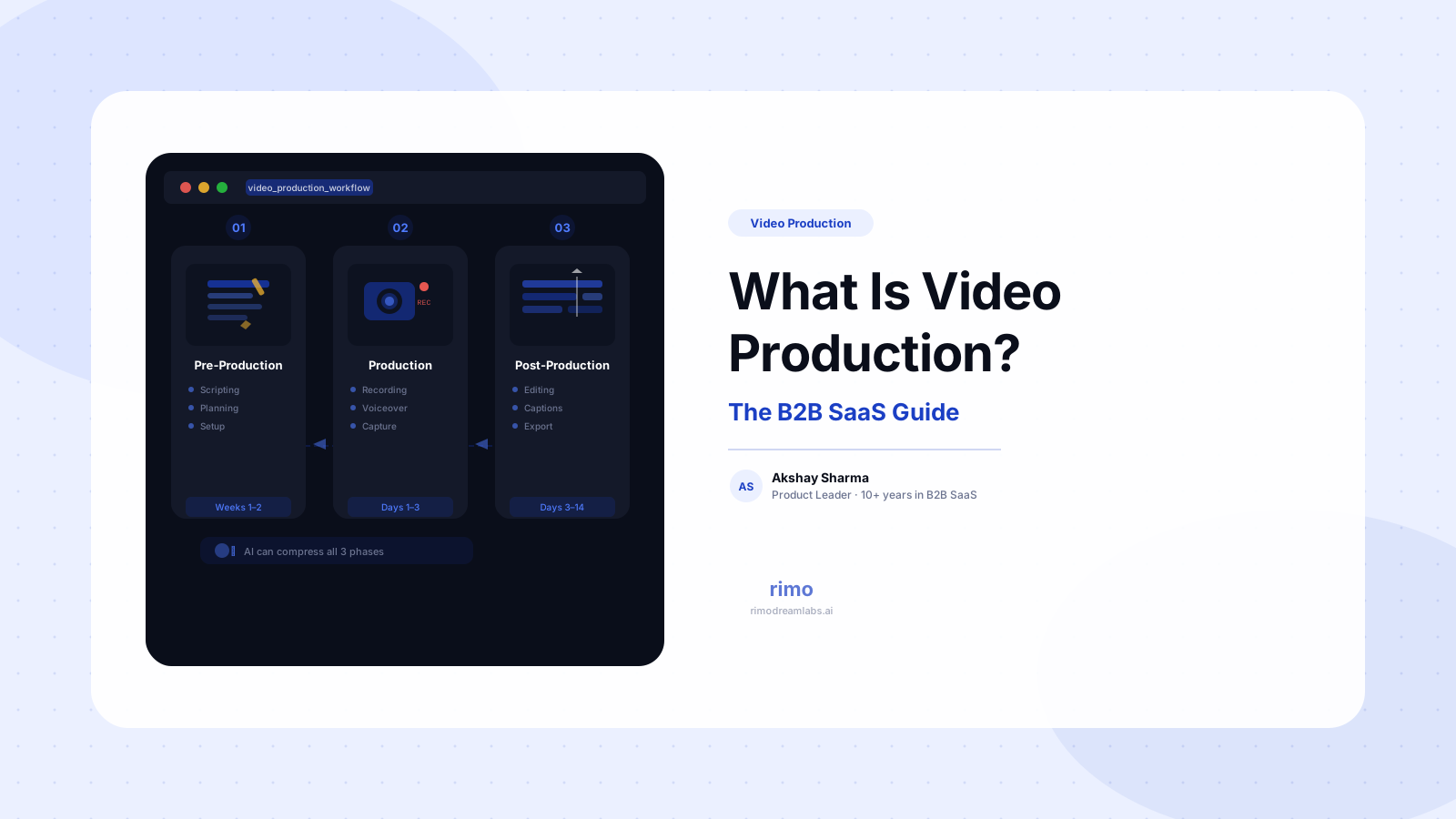
- The three phases of video production
- Pre-production
- Production
- Post-production
- Types of video production in B2B SaaS
- What makes B2B SaaS video production different
- The hidden cost of video production for SaaS teams
- How AI is changing video production
- Building a video production workflow that keeps up
- FAQ
What is video production?
Video production is the end-to-end process of planning, capturing, and editing video content — from the first line of a script to a finished file ready for an audience. It covers scripting, scheduling, recording, editing, sound design, captioning, and export: all of the work that transforms an idea into something a viewer can actually watch.
The term is broader than most people assume. It doesn't refer to a single task or tool. It refers to a complete operational system — one that includes creative decisions, technical execution, and distribution logic.
In B2B SaaS marketing specifically, the most common video production outputs are product demo videos, feature explainers, onboarding walkthroughs, and persona-specific use case videos aimed at different buyer segments. These are not interchangeable formats. Each has different shelf life expectations, different production requirements, and different consequences when they go out of date.
Understanding what video production actually involves — not just the glamorous output but the operational reality — determines how well a SaaS marketing team builds the processes, tools, and timelines around it.
The three phases of video production
Every video production workflow — regardless of budget, team size, or content type — moves through three core phases. They're worth understanding individually because the work in each phase is different, the bottlenecks are different, and the tools are different.
Pre-production
Pre-production is everything that happens before you start recording. For a product demo video, this includes:
- Defining the objective. Is this a top-of-funnel awareness piece or a sales enablement asset for a specific use case? The answer changes the script, the length, and the tone.
- Writing the script. A script maps to specific workflows in the product UI, so any change to the product may require a revision before recording starts.
- Setting up the demo environment. This means creating a clean, representative product environment — realistic data, no test accounts, no UI states that won't be familiar to buyers.
- Scheduling. Coordinating who needs to approve what, which subject-matter expert narrates, and when the recording window happens relative to the product release cycle.
Pre-production is where the most time gets lost and where the most expensive mistakes get made. A script that isn't locked before recording starts means re-records. A demo environment that wasn't properly set up means retakes. The best video teams spend more time in pre-production than in production itself.
Production
Production is the actual recording phase. For B2B SaaS demo content, this means screen recording with a capture tool, voiceover recording either simultaneously or separately, and camera footage if the format includes a presenter-on-screen segment.
The most common production bottleneck for SaaS teams is audio. G2 reviewers of tools like Loom cite audio sync failures and recording lag as the most frequently mentioned technical frustration — 147 separate mentions in Loom's G2 review base. Good production means clean audio first, good screen recording second. Most teams get that backwards.
Post-production
Post-production transforms raw footage into a finished video. It includes editing (cutting errors, sequencing clips, controlling pacing), visual enhancements like cursor highlights and UI zoom-ins, audio mixing, captioning for muted autoplay environments, color correction, and export in the right specs for each destination.
Post-production is where most SaaS marketing teams hit a wall — not because editing is impossible, but because it's slow. A 45-minute raw recording session doesn't become a 3-minute polished demo in an afternoon. Professional video edit-to-raw ratios run 5:1 to 10:1. That 3-minute video took 15–30 minutes of raw recording to capture, and another 4–8 hours to edit, caption, and deliver.
For teams that produce more than a handful of videos per quarter, this time math becomes the most important factor in whether their video production workflow is sustainable. Understanding the full workflow is one thing — understanding how to create product demo videos efficiently is where that knowledge turns into practice.
Types of video production in B2B SaaS
Not every video type requires the same production approach. B2B SaaS marketing teams typically work across four main categories, each with different shelf lives and production needs.
Product demo videos are the highest-stakes, shortest-shelf-life video type. They show a specific product workflow, speak directly to a buyer's problem, and need to stay current as the product evolves. Their production requirements are specific to SaaS: you need a working product environment, accurate UI recordings, and a script that maps to real buyer workflows.
Explainer videos are top-of-funnel pieces that explain a concept or category rather than a specific product. They tend to be animated or narration-led, age more slowly than demos, and require higher upfront creative investment. They're closer to traditional video production in their workflow — script once, produce once, run for 18–24 months.
Onboarding and tutorial videos are post-sale content: screencasts and walkthroughs that help new customers reach their first value moment. They age at exactly the same pace as the product interface, which means they require the same update discipline as demo content — just targeted at existing customers rather than prospects.
Social and short-form clips are 30–60 second assets optimized for LinkedIn, email sequences, or paid distribution. They're usually cut from longer demo or explainer footage, and their accuracy depends on the parent asset being current.
The production mistake most SaaS teams make is treating all four categories with the same workflow. Explainers can afford a full-production approach. Demo videos and tutorials cannot — not if they're going to stay accurate and useful as the product evolves.
What makes B2B SaaS video production different
Here is the observation that general writing about video production consistently misses: the entire model of traditional video production — script once, record once, publish, move on — assumes the subject of the video doesn't change.
For B2B SaaS, the subject of your video is your product. And your product ships every two to four weeks.
This creates what most teams eventually discover by accident: the perpetual update problem. Six months after you publish a polished product demo, the UI may have been reorganized, a feature renamed, a workflow that took five steps now takes three. The video isn't technically wrong — it just shows your buyer something your product no longer does, or no longer looks like.
Most teams respond to this by postponing updates. Re-recording requires the same production investment as the original: script revision, environment setup, recording session, editing queue. The video goes stale. It stays live because taking it down feels worse than leaving it up. Meanwhile, your sales team is still sharing it in active deals.
According to Gartner's 2024 research, B2B buyers spend only 17% of their total buying journey in direct contact with vendors. The other 83% happens independently — reviewing websites, watching videos, reading documentation. A video showing outdated product UI isn't just a content quality problem. It's directly influencing buyer decisions at the moment when you cannot intervene.
Traditional video production wasn't designed for this. The three-phase model works for content with long shelf lives — brand films, company culture videos, event highlight reels. It fails structurally for the content type that matters most in B2B SaaS: current, accurate product demos that reflect the product as it actually exists today.
Video production without the production overhead
Rimo generates polished product demo videos from a brief — your actual product screens, your brand, accurate to your current UI. No recording sessions to schedule, no edit queue to manage. Built specifically for the pace of SaaS product marketing.
The hidden cost of video production for SaaS teams
The visible cost of video production is the budget line item: agency fees, freelancer day rates, or tool subscriptions. The hidden cost is the time your team spends on coordination, revision cycles, and content maintenance — and the opportunity cost of the demos you never update because re-recording feels like too much work.
Traditional video production for a 60–90 second product video from a specialist agency costs between $8,000 and $50,000 depending on complexity, with a 4–8 week turnaround from kickoff to final delivery (Flowjam, 2026). That's a per-asset investment that becomes unsustainable the moment you need variations: persona-specific edits, localized versions, quarterly refreshes.
AI tooling has compressed some of this. Median per-minute production costs dropped from approximately $4,200 to $2,500 between 2023 and 2025 (Vidico, 2025). But even at lower per-minute costs, the fundamental problem remains: you still have to re-record every time the product changes.
Wistia's 2026 State of Video report found that 71% of companies now produce video in-house, primarily to control cost. The problem is that in-house teams face the same update-cycle pressure without the specialist skills. G2 reviewers of self-service screen recording tools consistently flag editing time as the biggest friction point — even for technically comfortable users, getting from raw recording to finished video takes longer than expected.
The real cost calculation for SaaS video production isn't cost-per-video. It's cost-per-accurate-video over the product's release cycle. A demo video that costs $3,000 to produce and $3,000 to update each quarter costs $15,000 per year. A demo video that costs $300 to generate and $50 to update costs under $2,000 per year. The difference is workflow, not quality ambition.
For a full breakdown of what video production costs at different quality tiers and team sizes, the product demo video cost guide covers pricing across agency, freelance, in-house, and AI-native approaches.
How AI is changing video production for SaaS teams
The AI video production landscape is moving in two directions simultaneously, and conflating them leads to wrong tooling decisions.
Direction 1: AI that accelerates traditional production. Tools like Descript use AI to make editing faster — text-based editing that removes footage by deleting transcript text, automatic silence removal, AI-generated captions. These tools reduce the time cost of post-production without changing the underlying model. You still record. You still edit. You do both faster. G2 reviewers note Descript reduces spoken-word editing time by an estimated 60–70% compared to traditional timeline editing.
Direction 2: AI that replaces the recording-first model entirely. This is a newer and more structurally significant category. Platforms in this space generate polished video directly from a product brief or product data, bypassing the capture-then-edit workflow. There's no recording session to schedule. There's no raw footage to manage. When the product changes, updating the video doesn't require re-recording.
Wistia's 2026 State of Video data shows that 41% of video professionals now incorporate AI into their creation process, up from 18% the previous year. Another 19% plan to start. The adoption is real, but the category matters. Teams adopting AI editing tools are solving a speed problem. Teams adopting AI generation tools are solving a structural workflow problem.
For teams that ship frequently — weekly or bi-weekly releases — the structural fix matters more than the speed fix. A tool that makes editing 60% faster still requires you to edit. A tool that generates video from a product brief means your PMM can produce an accurate, current demo video in the time it used to take to book a recording session.
The difference in outcome is significant. A video editor — human or AI-assisted — can only work with the footage that exists. If the product changed and you didn't re-record, no amount of editing tooling fixes that. The guide to automating demo video creation with AI covers how the structural shift works in practice.
Building a video production workflow that keeps up
A video production workflow that actually works for a B2B SaaS team has to solve for two things: quality on the first publish and maintainability on every subsequent update. Most teams optimize for the first and ignore the second until it's a problem.
Segment by shelf life. Not all video content ages at the same rate. Brand positioning content and thought leadership pieces can survive 18–24 months without updates. Product demo videos and feature walkthroughs may need refreshing every quarter — or more frequently if your release cycle is aggressive. Assign different production workflows and tools to each category rather than running everything through the same pipeline.
Lock the script before recording, always. Revision cycles that happen after recording multiply your time cost by 5–10x. The discipline of approving the script — including the demo environment and the specific workflow being shown — before anyone opens a screen recorder saves more time than any editing tool you'll ever buy.
Build update triggers into your release process. When a feature ships that affects an existing demo video, that fact should appear on someone's task list automatically. Most teams discover their demo is outdated when a prospect asks about a feature that no longer works as shown. Building the update trigger into the sprint process — even a Slack alert tied to release notes — turns reactive content maintenance into proactive.
Separate persona variations from core content. If you need a demo video for your enterprise buyer and a different one for your mid-market buyer, don't produce those as separate full-production projects. Build the core demo first, then create persona-specific variations from the existing assets. Or use an AI generation platform that can produce variations from a brief without re-recording — which is how the best SaaS marketing teams are handling this in 2026.
For the strategic context on why video production structure matters as much as video quality, the SaaS demo video best practices guide covers how the most effective B2B teams are organizing their video programs.
Video production for B2B SaaS isn't fundamentally different from any other video production. It's still script, record, edit, distribute. What's different is the update cycle. When your product ships every two weeks, a production model designed for one-time delivery becomes a compounding liability.
The teams making this work in 2026 aren't spending more on production. They're separating content by shelf life, building update triggers into their release process, and using AI-native tools for the high-velocity product content that has to move at sprint speed.
If your current demo video was produced more than six months ago, start there: watch it against your current product and count how many things have changed. That gap is your video production problem made visible.
Try Rimo free — build your next product demo video without a recording session, an editing queue, or a freelancer brief. Your product deserves to be shown the way it actually works today.
FAQ
What is video production in simple terms?
Video production is the full process of creating a video — from initial concept and script through recording, editing, and final delivery. It covers every step that transforms an idea into a finished video asset ready for distribution. In B2B SaaS specifically, it most often refers to the end-to-end process of producing product demo videos, feature explainers, and onboarding walkthroughs.
What are the three stages of video production?
The three stages are pre-production (planning, scripting, and environment setup), production (the actual recording or filming), and post-production (editing, captioning, audio mixing, and export). For B2B SaaS teams, a fourth operational phase — iteration and maintenance — is equally important, because product-tied content needs to be updated whenever the product evolves.
How long does video production take for a B2B SaaS product demo?
A professionally produced 60–90 second product demo typically takes 4–8 weeks from kickoff to final delivery through an external agency, or 1–2 weeks for experienced in-house teams using self-service tools. AI-native platforms that generate video from a product brief can reduce this to hours, though the output workflow differs from traditionally recorded screen demos.
How much does video production cost for B2B SaaS companies?
Agency rates for a 60–90 second product video range from $8,000 to $50,000 depending on complexity and revision rounds. In-house production with self-service tools is cheaper but trades budget for time investment. AI-native video generation platforms offer production at a fraction of agency cost — typically subscription-based with negligible marginal cost per video. For a complete cost breakdown, the product demo video cost guide covers all four approaches in detail.
What is the difference between video production and video editing?
Video production refers to the complete workflow from concept to finished asset — encompassing pre-production planning, recording, and post-production editing. Video editing is specifically the post-production phase: cutting footage, adjusting pacing, adding visual elements, and mixing audio. Editing is one step within production, not the whole process.
Do B2B SaaS companies need a dedicated video production team?
Not necessarily. Teams producing 4+ video assets per month with consistent quality requirements benefit from dedicated production resources — either in-house or via agency. Teams producing 1–3 videos per month can often manage with self-service editing tools or AI-native platforms. The more frequently your product ships changes, the more value there is in adopting a production approach designed for iteration — one that treats demo video updates as a routine operation rather than a production project.
Tags: video production, B2B SaaS, product demo video, AI video, video marketing
Blog Category: Marketing
Schema: Article, FAQPage
Akshay Sharma
Product Leader · 10+ years in B2B SaaS
Akshay has spent 10+ years building and marketing B2B SaaS products. He writes about product storytelling, demo production, and the operational side of product marketing.