What Is a Product Video? Types, Length & B2B SaaS Guide
Someone on your team says "we need a product video." And immediately, three people picture three different things. Your designer pictures an animated explainer with motion graphics and a voiceover. Your sales rep pictures a Loom walkthrough they can fire off after a discovery call. Your CMO pictures something closer to a launch film — high production, broad reach, brand-building.
They're all right. That's the problem.
"Product video" is a category, not a format. It covers everything from a 60-second homepage demo to a 4-minute onboarding walkthrough to a personalized two-minute clip a sales rep records before a follow-up call. Treating these as interchangeable is one of the most common and expensive silent mistakes B2B SaaS marketing teams make — you build the wrong thing for the wrong moment and then wonder why it isn't converting.
This guide maps all six types of product video to specific moments in the buyer and customer journey, explains what makes each work or fail in a B2B SaaS context, and gives you a framework for deciding which one to produce next. If you're responsible for video at a SaaS company — whether you're a one-person team or managing a full content function — this is the taxonomy you actually need.
In this guide
What is a product video?
A product video is any video that shows, explains, or demonstrates what a software product does, who it's for, and why it matters. In B2B SaaS, product videos exist at every stage of the buyer and customer journey — from the first homepage visit to onboarding after a contract is signed.
The category is intentionally broad. Unlike a brand video (which is about the company, not the product) or a thought leadership video (which is about an idea, not a workflow), a product video has one primary job: connect a viewer to the product in a way that advances a specific business outcome. That outcome might be a trial signup, a sales conversation, or a successful user activation. The format changes. The job doesn't.
According to Wistia's 2025 State of Video report, 91% of businesses use video as a marketing tool — the highest number ever recorded. For B2B SaaS specifically, video has become the primary format for explaining complex software to buyers who won't sit through a 30-page whitepaper. Gartner's 2024 research found that B2B buyers spend 80% of their buying journey without direct vendor contact. Your product video is often the closest a buyer gets to a real product evaluation before they decide whether to talk to sales at all.
Product videos aren't just for marketing. Sales teams use personalized video to stand out in outbound. Customer success teams use walkthrough videos to reduce support tickets. Product managers use launch videos to get existing users excited about a new feature. The format spans the entire organization — which is exactly why "product video" means something different to everyone who asks for one.
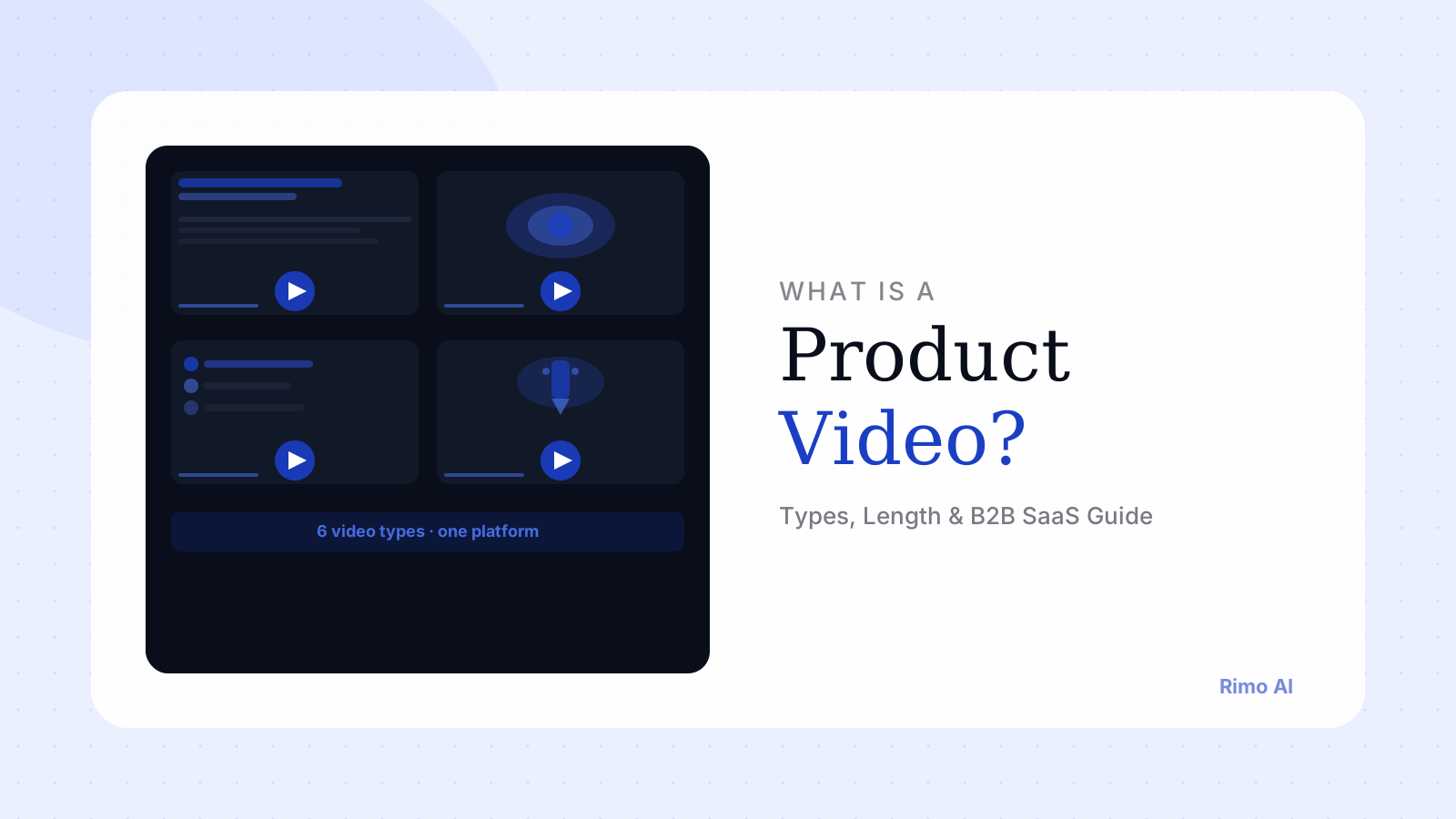
The 6 types of product video in B2B SaaS
Not all product videos serve the same purpose. Each type is built for a different buyer moment, a different level of intent, and a different goal. Confusing them is the most common production mistake B2B SaaS marketing teams make.
1. The product demo video
A product demo video shows real software doing a real workflow in a realistic use case. It's the most common product video type in B2B SaaS — and the most frequently misapplied. Demo videos are most powerful at the consideration stage, when a buyer knows the category but hasn't picked a vendor. They answer one question: does this product actually work the way they claim?
The most effective demo videos run 60–90 seconds for homepage use, and up to three minutes for persona-specific consideration content. Real product screens, not animations, are what build trust with B2B buyers. G2 reviews across leading demo tools consistently surface this: buyers respond to authenticity, and polished animations that don't reflect the real product UI quietly raise suspicion rather than build confidence.
2. The product explainer video
A product explainer video uses animation or narration to explain a concept, a problem, or how a product category works — before getting into the specific product. This is a top-of-funnel format: useful when buyers don't yet know the category exists, or when the product solves a problem most people haven't yet named.
The mistake is using an explainer when a buyer is already in active evaluation. They don't need concept education at that stage — they need proof. Sending a beautifully animated explainer to a buyer who's comparing vendors is like presenting your company origin story when they've asked for a technical spec sheet. Context matters more than polish.
3. The product walkthrough video
A product walkthrough video is a step-by-step guide through a specific workflow or feature set. It's longer than a demo video — typically 3–6 minutes — and goes deeper into process. Walkthroughs live primarily in the post-sale world: onboarding libraries, help centers, and knowledge bases.
The distinction from a demo video is purpose. A demo converts. A walkthrough teaches. Both use real product screens, but one is built for the moment before a buyer commits and the other is built for the moment after. Walkthroughs make terrible homepage assets, and demos make terrible onboarding content. Teams that conflate the two produce assets that underperform at both jobs.
4. The product launch video
A product launch video is a short announcement video built around a specific new feature, major update, or brand moment. It's not meant to teach the product in depth — it's meant to generate excitement, drive awareness, and push existing users or prospects to take one action: try the new thing.
Launch videos tend to run 60–90 seconds and are often the most heavily produced video type. They get distributed via email, social, and release notes. The shelf life is short — typically two to six weeks — which makes the production cost-value tradeoff tricky. Spending three weeks producing a launch video for a minor feature update is rarely worth it. For major platform releases, it usually is.
5. The personalized sales video
A personalized sales video is created by a sales rep or sales engineer for a specific prospect or account. It typically runs one to three minutes and references the prospect's company, their specific use case, or an objection raised in discovery. Vidyard's Video in Business report found personalized video drives 16× higher response rates compared to generic outreach — a gap that compounds over a full pipeline.
This is the video type most marketing teams don't plan for, because it's created by sellers rather than marketers. The best product marketing teams close that gap by providing scripted frameworks, message templates, and approved B-roll that reps can use to assemble personalized videos quickly. The video comes from the seller. The infrastructure comes from marketing.
6. The AI-generated product video
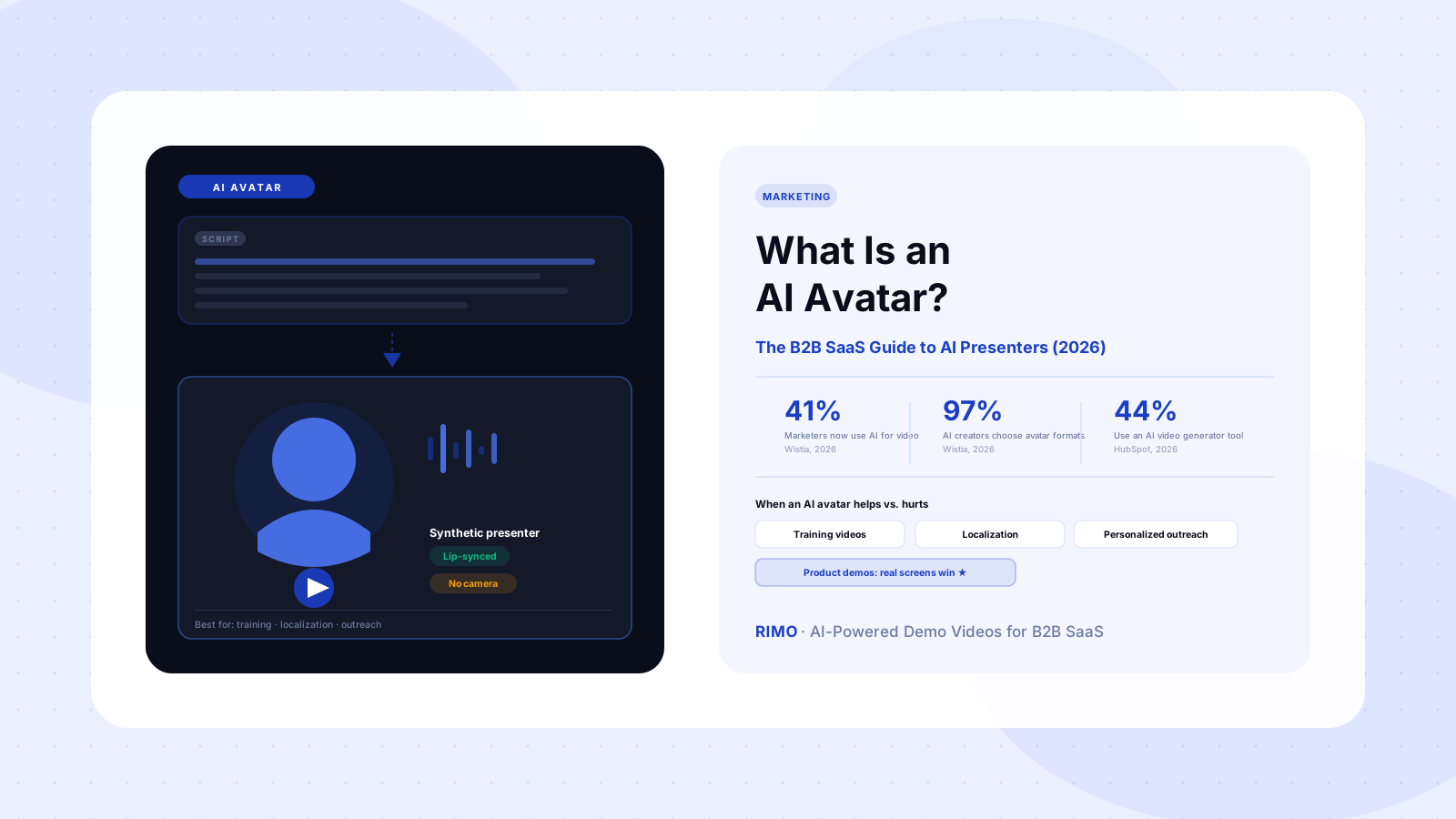
An AI-generated product video uses AI tooling to automatically create, narrate, or assemble video content from a written brief, product URL, or set of recorded screens. This is the fastest-growing category — Wistia's 2025 State of Video report found AI use in video production jumped from 18% to 41% in a single year, the largest adoption spike in the report's history.
For B2B SaaS teams, AI product video tools solve the velocity problem. Most product demo videos go stale within 90 days of being made, because SaaS products ship faster than traditional production cycles allow. AI-assisted production makes it possible to produce a finished, branded demo video in hours rather than weeks — which means keeping pace with a fast-shipping roadmap becomes achievable for the first time.
Rimo turns a plain-English brief into a product video
Real product screens. AI narration. No editor, no production team, no weeks of turnaround. Your next product video in hours.
How long should a product video be?
Length depends on format and buyer stage. The rule: the earlier in the journey, the shorter the video needs to be.
For homepage and awareness content, 60–90 seconds is the ceiling. Wistia's 2025 data shows videos under one minute hold a 50% average engagement rate. Videos over five minutes see that drop below 15%. A four-minute homepage tour is not a better demo — it's a longer opportunity for a buyer to leave.
For persona or use-case videos in active consideration, two to three minutes is appropriate. Buyers in evaluation mode have enough context to watch a deeper walkthrough, as long as it's specific to their role and pain point.
For post-sale walkthroughs and onboarding content, three to six minutes is acceptable. Customers are motivated to learn, and the content should be dense and practical — not padded with transitions and restatements.
The most common mistake is treating these ranges as aspirational targets rather than hard constraints. A demo that goes two and a half minutes because the editor couldn't decide what to cut is not a three-minute demo. It's a two-and-a-half-minute demo that kept one minute of footage that shouldn't have made the cut.
For a detailed breakdown of what goes in each minute and why, see the product demo video length guide.
The question isn't "how long is too long?" It's "what's the minimum length to get the job done?" Start from the minimum. Add only what earns its place.
Product video vs. demo video: what's the difference?
"Product video" and "product demo video" get used interchangeably in most marketing conversations. They're not the same level of the taxonomy. A product demo video is one type of product video. It's the most common type in B2B SaaS marketing — particularly at the consideration stage — but it's one of six.
The practical implication: when someone asks for "a product video," the first question should be "which kind?" The answer changes the length, tone, production approach, distribution channel, and call to action.
Most teams default to building a demo video when asked for "a product video." That's usually the right instinct at awareness or consideration stages. But a marketing team that only produces demo videos will have gaps: no launch assets, no walkthrough library for customer success, no personalized enablement content for sales. A mature video program eventually covers all six types — even if each doesn't require the same production investment.
One useful framing: think of "product video" as the genre and each of the six types as a specific format within it. A SaaS company's video library should eventually include entries in most of those formats. Start with the demo. Build from there.
How to produce product videos without a full team
The conventional production process requires a lot of parts: a producer, a script, a video editor, a voiceover artist, a review cycle, and a final cut. For a small B2B SaaS marketing team — often one or two people managing all of product marketing — that workflow can't run at the frequency that modern product shipping demands.
The in-house approach that scales uses three pillars:
Modular, single-workflow videos. Each video covers one use case, not the entire product. Short, focused videos are easier to produce, easier to update when the product changes, and easier to use in targeted distribution. A library of ten 90-second use-case videos consistently outperforms a single ten-minute product tour by every metric that matters: completion rate, CTA conversion, and operational maintainability.
A properly set up recording environment. The most common source of re-work in product video production is poor screen recording — wrong cursor pacing, cluttered demo environment, low resolution, or wrong aspect ratio. Getting the screen recording setup right before you hit record eliminates the downstream problems. G2 reviews of general-purpose recording tools surface the same pain point repeatedly: tools built for async messaging weren't designed for the controlled, repeatable environments that branded product video production requires. The recording works. The production workflow around it doesn't.
AI-assisted production for everything repeatable. The demo video production bottleneck has traditionally been editing and voiceover — both slow, both requiring specialized skills. Both are now addressable with AI at a quality level that works for standard formats. For teams where shipping speed matters more than production perfection, AI production tools have changed the unit economics of product video entirely.
How AI is changing product video production
The shift has been faster than most predictions. Two years ago, AI in video production largely meant auto-captions and transcription. Today it means:
- Generating a voiceover script from a one-paragraph brief
- Synthesizing natural AI narration without a recording setup
- Automating editing decisions: pace, cuts, transitions, lower-third timing
- Producing persona-specific versions from a single recording session
- Updating a published video when the product UI changes, without re-recording the whole thing
For B2B SaaS marketing teams, this changes the resource math. A team that was previously producing four to six product videos per quarter — limited by editing bandwidth — can now produce significantly more, covering additional personas, use cases, and distribution surfaces without adding headcount.
The one thing AI doesn't fix is strategy. An AI-generated video that shows the wrong workflow to the wrong buyer at the wrong stage is still the wrong video. Speed enables volume. Volume enables testing. Testing reveals what actually converts. The teams getting the most from AI product video use it to run more experiments with buyer messaging — not just to produce the same content faster.
For the full breakdown of what AI video production looks like in practice, see how to automate demo video creation with AI.
FAQ
What is a product video?
A product video is any video that shows, explains, or demonstrates what a software product does. In B2B SaaS, product videos include demo videos, explainer videos, walkthrough videos, launch videos, personalized sales videos, and AI-generated videos. The term describes a category with six distinct formats — each built for a different buyer moment and business goal. Choosing the wrong format for a given moment is one of the most common reasons product videos underperform.
What is the difference between a product video and a demo video?
A product demo video is one specific type of product video — the type that shows real product screens doing a real workflow to help a buyer evaluate fit during active consideration. A product video is the broader category that includes all six types used across the buyer and customer lifecycle. Every demo video is a product video, but not every product video is a demo video. The distinction matters for planning a complete video library.
How long should a product video be?
It depends on the format and the buyer stage. Awareness and homepage videos should be 60–90 seconds. Consideration-stage and persona-specific videos can run two to three minutes. Post-sale walkthrough content can extend to three to six minutes. Beyond those ranges, engagement drops sharply regardless of content quality. Shorter, more focused videos consistently outperform longer, comprehensive ones for conversion — and they're far easier to keep current as the product evolves.
How many product videos does a B2B SaaS company need?
A minimum viable program includes: one homepage overview demo (60–90 seconds), two to three persona-specific use-case videos (two to three minutes each), and a set of onboarding walkthroughs covering your core workflows (three to five minutes each). That's roughly 6–10 videos to start. Most mature SaaS marketing programs eventually maintain 15–50 videos across use cases, buyer roles, and product areas — but that library is built one video at a time, not all at once.
Can you make a product video without a video editor?
Yes — if the production workflow is systematized. The three components that traditionally required an editor are scripting, editing, and visual treatment (captions, transitions, CTAs). AI tools now handle all three at a quality level that works for standard demo and walkthrough formats. For high-investment hero videos — a homepage redesign launch or a major platform release — a dedicated editor still adds value. For everything else, an AI-assisted production workflow can get a finished video out the door without one.
What makes a product video effective for B2B buyers?
Specificity to the buyer's role, real product screens instead of animations, and a concrete outcome the viewer can recognize from their own workflow. Generic videos that try to show everything for everyone consistently underperform compared to narrow, role-specific ones that show one thing precisely. The most effective B2B product videos don't sell the product — they help the viewer imagine having already solved the problem. That's the shift that turns a passive view into an active next step.
Akshay Sharma
Product Leader · 10+ years in B2B SaaS
Akshay has spent 10+ years building and marketing B2B SaaS products. He writes about product storytelling, demo production, and the operational side of product marketing.