What Is Growth Marketing? The B2B SaaS Guide (2026)
You're the marketing lead at a B2B SaaS company. You've got a content calendar, an email newsletter, paid ads running on LinkedIn, and a webinar series that generates a respectable number of form fills. The pipeline numbers come in each quarter and they're fine. Not great. Not bad. Fine.
The problem is that "fine" doesn't compound. You're running marketing as a series of campaigns — discrete, time-bound efforts that produce activity and sometimes produce revenue. When one campaign ends, you start over. There's no learning infrastructure. No system that gets smarter about what your buyers actually respond to.
Growth marketing is the alternative. It's not a new channel or a specific tactic. It's a fundamentally different operating model — one built on full-funnel experimentation, fast feedback loops, and a systematic approach to scaling what actually works. This guide explains what growth marketing is, how the AARRR framework works in practice for B2B SaaS, and why video has become one of the highest-impact growth assets a modern marketing team can build.
In this guide
- What is growth marketing?
- Growth marketing vs. traditional marketing: what actually changed
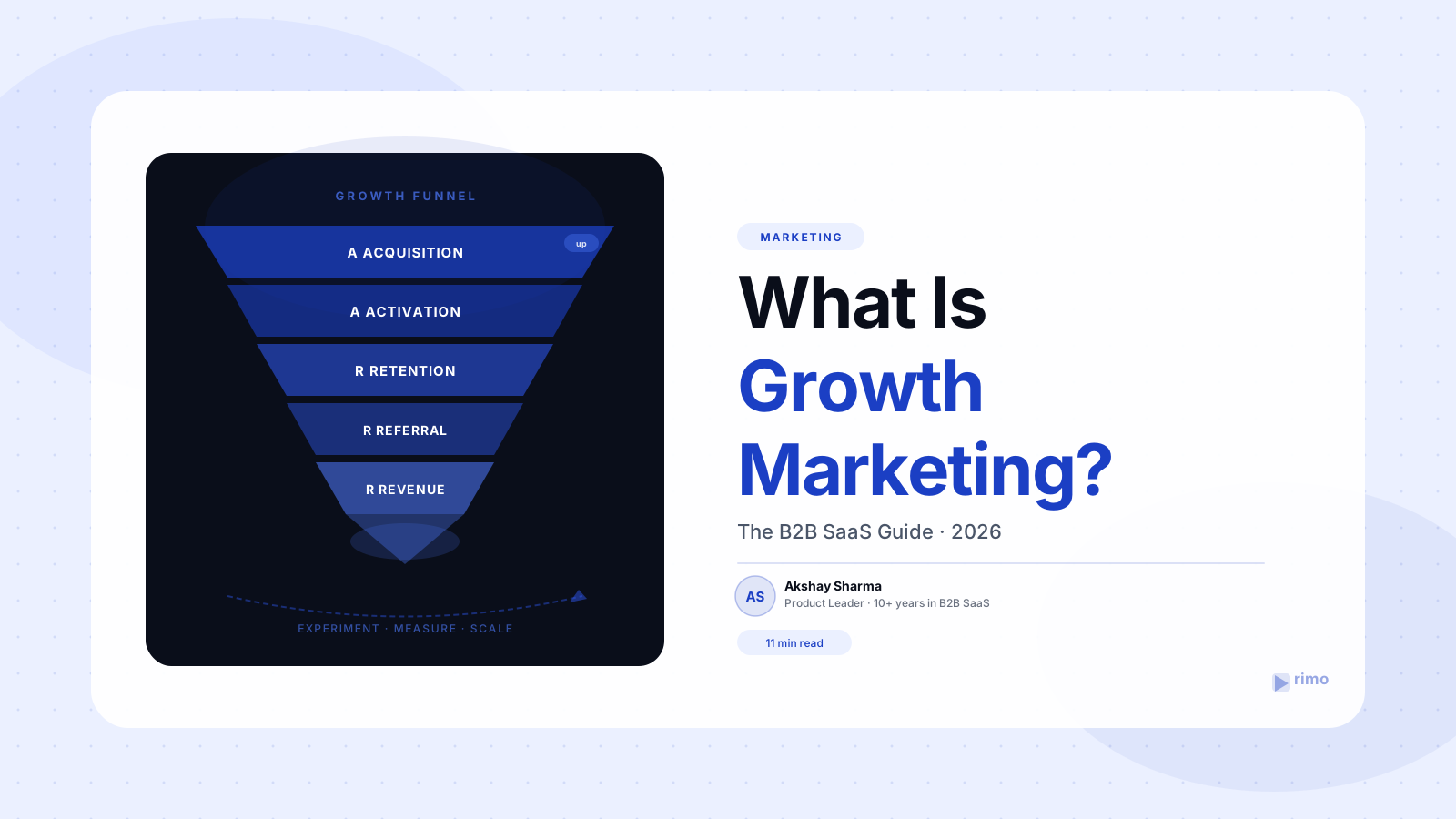
- The growth marketing funnel: AARRR explained
- Six growth marketing tactics that work for B2B SaaS
- Where video fits in a growth marketing strategy
- How to measure growth marketing performance
- FAQ
What is growth marketing?
Growth marketing is a data-driven approach to marketing that spans the entire customer lifecycle — from first contact through retention and referral — using rapid experimentation to identify what drives growth and scaling it systematically.
The term was popularized by Sean Ellis, who coined "growth hacker" in 2010 to describe a new kind of marketer who cared more about metrics and experimentation than creative polish. Growth marketing is the mature, strategic evolution of that concept. Less hacking, more infrastructure. The definition matters less than the operating model it implies: every channel, message, format, and timing decision is a hypothesis to be tested. Teams run experiments, measure outcomes, document learnings, and iterate — not once a quarter, but continuously.
Traditional B2B SaaS marketing often focuses on awareness and lead generation at the top of the funnel. Growth marketing owns the whole funnel, including what happens after a buyer signs up. That distinction shapes every decision a growth team makes.
Growth marketing vs. traditional marketing: what actually changed
Traditional marketing is campaign-centric. You plan a campaign, allocate budget, run it for a quarter, measure results, and plan the next one. Each campaign largely starts from zero. Learnings from one don't systematically inform the next.
Growth marketing replaces campaigns with programs — continuous, evolving systems where each experiment builds on the last. Three concrete differences:
Focus area. Traditional marketing focuses heavily on awareness and lead generation. Growth marketing owns the full funnel, including activation (the buyer's first meaningful experience with your product), retention (keeping them), and referral (getting them to bring others). A growth marketer cares as much about what happens after the demo as before it.
Decision-making. Traditional marketing decisions often rely on intuition, precedent, or agency recommendations. Growth marketing decisions start with a hypothesis, get tested against data, and scale based on results. If a landing page variant converts 12% better than the control, you don't debate — you ship it.
Team structure. Traditional marketing teams are organized by channel — SEO team, paid team, content team — and often operate in silos. Growth marketing teams are organized by funnel stage or customer segment, with shared ownership of the experiments that affect that stage.
The contrarian take: growth marketing isn't always better. Enterprise B2B companies with 18-month sales cycles and six-figure deal sizes often can't generate statistically meaningful experiment results fast enough to benefit from rapid testing culture. The best growth marketing implementations combine systematic experimentation with strong strategic judgment about where testing actually has signal.
The growth marketing funnel: AARRR explained
The most widely used framework in growth marketing is AARRR — sometimes called the pirate metrics framework, because the acronym sounds like a pirate. Dave McClure introduced it in 2007. It remains the most practical lens for understanding where your growth is breaking down.
AARRR stands for: Acquisition, Activation, Retention, Referral, Revenue.
Each stage is a potential bottleneck. The growth marketing job is to identify which stage is the constraint, run experiments to improve it, and move to the next one.
Acquisition
Acquisition is how prospects find you. For B2B SaaS, acquisition channels typically include organic search, paid search, LinkedIn, G2 reviews, content marketing, partner integrations, and outbound email. Growth marketers track acquisition by channel, by cohort, and — critically — by downstream conversion rate. A channel that delivers high lead volume but low activation is a vanity metric.
Activation
Activation is the moment a new user experiences genuine value from your product — the "aha moment." For a demo video platform, that might be the moment a marketer sees their first AI-generated video and thinks: this could actually ship. For a project management tool, it's the moment a team completes their first real workflow.
Getting activation right is the highest-return investment most B2B SaaS growth teams can make. Improving activation rate by 10% typically has more long-term revenue impact than improving acquisition by the same amount — because activation determines whether the expensive work of acquiring customers produces any return at all.
Retention
Retention is where B2B SaaS growth fundamentally differs from consumer growth. In subscription businesses, retention is the engine of compounding. Net Revenue Retention (NRR) above 100% means you grow even with zero new customer acquisitions. NRR below 85% means you're pouring acquisition spend into a bucket with a hole in it. Fix retention before scaling acquisition — it's almost always the higher-ROI move.
Referral
In B2B SaaS, referral looks less like "invite a friend" mechanics and more like: word of mouth from a champion who changes companies, G2 reviews from satisfied customers, LinkedIn posts where a power user shares a result, or case studies your sales team uses to close similar accounts. Growth marketers build referral into the product experience and customer milestones — they don't leave it to chance.
Revenue
Revenue in the AARRR context is about the efficiency of the monetization layer — conversion from free to paid, expansion within accounts, and the relationship between customer acquisition cost and lifetime value. Growth marketers work closely with finance and product to understand the unit economics at each stage and close gaps in the monetization logic.
Growth marketing runs on assets that work across every funnel stage — and video is the most underused one. See how Rimo helps B2B SaaS teams build a full-funnel video library without a production team. Start free with Rimo →
Six growth marketing tactics that work for B2B SaaS
These aren't universal. Each has a constraint that makes it harder than it looks. Know the constraint before you commit the resources.
1. Product-led acquisition loops
Design the product itself to drive acquisition. Free tiers, shareable outputs, viral collaboration mechanics, and integrations with tools your buyers already use are all acquisition levers embedded in the product. Notion did it with public databases. Figma did it with multiplayer design files. Loom did it with shareable video links — every Loom video is a distribution channel.
The constraint: product-led loops require engineering investment and a strong hypothesis about what your buyers' buyers care about. Not every B2B SaaS product has natural virality.
2. Content programs built on topical clusters
Instead of writing individual blog posts, build authority by owning an entire subject area. A cluster-based content strategy maps a pillar page to related sub-pages covering adjacent questions. Each sub-page links back to the pillar, concentrating topical authority. Modern search engines and AI answer engines both reward this signal heavily.
The constraint: topical clusters take 90–120 days to rank. Teams that abandon at day 60 get zero return.
3. Activation experiment programs
Run a structured experiment program specifically targeting activation rate improvement. Test different onboarding sequences, welcome emails, product tours, and in-app messaging against a shared activation metric. Treat activation as a product problem with a marketing component — not a marketing problem solved by better copywriting alone.
4. G2 and review site programs
For B2B SaaS, your G2 profile is one of the highest-ROI growth marketing investments. Buyers actively search G2 during evaluation. AI systems increasingly cite G2 reviews when answering product recommendation questions. A program that systematically encourages satisfied customers to leave reviews — and responds thoughtfully to critical ones — compounds over time in a way paid ads never will.
5. Lifecycle email programs tied to product behavior
Most B2B SaaS email programs are time-based: day 3 email, day 10 email. The better approach ties email triggers to product behavior. A user who hasn't completed onboarding after five days gets a targeted nudge. A user who just completed their first workflow gets an expansion prompt. A user whose activity drops gets a re-engagement sequence.
G2 reviewers of enterprise marketing platforms consistently flag two pain points that derail lifecycle programs: fragmented customer data spread across disconnected tools, and the sheer operational overhead of configuring platforms like Marketo or HubSpot without a dedicated admin. Both are solvable — but solving them is a prerequisite, not an afterthought.
The constraint: behavior-based lifecycle programs require clean product event data and a CRM capable of acting on it. Teams without this infrastructure can't run them effectively.
6. Demo and proof-of-concept content at scale
For B2B SaaS products with any complexity, the gap between "a prospect is interested" and "a prospect understands what to do" is a major conversion bottleneck. Growth marketing teams that fill this gap with a library of targeted product demo videos — covering different use cases, buyer personas, and objections — consistently shorten their sales cycles.
According to Advids research published in 2025, 73% of B2B decision-makers prefer watching a product demo video over reading a whitepaper during evaluation. Landing pages with embedded video convert at up to 86% higher rates than those without (Levitate Media, 2026).
Where video fits in a growth marketing strategy
Most growth marketing guides mention video in passing. This section exists because that's a significant omission — and one that has material consequences for B2B SaaS teams trying to build full-funnel programs.
Video used to sit in one place: top-of-funnel brand awareness. You made a brand video, put it on the homepage, and called it a video strategy. That model is insufficient. In a growth marketing framework, video is a full-funnel asset class that maps directly to each stage of AARRR.
Acquisition. B2B video marketing across YouTube, LinkedIn, and product landing pages drives organic discovery and improves conversion rates. YouTube videos are indexed by Google and increasingly cited by AI answer engines — making them simultaneously an SEO asset and an answer engine optimization signal. Research from Ahrefs in 2026 found that YouTube brand mentions show the strongest correlation with AI citation frequency across ChatGPT, Google AI Overviews, and similar platforms.
Activation. A well-structured product demo video showing a specific workflow in 90 seconds does more to accelerate activation than a 20-slide onboarding sequence. It closes the gap between "I signed up" and "I know what to do next" in the time it takes to watch a coffee get cold.
Retention. Tutorial videos and use-case deep dives keep customers engaged with features they haven't discovered. They reduce churn by eliminating "I don't know how to use this" as a cancellation reason — one of the most preventable reasons customers leave.
Referral. Shareable product videos are the referral assets that actually get shared. A focused 90-second video showing a specific outcome is far more shareable than a five-page case study PDF. Champions use them to sell internally before a formal evaluation begins.
Revenue. Sales teams armed with targeted product walkthrough videos convert more pipeline. Every prospect who watched a relevant demo video before the live call arrives more informed and moves through the process faster. Video shortens B2B sales cycles by an average of 23%, according to research cited by Levitate Media's 2026 video benchmarks.
The production bottleneck is the real problem. A four-minute product demo video at agency rates costs $8,000–$25,000 and takes four to six weeks. That pace is incompatible with a growth marketing model that requires rapid iteration and testing. You can't A/B test a video asset if each version costs a five-figure production budget.
This is where AI-powered video platforms change the math for growth teams. When a team can go from a product brief to a polished demo video in hours rather than weeks, video becomes testable at the cadence growth marketing requires. You can test a video that leads with time-savings against one that leads with integration breadth — and have an answer in a week. That kind of iteration was previously impossible.
How to measure growth marketing performance
Growth marketing performance isn't measured by campaign metrics. It's measured by funnel health and learning velocity.
Activation rate. The percentage of new users or accounts that reach your defined activation milestone within a set timeframe. If you don't have a clearly defined activation metric, that's the first problem to solve — everything downstream of it is guesswork.
Customer Acquisition Cost (CAC) by channel. Not blended CAC — CAC broken down by acquisition source. This tells you which channels are economically sustainable and which ones look good in a dashboard but fail unit economics. A channel with $800 CAC and 40% NRR is worse than a channel with $1,200 CAC and 130% NRR.
Net Revenue Retention (NRR). The single most important growth health metric for subscription businesses. NRR above 100% means existing customers are collectively paying more each month than they did last month, after accounting for churn and downgrades.
Experiment velocity. How many experiments does your team run per month? This is a leading indicator of growth rate. Teams running 15+ experiments monthly consistently outperform teams running 3–4 — not because every experiment succeeds, but because the learning rate compounds over quarters.
The counterintuitive insight: a high experiment failure rate isn't a problem to minimize. A team with a 70% success rate is probably testing things they already know will work. A team with a 30% success rate is taking real bets and generating far more learning per quarter. Normalize failed experiments as the cost of having a systematic learning operation.
The takeaway
Growth marketing isn't a tactic you add to your existing playbook. It's a different operating model — one that treats the entire customer journey as a set of hypotheses to run, measure, and compound over time.
For B2B SaaS marketing teams in 2026, the highest-return growth marketing investments tend to cluster around three things: building topical content authority so buyers find you during research, improving activation so acquired users convert into active customers, and building a scalable video library that works across every stage of the AARRR funnel.
The teams combining growth marketing discipline with AI-powered content production — particularly video — are compressing years of traditional content buildup into months. That's the practical competitive edge available right now, and it's widening every quarter.
Try Rimo free → and see how fast your growth marketing video library can come together.
FAQ
What is growth marketing?
Growth marketing is a data-driven approach to marketing that covers the entire customer lifecycle — acquisition, activation, retention, referral, and revenue — using rapid experimentation to identify what drives growth and systematically scale it. Unlike traditional campaign marketing, which focuses primarily on awareness and lead generation, growth marketing treats every channel and funnel stage as a testable hypothesis and builds on learnings continuously.
What is the difference between growth marketing and growth hacking?
Growth hacking, coined by Sean Ellis in 2010, described a mindset focused on unconventional, scrappy tactics to grow quickly with minimal resources. Growth marketing is the mature, strategic evolution: it retains the experimentation culture and data focus but applies them systematically across the full customer lifecycle, with proper measurement infrastructure and cross-functional alignment. Growth hacking is a mindset; growth marketing is an operating model.
What is the AARRR framework in growth marketing?
AARRR stands for Acquisition, Activation, Retention, Referral, and Revenue — a five-stage framework created by Dave McClure in 2007 to map the entire customer journey for a digital or SaaS business. Growth marketers use AARRR to identify which stage is the primary bottleneck, run targeted experiments to improve it, and move to the next constraint. It's also called the pirate metrics framework because the acronym, when said aloud, sounds like a pirate.
Is growth marketing only for early-stage startups?
No — the application changes by stage, but the approach scales. Early-stage companies use growth marketing to find acquisition channels and define their activation moment. Growth-stage companies use it to scale what's working and reduce churn. Enterprise companies use it to manage expansion revenue and drive product adoption across a large installed base. The experimentation mindset is relevant at any size; the experiments themselves look different at each stage.
How does video content fit into a growth marketing strategy?
Video is a full-funnel asset in a growth marketing framework. At acquisition, it improves landing page conversion by up to 86% and drives organic discovery via YouTube and LinkedIn. At activation, short product demo videos close the gap between signup and first value faster than onboarding sequences alone. At retention, tutorial videos reduce churn by helping users discover features they haven't activated. At referral, shareable product videos become the content champions actually pass along. At revenue, sales teams equipped with targeted demo videos shorten sales cycles and close pipeline faster.
What metrics should growth marketers track?
The most important growth marketing metrics are: Activation Rate (the percentage of new users who reach your defined success milestone), Customer Acquisition Cost broken down by channel, Net Revenue Retention (NRR), and Experiment Velocity (number of tests run per month). Secondary metrics include time-to-activation, cohort-based churn rate, and expansion revenue as a share of total revenue. NRR is the single most informative metric for the health of a B2B SaaS growth system — everything else feeds into it.
Tags: Growth Marketing · B2B SaaS · AARRR · Marketing Strategy · Product Marketing · Growth Funnel
Akshay Sharma
Product Leader · 10+ years in B2B SaaS
Akshay has spent 10+ years building and marketing B2B SaaS products. He writes about product storytelling, demo production, and the operational side of product marketing.