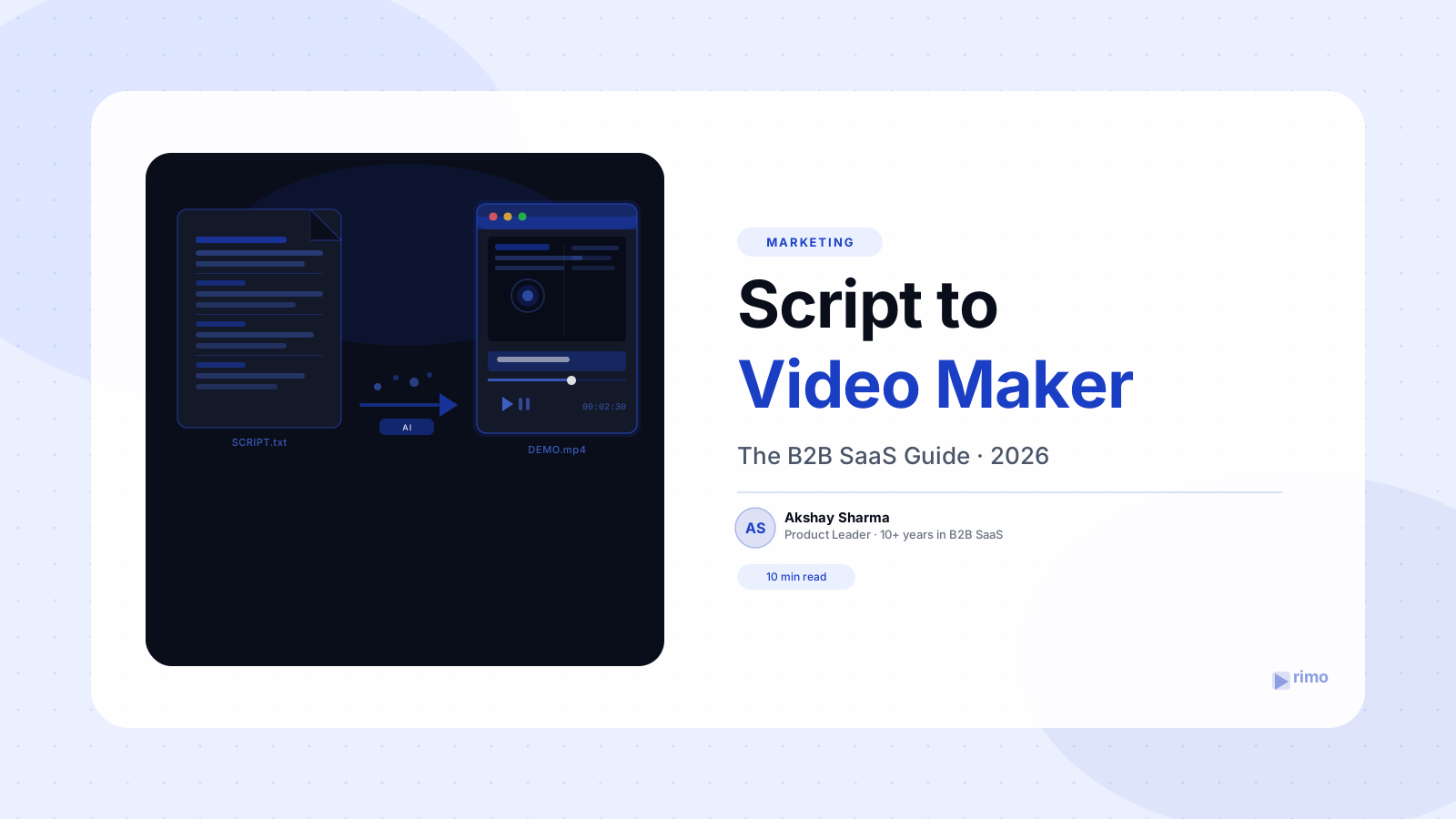
Script to Video Maker: The B2B SaaS Guide (2026)
Your product demo script is done. You've mapped the workflow, sequenced the value props, built the before-and-after arc. Now someone in Slack asks: "Can we turn this into a video by Thursday?"
Two years ago, that question meant booking a recording session, finding a freelancer, and bracing for a two-week turnaround. Today a script to video maker makes the answer possible in an afternoon.
That shift is real — but it comes with a catch most guides skip over. Not every script to video maker is built for the same job. A tool designed to turn a blog post into social clips will fail when you point it at a product demo script. The visuals it generates won't show your product. The voice won't match your brand. And six weeks later, when your UI ships a redesigned navigation bar, none of it will be updatable without starting over.
This guide covers what a script to video maker actually is, how the four main tool types work, and — critically — which ones are built for B2B SaaS product marketing versus which ones will waste your sprint.
In this guide
- What is a script to video maker?
- How a script to video maker works
- The 4 types of script to video makers
- Why most tools fail for product demos
- How to use a script to video maker for B2B SaaS
- Top tools compared
- How to choose the right tool
- FAQ
What is a script to video maker?
A script to video maker is a tool that takes written text — typically a structured video script — and converts it into a finished video automatically. You input the copy; the platform generates visuals, synthesizes voiceover, syncs timing, and produces a ready-to-publish file.
The category is broader than it looks. At one end, you have text-to-video AI platforms that pull stock footage to match your script and overlay a synthetic narrator. At the other end, you have purpose-built platforms that generate video from a product brief — using your actual product screens, your brand, your messaging — without you recording anything.
That distinction matters enormously for B2B SaaS teams. A stock-footage script to video maker gets you something fast. What it won't get you is a product demo video that shows buyers your actual software.
How a script to video maker works
The mechanics differ by tool, but the core process follows a consistent pattern:
1. Script input. You paste your script — written in scene-by-scene or line-by-line format — into the platform. Some tools accept a full-length script; others work better with short-form copy organized by section.
2. Visual matching. The platform analyzes the script and assigns visuals to each segment. In stock-footage tools, this means pulling B-roll from a media library based on keyword matching. In product-aware tools, this means generating or pulling product UI screenshots relevant to each script section.
3. Voiceover synthesis. An AI voice narrates the script. Most tools offer a selection of neural TTS voices across languages and tones. Some support voice cloning from a short sample of your own or a spokesperson's voice. The quality gap between AI voice over in 2022 and 2026 is dramatic — the robotic quality that once disqualified AI narration from professional use is largely gone for high-quality tools.
4. Timing and layout. The platform syncs voiceover to visuals, adjusts scene durations, adds captions, and applies brand elements like logo, colors, and lower-third text labels.
5. Export. You receive a finished video file, usually with a review layer where you can adjust specific scenes before downloading.
The critical variable — the one that separates tools — is what happens in step 2. Generic stock footage produces a generic marketing video. Your actual product screens, shown in context, produce a demo.
The 4 types of script to video makers
Not all tools in this category solve the same problem. Understanding the four main types prevents wasting time on a tool that's wrong for your use case.
1. Stock-footage text-to-video tools
Examples: Pictory, InVideo, Lumen5
These tools match your script text to stock footage clips from a library, then add synthetic voiceover. They're fast, affordable, and good for repurposing written content into social media video.
Where they work: Awareness content, social media clips, listicle-style videos where B-roll doesn't need to show actual product.
Where they break: Product demos. The AI scene selection consistently pulls imagery that's thematically related but visually inaccurate. A script line about "managing your pipeline" surfaces stock footage of a construction worker — not your CRM. This is the top frustration across G2 and Capterra reviews for Pictory: users spend as much time correcting AI visual selections as they would have spent building the video manually. Pictory's G2 reviewers also flag a voice quota issue — the platform consumes monthly usage just to preview a premium voice against your script, before you know whether the voice actually works for your content.
2. Avatar-based script to video tools
Examples: Synthesia, HeyGen, D-ID
These tools place a talking-head AI avatar on screen to narrate your script, with realistic lip-sync to the generated voiceover. Useful for training content and explainer videos where a human presenter adds authority.
Where they work: Corporate training, product onboarding walkthroughs narrated by a presenter, HR communications, and multilingual content at scale. Synthesia supports 140+ languages with realistic lip-sync — a genuine advantage for teams with global buyer audiences.
Where they break: You're constrained to a presenter-on-screen format. Synthesia's G2 reviewers consistently note that the platform doesn't support showing complex product interactions — if you need to demonstrate an actual workflow rather than narrate one, avatar tools hit a ceiling quickly. Enterprise pricing for advanced localization features also draws repeated criticism.
3. Slide-based script to video tools
Examples: Canva Video, Veed.io, Animaker
These tools build video from a sequence of designed slides, with each slide corresponding to a script section. You add visuals and text per slide; narration runs over the top.
Where they work: Process overviews, simple walkthroughs, educational content where visual complexity is low. Teams with design skills can produce polished content without much learning curve.
Where they break: Each slide requires manual visual design work, which erodes the speed advantage of a script-to-video workflow. The output also reads as "presentation-style" — a look that B2B buyers increasingly associate with lower-effort content, which is the wrong signal to send at the evaluation stage.
4. Product-aware script to video tools
Example: Rimo
These tools generate video from a product brief or structured script using your actual product screens — screenshots, feature flows, UI elements — rather than stock footage, slides, or avatars. You describe what you want shown; the platform produces a video using visuals that actually match your product.
Where they work: This category is built for product demo videos, product launch videos, and use-case-specific walkthroughs where buyers need to see the actual software. It's the only type that solves the two core problems of B2B SaaS video: visual accuracy and shelf-life.
Where they work best: Teams shipping frequent product updates. Because the source material is a description and brief rather than a locked recording, updates are faster and don't require re-recording every time a UI element changes.
Why most script to video tools fail for product demos
Here's the observation that most tool comparison articles miss: the script to video maker category was built for content creators, not product marketers.
Content creators need engaging video fast. Stock footage is acceptable because their content is about ideas, not interfaces. A video about "five productivity habits" doesn't need to show a specific app — it needs to be visually interesting.
Product marketing is different. The video's entire job is to make the buyer confident that your software will solve their specific problem. That requires showing them the actual software, in context, doing the thing they care about. Generic visuals don't build that confidence. They quietly undermine it — buyers notice when a demo video looks like it could belong to any product in the category.
73% of SaaS homepages still don't feature a product video, despite research showing that demo videos boost purchase likelihood by 1.81x and lift landing page conversions up to 86% (2026). The gap isn't a lack of interest in video. It's the difficulty of producing product-accurate video without a recording setup, an editor, and a two-week timeline.
The second failure mode is what experienced teams call the shelf-life problem. A B2B SaaS product ships every two to four weeks. The navigation bar changes, a feature gets renamed, a workflow gets simplified from four steps to three. None of these changes are dramatic — but they compound. Six months after you publish a demo video, there's a real chance it's showing buyers a product that no longer exists.
Stock-footage and avatar tools can't solve this. The footage is the footage. The only fix is re-recording from scratch. Nearly 70% of B2B software companies report that AI-powered video creation saves them over $80,000/year in production costs (Trainn, 2025) — but that ROI only materializes when the tool can actually produce and maintain accurate product video, not just fast generic video.
Script written. Ready for the video?
Rimo turns your product demo script into a polished video using your actual product screens — no recording session, no editing queue, no freelancer brief. From script to published in under an hour.
How to use a script to video maker for B2B SaaS
The workflow that produces usable B2B SaaS video from a script follows five steps, regardless of which tool type you choose.
Step 1: Write a structured script, not a prose document. Script-to-video tools work best with scripts written in scene units — short blocks that correspond to one visual moment. A good demo script organizes content by workflow step, with each step as its own scene. The SaaS demo script template covers this structure with ready-to-use frameworks for awareness, use-case, and sales-follow-up formats.
Step 2: Organize your visuals alongside the script. For stock-footage tools, note the B-roll concept you want per scene. For product-aware tools, note which product screen or feature each scene should show. This gives the AI better signal — and dramatically reduces the correction cycle after initial generation.
Step 3: Select voice and brand settings before processing. Most tools apply default settings if you don't configure them first. Selecting voice tone, speed, and language before processing your full script saves a full round of regeneration. On platforms that charge per generation, this is also a cost issue — a mistake at this step means paying twice for the same video.
Step 4: Review by scenes, not as a whole video first. Watch scene by scene to catch visual mismatches early. If you watch the full video first, you'll unconsciously average out individual problems and underestimate how much manual adjustment is needed. Catching a wrong visual on scene 3 is a 20-second fix. Realizing in the client review that half the scenes are wrong is a production restart.
Step 5: Export for the right destination. A homepage demo needs different dimensions and compression than a video attached in a sales email or embedded in a Highspot page. Set export specs before rendering — not after.
Top script to video maker tools compared
Here's a practical breakdown for B2B SaaS teams evaluating options:
| Tool | Best for | Visual source | B2B product demo fit |
|---|---|---|---|
| Pictory | Blog and content repurposing | Stock footage | Low |
| InVideo | Social media and marketing clips | Stock footage + templates | Low |
| Synthesia | Training and multilingual explainers | AI avatar | Medium |
| HeyGen | Spokesperson videos and localization | AI avatar | Medium |
| Canva Video | Slide-based walkthroughs | Designed slides | Low–Medium |
| Rimo | Product demo and launch videos | Product-aware AI | High |
The column that matters most for B2B SaaS is "Visual source." If your buyers can't see your actual product in the video, the video is doing awareness work at best — not conversion work.
For a deeper evaluation of purpose-built tools in this space, the demo video software guide covers pricing tiers, feature depth, and workflow integration in detail.
How to choose the right tool
The selection criteria come down to what the video actually needs to do:
If the video doesn't need to show your product UI: Any stock-footage tool works. Pictory and InVideo are fast, affordable, and require minimal setup. Use them for awareness content, social media, and thought leadership video where the goal is engagement, not product education.
If you need a presenter on screen: Avatar tools like Synthesia or HeyGen are the right fit — particularly when you need multilingual output at scale. Synthesia's lip-sync quality across 140+ languages is a real advantage for teams selling into international markets.
If the video must show your actual product accurately: You need a product-aware platform. Stock footage, avatars, and slides will produce something that looks like a demo but doesn't function as one. The gap between "looks like a product video" and "actually shows the product" is visible to buyers — even if they can't articulate why one feels more trustworthy than the other.
If your product ships frequently: The update cycle is your primary selection criterion. Tools that generate from a product brief can be refreshed faster than tools requiring re-recording. For teams running quarterly sprint cycles, the practical guide to automating demo video creation is worth reading before committing to a production workflow.
One thing worth saying plainly: the tool selection decision at most B2B SaaS companies is driven by price or brand familiarity, not job fit. A PMM who picks Pictory because it's well-reviewed and affordable will produce content that looks polished — and shows no product. Then wonder why the video isn't moving pipeline. Choosing the wrong category of tool is not a configuration problem you can fix. It's a category mismatch.
FAQ
What is a script to video maker?
A script to video maker is a tool that converts written text or a video script into a finished video automatically — generating or sourcing visuals, synthesizing voiceover, syncing timing, and producing a ready-to-publish video file. The category includes four main types: stock-footage tools, avatar-based tools, slide-based tools, and product-aware AI platforms, each suited to different content goals and use cases.
Can a script to video maker create a product demo video?
Only some script to video makers are built for this. Stock-footage and avatar-based tools cannot show your actual product UI — they produce generic visuals based on keyword matching. Product-aware platforms like Rimo generate demo video using your actual product screens, making them the correct choice for product demo content in B2B SaaS. Using the wrong tool type produces something that looks like a demo but won't convert like one.
How long does it take to create a video with a script to video maker?
Basic videos from short scripts typically take 5–15 minutes to generate after the script is input, depending on video length and render complexity. Product-accurate demo videos using product-aware tools require upfront context input but still produce finished video in under an hour — significantly faster than the 2–3 day turnaround of screen recording plus professional editing.
What makes a good script for a script to video maker?
The best scripts are structured by scene — short blocks of 1–3 sentences, each corresponding to a single visual moment. Each scene should describe one action, one benefit, or one product step. Avoid long paragraphs; AI tools parse and assign visuals more accurately when copy is organized in discrete units. For a ready-to-use structure, the SaaS demo script template covers awareness, use-case, and sales follow-up formats.
How much does a script to video maker cost?
Pricing varies significantly by type. Stock-footage tools like Pictory and InVideo start at $20–$30/month for basic plans. Avatar-based tools like Synthesia typically run $30–$90/month for standard tiers, with enterprise pricing for advanced localization. Product-aware AI platforms reflect more specialized capability — and the ROI calculation shifts when the alternative is a $5,000–$15,000 professional production per video. Research from Trainn (2025) found that nearly 70% of B2B software companies report AI-powered video creation saves them over $80,000/year in production costs once it replaces agency-led or freelance-led workflows.
Are script to video makers suitable for B2B SaaS marketing?
Yes — with the right tool selection. Script to video makers compress production time from weeks to hours and production cost from five figures to hundreds of dollars. The qualifier for B2B SaaS is product accuracy: buyers evaluating software need to see it working, not stock footage. The right evaluation question isn't "which script to video maker has the best reviews?" It's "which one can show my actual product?"
The right script to video maker doesn't just save time. It removes the structural bottleneck that keeps most B2B SaaS teams publishing fewer videos than they know they need. Every sprint that ships without a demo video is a sprint where buyers who didn't see the product didn't buy it.
If you're producing product demos that need to show real software — at the pace your product actually ships — try Rimo free and see how fast your next demo video actually takes.
Akshay Sharma
Product Leader · 10+ years in B2B SaaS
Akshay has spent 10+ years building and marketing B2B SaaS products. He writes about product storytelling, demo production, and the operational side of product marketing.