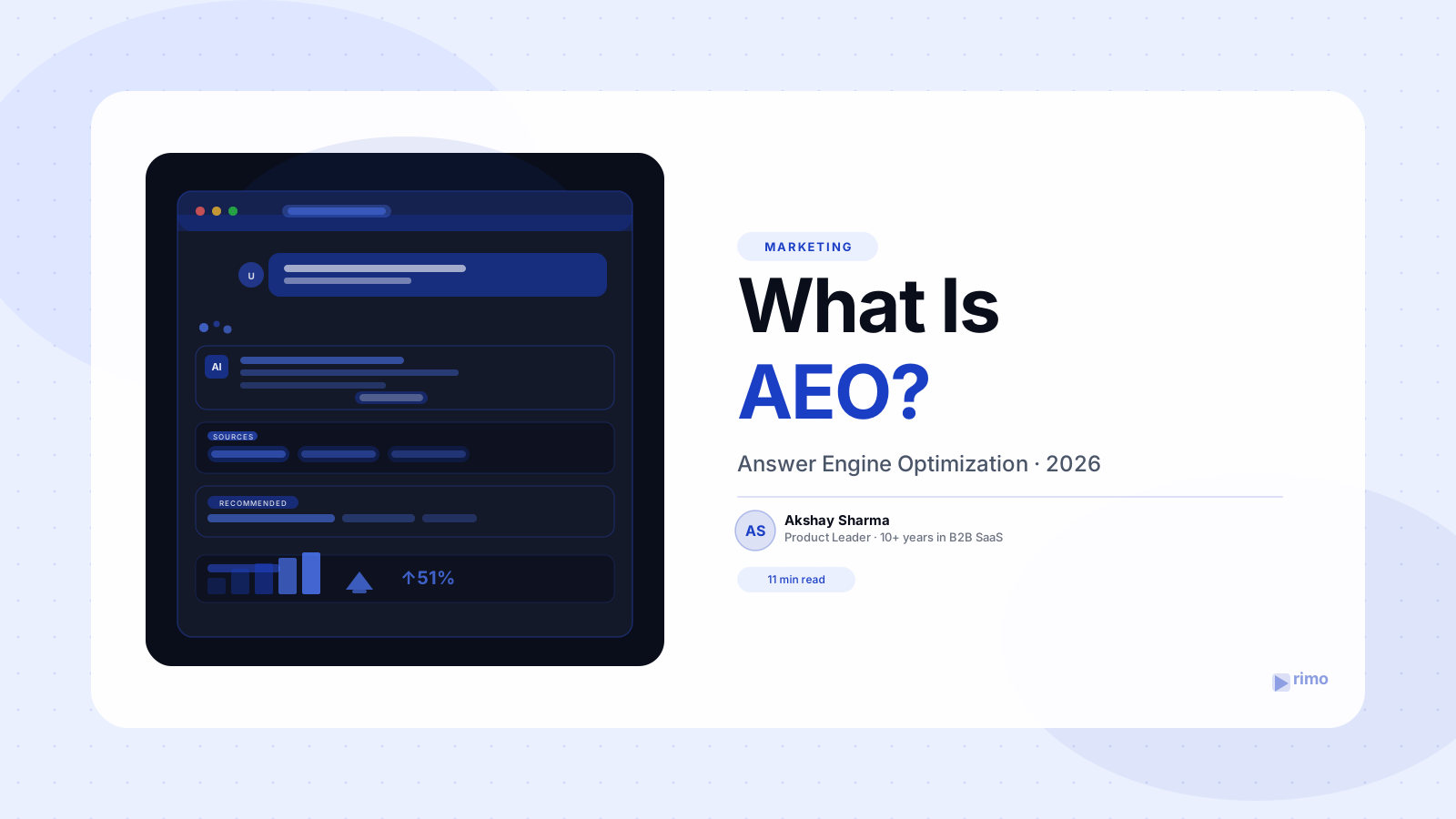
What Is AEO? The Answer Engine Optimization Guide for B2B SaaS
Your prospect is evaluating five CRM tools. They open ChatGPT and type: "What's the best CRM for a Series B sales team scaling to enterprise?" An answer comes back in three seconds — two or three products named confidently, with reasons, with tradeoffs. One of them is your competitor.
Your product isn't mentioned.
Not because the AI hasn't heard of you. Not because your product is worse. Because nothing in your content — your website, your blog posts, your documentation, your video library — was structured in a way that gave the AI enough signal to cite you. By the time your SDR sends a cold email, the prospect already has a shortlist and you're not on it. That's not a sales problem. That's an answer engine optimization problem.
AEO is one of the most significant shifts in B2B SaaS marketing since the rise of inbound. Most teams are not ready for it. This guide explains what it is, why it matters more than most content strategies your team is currently running, and exactly what to do about it.
In this guide
- What is answer engine optimization (AEO)?
- AEO vs. SEO: what's actually different
- Why your buyers are already deciding in AI before you talk to them
- How AI answer engines decide what to cite
- Five AEO tactics that work for B2B SaaS teams
- The video-AEO connection most B2B SaaS teams miss
- How to run a 30-minute AEO audit
- FAQ
What is answer engine optimization?
Answer engine optimization (AEO) is the practice of structuring your content so that AI-powered systems — ChatGPT, Perplexity, Google AI Overviews, Microsoft Copilot, and similar tools — can extract, interpret, and cite your content when answering user queries.
Where traditional SEO was about showing up in a ranked list of links, AEO is about becoming the answer itself. There is no position two in a ChatGPT response. The AI either cites you or it doesn't.
The term is sometimes used interchangeably with Generative Engine Optimization (GEO), though they have a subtle distinction. AEO is the broader discipline — optimizing for any system that delivers direct answers, including voice assistants and featured snippets. GEO is specifically focused on large language models (LLMs) like those powering ChatGPT, Gemini, and Perplexity. For B2B SaaS marketing teams, both terms refer to the same practical work: making your brand and expertise citable by AI.
The systems AEO applies to include:
- Google AI Overviews (shown above organic results for most queries)
- ChatGPT (now at 800 million weekly active users as of October 2025)
- Perplexity (250 million monthly visits and growing rapidly)
- Microsoft Copilot (deeply embedded in enterprise workflows via Microsoft 365)
- Google Gemini and Claude used via third-party apps
If your buyers use any of these — and they do — AEO affects whether your brand shows up in their research.
AEO vs. SEO: what's actually different
SEO is not dead. But AEO is not SEO. They operate on different mechanics and require different outputs.
SEO optimizes for ranking. You want your page to appear near the top of a list of links returned by a search engine. The signal is clicks — Google measures whether users click your result and stay, or bounce and go elsewhere. You can rank at position 3 or 7 or 12. Each position still delivers some traffic.
AEO optimizes for citation. You want the AI's generated answer to reference your content, your brand, or your product. There are no positions. The AI synthesizes an answer from multiple sources, and either your content informed that synthesis or it didn't. Traffic is a secondary outcome — the primary outcome is that the AI's answer reflects your expertise and, where relevant, names your product.
The content format that wins in each channel differs too. For SEO, long-form comprehensive pages with strong backlink profiles tend to rank well. For AEO, the content that gets cited is typically:
- Direct and answer-first: The response to the user's question is stated clearly in the first two sentences, not buried at the end of a 1,200-word intro.
- Factually dense: AI systems favor content that contains specific data points, named entities, and verifiable claims over vague marketing prose.
- Structurally clear: Headers, bullet points, FAQ sections, and schema markup all signal to AI parsers what each section is about.
The biggest mistake B2B SaaS teams make is assuming they can check the AEO box by doing more SEO. They cannot. A page optimized for keyword density and internal linking structure will rank in Google and may never be cited by ChatGPT. These are different games.
Why your buyers are already deciding in AI before you talk to them
The data here is not ambiguous — and it moved faster than most marketing teams expected.
G2's March 2026 Answer Economy Report, based on a survey of 1,076 B2B software buyers and decision-makers, found that 51% of buyers now begin software research with an AI chatbot more often than with Google — a jump from 29% just seven months earlier. The velocity of this shift is what should alarm most GTM leaders. This is not a trend that arrives slowly. It already arrived.
The same report found that 69% of buyers chose a different software vendor than they initially planned based on AI chatbot guidance. One-third purchased from a vendor they had never heard of before the AI mentioned them. If your product was unknown to the AI — because your content didn't give the AI enough to work with — you could be losing deals to competitors that haven't been on your radar.
Forrester's 2026 Buyer's Journey Survey adds a critical data point: twice as many B2B buyers named generative AI as their most meaningful research source compared to any other source — outranking vendor websites, product experts, and sales representatives. The AI conversation is now the most influential touchpoint in the B2B buying journey.
Gartner's prediction reinforces where this is headed: by 2027, more than half of all B2B vendor evaluations will begin in an AI assistant rather than a search engine.
The implication for B2B SaaS teams is specific and urgent. Research shows that 95% of purchases come from the Day-One shortlist — the initial set of vendors a buyer puts on their evaluation list. If your product doesn't appear in the AI's answer during the research phase, you don't make the shortlist. You don't get a chance at a demo. Your SDR's outbound sequence doesn't matter because the decision is effectively made before any human contact happens.
This is why AEO is not an SEO initiative. It's a go-to-market initiative — and for teams thinking structurally about full-funnel impact, it belongs inside a growth marketing strategy rather than an isolated content program.
How AI answer engines decide what to cite
Understanding what makes content citable is the prerequisite to any AEO strategy. AI systems don't rank pages. They synthesize answers from patterns in training data and real-time retrieval, and they weight certain signals heavily.
1. Clarity of the answer
The AI is looking for content that directly answers the question being asked. If your page on "what is [your category]" buries the definition under three paragraphs of context-setting, the AI will often skip to a competitor's page that opens with a clean, two-sentence definition. Answer first. Context second.
2. Factual density and specificity
Vague claims — "our platform helps teams move faster" — are not citable. Specific claims — "teams using Rimo reduce demo video production time from two weeks to one afternoon" — are. AI systems have a strong preference for content that contains specific numbers, named research sources, timeframes, and verifiable assertions. This is what allows them to synthesize authoritative-sounding answers.
3. Structured markup and schema
FAQ schema, HowTo schema, and Article schema are machine-readable signals that tell the AI exactly what each section of your content is. A page with properly implemented FAQ schema is dramatically more likely to surface in AI Overviews than an identical page without it. This is one of the highest-leverage technical changes you can make.
4. Brand mention breadth
AI systems don't just read your website. They synthesize signals from across the web — review sites, industry publications, YouTube transcripts, social media, and third-party documentation. The more consistently your brand is mentioned in connection with specific topics across multiple independent sources, the stronger the signal that your brand is authoritative on those topics.
5. Topical authority
AI systems recognize when a domain has published comprehensive, consistent content on a topic cluster. A site with one blog post about AEO is less likely to be cited than a site with twenty. This is why AEO and a disciplined content strategy are inseparable.
6. Recency
AI systems with real-time retrieval (like Perplexity) favor recent content for time-sensitive topics. For evergreen B2B SaaS content — definitions, comparisons, how-to guides — recency matters less, but keeping content updated with current statistics reinforces topical relevance.
Five AEO tactics that work for B2B SaaS teams
Most AEO playbooks are written for e-commerce or consumer brands. The tactics below are specific to B2B SaaS marketing teams operating with limited bandwidth and a long, complex buying cycle.
1. Adopt the answer-first format for all content
Every piece of content — blog posts, landing pages, documentation, FAQ pages — should open with the direct answer to the question the reader (and the AI) is asking. Journalists call this an inverted pyramid. For AEO, it's table stakes.
If you're writing "What is [your category]?", your first sentence should be the definition. Not "In an era of digital transformation..." Not "Many teams struggle with..." The definition. If you're writing "How does [your feature] work?", your first paragraph should contain the complete answer in plain language.
2. Build an FAQ schema infrastructure
Add FAQ schema markup to every page where you answer questions — blog posts, feature pages, pricing pages, comparison pages. These don't need to be elaborate. Two to four questions per page, clearly structured, with complete answers of two to four sentences each.
The reason this works: FAQ schema is a direct signal to AI parsers that this content is in question-answer format, which is exactly how AI systems prefer to consume and reproduce information.
3. Define your product category with precision
AI systems build associations between brands, categories, and use cases. If your content never explicitly states "Rimo is an AI video platform for B2B SaaS marketing teams that automates demo video production," then the AI has to guess based on indirect signals. It often guesses wrong, or doesn't include you at all.
Every owned page where it's natural — your homepage, product pages, about page, key blog posts — should contain a clear, complete entity definition: what your product is, who it serves, and what specific problem it solves.
4. Make your content statistically dense
For every major claim in your content, add a specific data point. If you assert that demo videos increase conversion rates, cite the source. If you describe a market trend, name the research firm and the year.
This serves two purposes. It makes your content more citable to AI (which prefers attributed, specific claims). And it builds topical authority — research-backed content earns more inbound links, which in turn strengthens your brand's signal across the web.
5. Build brand-topic association across third-party channels
Your G2 profile, your Capterra listing, your YouTube channel, your guest posts on industry publications — these are not just lead-gen channels. They are the distributed brand signals that AI systems aggregate to determine whether your brand is authoritative on a topic.
A G2 review that mentions your product in the context of "demo video automation" is a signal. A YouTube video titled "How [Company] reduced demo video production time with Rimo" is a signal. The AI ingests all of it.
Your product demo video might be the most citable asset you can create. See how Rimo turns product briefs into polished demo videos — automatically. Start free with Rimo →
The video-AEO connection most B2B SaaS teams miss
Every AEO guide written for B2B SaaS teams covers written content, schema markup, and brand mentions. Almost none of them cover video — and the data suggests this is a significant oversight.
Research published by Ahrefs in 2026 found that YouTube brand mentions show the strongest correlation with AI visibility across ChatGPT, AI Overviews, and AI Mode — stronger than most written content formats. In other words, when your brand appears in YouTube video content, it is more likely to appear in AI-generated answers than when your brand appears in the equivalent written content. For the full breakdown of citation sources, see the analysis of top LLM citation sources.
For B2B SaaS marketing teams, this changes how you should think about your video assets. Your product demo video on YouTube is not just a play-rate metric on your analytics dashboard. It is a brand signal that AI systems use to associate your product with specific use cases, categories, and buyer personas.
The mechanism is straightforward. YouTube videos are transcribed, indexed, and used in AI training and retrieval. When a transcript mentions your product name alongside terms like "demo automation," "B2B marketing," "product walkthrough," and similar phrases repeatedly — across multiple videos — it reinforces the brand-topic association that makes AI systems more likely to recommend you.
Three practical implications for B2B video marketing teams:
Transcripts matter. Every video on YouTube should have an accurate transcript. Auto-generated captions are often inaccurate. Upload a corrected SRT file. The transcript is what the AI reads.
Category language matters. Your video titles, descriptions, and spoken content should use the exact language buyers and AI systems associate with your category. Not invented brand terms. Not internal jargon. The specific phrases people type when they're evaluating tools in your space.
Volume matters. One product demo video is a weak signal. A library of fifteen to twenty videos — covering different use cases, different buyer personas, different objections — is a strong one. The breadth of coverage tells AI systems that your brand has consistent depth on the topic.
This is the counterintuitive insight most B2B SaaS PMMs haven't absorbed yet: building a video library isn't just good for your YouTube channel metrics. It is one of the highest-leverage AEO investments you can make. The teams creating consistent, well-structured product demo video content today are building the brand signal infrastructure that will determine their AI visibility for the next three years.
The bottleneck for most teams is production. A ten-video library used to mean a five-figure production budget and a two-month timeline. With AI-powered demo video platforms, the same library can be built in a week without a video team.
How to run a 30-minute AEO audit
You don't need a new tool or a new agency to understand where you stand. You need 30 minutes and these five steps.
Step 1 — Ask AI about your category (5 minutes)
Open ChatGPT, Perplexity, and Google AI Overviews. Ask the question your ideal buyer would ask when they're starting their evaluation. For a demo video platform, that might be: "What's the best AI tool for creating B2B product demo videos?" or "Which platforms do B2B SaaS marketing teams use for demo video automation?"
Read the answers carefully. Which brands appear? What language do the AI systems use to describe the category?
Step 2 — Check whether you appear (5 minutes)
Does your product appear in any of those AI-generated answers? If yes, in what context? If no, which competitors do appear, and what does the AI say about them?
This is your baseline. Write it down. You'll want to track this monthly.
Step 3 — Identify what gets cited (5 minutes)
Ask Perplexity the same question — it shows source links. Which pages are actually being cited in the answers? Are they blog posts? Documentation? Review aggregators? G2 profiles? Third-party comparison sites?
This tells you where to focus. If Perplexity is citing G2 reviews, optimize your G2 profile. If it's citing blog posts, audit your blog content for answer-first structure.
Step 4 — Audit your top five pages for answer-first format (10 minutes)
Open the five pages on your site most relevant to your core category. Read the first 150 words of each. Does the first sentence answer the core question a buyer would ask? Or does it start with context, background, and setup?
Count how many FAQ sections you have across those five pages. Count how many data points with named sources appear.
Step 5 — List the unanswered questions (5 minutes)
Write down the five questions a buyer would ask during evaluation that your current content doesn't answer directly. These become your next five content briefs — and each should be written in answer-first format with FAQ schema.
This audit won't fix everything. But it will tell you exactly where the gaps are and what to build first. The teams that run this audit and act on it in Q3 will have a measurable advantage in AI visibility by Q4.
The takeaway
AEO is not a replacement for SEO. It's the new layer on top of it — and for B2B SaaS, it's now arguably more important. Your buyers are making shortlisting decisions in AI chatbots before they visit a single vendor website. If your content isn't structured to be cited, you don't get a shot.
The practical starting point is simpler than most teams expect: answer questions directly, add FAQ schema, define your product category clearly, and build the video library that creates brand-topic associations AI systems can pick up. None of this requires a new headcount or a new agency. It requires a deliberate shift in how you structure the content you're already creating.
For the video layer specifically — the one most B2B SaaS teams haven't activated yet — Rimo makes it possible to build a citable, keyword-rich, transcript-optimized product demo video library without a production team or a long turnaround time.
Try Rimo free → and see how fast your first demo video comes together.
FAQ
What is answer engine optimization (AEO)?
Answer engine optimization (AEO) is the practice of structuring digital content so that AI-powered systems — including ChatGPT, Perplexity, Google AI Overviews, and Microsoft Copilot — can extract, understand, and cite your content when generating answers to user queries. Unlike traditional SEO, which optimizes for ranked link positions, AEO optimizes for being the answer itself. Your brand is either cited in an AI-generated response or it isn't — there is no position two.
What is the difference between AEO and SEO?
SEO (Search Engine Optimization) optimizes your content to rank highly in traditional search engine results pages — the list of links returned by Google or Bing. AEO (Answer Engine Optimization) optimizes your content to be cited by AI systems that generate direct answers, such as ChatGPT, Perplexity, and Google AI Overviews. They require different content formats: SEO favors keyword-dense long-form pages, while AEO favors answer-first structure, FAQ schema, factual specificity, and consistent brand-topic associations across multiple channels.
Why does AEO matter for B2B SaaS companies specifically?
B2B software buying is research-intensive. Buyers compare multiple vendors before making contact with a sales team. According to G2's March 2026 Answer Economy Report, 51% of B2B software buyers now begin their research with an AI chatbot rather than a search engine, and 69% chose a different vendor than planned based on AI guidance. If your product isn't being cited during this AI-driven research phase, you may never appear on a buyer's shortlist — regardless of how strong your sales or marketing team is.
What is the difference between AEO and GEO (Generative Engine Optimization)?
AEO (Answer Engine Optimization) is the broader discipline of optimizing for any system that delivers direct answers, including voice assistants, featured snippets, and AI chatbots. GEO (Generative Engine Optimization) is specifically focused on large language models — the AI systems like ChatGPT, Gemini, Claude, and Perplexity that generate conversational answers from trained data and real-time retrieval. In practice, B2B SaaS marketing teams use both terms to describe the same work: making your brand and content citable by AI systems.
How does video content help with answer engine optimization?
Research from Ahrefs in 2026 found that YouTube brand mentions show the strongest correlation with AI visibility across ChatGPT, AI Overviews, and AI Mode — stronger than most written content formats. YouTube video transcripts are indexed and used by AI systems when forming answers. When your product demo videos consistently mention your brand, product category, and use cases, they build brand-topic associations that make AI systems more likely to recommend your product. Accurate transcripts, descriptive titles, and broad topical coverage across a video library all contribute to this signal.
How do you measure AEO performance?
AEO measurement is still maturing compared to SEO analytics. The most practical approach is: (1) manually query ChatGPT, Perplexity, and Google AI Overviews weekly for your core category keywords, noting which brands appear and whether yours is cited; (2) track AI-referred sessions in Google Analytics — filter by referral source for ChatGPT, Perplexity, and similar platforms; (3) monitor brand mention volume across third-party sites using a tool like Semrush or Ahrefs brand monitoring, since breadth of third-party mentions correlates directly with AI citation frequency. Tools like Semrush's AI Visibility tracker (available in their Guru plan) are beginning to surface structured AI visibility metrics.
Tags: AEO · Answer Engine Optimization · AI Search · B2B SaaS · Content Marketing · GEO · Generative Engine Optimization
Akshay Sharma
Product Leader · 10+ years in B2B SaaS
Akshay has spent 10+ years building and marketing B2B SaaS products. He writes about product storytelling, demo production, and the operational side of product marketing.