Top Sources for LLM Citations: Why YouTube Leads and What B2B SaaS Teams Should Do
Three of the most important dashboards in B2B SaaS marketing are moving in the wrong direction simultaneously.
Google Ads costs per click rose roughly 40% over three years as conversion rates fell in 13 of 14 industries tracked by WordStream in 2025. Organic search traffic from informational queries — the blog content that used to fill pipelines — lost 61% of its click-through rate the moment Google started inserting AI Overviews above the results. And the text content strategy that worked in 2021 is now producing content identical to what every other marketing team told an AI to write, indexed into the same Google results nobody is clicking.
Marketing teams running all three channels at once are watching all three degrade at once. That's not a channel problem. It's a structural shift in how buyers discover and evaluate software. Understanding which channels are actually growing — and specifically which sources are being cited by AI systems when buyers ask about products — is now one of the most important strategic questions in B2B SaaS go-to-market.
The top sources for LLM citations are not random. They form a clear, data-supported pattern. And for B2B SaaS teams, the implications are more specific and more actionable than most marketing strategies currently in use.
In this guide
- Three marketing channels breaking at the same time
- The top sources for LLM citations: what 30 million citations reveal
- Why YouTube leads all LLM citation sources by 200x
- What the top cited sources have in common
- The business case for video as a citation strategy
- How to build a video library that LLMs actually cite
- FAQ
Three marketing channels breaking at the same time
The three channels degrading simultaneously are not coincidentally linked. They are all collateral damage from the same underlying shift: AI is now processing and synthesizing information that used to require a user to click through to your website to consume.
The paid channel problem
Google's average cost per lead jumped 25% in 2025, reaching $66.69 — up from $53.52 the year before (WordStream, 2025 Google Ads Benchmark Report). Return on ad spend declined 10% in the same period. CPCs have risen roughly 40% over the last three years while conversion rates improved only 7.5%.
The reason is mechanical. When 60% of Google searches end without a click — a share that has grown from 56% to 69% between May 2024 and May 2025 — there are simply fewer buyers arriving at landing pages. Fewer clicks means more competition for the clicks that remain, which drives CPCs up further. Advertisers who built pipeline models on 2016 or even 2020 performance benchmarks are now running the same spend against a fundamentally smaller addressable click pool.
Paid social is not the escape. Facebook and LinkedIn CPMs have followed the same upward curve as Google, driven by increasing advertiser demand on platforms with limited new inventory.
The ROI on paid that justified aggressive spend ten years ago is not coming back. The economics changed when search behavior changed.
The SEO and organic search problem
Organic search was supposed to be the cost-effective alternative to paid. For a decade, the standard B2B SaaS playbook was straightforward: publish high-quality blog content targeting buyer-intent keywords, rank on page one, generate organic traffic, convert to leads. It worked.
What happened was this: Google deployed AI Overviews at scale. By Q1 2026, AI Overviews appear in approximately 13% of all search queries globally — and on informational queries where those Overviews appear, organic click-through rates fell 61% compared to pre-Overview baseline (Seer Interactive, 2025). Google answers the question directly. The user doesn't need to click.
HubSpot, one of the most sophisticated content marketing organizations in B2B SaaS, lost 70–80% of its organic traffic between November and December 2024. Monthly organic visits dropped from approximately 13.5 million to under 7 million in a single month. If that can happen to HubSpot's domain authority, it can happen to any B2B SaaS blog operating with standard on-page SEO.
The counterintuitive observation here: Google is not penalizing SEO. Google is simply answering questions itself. Ranking well no longer guarantees traffic. The channel has fundamentally changed.
The text content saturation problem
The response from most marketing teams has been to publish more. More blog posts, more guides, more how-to content. Most of it now starts with a ChatGPT or Claude prompt.
Google's March 2026 "scaled content abuse" enforcement targeted this directly. Sites publishing hundreds of AI-generated pages without editorial oversight saw 50–80% traffic losses. Niche information sites with 500 or more AI pages published in 2025 saw 60–80% traffic loss — not because the content was AI-generated, but because it provided no information that couldn't be found identically elsewhere.
The underlying problem is more fundamental than a Google algorithm update. When it costs almost nothing to publish 500 blog posts, 500 competitors publish 500 blog posts. The supply of text content answering any given question is now effectively infinite. Differentiation through text volume is over.
The top sources for LLM citations: what 30 million citations reveal
If paid is expensive and declining, SEO is being cannibalized by AI Overviews, and text content is oversaturated — where does growth come from?
The answer is in what AI systems actually cite when they answer questions. Every time ChatGPT, Perplexity, Google AI Mode, or Gemini generates an answer, it draws on sources. Those sources get brand visibility and implicit recommendation at the most influential moment in the B2B buying journey — before the buyer has visited any vendor's website.
Analysis of tens of millions of citations across major AI platforms (Semrush, 2025; Peec AI 2026; LLM Pulse 2026) consistently surfaces the same top-tier domains:
The top 10 most-cited domains across AI platforms:
- Reddit — The most-cited domain across Perplexity, ChatGPT, and Google AI Mode. Community-based experience and opinion, not brand content.
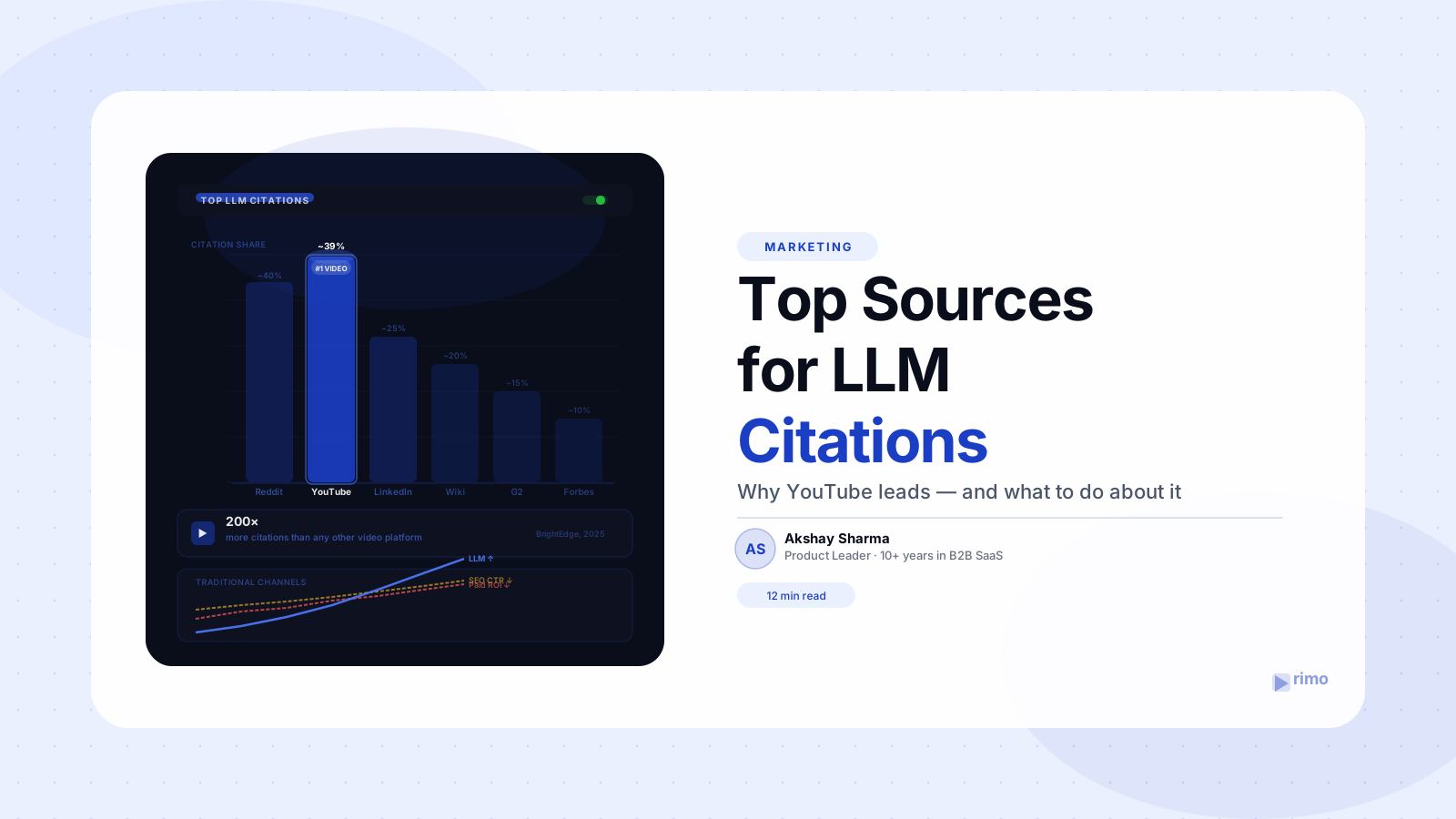
- YouTube — Second most-cited overall; #1 in Google AI Overviews (cited in 29.5% of all AI Overview responses).
- LinkedIn — Cited heavily by both ChatGPT and AI Mode for professional and B2B queries.
- Wikipedia — Dominant in ChatGPT specifically, which accounts for up to 48% of its top-10 citation share.
- Forbes — The leading editorial brand in B2B AI citations.
- G2 — The highest-ranking review platform; heavily cited by Perplexity for software and vendor queries.
- Yelp — Local and consumer review context.
- Facebook — Growing citation share in social context queries.
- Medium — Long-form independent opinion and analysis.
- TechRadar — Technology editorial.
For B2B SaaS marketing teams, the immediately actionable domains on this list are: YouTube, LinkedIn, G2, and Medium — the four platforms your team can directly create and optimize content on, without requiring domain authority you don't have.
The concentration is striking. The top 15 domains capture 68% of all consolidated AI citation share across platforms (Peec AI, 2026). AI citation is not democratized the way Google rankings can be for long-tail keywords. The rich get richer here — but the list of "rich" sources includes platforms any company can publish on.
One critical caveat: citation patterns are volatile. ChatGPT's Reddit citation share fell from roughly 60% to 10% in six weeks in late 2025 following a single Google infrastructure change. Any strategy built around a single platform's citation share is fragile. The durable play is building brand signal across multiple top-cited sources simultaneously.
This is exactly what answer engine optimization practitioners call "brand-topic association breadth" — and it is the structural advantage that compounds over time.
Why YouTube leads all LLM citation sources by 200x
YouTube is not just the second most-cited domain overall. In video content, it is in a category of one.
BrightEdge analyzed citation patterns across Google AI Overviews, Google AI Mode, ChatGPT, and Perplexity from May 2024 through 2025. Their finding: YouTube is cited 200 times more than any other video platform in AI search results. Vimeo, TikTok, Dailymotion, and Twitch are statistically invisible by comparison, each registering 0.1% or less of YouTube's citation volume.
YouTube commands approximately 39.2% citation share across AI platforms — up from 18.9% when BrightEdge began tracking. In Google AI Overviews specifically, YouTube is the single most-cited domain overall, appearing in 29.5% of AI Overview responses — ahead of editorial giants like the Mayo Clinic, Forbes, and Wikipedia.
The platform-agnostic nature of this preference is what makes it significant. Perplexity and ChatGPT have no commercial incentive to favor Google properties. They cite YouTube anyway, because YouTube content delivers what AI systems are looking for.
Why YouTube specifically?
1. Transcripts are structured, machine-readable text. Every YouTube video generates a transcript. High-quality videos with accurate captions — either auto-generated and corrected, or uploaded manually — give AI systems a clean, text-readable version of the spoken content. A 10-minute educational video contains roughly 1,500 words of dense, topically focused content that an AI can parse, extract, and cite.
2. Descriptions, chapters, and metadata create semantic structure. A well-optimized YouTube video includes a description with relevant terms, chapter markers that segment content into distinct topics, and tags. This structure tells AI systems what each segment of the video is about — the same function that FAQ schema and header tags serve on a web page.
3. Long-form educational content is semantically dense. AI systems prefer content that is specific, informative, and factually detailed. A YouTube video explaining "how to run a product demo for enterprise buyers" is semantically denser than a 500-word blog post on the same topic. The audio content has depth that text content rarely matches at equivalent length.
4. Popularity is not the deciding factor. This is the most important insight for B2B SaaS teams: BrightEdge found that 41% of YouTube videos cited by AI search have under 1,000 views. AI systems are not citing the most-watched videos. They are citing the most informative ones. A product walkthrough with 200 views that clearly explains a specific workflow is more likely to be cited than a polished brand video with 50,000 views that says nothing specific.
The implication for B2B video marketing strategy is direct. You do not need to build a YouTube channel with millions of subscribers. You need to build a library of specific, transcript-rich, well-described videos covering the exact questions your buyers ask during evaluation.
The citation play is in specificity, not scale. A library of 20 videos covering distinct use cases, buyer personas, and product workflows is more valuable for LLM citations than one viral video. See how Rimo makes that library buildable in a week. Start free →
What the top cited sources have in common
Look at the top 10 cited domains and a pattern emerges that text-heavy content strategies miss entirely.
They are predominantly human-generated. Reddit, YouTube, LinkedIn, G2 — these are platforms where real people write, speak, and review from direct experience. Yelp, Facebook, Medium — same. The AI systems that are replacing search are, somewhat ironically, most drawn to human-generated, experience-based content. They cite opinion, firsthand accounts, and real-world demonstrations far more than they cite polished brand copy.
They carry multi-format signals. YouTube provides transcript text, audio, video, descriptions, comments, and engagement metrics. Reddit provides post text, community discussion, voting signals, and linked references. LinkedIn provides professional profiles, company associations, and professional context. Each of these platforms gives AI systems multiple signal types to assess authority and relevance — far more than a blog post on your own domain.
They have structural organization AI can parse. YouTube chapters. Reddit thread structure. G2 review categories and rating breakdowns. LinkedIn articles with headers and lists. These structures make content machine-readable in ways that unstructured prose cannot match.
They create brand-topic associations at scale. When ten different YouTube videos mention your product in the context of "enterprise demo automation," and twenty G2 reviews describe your product using similar language, AI systems build a strong association between your brand and that topic cluster. A single well-written blog post on your own domain cannot replicate that distributed signal.
The common thread is this: AI systems trust evidence over assertion. A buyer testimonial on G2 is evidence. A product demo walkthrough on YouTube is evidence. A LinkedIn post from a practitioner describing how they use your tool is evidence. A marketing blog post asserting that your product "transforms" something is assertion. AI systems systematically favor the former.
The business case for video as a citation strategy
Most B2B SaaS teams underinvest in video because the production math has never worked. A single high-quality product demo video used to require two to three weeks, multiple stakeholders, a freelance editor or agency, and anywhere from $3,000 to $10,000. Building a library of 20 videos — the volume needed to meaningfully build brand-topic association across use cases — was a quarterly project with a significant budget.
This math changes the strategic calculus completely. If producing 20 videos costs $80,000 and takes three months of planning, video becomes a strategic bet reserved for major product launches. If producing 20 videos costs an afternoon, it becomes a standard marketing motion that runs continuously alongside product releases, feature updates, and new use cases.
The citations data makes the ROI argument straightforward. Your product demo video on YouTube does three things simultaneously: it gives buyers a self-serve evaluation asset; it builds organic presence on a platform with 2+ billion monthly users; and it creates a machine-readable, AI-citable brand signal that influences buyers before they ever visit your website.
A single piece of content doing all three simultaneously is an extremely efficient asset. The only reason most B2B SaaS teams don't have 30 of them is that production has historically been slow, expensive, and painful.
The video platforms and AI tools that have emerged in the last 18 months have changed that. What matters now is not whether you can afford video — it's whether your team has built the production process to create video consistently and at scale.
How to build a video library that LLMs actually cite
Getting cited by AI systems is not primarily a promotion problem. It is a production problem. You cannot promote content you haven't created. Here is how to build the library that earns citations.
Build for use cases, not for views
The citation data is clear: AI systems cite specific, informative videos regardless of view count. Build each video around a specific buyer question or use case: "How [your product] works for enterprise sales teams," "How to set up [your integration] in under 10 minutes," "Why [your product] is used instead of [common alternative]."
Each video is a targeted asset addressing one specific query. 20 targeted videos covering 20 specific use cases will generate more LLM citations than one polished brand video covering everything generically.
Make transcripts the priority
Upload corrected transcripts to every video. Do not rely on YouTube's auto-generated captions — they contain errors that reduce semantic quality. The transcript is what AI systems read. Treat it with the same care you'd give a blog post. Use the exact language buyers use when they describe their problems and evaluate solutions.
Write descriptions for AI, not humans
A good YouTube description for LLM citations is 200–400 words of structured text: what the video covers, who it's for, what specific outcome it demonstrates, and what related topics it touches. Think of it as the metadata that tells the AI what to do with the transcript. Include your product category language, buyer persona, and use case terms naturally.
Volume beats perfection
The instinct in most marketing teams is to make each video production-quality before publishing. For LLM citations, this is the wrong optimization. A video that is informative, specific, and transcript-accurate — even if the production aesthetics are modest — will be cited. A production-perfect video that says nothing specific will not.
Aim for 20 videos covering your core use cases before you worry about visual polish. AI systems don't grade production value.
Pair video with G2 review generation
The two most impactful B2B SaaS platforms for LLM citations are YouTube and G2. A systematic program to generate G2 reviews — ideally reviews that describe specific use cases in the reviewer's own words — builds the same distributed brand-topic association that YouTube does, through a different channel. Running both in parallel creates overlapping citation signals that reinforce each other.
The takeaway
The three marketing channels that powered B2B SaaS growth over the last decade are all under pressure simultaneously. Paid is expensive. Organic search is being cannibalized by AI answers. Text content is oversaturated.
The top sources for LLM citations reveal where buyer attention actually goes during AI-assisted research: Reddit, YouTube, LinkedIn, G2. Three of those four are platforms where B2B SaaS companies can publish directly. YouTube alone commands a 200x citation advantage over every other video platform and appears in 29.5% of all Google AI Overview responses.
The strategic bet for B2B SaaS marketing teams is clear: build the video library that earns citations. Not one video per quarter. A library of 20 or more — covering use cases, personas, comparisons, and product walkthroughs — that gives AI systems the specific, transcript-rich, structured content they consistently prefer to cite.
The only bottleneck is production. Rimo exists to remove it.
Try Rimo free → and build your first citation-worthy product demo video today.
FAQ
What are the top sources for LLM citations?
Based on analysis of 30+ million citations across ChatGPT, Perplexity, Google AI Overviews, and Gemini (Semrush, 2025; Peec AI, 2026), the top 10 most-cited domains are: Reddit, YouTube, LinkedIn, Wikipedia, Forbes, G2, Yelp, Facebook, Medium, and TechRadar. The top 15 domains capture approximately 68% of all AI citation share. For B2B SaaS marketing teams, the most actionable platforms on this list are YouTube, LinkedIn, G2, and Medium — all of which any company can publish on directly.
Why is YouTube cited so much more than other video platforms?
BrightEdge research found that YouTube is cited 200 times more than any other video platform — including Vimeo, TikTok, and Dailymotion — by AI systems including ChatGPT, Perplexity, and Google AI Overviews. The reasons are structural: YouTube videos produce machine-readable transcripts that AI systems can parse as text, video descriptions and chapter markers create semantic structure, and the content is typically informative and specific. Critically, 41% of YouTube videos cited by AI have fewer than 1,000 views — AI systems cite for information density, not popularity.
Is SEO dead? Should teams stop investing in organic content?
SEO is not dead, but its model has changed significantly. Google AI Overviews now appear in 13% of all queries, and organic CTR on informational queries where Overviews appear has fallen 61% (Seer Interactive, 2025). Teams should continue optimizing for search, but the content format needs to shift — answer-first structure, FAQ schema, and factual specificity that can be cited in AI answers. The pure "publish more blog posts" approach no longer generates proportional returns. The most durable content investments in 2026 combine SEO and AEO (Answer Engine Optimization) principles simultaneously.
Why is text content becoming less effective for organic growth?
Two forces are compressing text content returns simultaneously. First, AI Overviews are intercepting informational query traffic before it reaches blog posts. Second, the supply of text content has expanded faster than demand — because AI writing tools make it trivial to produce hundreds of blog posts. Google's March 2026 "scaled content abuse" enforcement targeted sites publishing high volumes of thin AI-generated pages, with sites losing 60–80% of their traffic. Differentiation through text volume alone is no longer a viable strategy. The content that still performs combines genuine expertise, original data, and structured formatting that earns AI citations.
How many videos does a B2B SaaS company need to start seeing LLM citation results?
There is no hard minimum, but the goal is building enough topical coverage to establish consistent brand-topic association. A library of 15 to 20 videos covering distinct use cases, personas, and product workflows gives AI systems enough signal to associate your brand reliably with your category. Each video should focus on a specific buyer question rather than covering everything broadly. With modern AI-powered video platforms, a library of this size is buildable in a week rather than a quarter — removing the production bottleneck that has historically made video content underinvested relative to its impact.
How is LLM citation different from traditional SEO ranking?
SEO ranking determines where your page appears in a list of links on a search results page — you can rank 3rd, 7th, or 15th. LLM citation is binary: the AI either cites your content in its answer or it doesn't. There are no positions. Additionally, the signals that drive LLM citations differ from traditional ranking signals — structured schemas, answer-first content format, brand mention breadth across third-party platforms, and transcript quality in video content all matter more than backlink profiles and keyword density. This distinction is the foundation of Answer Engine Optimization (AEO), which is the emerging discipline addressing how to earn AI citations rather than search rankings. For teams specifically optimizing for generative AI platforms like ChatGPT and Perplexity, generative engine optimization (GEO) builds on these principles with LLM-specific tactics.
Tags: LLM Citations · YouTube · AI Search · Content Strategy · B2B SaaS · Video Marketing · AEO
Akshay Sharma
Product Leader · 10+ years in B2B SaaS
Akshay has spent 10+ years building and marketing B2B SaaS products. He writes about product storytelling, demo production, and the operational side of product marketing.