What Is a Sales AI Demo Agent? The B2B SaaS Guide (2026)
Your prospect fills out the "Book a Demo" form at 9:47 PM on a Tuesday. Your AE sees it Wednesday morning, sends a Calendly link by noon. The prospect picks Thursday at 2 PM. By then, it's been thirty-eight hours — and according to internal data from multiple B2B SaaS teams, somewhere between 25 and 35 percent of prospects who book a demo never show up to it. They found another answer, lost urgency, or just moved on.
That gap — between request and access — is one of the most expensive problems in B2B SaaS, and most teams treat it as simply the cost of doing business. It isn't. It's a product problem that now has a product solution.
A sales AI demo agent closes that gap by running a personalized, qualified product demo the moment a buyer requests one — without a sales rep, without a scheduled call, and without waiting until business hours in your time zone. This guide explains exactly what a sales AI demo agent is, how it works mechanically, when it outperforms other demo formats, and when it doesn't.
In this guide
- What is a sales AI demo agent?
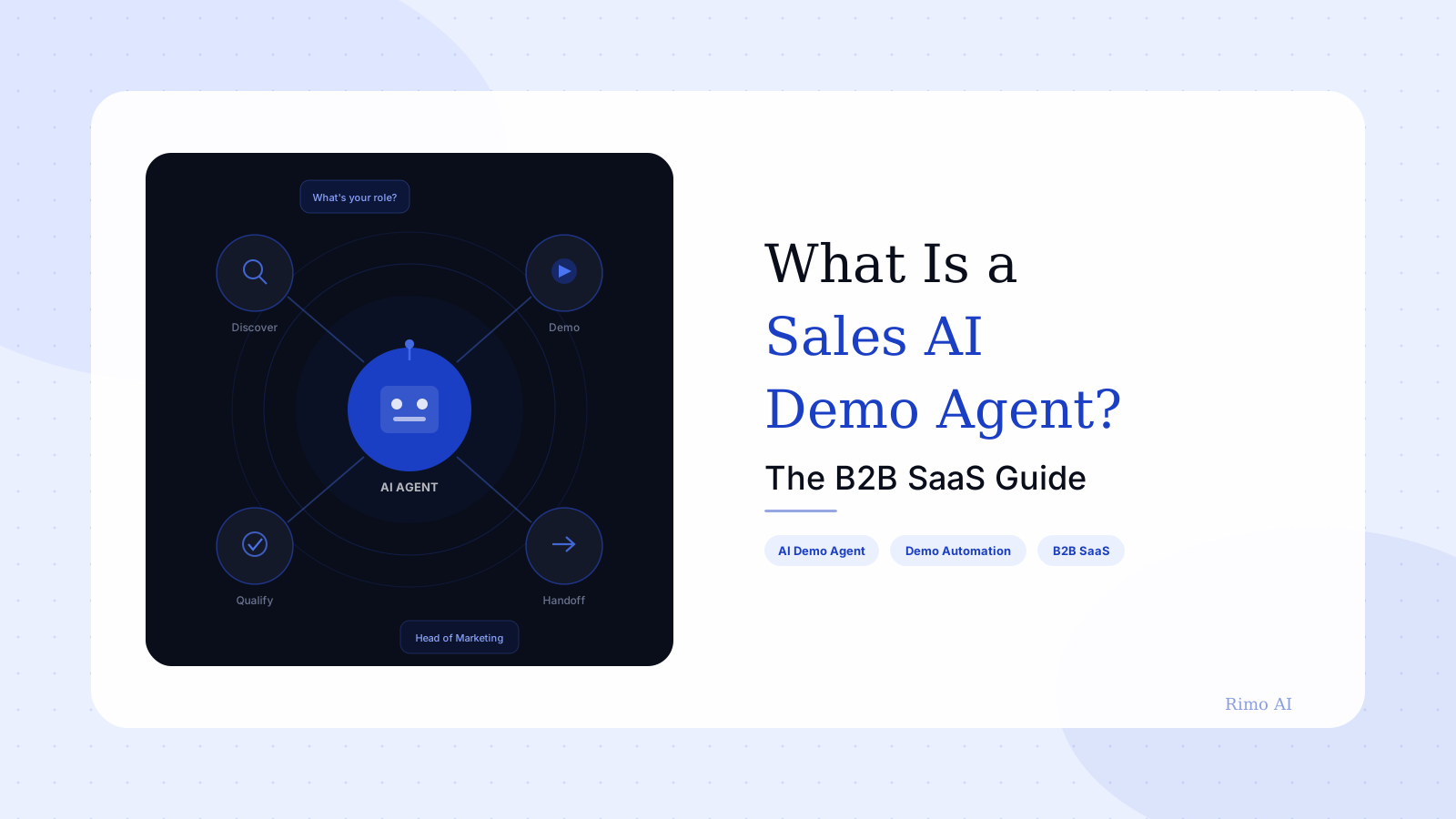
- How a sales AI demo agent works: the 4-step flow
- Sales AI demo agent vs. interactive tour vs. AI demo video
- 5 use cases where a sales AI demo agent converts best
- What separates great AI demo agents from average ones
- When NOT to use a sales AI demo agent
- How to build a demo stack around an AI demo agent
- FAQ
What is a sales AI demo agent?
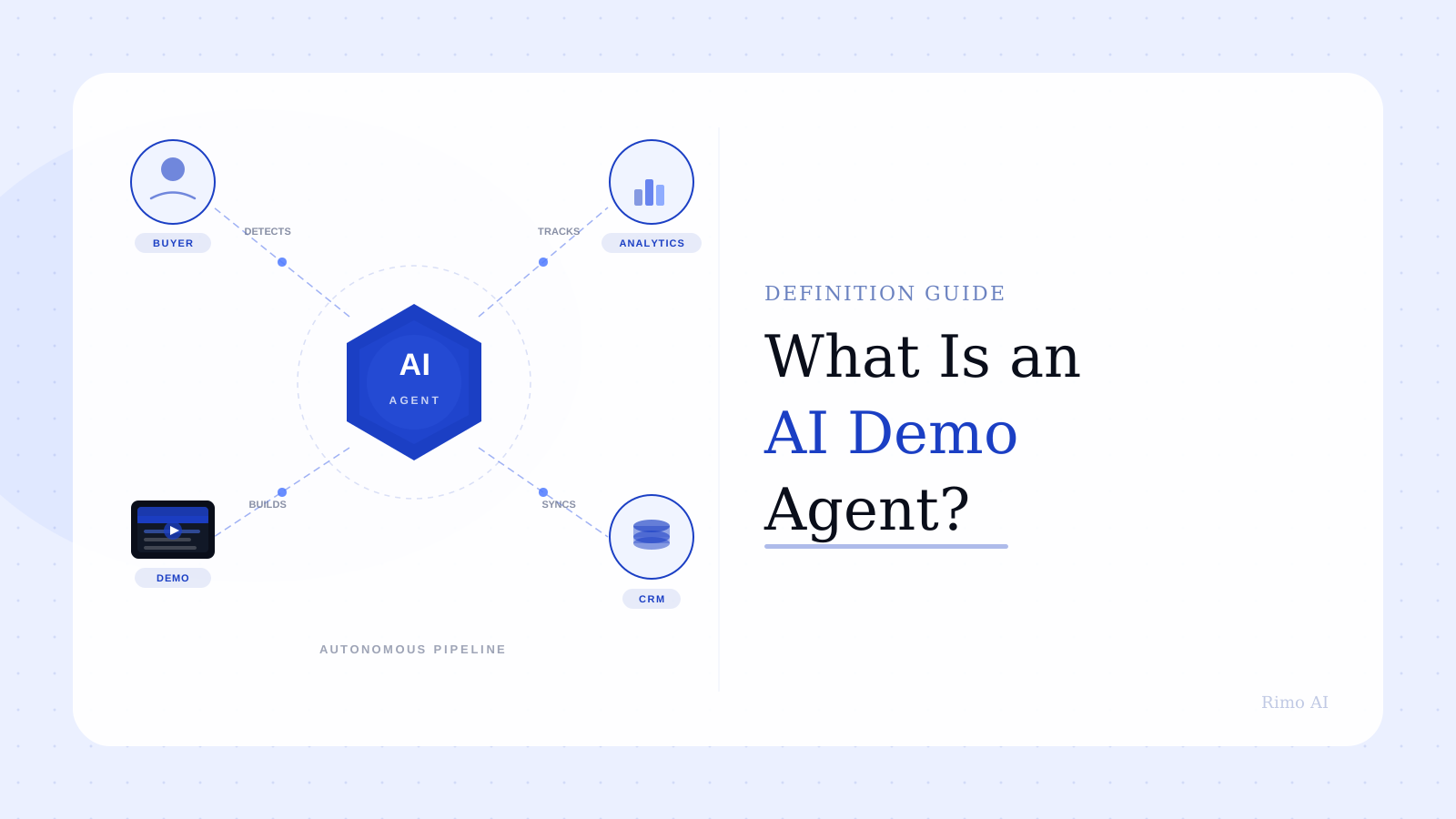
A sales AI demo agent is an autonomous software system that conducts personalized product demonstrations on behalf of your GTM team — without requiring a human sales rep or pre-scheduled call. It converses with the buyer in natural language, asks discovery questions to understand their role and problem, adapts the product walkthrough accordingly, handles objections in real time, and routes qualified buyers toward the next step in your pipeline.
The key word is autonomous. This is not a chatbot that answers FAQ questions, and it's not a scripted interactive tour where buyers click through screenshots. A sales AI demo agent makes decisions: which product capabilities to show, in which order, how deep to go on a specific feature, when to pivot based on what the buyer says.
The category emerged in late 2024 and exploded in 2025–2026. Platforms like Supademo, Naoma, Saleo, and Consensus have all introduced agent layers onto their demo tooling. At least six pure-play AI demo agent startups launched in that window. The trigger was the same across all of them: Gartner's finding that 67% of B2B buyers now prefer a rep-free experience for at least part of their evaluation (Gartner, 2026).
How a sales AI demo agent works: the 4-step flow
Understanding the mechanics makes it easier to evaluate whether this category solves your specific problem. Most production-grade AI demo agents run through four sequential phases.
Step 1: Entry and intent detection
The agent activates at a trigger point — a website demo request form, a pricing page visit, a product trial sign-up, or a link embedded in a sales email. It immediately opens a conversational interface. Some agents present as a chat window; others render as a video avatar with a voice. Both formats are live in the market.
This is the moment that defines the agent's ceiling. The best agents don't open with "Hi, I'm Rimo's AI Demo Agent, how can I help?" That's a chatbot introduction. They open with a question: "What problem were you trying to solve when you landed here?" The framing sets the tone for a discovery conversation, not a support ticket.
Step 2: Discovery
The agent asks structured questions to understand the buyer's context. Role (AE, PMM, IT director). Company size. Current tools in use. The specific workflow they're trying to fix. Timeline. Budget signals.
This is not arbitrary. The discovery answers directly determine which product paths the agent walks through. A sales engineer at a 500-person SaaS company asking about API integrations should see a completely different demo than a head of marketing at a 20-person startup asking about one-click video creation. The agent personalizes in real time based on what it learns.
Step 3: Personalized demo delivery
With discovery answers in hand, the agent navigates your actual product or a sandboxed replica. It highlights the capabilities most relevant to what the buyer described, explains the "why" not just the "what," and responds to interruptions. A buyer who types "wait, can you show me how that integrates with Salesforce?" gets that exact answer, mid-flow.
This real-time adaptability is what separates agents from recorded demos. A product demo video is fixed content — it shows the same thing to every viewer. An AI demo agent adjusts on every axis based on what's happening in the conversation.
Step 4: Qualification and handoff
After the demo, the agent captures intent signals: how many questions the buyer asked, which features they asked about, whether they mentioned timeline or budget. It routes high-fit buyers directly to a human rep with a structured handoff note — role, stated pain point, features they cared about, next step they requested. Low-fit or early-stage prospects get routed to self-serve resources or a nurture sequence.
This qualification layer is where the ROI calculation lives. Your AEs aren't fielding every demo request; they're fielding the ones the agent has pre-qualified as worth their time.
Sales AI demo agent vs. interactive tour vs. AI demo video
Three distinct formats now compete for the same buyer moment, and most content in this space conflates them. They are not the same thing.
Interactive product tour — A pre-built, click-through walkthrough of your product. The buyer navigates at their own pace, but the path is predetermined. Tools like Storylane, Navattic, and Arcade build these. They're excellent for product pages, G2 profiles, and onboarding. They're buyer-controlled, not AI-driven. G2 reviewers of Storylane consistently flag two limitations: no mobile-responsive rendering, and shallow analytics on lower-tier plans. The tours show the same content to every viewer regardless of what the buyer said they needed.
AI demo video — A polished, pre-rendered video of your product that uses AI to generate narration, branding, and structure from a brief or script. Tools like Rimo build these. Unlike interactive tours, they play like a broadcast — one direction, fixed content. The advantage is production quality and scalability: a single brief produces a professional video in under two hours. They work exceptionally well for async follow-up, outbound sequences, website hero sections, and re-engaging stalled deals. You can explore AI demo video generators as a category to compare tools.
Sales AI demo agent — Conversational, adaptive, real-time. The buyer talks; the agent responds. Discovery happens before the demo starts. The product walkthrough adapts to what the buyer said. This is the highest-lift format to build and the most resource-intensive to maintain, but it converts best for high-intent, mid-funnel buyers who are ready to evaluate but not ready for a human call.
The correct framing: these aren't competing products. They're different tools for different moments in the buying journey. A mature GTM team uses all three. The question is which moment belongs to which format — and that's what the next section answers.
5 use cases where a sales AI demo agent converts best
The demo automation market doesn't have a use-case problem. It has a deployment problem. Teams buy the tool without mapping it to a specific moment in their funnel. These five use cases have the clearest evidence for AI demo agent deployment.
1. High-intent website visitors
A buyer who navigates to your pricing page, reads the demo page, and clicks "Request a Demo" is showing intent signals that most teams ignore at the moment they're strongest — by making them wait. An AI demo agent on that page runs the demo immediately, in the same session. Supademo's internal data shows that buyers who see the demo immediately convert at rates 4–6x higher than buyers who are routed to a "we'll follow up" form.
2. Off-hours and international prospects
Sixty-seven percent of buyers prefer rep-free evaluation. But even among the 33% who want a human, many are in a time zone where your sales team is asleep. An AI demo agent is the only format that handles a Tokyo-based buyer's 11 PM product evaluation without requiring overnight SDR coverage.
3. Top-of-funnel qualification
Not every inbound lead deserves AE time. An AI demo agent runs discovery before any human is involved, scores the output, and separates buyers who described a real use case from those who are exploring broadly. This is particularly high-value for PLG companies where trial volume is high and qualification bandwidth is scarce.
4. Complex multi-persona products
If your product serves very different buyers — a head of marketing, a RevOps manager, and a CFO all buying the same platform for different reasons — an agent can detect which persona is in the conversation and adapt accordingly. This is where static interactive product tours break down: they force you to choose a single path or build separate tours for each persona, both of which are maintenance-intensive.
5. Event and conference demos
At a trade show, your demo station gets a thousand visitors with different levels of interest. A human rep can run maybe 20 good demos per day. An AI demo agent runs concurrent conversations with no degradation in quality between session 3 and session 47. Buyers can self-select into the experience at whatever depth they want.
AI demo videos that pair perfectly with your demo agent
Rimo generates screen-accurate, branded product demo videos from a plain-English brief — in under two hours. Use them for outbound follow-up, post-agent nurture sequences, and website hero content. No video team needed.
What separates great AI demo agents from average ones
The category is young enough that quality varies enormously. These five criteria separate production-grade agents from demos that will frustrate buyers.
Discovery depth. The best agents ask 4–6 discovery questions before showing anything. Average agents ask one question, then default to a generic walkthrough. If the agent can't adapt its path based on answers — if every buyer sees the same feature sequence regardless of what they said — it's a scripted tour with a chat widget bolted on, not an agent.
Product accuracy. An agent navigating an outdated version of your product, or a prototype that doesn't match your actual UI, destroys trust immediately. Any serious deployment requires a maintenance process that keeps the agent's product knowledge current. G2 reviewers of Navattic flagged this as a persistent pain point: keeping demos accurate after product updates is tedious when done manually, and most teams fall behind within 60 days.
Objection handling. Buyers test agents. "Can it integrate with our data warehouse?" "What happens to our data?" "Does this work for teams over 200?" An agent that responds with "I'll have a rep follow up on that" immediately signals that it's not truly capable. A capable agent has specific answers, knows its limits, and distinguishes between "I can show you that right now" and "that's a configuration question worth discussing with an engineer."
Handoff quality. The output the agent passes to your AE is as important as the demo itself. A structured handoff note — role, stated problem, features demoed, questions asked, engagement score — means the AE can walk into the follow-up call prepared rather than starting from zero. Poor handoffs erase much of the efficiency gain from automating the demo.
Analytics. You can't improve what you can't measure. Buyer-level engagement data (which features they explored, which questions they asked, where they dropped off) is the signal that helps you tune the agent over time. Shallow analytics was the most common complaint in G2 reviews of Supademo's Scale plan — account-level identification, in particular, requires the Growth tier.
When NOT to use a sales AI demo agent
Nobody in this space talks about this, which is exactly why it's worth spending time on.
AI demo agents are not the right tool for late-stage enterprise deals. When a buying committee of thirteen people is three weeks from a contract decision, they don't want an AI agent. They want a senior solutions engineer who knows their specific requirements, has reviewed their security questionnaire, and can answer in-the-weeds integration questions live. The sales demo at that stage is a human act — and it should be.
They're also not the right tool when your product is new enough that it changes every sprint. An agent requires maintenance. If your UI is updating every two weeks, the cost of keeping the agent accurate may exceed the time it saves.
And they're not a substitute for an async demo video in every scenario. If a buyer is at the awareness stage — they're still researching whether they have a problem worth solving — an AI demo agent is the wrong format. That buyer needs a two-minute short product video on your website, not a 15-minute conversation. Deploying agent technology at the top of funnel creates friction before there's intent to evaluate.
The right question isn't "should we have an AI demo agent?" It's "at which stage of our funnel does an AI demo agent replace a human interaction that currently fails?"
How to build a demo stack around an AI demo agent
Most teams treat demo format as a single decision — "what tool do we use for demos?" The better model is a demo stack: different formats for different moments, connected so that output from one feeds the next.
Awareness layer (top of funnel): Short AI-generated product videos on your website, G2 profile, and LinkedIn ads. These are 60–90 second overviews that make the value proposition tangible before a buyer decides whether to evaluate. Rimo builds these from a brief. They require no maintenance after production.
Evaluation layer (mid-funnel): Your sales AI demo agent handles this moment. High-intent visitors who request a demo, trial users who get stuck before reaching value, inbound leads in off-hours time zones. This is where the agent runs discovery and delivers the personalized walkthrough.
Validation layer (late funnel): Human-led live product demonstrations for qualified enterprise buyers. AEs and solutions engineers for technical deep dives and multi-stakeholder presentations. The agent's handoff note becomes the briefing document for this call.
Nurture layer (post-demo): Personalized AI demo videos sent as follow-up assets after the agent interaction or human demo. "Here's a 3-minute walkthrough of the integration we discussed" — targeted to the specific capability that came up in the conversation. Check the SaaS demo video best practices guide for how to structure these follow-up assets.
This stack model matters because it's how you avoid the trap most teams fall into: deploying one format, finding it works for some buyers but not others, concluding "demo automation doesn't work for us," and retreating to all-human. Each format is built for a different buyer at a different stage. They work together, not in competition.
FAQ
What is the difference between a sales AI demo agent and a chatbot?
A chatbot answers predefined questions using keyword matching or simple intent detection — it responds, it doesn't lead. A sales AI demo agent conducts an entire discovery and demo workflow: it asks questions, adapts based on answers, navigates product capabilities, handles follow-up questions in context, and routes the buyer to a next step. The difference is agentic behavior — the system is pursuing a goal (a qualified demo) rather than responding to individual prompts.
How long does it take to deploy a sales AI demo agent?
Implementation timelines vary by platform and product complexity. Most platforms quote two to four weeks from kickoff to a live agent for a mid-complexity SaaS product. The majority of that time is product configuration — building the knowledge base, defining discovery question flows, setting routing rules, and integrating with your CRM. Initial setup is faster than ongoing maintenance; most teams underestimate the effort required to keep the agent current as the product evolves.
What does a sales AI demo agent cost?
Pricing in this category ranges from roughly $1,000 to $5,000 per month for mid-market deployments, depending on volume, number of products, and platform. Pure-play AI agent platforms (Naoma, Saleo) tend to price on usage volume. Interactive demo platforms that have added an agent layer (Supademo, Consensus) often price it as a tier upgrade — typically a $300–$500/month jump from their standard plans. Enterprise contracts are custom. ROI is typically modeled against the cost of SDR time spent on unqualified demo requests.
Can a sales AI demo agent replace a sales engineer?
No — and the vendors selling AI demo agents are careful to say so. A sales AI demo agent replaces the discovery and initial demo for lower-fit or early-stage buyers. A skilled sales engineer handles technical deep dives, POC scoping, enterprise security reviews, and multi-stakeholder presentations — work that requires judgment, adaptability, and relationship intelligence that current AI systems can't replicate. The right frame is that an AI demo agent handles volume, freeing sales engineers to apply their time where it converts.
How do buyers respond to AI demo agents?
Response rates depend heavily on implementation quality. Buyers who interact with well-built AI demo agents report high satisfaction — they get an immediate, personalized product experience without scheduling friction. Buyers who hit agents that give generic answers, fail to adapt to their stated problem, or route to a "someone will follow up" message report frustration equivalent to a bad chatbot experience. Buyer response is a direct proxy for agent quality.
Should a sales AI demo agent replace async demo videos?
No — they're different formats for different moments. An AI demo agent is conversational and real-time; it works for buyers who are ready to evaluate right now. An async demo video is asynchronous and controlled; it works for awareness-stage buyers, post-demo follow-up, and outbound sequences where you can't guarantee the buyer is ready to engage. The best GTM teams use both: the agent handles live evaluation, and AI-generated demo videos handle every before-and-after moment in the funnel.
Akshay Sharma
Product Leader · 10+ years in B2B SaaS
Akshay has spent 10+ years building and marketing B2B SaaS products. He writes about product storytelling, demo production, and the operational side of product marketing.