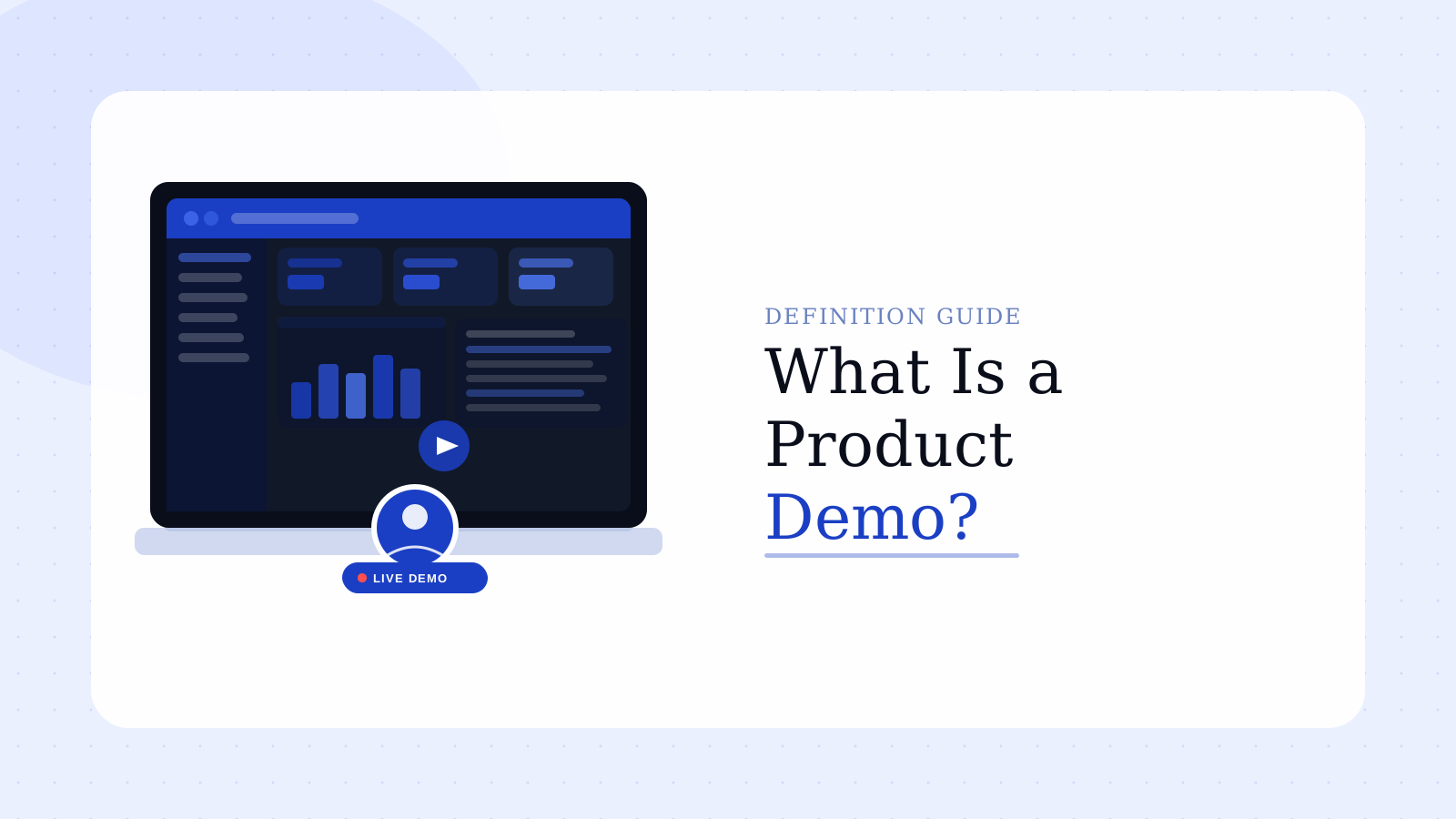
What Is a Product Demo? Types, Formats & Best Practices
Your prospect has done their research. They've read your landing page, scanned your G2 reviews, maybe watched your 60-second homepage video. Now they want to see the actual product — not a slide deck, not a one-pager, not another discovery call. They want a demo.
What happens next determines whether they move forward or go dark.
The word "demo" gets used to describe a lot of different things in B2B SaaS: a 45-minute Zoom call with an AE, a self-hosted sandbox, a two-minute product video, an interactive walkthrough embedded on a pricing page. These are not the same thing. They serve different buyers at different stages with different questions, and treating them interchangeably is one of the most consistent ways revenue teams leave money on the table. This guide covers what a product demo actually is, what the four main formats are, and how high-performing teams decide which to run when.
In this guide
- What is a product demo?
- The 4 types of product demos in B2B SaaS
- Why product demos are the most critical moment in the buying journey
- Live demo vs. recorded demo: what actually converts
- How to structure a product demo that works
- The demo environment problem most teams ignore
- How AI is changing the way teams run product demos
- FAQ
What is a product demo?
A product demo is a structured demonstration of how a software product works — shown to a prospective buyer, customer, or evaluator — with the goal of proving that the product solves a specific problem worth paying for.
Every word in that definition matters. "Structured" means it is not a free-roaming feature tour. "Specific problem" means it is not a generic overview of what the product can do. "Worth paying for" means the demo exists to move a buying decision, not to educate.
Product demos are distinct from training sessions, onboarding calls, and product documentation — even though all of those also show how the product works. The difference is intent. A training session assumes the buyer has already committed. A product demo helps them decide whether to commit in the first place.
The format a product demo takes — live presentation, recorded product demo video, interactive tour, or self-guided sandbox — varies by stage, audience, and resources. But the underlying job is always the same: give the buyer enough evidence to form a confident opinion.
The 4 types of product demos in B2B SaaS
Not every demo is the same thing. There are four distinct formats that serve different moments in the buying journey, and knowing which format fits which moment is the single biggest unlock for most go-to-market teams.
1. The live sales demo
This is the format most people picture when they hear "product demo": a real-time screen share between a sales rep or solutions engineer and a buying group, typically 30–60 minutes, tailored to what surfaced in discovery.
A live sales demo is your highest-stakes touchpoint. When it goes well, it compresses weeks of evaluation into a single hour. When it goes badly — wrong features, wrong depth, wrong audience — it can stall a deal that took three months to develop.
The live demo has one irreplaceable advantage: it is responsive. A prospect asks an unexpected question and you pivot. You notice the IT manager leaning in and go deeper on the security model. No other format gives you that flexibility. But that flexibility is also its weakness — it scales poorly, it is inconsistent across reps, and it requires the buyer to show up at a time that works for both parties.
2. The recorded product demo video
A recorded demo is a pre-produced video — anywhere from 60 seconds to 10 minutes — that walks through specific features, workflows, or use cases. It is asynchronous, repeatable, and scalable in ways a live demo never will be.
The key difference from a promotional explainer video: a product demo video shows the actual product in realistic conditions. Real screens, real data, real workflows. Not animated mockups, not abstract metaphors about what the software does conceptually.
Recorded demos are the highest-leverage format for awareness and consideration-stage content. They live on your website, in outreach sequences, in email nurture, in the leave-behind after a discovery call. A single well-made recorded demo gets watched hundreds or thousands of times. A single live demo gets watched once.
The catch: recorded demos go stale fast. Every time your UI changes — new navigation, renamed features, updated icons — a previously accurate video becomes misleading. Teams that underestimate this end up with a library of outdated content that erodes buyer trust the moment someone notices the product looks nothing like the video.
3. The interactive product tour
An interactive product tour is a guided, clickable walkthrough of the product — often built with a tool like Navattic, Storylane, or Arcade — that lets buyers self-navigate through a scripted path while feeling like they're in the actual product.
The distinction from a recorded product demo video vs an interactive tour comes down to control. A video is passive; the viewer watches. An interactive tour is active; the viewer clicks. Both have legitimate places in a go-to-market stack. The choice comes down to what you want buyers to do and how much uncertainty you want them to encounter.
Interactive tours work best for technically sophisticated buyers who want to explore at their own pace. They convert poorly when the product has a learning curve that the guided tour glosses over, leaving the buyer stranded mid-flow.
4. The sandbox or free trial demo
A self-service trial or sandbox gives buyers direct access to the product — sometimes with sample data, sometimes with limited features — so they can validate fit on their own terms.
This is not a "demo" in the traditional sense, but it functions as one: it is the moment when a buyer either confirms or disproves their hypothesis about whether your product works for them. For PLG (product-led growth) companies, the sandbox is the demo strategy.
The challenge with sandboxes is activation. Research from Appcues and Pendo consistently shows that most trial signups never reach the "aha moment" that makes the product's value obvious. A sandbox without intentional onboarding is just an empty room.
Why product demos are the most critical moment in the buying journey
Gartner's 2023 B2B Buying Survey found that buyers spend only 17% of their purchase journey meeting with all potential suppliers combined — not just you, all of them combined. The rest of that time is spent on independent research, internal discussions, and evaluation.
That 17% is your window. And a significant portion of it is your demo.
The implication is counterintuitive: the demo is not where selling happens. By the time a prospect agrees to a demo, they have already done the majority of their evaluation. What the demo does is either confirm or contradict the story they have already told themselves about your product.
This is why generic demos consistently underperform. A generic demo answers "what does this product do?" The buyer at demo stage already has a rough answer to that question. What they need to answer is "does this product do what I specifically need it to do, for people in my role, with systems like mine?" That is a completely different question, and most generic demos do not touch it.
G2 review data for demo automation platform tools tells the same story. Users of platforms like Navattic and Storylane consistently cite the same frustration: they built a great general-purpose product tour, got high play rates, and still saw no meaningful pipeline impact. The demos showed the product. They just didn't show it for the right person, doing the right thing, in a recognizable context.
The specificity test: Before building any demo, ask: could a buyer from a different industry, role, or company size watch this and find it equally relevant? If yes, your demo is too generic. The more narrowly targeted a demo feels, the higher its conversion rate — even if it reaches fewer total viewers.
Live demo vs. recorded demo: what actually converts
The instinct in most B2B SaaS companies is to prioritize the live demo. It has the most prestige, the most preparation, and — at least historically — the most resources attached to it. But the data on buyer behavior suggests the recorded demo deserves significantly more investment than most teams give it.
Forrester's 2023 B2B Buying Study found that 68% of buyers prefer to research independently before engaging with a salesperson. That preference does not disappear once they book a demo — it means the recorded content they consume before and between calls often has more influence on the final decision than the live sessions themselves.
Wistia's 2025 State of Video report found that buyers who watch a product demo video before a live call report 40% higher satisfaction with the live demo, because they arrive with context and specific questions rather than basic orientation questions. The video pre-qualifies both sides.
The practical implication: the most effective demo strategy is not live or recorded — it is both, sequenced deliberately. A recorded demo surfaces interest. A live demo closes conviction. Teams that invest in only one are leaving the other half of the job undone.
One pattern consistently emerges in high-performing sales orgs: the best sales reps use video asynchronously as a follow-up tool. After a discovery call, they send a 3-minute recorded walkthrough addressing the specific use case discussed. Vidyard's 2024 Video in Business report found that sales reps who use video are 4x more likely to receive a response from prospects compared to reps sending text-only emails. The video does not replace the live demo — it keeps the deal moving between live touchpoints.
Build demo videos in minutes, not weeks
Rimo turns your product screenshots and copy into polished, persona-specific demo videos — no video team, no screen recording sessions, no production lag.
How to structure a product demo that works
Whether you are running a live demo or building a recorded one, the underlying narrative structure is the same. The version that converts does not open with a feature tour. It opens with a problem.
The five-part demo arc:
1. Anchor on the outcome (30–60 seconds) Start by naming the specific business result the buyer is trying to achieve. Not "today I'll show you our reporting module" — "let me show you how your team can cut reporting time from three hours to fifteen minutes." The outcome comes first; the feature that enables it comes second.
2. Establish the before state (60 seconds) Show or describe what the current workflow looks like without your product. This is the pain. Do not assume the buyer will map your features to their pain automatically — you have to make that connection explicit. The best demos make buyers wince slightly at the "before" because they recognize it.
3. Walk through the core workflow (3–5 minutes for a recorded demo; longer for live) Now show the product. Not everything it can do — the specific thing that solves the specific problem you just established. Every feature you show that does not connect back to the outcome you named in step one is erosion. Keep cutting until every screen earns its place.
If you need a detailed script to stay on track, a demo video script structure can help structure the narrative before you record or present.
4. Handle the "so what" moment At some point in the demo — usually right after a key feature — the buyer thinks "okay, but how does that change things?" Anticipate it. Name the impact. "This means your team gets this report automatically every Monday morning instead of someone running it manually."
5. Close with a concrete next step The end of a demo should not trail off into "any questions?" It should land on a specific, low-friction next step. For a live demo: "Based on what we just covered, the right next step is a technical deep-dive with your IT lead — can we set that up this week?" For a recorded demo: a CTA that matches the buyer's stage.
The demo environment problem most teams ignore
One of the most consistently cited pain points in G2 reviews for demo tooling is not the content of the demo — it is the environment it runs in.
Live demos, by definition, run on the actual product. That means every bug, every incomplete feature, every piece of sample data that makes no sense in the buyer's context is visible. Sales engineers at SaaS companies spend enormous amounts of time maintaining a separate demo environment — curated data, disabled features, sandboxed configurations — just to ensure the product looks clean during evaluation.
This is unglamorous work, and teams chronically underinvest in it. G2 reviewers for platforms like Demostack and Reprise frequently cite "demo environment crashes" and "showing unfinished features by accident" as the most damaging moments in their sales process — not objections about pricing or competition. The demo environment failed before the demo had a chance to succeed.
A separate demo screen environment setup is worth investing in regardless of which demo format you prioritize. The principle applies equally to live and recorded formats: the environment the buyer sees should reflect the product at its best, not its average.
How AI is changing the way teams run product demos
For most of the past decade, producing quality demo content required a minimum viable team: a product manager who knew the use cases, a solutions engineer who could configure the demo environment, a designer for visual polish, and often a video editor for recorded formats. Smaller companies either lived with low-quality demos or paid agencies tens of thousands of dollars per asset.
AI has changed that calculation significantly in 2025 and 2026.
The most immediate change is in recorded demo production. AI-powered tools can now generate narration, match screen recordings to scripts, and produce edited, branded demo videos at a fraction of the previous cost and time. What previously took a three-week production cycle can now happen in a day. What previously required a video team can now be handled by a single product marketer.
The second change is personalization at scale. Historically, creating persona-specific recorded demos was prohibitive — you would need a separate production run for every buyer segment you wanted to target. AI generation enables teams to create variants for different industries, roles, or company sizes without multiplying production effort linearly.
The third change is maintenance. When the product UI updates, AI-assisted re-generation means you are not throwing out existing assets and starting over — you are updating components and re-rendering. The demo library becomes a living asset rather than a collection of snapshots that decay.
If you want to see how modern teams are approaching this, the guide on how to automate demo video creation with AI covers the specific workflow in detail.
The metric most teams forget to track
Almost every revenue team tracks demo request volume and demo-to-opportunity conversion rate. Far fewer teams track what happens between those two events.
Specifically: how many prospects who accepted a demo invitation actually watched the recorded content beforehand? Of those who did, how did their live demo engagement compare to those who came in cold? How many deals where the prospect watched a persona-specific recorded demo before the live call converted at higher rates than deals where they didn't?
This is the data that proves or disproves the value of investing in recorded demo content. Without it, demo video production stays a nice-to-have rather than a revenue-critical function. With it, even one well-run analysis tends to surface a 30–50% conversion rate difference that justifies the entire program budget.
Track it. You will find the demo environment doing more work than anyone on your leadership team has given it credit for.
Conclusion
A product demo is the moment a B2B buyer decides whether they believe what you've been telling them. That moment can happen in a Zoom call, a video embed, an interactive tour, or a sandbox trial — and the best go-to-market teams have deliberately designed for all four, not just one.
The definition is simple. The execution is where most teams leave performance behind. Build demos for specific people in specific contexts. Invest in the environment as much as the content. Make your recorded demos as deliberate as your live ones. And when a product update changes your UI, treat it as a maintenance event, not an excuse to let your demo library go stale.
If you are building or rebuilding your demo program, start with what you can produce at scale today. Rimo makes it possible for a single product marketer to create polished, persona-specific demo videos without a video team or production budget.
FAQ
What is the difference between a product demo and a sales demo? A product demo is any structured demonstration of how software works, regardless of format — it includes recorded videos, interactive tours, live presentations, and sandbox trials. A sales demo is a specific type of live product demo conducted by a salesperson or solutions engineer with a prospective buyer, explicitly designed to advance a purchase decision. All sales demos are product demos, but not all product demos are sales demos.
How long should a product demo be? It depends on the format and stage. A homepage awareness demo should be 60–90 seconds. A consideration-stage persona demo runs 2–4 minutes. A live sales demo for mid-market buyers typically runs 30–45 minutes. Enterprise technical evaluations often run 60–90 minutes. The consistent principle: every minute should answer a question the buyer actually has, not demonstrate a feature for its own sake.
What makes a product demo effective? Three things: specificity to the buyer's role and use case, a clear narrative arc from problem to outcome, and a concrete next step at the end. Generic demos that try to speak to everyone rarely move any individual buyer. The most effective demos feel like they were built for one person — because they were.
What is a product demo environment? A demo environment is a separate, curated instance of the product maintained specifically for demonstration purposes. It contains realistic sample data, has potentially incomplete or in-progress features disabled, and is configured to show the product at its best. Companies that invest in dedicated demo environments consistently run more effective live demos and produce more credible recorded content.
Can a product demo replace a free trial? Not for all buyers, but often for most. A well-structured recorded demo or interactive tour can answer the majority of evaluation questions without requiring the buyer to invest in a full trial setup. Trials are most valuable for buyers who need to validate a specific technical integration or test with their own data. For buyers evaluating conceptual fit, a targeted demo often gets them to a decision faster.
How often should product demo videos be updated? Any time a UI change makes the current demo visually inaccurate, update it. As a baseline, review your recorded demo library every quarter and flag any asset where the product experience in the video differs from the live product by more than minor visual details. A demo that shows an outdated interface tells buyers you are not paying attention — exactly the wrong signal during evaluation.
Akshay Sharma
Product Leader · 10+ years in B2B SaaS
Akshay has spent 10+ years building and marketing B2B SaaS products. He writes about product storytelling, demo production, and the operational side of product marketing.