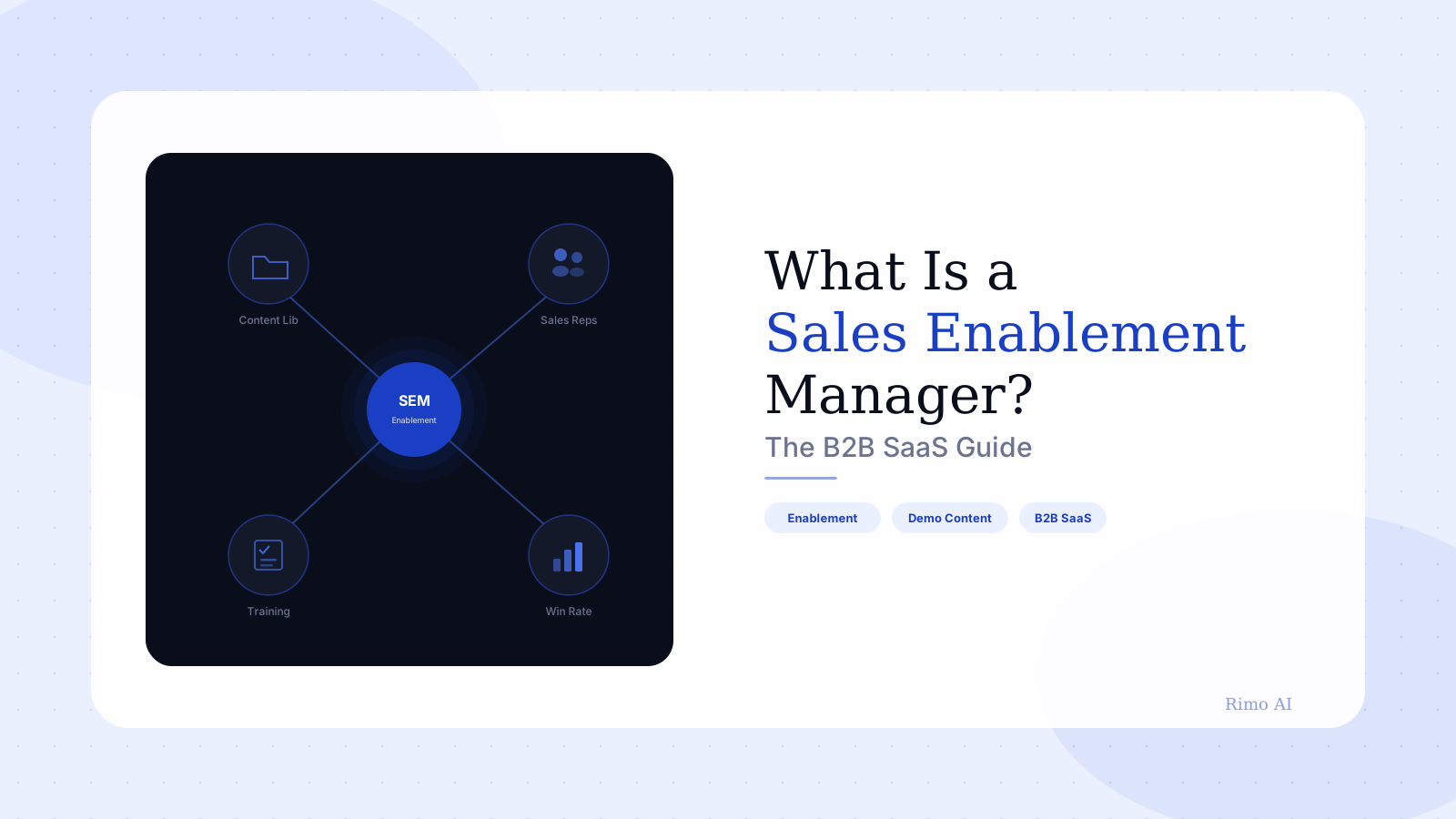
What Is a Sales Enablement Manager? The B2B SaaS Guide (2026)
Your VP of Sales just asked why the new pricing page messaging still hasn't shown up in a single rep's deck three weeks after launch. You know exactly why: the battlecard update is sitting in a shared drive nobody checks, the demo script still references the old plan names, and the one person who could fix all of it — you — is also running onboarding for four new hires this week.
This is the daily reality of a sales enablement manager: the person accountable for whether a sales team can actually execute the go-to-market motion that leadership just approved. Not the strategy. The execution layer underneath it — the content, the training, the tools, and the discipline of keeping all three current while the product and the market keep moving.
This guide covers what a sales enablement manager actually does, how the role differs from sales engineering, product marketing, and sales operations, what the modern enablement tech stack looks like after a year of major consolidation, and why demo content — not messaging decks — has quietly become the hardest part of the job to keep current.
In this guide
- What is a sales enablement manager?
- What does a sales enablement manager do?
- Sales enablement manager vs. sales engineer vs. PMM
- The sales enablement tool stack in 2026
- How sales enablement managers are measured
- The demo content bottleneck every enablement manager faces
- Sales enablement manager salary and career path
- FAQ
What is a sales enablement manager?
A sales enablement manager is the person responsible for equipping a sales team with the content, training, tools, and coaching they need to sell effectively — and for making sure all three stay current as the product, the market, and the buyer keep changing.
The title gets used loosely. At some companies it means "runs the content library." At others it means onboarding design, live coaching, tech stack ownership, and a seat in the revenue planning meeting. The common thread across every real version of the job: a sales enablement manager doesn't carry a quota, but their work directly determines whether the people who do carry one can hit it.
That distinction is worth sitting with. Sales enablement managers are judged on a lagging, borrowed metric — rep performance — that dozens of other factors also influence. It's one of the few revenue-adjacent roles where the day the enablement program is working perfectly is also the day nobody mentions you in the pipeline review, because nothing broke.
That 55% figure is the uncomfortable part. Most companies don't lack a strategy. They lack the operational layer that turns strategy into something a rep can pick up and use in a live call — which is exactly the gap a sales enablement manager is hired to close.
What does a sales enablement manager do?
The scope varies by company size and maturity, but four responsibilities show up in nearly every version of this job.
Content operations and the demo library
Messaging changes. Pricing changes. Product screens change. Every one of those changes has to flow into what a rep actually shows and says on a call — the deck, the battlecard, the demo script, the recorded walkthrough sent as a follow-up. A product marketing manager usually creates the source messaging; the enablement manager owns getting it into the field and keeping it current once it's there.
This is the least visible part of the job and the one that decays fastest. A pricing page can be updated in an afternoon. A library of forty demo videos referencing the old plan names takes considerably longer to fix — and until it's fixed, reps are technically misrepresenting the product.
Onboarding and training design
New reps need to reach full productivity fast. Ramp time — the gap between hire date and first full quota-carrying month — is one of the enablement manager's most closely watched numbers. That means building structured onboarding curricula, certification checkpoints, and role-play exercises rather than handing a new hire a folder of old decks and a Slack channel.
Sales tech stack ownership
Content platforms, call recording and coaching tools, LMS systems — the enablement manager typically owns the buying decision, the rollout, and the ongoing adoption push for this stack. Adoption is the harder half. Buying a platform is easy. Getting forty reps to actually search it before building their own deck from scratch takes months of deliberate reinforcement.
Coaching and performance feedback
Working alongside sales managers, the enablement manager identifies skill gaps at the team level — not "Alex needs help," but "the whole East region is fumbling the security-objection response" — and builds targeted coaching content or live sessions to close it. According to Highspot's 2025 research, managers now spend an average of 13 hours a week coaching reps, which is precisely the volume of activity that a good enablement program is built to make more consistent and less improvised.
Sales enablement manager vs. sales engineer vs. PMM
The confusion here is understandable — all three roles touch the same content and show up in the same deal reviews. The differences are in what each role is actually accountable for.
| Sales Enablement Manager | Sales Engineer | Product Marketing Manager | |
|---|---|---|---|
| Core question | Can reps execute this motion consistently? | Can this product technically do what the buyer needs? | Why should the market care, and how do we say it? |
| Primary deliverable | Training, playbooks, content library, tech stack | Live demos, POCs, technical documentation | Positioning, messaging, launch content |
| Works closest with | Sales managers, RevOps, PMM | AEs, product, engineering | Product, sales, demand gen |
| Success metric | Ramp time, content utilization, win-rate lift | Demo-to-POC conversion, POC win rate | Message adoption, launch velocity, win/loss themes |
| Time horizon | Ongoing, team-wide | Deal-by-deal | Campaign and launch cycles |
The sales engineer is deal-facing and technical — they're in the room proving the product works for one specific buyer. The enablement manager is team-facing and operational — they're building the system that lets every rep run a competent version of that conversation without an SE on every call. PMM sits upstream of both: they decide what the story is; enablement and the SE decide how it gets delivered.
In practice, the best enablement managers spend a disproportionate amount of time translating between these three worlds — turning a PMM's launch messaging and an SE's technical talk track into something a generalist AE can credibly deliver on their own.
The sales enablement tool stack in 2026
Three platforms dominate G2's sales enablement category: Highspot, Seismic, and Showpad. Reviewers across all three describe a strikingly similar pattern — real value, real friction.
Highspot reviewers consistently praise the centralized content library and native Salesforce integration that auto-logs which assets actually get used in live deals. The recurring complaints: a noticeably weaker mobile experience than desktop, unintuitive reporting terminology, and a real learning curve before new admins feel confident building their own content pages.
Seismic users cite the deal-based content recommendations and real-time engagement analytics as the biggest wins — reps default to whatever the system flags as best-fit, which measurably improves consistency. The most repeated complaint across reviews, by a wide margin, is the lack of a native mobile app and offline access — a real gap for field reps working a trade show floor or an on-site customer visit with no signal.
Showpad reviewers rate the rep-facing experience highly — content prep time reportedly drops from 30-plus minutes to under 10 once a library is properly organized. The pain shows up on the admin side: reporting and analytics are harder to configure than they should be, and buyers report limited layout customization compared to competitors.
Worth knowing before you buy: on February 12, 2026, Highspot and Seismic announced a signed agreement to merge, with the combined company operating under the Seismic name. Two of the three category leaders you'd shortlist today are becoming one company. If you're evaluating platforms this year, that consolidation — not feature comparison — should be the first question you ask a sales rep on the call.
None of this makes any of the three platforms a bad choice. It does mean the buying decision now includes questions that weren't relevant twelve months ago: migration risk, contract terms surviving an acquisition, and whether a newly merged roadmap still serves your team's specific workflow.
Pricing is where the category gets genuinely exclusionary for smaller teams. Enterprise Highspot deals commonly run $70,000–$180,000 a year. Seismic implementation alone can run $15,000–$50,000 before the subscription, with a three-to-four-month rollout and no free trial. Showpad's reported $42,000-a-year minimum "rarely pencils out," per buyer reviews, for teams under 50 reps. For a mid-market SaaS company, the enablement platform itself can be a bigger line item than the entire content production budget it's meant to organize.
Content is only useful if it's current
Rimo turns a plain-English brief into a finished, on-brand demo video in under two hours — so the library your enablement platform organizes doesn't go stale the moment the product ships.
How sales enablement managers are measured
Enablement metrics fall into three tiers, and the tier a company measures at says a lot about how mature the function is.
Activity metrics — content views, training completions, certification pass rates — are the easiest to track and the least convincing to leadership. They tell you the program is running, not that it's working.
Adoption metrics — content utilization rate (percentage of published assets actually used in live deals), search-to-find success rate, time-to-first-deal-use for new content — start connecting the program to real behavior.
Outcome metrics — ramp time to full quota, win-rate lift for reps who completed a given training track, quota attainment by cohort — are what actually justify the enablement budget. Aberdeen's research (via Seismic, 2025) found organizations with successful enablement programs see 32% higher team-wide quota attainment and 24% better individual rep attainment.
The honest version of this section: most enablement teams still report mostly at the activity tier, because outcome-tier data requires clean integration between the content platform, the CRM, and the LMS — and building that pipeline is itself a project most under-resourced teams never get to. Gartner's 2025 Magic Quadrant for Revenue Enablement Platforms names this consolidation gap directly, and a Gartner press release from April 2026 predicts AI-driven enablement will deliver 40% faster sales-stage velocity than traditional methods by 2029 — largely by closing exactly this measurement gap automatically.
The demo content bottleneck every enablement manager faces
Here's the part of the job that rarely makes it into a job description: enablement managers are supposed to keep the content library current, but the content that decays fastest — recorded demo videos and screen-based walkthroughs — is also the most expensive and slowest to update.
A messaging deck is a design file. Updating it is an afternoon of work. A product demo video referencing a UI that shipped a redesign three sprints ago requires re-recording, re-editing, and re-publishing — work that competes directly against onboarding, coaching, and the next quarter's certification refresh. It loses that competition constantly, which is why so many enablement libraries contain a handful of current decks and a graveyard of outdated recordings nobody has the heart to delete.
This is the quiet cost behind Highspot's 55% "can't effectively execute GTM initiatives" statistic. It isn't only a strategy problem. A meaningful share of it is a production-capacity problem: the content that would let reps execute the strategy exists in theory and is stale in practice, because the team that owns it doesn't have the bandwidth to keep re-recording video every time the product changes.
The teams closing this gap fastest aren't hiring more content producers — they're removing the re-recording step entirely. AI-assisted demo video creation takes a brief and current product screens and produces an updated, branded walkthrough in hours instead of weeks, which means the enablement manager can treat demo content the same way they treat a deck: something you update the same week the product changes, not the same quarter.
That's a genuinely counterintuitive shift for a function built for a decade around "produce once, reuse for a year." The enablement libraries that perform best in 2026 aren't the ones with the most content. They're the ones where the oldest asset is never more than a few weeks old.
Sales enablement manager salary and career path
As of 2026, sales enablement managers in the United States earn an average base salary of $95,000–$130,000, with total compensation reaching $140,000–$165,000 at companies that include a bonus tied to team-level revenue metrics (Glassdoor, Salary.com, 2026). Directors of enablement typically earn $150,000–$190,000, and VP-level enablement leaders at larger SaaS companies clear $200,000+.
The typical career path:
- Enablement Specialist / Coordinator — content organization, training logistics, close support from a senior enablement manager
- Sales Enablement Manager — end-to-end ownership of onboarding, content operations, and tech stack adoption for a defined team or region
- Senior Enablement Manager / Enablement Lead — cross-functional ownership spanning multiple sales segments, direct input into GTM planning
- Director of Sales Enablement — team leadership, budget ownership, executive reporting on enablement ROI
- VP of Revenue Enablement / Chief Enablement Officer — the newest tier, reflecting how central this function has become at scaled B2B SaaS companies
Common entry paths include sales operations (strong analytical foundation, needs content instincts), sales itself (deep field credibility, needs systems thinking), and product marketing (strong content skills, needs sales-floor fluency). The rarest and most valuable combination is the same one that defines great sales engineers: genuine field credibility paired with genuine operational discipline. Enablement managers who've actually carried a quota build programs reps trust. Enablement managers who haven't tend to build programs that look right in a slide and get ignored in the field.
The best enablement managers I've worked with don't measure success by how much content they've shipped. They measure it by how little of it is more than a month old. A smaller, current library beats a massive, stale one every time — reps can feel the difference in the first ten seconds of using either.
Get the content layer right, then let AI keep it current
A sales enablement manager's job was never really about building a library. It's about making sure the thing a rep pulls up in front of a buyer is accurate, on-message, and current — every single time, regardless of how fast the product or the market moves underneath it.
The platform decisions matter. So does the training curriculum. But the recurring failure point isn't strategy or tooling — it's the production bandwidth to keep demo content current once the initial library gets built. Solve that specifically, and most of the "GTM execution gap" that 55% of leaders describe starts closing on its own.
If your team is buried in demo videos that no longer match the product, that's the exact problem Rimo was built to remove.
Keep your demo library as current as your product
Rimo turns a brief into a finished, on-brand demo video in under two hours — no editor, no re-shoot, no three-week turnaround. Built for teams that ship faster than their content can keep up.
FAQ
What is a sales enablement manager?
A sales enablement manager is the person responsible for equipping a sales team with the content, training, tools, and coaching needed to sell effectively — and for keeping all three current as the product and market change. They don't carry an individual sales quota, but their program directly affects whether the reps who do can hit theirs.
What is the difference between sales enablement and sales operations?
Sales operations focuses on process, systems, and data — territory design, CRM administration, forecasting, compensation planning. Sales enablement focuses on people and content — training, onboarding, playbooks, and the materials reps use in live conversations. The two functions frequently sit under the same revenue operations leader and share tooling, but enablement is about rep readiness while operations is about process infrastructure.
What does a sales enablement manager do day to day?
A typical week includes maintaining and updating the content library, running or designing onboarding sessions for new hires, coordinating with product marketing on messaging rollout, analyzing which content and training programs correlate with stronger rep performance, and administering the enablement tech stack. Content maintenance — keeping decks, battlecards, and demo videos aligned with the current product — is consistently the most time-consuming and most underestimated part of the role.
What skills does a sales enablement manager need?
Core skills span three areas: instructional design (building training that actually changes rep behavior, not just delivering information), content operations (organizing and maintaining a library reps will actually use), and data literacy (connecting content and training activity to ramp time and win-rate outcomes). Field credibility — some direct sales or sales engineering experience — significantly increases how much reps trust an enablement program.
How much does a sales enablement manager make?
In the United States, sales enablement managers earn an average base salary of $95,000–$130,000, with total compensation reaching $140,000–$165,000 at companies offering bonus structures tied to team revenue performance, based on 2026 data from Glassdoor and Salary.com. Directors of enablement typically earn $150,000–$190,000.
Is sales enablement a good career path?
Yes, particularly as the function has gained executive visibility — the newer VP of Revenue Enablement and Chief Enablement Officer titles reflect this. The clearest path to senior enablement roles combines field sales or sales engineering experience with strong content and systems skills. Highspot's 2025 research found that 164% more companies used AI tools in sales training programs than the year prior, making AI fluency an increasingly valuable and differentiating skill for anyone entering the field today.
Akshay Sharma
Product Leader · 10+ years in B2B SaaS
Akshay has spent 10+ years building and marketing B2B SaaS products. He writes about product storytelling, demo production, and the operational side of product marketing.