What Is an AI Demo Agent? The Complete B2B SaaS Guide (2026)
Your best solutions engineer runs twelve demos a week. Six of them are with buyers who qualified themselves out before the call ended. Two were with the wrong stakeholder. Three had nothing to do with your SE's actual expertise. Only one was the complex, high-ACV deal that genuinely required a tenured human in the room.
That's not a hiring problem or a qualification problem. It's an infrastructure problem — the gap between what buyers need at the 30% mark of their evaluation and what your team can realistically deliver without burning out your highest-leverage people on introductory walkthroughs.
An AI demo agent is the category built to close that gap. Not by replacing the demos that require human judgment — those still close the deals that matter. By removing the human bottleneck from the parts of the demo motion where a well-built autonomous system can do the same job, or a better one.
In this guide
- What is an AI demo agent?
- The problem AI demo agents solve
- The full demo landscape: a taxonomy
- The two types of AI demo agent
- How a video demo generation agent works
- AI demo agent vs. traditional demo formats
- When to use an AI demo agent — and when not to
- Building your first AI demo agent workflow
- FAQ
What is an AI demo agent?
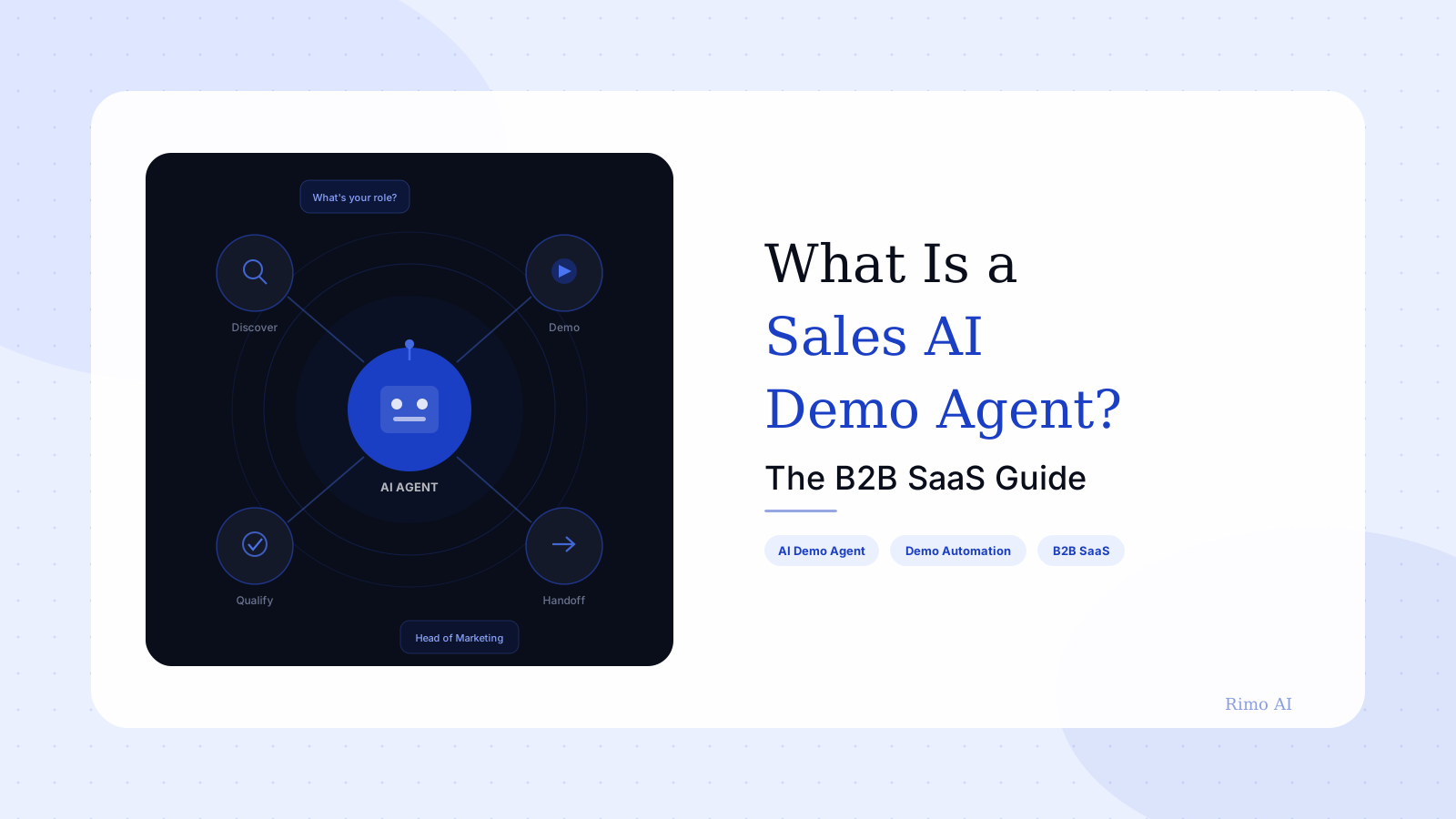
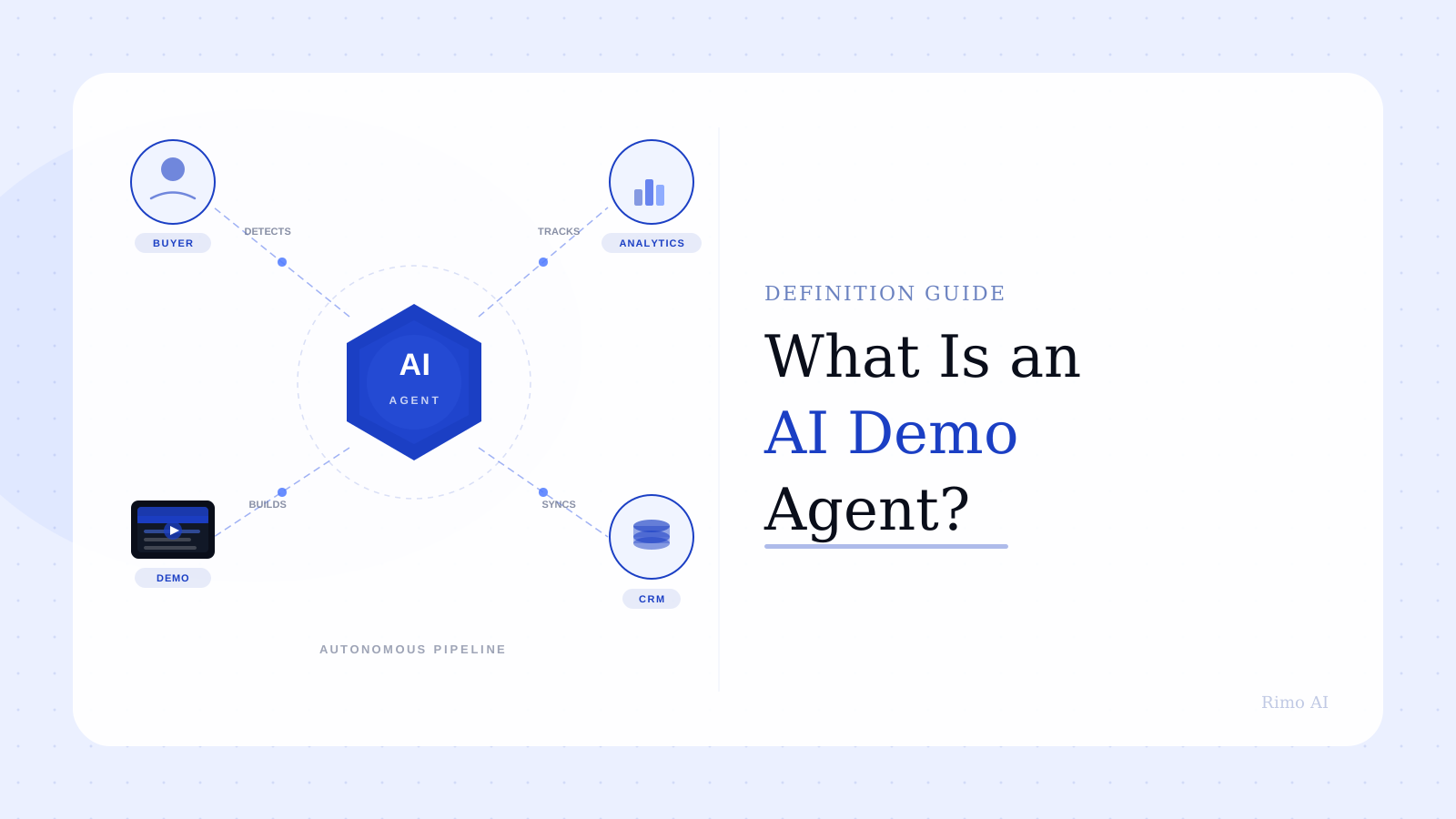
An AI demo agent is an AI-powered system that automates part or all of a product demonstration — detecting buyer intent, personalizing demo content, delivering the experience, and logging the outcome — without requiring a human sales rep or solutions engineer to be present for every interaction.
The "agent" framing is intentional and specific. A recorded demo video is not an agent. An interactive product tour is not an agent. An agent has autonomy: it receives inputs, makes decisions based on those inputs, and produces an output appropriate to the context. A true AI demo agent can be triggered by a prospect completing a qualifying form, spending time on a pricing page, or clicking through to a specific feature category — and respond with a demo experience calibrated to that buyer's role, industry, and stated problem.
The category currently splits into two meaningfully different types, and most buying guides collapse them into one. Understanding the distinction is more important than picking a vendor.
The problem AI demo agents solve
The core problem isn't that B2B buyers don't want demos. They want them more than ever. The problem is the mechanism by which most SaaS companies deliver them.
The "Book a Demo" button is the gatekeeper to product information in most B2B SaaS GTM motions. A buyer who wants to understand how your product handles their specific workflow has one option: submit a form, wait 1–2 business days for an SDR to respond, then wait another week to find a 45-minute slot that works for both parties. At that point, they may or may not get a demo tailored to their actual problem — depending on which AE or SE picks up the calendar invite.
That friction is by design for some deal types. For many others, it's just lost pipeline that nobody counted.
The G2 review record on demo tools tells the real story from the people building and managing these systems. Across Walnut, Storylane, Reprise, and Navattic — the four largest demo automation platforms — the most consistent complaints aren't about missing features. They're about maintenance:
"With a new feature release, there is always a need to revisit the current demo flows to maintain them up to date." — Walnut user, G2
"Screenshot-based editing is a pain involving a ton of manual work — most product screens will look similar." — Storylane user, G2
"When there are too many demos, it gets very difficult to manage — people complain of having a hard time structuring and keeping their working space clean after creating many demos." — Storylane user, G2
The pattern across all four platforms is the same: teams invest in demo infrastructure, then discover that the real cost isn't the platform license — it's the ongoing labour of keeping every demo accurate as the product ships. A SaaS product that ships every two weeks generates a demo maintenance burden that scales faster than any team can manually absorb.
AI demo agents solve this at two levels. They reduce the time to create new demos from hours to minutes. And they make it possible to update a demo library at the speed of product development, not the speed of a manual screenshot-and-re-record cycle.
The second problem they solve is qualification. According to research from Consensus, 35% of demos delivered by presales teams are with unqualified or underqualified prospects. That's not a small rounding error — it's a third of your highest-cost sales resource being spent on buyers who either aren't ready or aren't the right fit. An AI demo agent that handles initial product education and qualification lets human demos be reserved for the buyers who genuinely need them.
The full demo landscape: a taxonomy
Before buying into any vendor's definition of an "AI demo agent," it helps to see where the category sits in the full spectrum of demo formats. Most buying guides skip this context and leave teams confused about what they're actually evaluating.
Here is the full landscape, ordered by buyer control and delivery complexity:
Static demo video — A pre-recorded walkthrough of the product, typically 2–5 minutes. High polish, zero personalization, cannot adapt to viewer context. Best for top-of-funnel awareness and homepage embedding. Goes stale with every product update.
Screen recording with annotation — A live or semi-edited recording of actual product use, created with tools like Loom. Fast to produce, informal in tone, minimal branching. Best for async follow-ups, quick support walkthroughs, and internal knowledge sharing. Not suitable for high-volume personalized demo production.
Interactive product tour — A guided, clickable walkthrough of a product simulation (Navattic, Storylane, Arcade). The buyer controls the pace. The path is pre-scripted. Best for website embeds and marketing-led PLG flows. According to Navattic's 2025 research, interactive demos achieve 24.35% website conversion rates versus 3.05% for traditional approaches — a genuine performance lift, but dependent on buyer engagement with a scripted flow.
Demo automation / cloning tool — A full-fidelity capture of the product that a sales rep or SE can personalize for each prospect (Walnut, Reprise, Demostack). High investment to configure. Highest fidelity to real product. Best for enterprise deals with complex, multi-stakeholder evaluation requirements. The G2 feedback is consistent: "Demo cloning was more than what we needed and it was too expensive." Not suited to mid-market volume.
AI demo agent — An autonomous system that detects buyer intent, generates or personalizes demo content at the moment of demand, delivers it without a human in the loop, and feeds engagement data back to the GTM stack. This is the category we're covering — and it currently has two distinct subtypes.
The two types of AI demo agent
This is the distinction that the current market is actively conflating, and getting it wrong is expensive.
Type 1: Conversational AI demo agents
A conversational AI demo agent runs a live, interactive demo in real time — without a human presenter. The buyer asks questions, the agent responds in natural language, navigates the product or a simulation of it, surfaces the relevant feature, and adapts the flow based on what the prospect says.
Think of it as the full sales engineer workflow on autopilot: discovery, personalization, product walkthrough, objection handling, qualification scoring, and handoff to a human rep with full context. Vendors building this type include Saleo (explicitly positions as "the AI Demo Agent that handles real-time discovery and delivers personalized demos like a tenured SE"), Supademo (launched their AI Demo Agent in 2025 specifically to "kill the Book a Demo form"), and Repixa (whose definition is precise: "An interactive demo is buyer-driven — the buyer clicks. An AI demo agent is conversation-driven — the buyer talks").
The ceiling on this type is high. The current production reality is that it requires deep product integration, rigorous accuracy guardrails, and ongoing knowledge base maintenance. Any hallucinated answer — showing a feature that doesn't work as described, or claiming a capability the product doesn't have — destroys the trust that the whole interaction was designed to build.
Type 2: AI video demo generation agents
A video demo generation agent automates the production of personalized demo videos — without a recording session, without a video editor, without a multi-week production timeline. You provide the buyer context (persona, industry, use case), the agent generates a scripted, narrated, branded demo video tailored to that specific buyer, and it's ready to deliver in hours.
This is meaningfully different from a conversational agent. It doesn't run a live interaction — it produces an asynchronous demo asset. The "agent" capability is in the generation pipeline: automatically selecting the relevant product workflows to demonstrate, writing a script framed around the buyer's job to be done, syncing narration to visual sequences, and producing a finished video that's accurate to the current product state.
This is the type most directly suited to marketing teams and high-volume outbound sales motions. A team managing 50 inbound demo requests per week cannot manually record 50 personalized demos. An AI demo video generator built on an agent architecture can produce all 50 — at the quality level a single manually-produced demo would take a day to create.
The two types aren't competing. They serve different stages of the buying journey. A video demo generation agent works best for mid-funnel product education — delivering a personalized "why this product solves your problem" experience before a buyer has committed to a live call. A conversational agent works best for buyers actively evaluating and asking specific questions. Used together, they collapse the evaluation timeline for buyers who don't need a human until the final decision stage.
How a video demo generation agent works
The pipeline of a video demo generation agent runs in four stages, and the quality gap between platforms lives almost entirely in the first two.
Stage 1: Input processing. The agent receives buyer context — either manually specified by a sales rep (ICP, industry, use case, company size) or automatically inferred from behavioral signals (what the buyer clicked, how long they spent on which pages, what category they came from). This input determines everything about the demo that gets built.
Stage 2: Script generation. Using the buyer context, the agent generates a structured voiceover script tailored to that buyer's situation. A well-built agent produces scripts that address the buyer's specific workflow, surface the capabilities most relevant to their role, and frame the product story around their job to be done. A poorly-built one produces reformatted feature documentation with a buyer's industry name bolted on.
This is where the quality variance across platforms is sharpest. Before committing to any video demo generation platform, test its script output on two different buyer personas with genuinely different contexts. Generic copy that sounds fine for a "marketing manager at a software company" often collapses when you specify "head of revenue operations at a mid-market logistics firm." The script quality floor reveals itself on specificity.
Stage 3: Visual assembly. The agent combines product screenshots, screen captures, and brand elements into a timed visual sequence synced to the narration. This layer requires either live product integration (the agent navigates the actual product) or a curated asset library the agent selects from. Accuracy here is non-negotiable — a demo that shows an outdated interface or a workflow that no longer exists damages credibility before a sales rep ever speaks to the buyer.
Stage 4: Delivery and tracking. The finished demo is packaged for delivery — email link, website embed, or hosted landing page — with engagement analytics built in. Who watched. How long. Which sections they replayed. Whether they forwarded it to a colleague. That behavioral data feeds back into the pipeline as qualification signal and input for the next demo in the sequence.
AI demo agent vs. traditional demo formats
Where does an AI demo agent fit relative to what most B2B SaaS teams already have? Here's the honest comparison.
vs. the live sales demo. The live sales demo is irreplaceable for complex deals — specifically because it's responsive. A skilled SE who pivots on a live objection, follows the energy of the room, and improvises a demonstration around an unexpected question is doing something no current AI system reliably replicates. AI demo agents don't replace the live demo. They protect it. By handling earlier-stage product education, they ensure the buyers who reach a live demo have already self-qualified — and the human's time goes to the deals that actually need human judgment.
vs. the recorded demo video. A static demo video has one structural constraint: it can't personalize. A product manager at a 200-person fintech and a procurement lead at a 2,000-person logistics company see the same recording. An AI video demo agent changes that — a different narrative, a different feature emphasis, a different framing of value for each persona, produced without a separate recording session for each one.
vs. the interactive product tour. The interactive product tour gives the buyer control. The AI demo agent gives the buyer clarity. These serve different needs at different moments — and the highest-performing GTM teams use both. An AI demo video to establish relevance and drive initial conviction, followed by a self-guided interactive tour for deeper pre-call exploration. The two formats are complementary assets in the same funnel, not competitors.
vs. demo automation tools (Walnut, Reprise). Enterprise-grade demo automation tools are built for the live personalization problem: an SE clones the product, swaps in the buyer's data, and runs a tailored live session. They require significant configuration, presales expertise, and ongoing maintenance. The G2 feedback is consistent — "No free trial, which means signing a $9,000 annual contract without testing the product against your specific use case." AI demo agents are not a direct replacement for demo cloning at enterprise scale. They are a practical alternative for mid-market teams that need personalization at volume without the complexity.
When to use an AI demo agent — and when not to
AI demo agents have a clear performance ceiling. Deploying them beyond it doesn't just produce mediocre results — it actively undermines the buying relationship.
Use an AI demo agent when:
- Inbound MQLs need a product experience before they're willing to book a live call
- Outbound volume makes manually personalized demos impractical
- Post-demo follow-up needs to be specific and fast — a targeted video recap for a specific stakeholder on the buying committee
- Partner and channel teams need demo assets they can deploy without waiting on your internal team
- Trial activation flows require a guided first experience without a CSM available
- Website visitors need more than a click-through tour but aren't ready for a live session
Don't use an AI demo agent as a replacement for:
- Enterprise deals with 7+ stakeholders and complex technical evaluation requirements
- Categories where trust and relationship are the primary buying variable
- Any scenario where the AI-generated demo cannot be guaranteed to be accurate relative to current product state
The third point deserves more attention than it typically gets. The failure mode most buyers of demo automation discover late is that their demo library grows faster than their ability to maintain it. Demos go live. The product ships. Nobody updates the demo. A prospect watches a walkthrough featuring a workflow that was redesigned three sprints ago.
According to G2 reviewers of Walnut and Storylane, this isn't an edge case — it's the norm for teams that scaled production without scaling their review process. The competitive advantage of an AI demo agent is its speed. That advantage disappears the moment a buyer encounters a demo that doesn't match what the product actually does. Build your accuracy review checkpoint before you build your first automated demo.
Building your first AI demo agent workflow
For most B2B SaaS teams, the highest-leverage entry point isn't the most sophisticated use case. It's the highest-volume bottleneck with the clearest audience.
Step 1: Find your volume problem. Where is demo demand outpacing your team's capacity? Inbound MQLs waiting days for a response? Outbound sequences with no personalized demo asset? Trial signups who see the product cold? Identify the specific queue, because that's where the ROI is clearest.
Step 2: Define three buyer personas with specificity. An AI demo agent produces proportionally better output with tighter input. Before running the system, document each persona: their role, their top three pain points, and the two product capabilities most relevant to their workflow. This becomes the input template your first demos are built from. Generic persona definitions produce generic demos.
Step 3: Build a clean, current asset library. Video demo generation agents need accurate product screenshots or screen captures to assemble from. Create an organized set of your key workflows — realistic dummy data, current UI, no deprecated screens. This library is the raw material the agent works from. Outdated assets are the most common quality failure in first deployments.
Step 4: Start with one use case, one format. Don't launch a conversational demo agent, a video demo agent, and an interactive tour update simultaneously. Pick the format that fits your highest-priority bottleneck, run it for 60 days, and measure before expanding. The teams that fail at AI demo adoption usually tried to solve everything at once.
Step 5: Build accuracy review into the publishing gate. Every AI-generated demo should pass through a human accuracy check before reaching a buyer. This doesn't need to be a full production review — a 10-minute spot-check against the current product state, done before any demo is published or sent. Accuracy isn't a production quality standard. It's a business requirement.
If you're still calibrating what a high-quality demo looks like before automating its production, reviewing SaaS demo video best practices is a useful baseline before deploying AI generation at scale.
Conclusion
The AI demo agent category is new enough that vendor definitions are still forming and capability claims vary widely. The clearest framing to carry forward: an AI demo agent is any system that removes the requirement for a human to be present at part of the demo motion — while maintaining or improving the quality and relevance of the buyer experience.
For B2B SaaS teams in 2026, the most pragmatic starting point is a video demo generation agent — a platform that produces personalized, accurate demo videos from a buyer brief at the volume inbound and outbound demand requires, without blocking your best people on demos that don't need them.
That's the exact problem Rimo was built to solve. From a plain-English buyer brief to a finished, branded, screen-accurate demo video — in under two hours, no recording session, no editor, no agency.
Start free with Rimo → or book a demo to see an AI-generated demo built for your specific product.
FAQ
What is an AI demo agent?
An AI demo agent is an AI-powered system that automates part or all of a product demonstration without requiring a human sales rep to be present. It covers two distinct types: conversational AI demo agents that run live, adaptive product walkthroughs in response to buyer questions, and video demo generation agents that autonomously produce personalized demo videos from a buyer brief. Both types share the same goal — delivering a relevant product experience to a buyer at the moment they need it, without a human in the loop for every interaction.
How is an AI demo agent different from an interactive product tour?
An interactive demo tool (Navattic, Storylane, Arcade) creates a scripted click-through experience that the buyer navigates at their own pace. The path is pre-built by your team and doesn't change based on who's watching. An AI demo agent is dynamic — a conversational agent adapts in real time based on what the buyer says, and a video generation agent produces a different demo for each buyer based on their persona and context. The interactive tour is buyer-driven navigation. The AI demo agent is system-driven personalization.
Can an AI demo agent replace a human sales rep?
For complex enterprise deals with multiple stakeholders, custom integration requirements, or high-stakes technical evaluations, no. The best vendors are honest about this. Where AI demo agents genuinely replace human effort is in the high-volume, early-to-mid-funnel parts of the demo motion: initial product education, persona-specific demo delivery, self-serve qualification, and outbound personalization at scale. The goal isn't to remove humans from demos. It's to ensure that human demos happen only when they're actually necessary.
What does it cost to implement a sales AI demo agent?
Costs vary significantly by type and vendor. AI video demo generation platforms typically start at $300–$600 per month for small teams, scaling to custom enterprise pricing for high-volume production. Interactive demo builders with AI capabilities range from $500–$2,000 per month. Conversational AI demo agents are generally custom-priced due to integration complexity. Before evaluating price, calculate your current cost per demo — rep time, SE time, scheduling overhead, and maintenance burden. For most teams with a demo volume problem, the ROI comparison is straightforward once that baseline number exists.
What is the biggest risk with AI demo agents?
Accuracy failure. An AI-generated demo that shows the product differently from how it actually works creates a buyer expectation gap. When those buyers convert and encounter the real product at onboarding, they churn — and they tell others why. G2 reviews of Walnut and Storylane cite this specific failure mode repeatedly: demos that were built, scaled, and never updated after product changes. Build an accuracy checkpoint into your publishing process before any AI-generated demo reaches a buyer. Without it, you're trading short-term volume for long-term trust damage.
How do I know which type of AI demo agent is right for my team?
Start with your bottleneck. If the problem is demo volume — too many buyers need a product experience and not enough humans to deliver it — a video demo generation agent solves that directly. If the problem is live demo quality and qualification — too many unqualified prospects reaching your SE team — a conversational AI demo agent is a closer fit. If the problem is website conversion — buyers arriving and leaving without engaging deeply enough — an interactive demo tool upgraded with AI personalization is likely the right first step. The correct answer is the format that removes the most friction from your highest-volume problem.
Akshay Sharma
Product Leader · 10+ years in B2B SaaS
Akshay has spent 10+ years building and marketing B2B SaaS products. He writes about product storytelling, demo production, and the operational side of product marketing.