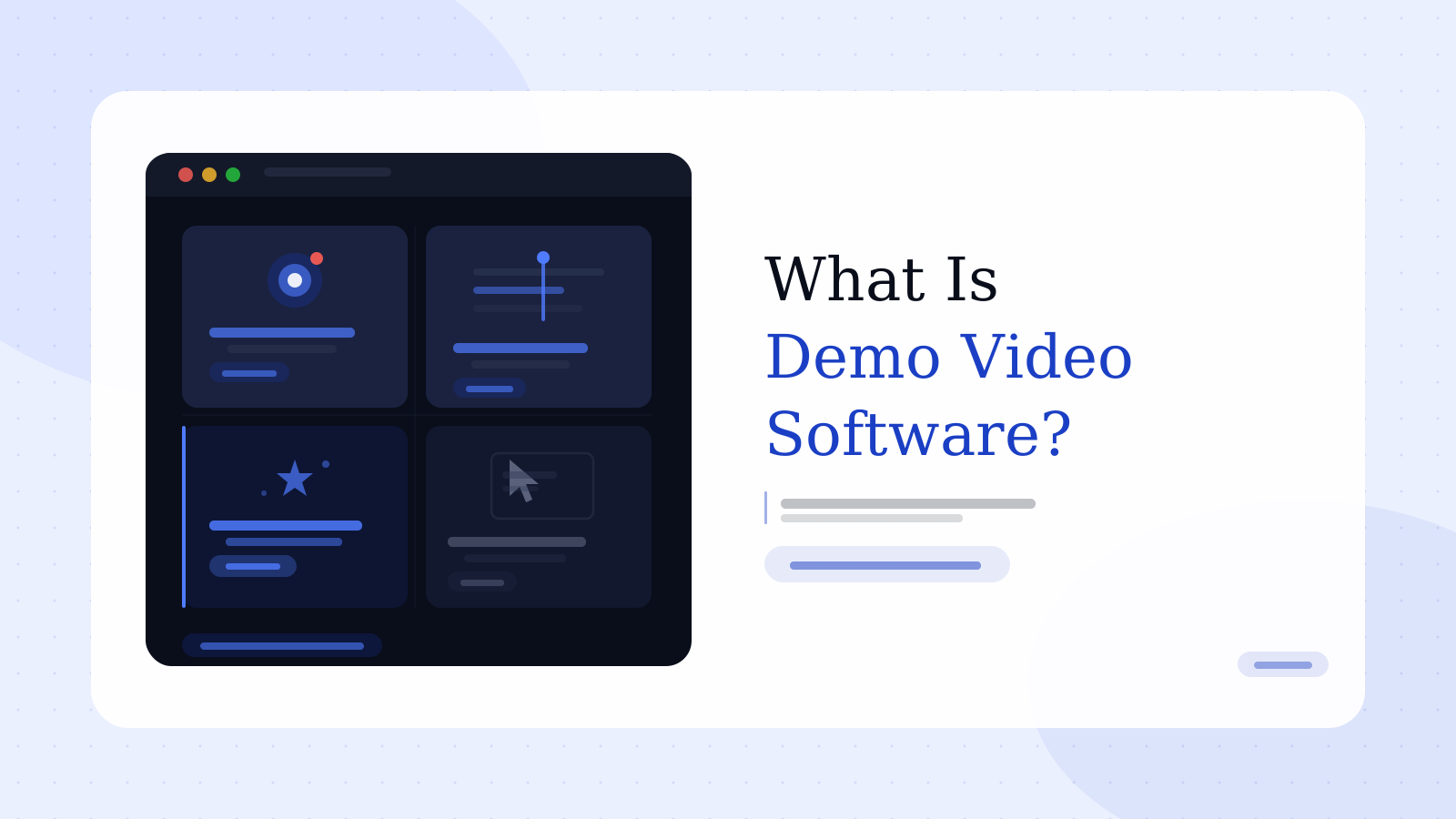
What Is Demo Video Software? The Complete B2B SaaS Buyer's Guide
You've been asked to produce three demo videos before next week's product launch. You open Loom because the sales team uses it. You record something, realise it looks like a Slack update instead of a marketing asset, and start searching for something better. Someone mentions Descript. You spend four hours learning the text-based timeline before capturing a single screen. Then you read "interactive product tour" in a blog and kick off yet another free trial.
Two days later, four browser tabs are open and zero videos are published.
This is what happens when demo video software gets treated as a single category. It isn't. There are four fundamentally different types of tools — each built for a different production context, a different buyer moment, and a different definition of "done." Picking the wrong one doesn't just slow your team down; it shapes the kind of content you're capable of shipping at all. This guide breaks down every category, what it actually costs (including what the pricing pages omit), and how to pick the right fit before you waste another trial period.
In this guide
- What is demo video software?
- The 4 categories of demo video software
- What separates good demo video software from expensive frustration
- The hidden costs most teams discover after signing
- How demo video software fits your production workflow
- Which type of demo video software is right for your team?
- FAQ
What is demo video software?
Demo video software is any tool that helps B2B SaaS teams plan, record, produce, and distribute videos that show their product working. The defining characteristic is that the output is video — not a clickable prototype, not a static screenshot tour, not a live call recording. Video. Specifically, video that captures the product in motion, usually with a script, a voiceover, and a clear workflow shown from start to finish.
The category sits at the intersection of screen recording, video production, and product marketing. What it isn't — and this distinction matters — is live demo software for running real-time product calls, interactive demo platforms for building HTML-based product tours that prospects click through, or general-purpose video conferencing tools.
Most buying confusion comes from conflating demo video software with interactive demo platforms. Tools like Storylane, Arcade, and Navattic let prospects click through a product simulation independently. That's a different category entirely — valuable, but not video. You can't embed a Navattic tour in a LinkedIn post, sequence it into a nurture email, or play it in a webinar the same way you can a 90-second product demo video. The formats answer different buyer questions at different moments, and treating them as substitutes is how teams end up with silent conversion gaps they never trace back to the format decision.
A working definition: demo video software is anything that takes your team from "we need a video that shows this workflow" to a polished, distributable video asset — without bringing in an external production company.
The 4 categories of demo video software
Not every demo video software is built the same. The four categories below are functionally distinct — in what they produce, who operates them best, and where they break down.
1. Screen recording tools
Screen recording tools capture what's happening on your screen, usually with a voiceover or webcam overlay. Common examples: Loom, Zight, Screencastify.
These are the most commonly used and the most misapplied tools in the category. Screen recorders work well for async communication — a quick walkthrough for a prospect, a support explanation, a bug capture for engineering. They were not designed for polished marketing demos that need to be watched by thousands of people, maintained across product updates, and optimised for completion.
The friction surfaces fast. Loom's top complaint category on G2, with 147 separate mentions, is recording reliability — frozen recordings, failed uploads, videos stuck at the "Uploading" phase, and audio sync problems. These are symptoms of using an async messaging tool for structured, repeatable production. A screen recorder's strength is spontaneity. Its weakness is everything that needs to happen after you click record: edit, brand, revise, and keep current as the product evolves.
2. Video editing and production platforms
These tools take raw recordings and transform them into polished outputs: trimming, adding captions, overlaying branding, removing silences and filler words. Common examples: Descript, Camtasia, ScreenFlow. For a ranked comparison, see the best AI video editing tools guide.
Descript is the most capable tool in this category. Its text-based editing workflow — edit the transcript and the video timeline updates accordingly — meaningfully reduces clean-up time. The tradeoff is the learning curve. Teams that commit to Descript produce better output, but the path from "I have a recording" to "the video is published" still requires someone who knows the tool and has the time to use it.
Editing platforms are also maintenance-heavy by nature. Every time your product ships a UI change, any clip showing the old screens needs to be re-recorded and re-edited. For teams shipping product updates frequently, this quickly becomes a production debt that compounds.
3. AI-powered demo video generators
This is the fastest-growing category, and the most relevant to B2B SaaS teams that need to produce demos at volume without a dedicated video editor on staff.
AI demo video generators take a brief, a script, or a set of screen recordings and produce a complete, branded video — including voiceover, transitions, captions, and in some cases the screen capture itself. The output is a finished video, not a raw clip that still requires editing time.
The category is maturing fast. Wistia's 2025 State of Video report found that 41% of companies now use AI in video production, up from 18% just one year earlier — the single largest annual jump the report has recorded in any capability area. Teams adopting AI in their demo video workflow aren't trading quality for speed; they're compressing the gap between "product shipped" and "demo video published."
Rimo sits in this category. A team using Rimo describes what they need in plain English, and Rimo produces a complete product demo video using real product screens — no editor, no production queue, no recording setup. The cycle that used to take days runs in hours.
4. Interactive demo platforms
Strictly speaking, interactive demo platforms are not demo video software. But they appear in enough search results and Slack recommendations alongside video tools that the distinction is worth making explicitly.
Interactive demo platforms — Storylane, Arcade, Navattic, Consensus — let prospects click through a simulated product experience on their own time. These are powerful for product-led growth flows and high-intent self-serve evaluation. They're not video. They don't distribute the same way, don't require the same production workflow, and typically need more engineering and design input to build and maintain.
The practical rule: video demos perform better at the top and middle of the funnel — on product pages, in outbound sequences, in nurture emails — anywhere the buyer controls whether and when to engage. Interactive tours perform better at the bottom of the funnel, where a high-intent buyer wants to simulate product ownership before committing to a trial or commercial conversation. Both are worth building. They are not substitutes for each other, and most teams that have only one are missing conversions the other would capture.
Demo video software that keeps pace with your product
Rimo turns a plain-English brief into a polished product demo video — real screens, no editor, no production backlog. B2B SaaS teams use it to ship demos in hours, not weeks.
What separates good demo video software from expensive frustration
Most tools promise to simplify demo video production. The ones that actually deliver it share three properties the pricing page won't show you.
Production speed that matches your release cadence
If your product ships updates every two weeks but your demo video production cycle takes three weeks, you will always be publishing demos that show an outdated product. That's not a marketing problem — it's a systems problem. Good demo video software reduces the cycle time between "the product changed" and "the demo reflects it."
The right question to ask in any trial isn't "can this produce a good first video?" It's: "how fast can I update it when the product changes next month?" Teams that use AI-powered demo video automation can turn a product update into a new published demo in hours. Teams running manual production workflows typically take days to weeks. The compounding cost of that gap is one of the most consistently underestimated line items in B2B SaaS marketing.
Output that doesn't require post-production
The real cost of most screen recording tools isn't the subscription — it's the editing hours that follow every recording session. A raw recording needs silence removal, caption generation, brand overlays, and an intro/outro at minimum. If every demo video requires three hours of editing after the screen is recorded, your "free" screen recorder is one of the most expensive tools in your stack — it just doesn't look that way in the finance system.
The benchmark: can your team go from brief to publishable video in under two hours, without a professional editor? If not, the tool is creating work, not removing it.
Output formats that match where buyers actually watch
According to Gartner's 2025 research on B2B buying behaviour, buyers now spend only 17% of their total buying time meeting with suppliers. The rest happens independently — on your website, in their LinkedIn feed, inside nurture email sequences. Your demo video software needs to output formats those channels require: horizontal for website embeds, vertical for LinkedIn and social feeds, square for email thumbnails.
Most screen recorders produce one format. Editing platforms handle multiple formats but require manual resizing. AI-powered generators handle multi-format output automatically as part of the production process.
The hidden costs most teams discover after signing
Three costs that don't appear on the pricing page:
Per-seat billing surprises. Loom's pricing shift following the Atlassian acquisition caught hundreds of teams off guard. Users who had invited free collaborators found those seats converting to paid seats without explicit confirmation — with some teams reporting per-user cost increases of 10–15x. Before signing any demo video software contract, map every person who will ever need access: not just the video producers, but reviewers, approvers, and anyone who needs to view private recordings. The number is almost always higher than the initial estimate.
Re-recording debt. No tool advertises this cost, but it's real and it compounds. Every time your product's UI changes — and in B2B SaaS, it changes constantly — any existing recording showing that UI becomes inaccurate. A library of 40 demo videos is 40 potential re-recordings. The B2B SaaS demo video mistakes that consistently kill pipeline performance include stale, outdated demos — and the teams that fix this problem structurally are the ones that choose tools with modular clip updates rather than full re-record workflows.
Script revision cycles. G2 reviews of video production tools consistently surface the same frustration: discovering after a full recording session that the script needed changes, forcing a complete restart. Demo video software that supports brief-first or script-first workflows — where the video is structured before any recording happens — eliminates this category of waste. For the practical side of building a brief-first production workflow, the product demo video script template covers the structure in detail.
How demo video software fits your production workflow
A useful mental model: demo video software sits between your product and your buyers. Every video it produces has to cross two thresholds — it has to accurately represent the product, and it has to communicate value to a specific buyer persona in the time that buyer is willing to give it.
The production workflow for any demo video moves through four stages:
- Brief — What does this video need to show? Who is it for? What's the single thing the viewer should know at the end?
- Record — Capture the relevant product screens in the right sequence, in a clean environment, with realistic demo data.
- Produce — Add voiceover, captions, transitions, and branding. Trim dead space.
- Distribute — Publish in the right formats to the right channels.
Screen recording tools optimise for stage 2. Editing platforms optimise for stage 3. AI-powered generators compress all four stages into a single workflow — brief in, polished video out.
The practical question isn't which tool is best at a single stage in isolation — it's which stage is the bottleneck for your team right now. If you have strong producers but no systematic brief process, an AI generator will unlock more than a better editor will. If you're producing 50 videos per quarter but the editing queue is six weeks behind, the recording tool isn't the problem.
The teams that always have fresh, accurate demo videos aren't the ones with bigger budgets. They're the ones with shorter production cycles. A two-hour turnaround beats a two-week one regardless of the quality difference — because a two-week cycle means half your demos are already wrong by the time they publish.
Which type of demo video software is right for your team?
The decision comes down to three variables: how often you need to produce demos, how much production expertise exists on your team, and how fast your product changes.
| Situation | Best fit |
|---|---|
| Occasional async walkthroughs for sales follow-up | Screen recorder (Loom, Zight) |
| High production quality, dedicated video producer on team | Editing platform (Descript, Camtasia) |
| High-volume production, no dedicated editor | AI demo video generator (Rimo) |
| High-intent self-serve buyers at product-led growth stage | Interactive demo platform (Storylane, Navattic) |
| Fast-shipping product with frequent UI changes | AI demo video generator |
| Multi-persona demo library across different buyer roles | AI demo video generator |
One nuance most comparison guides overlook: this isn't a startup vs. enterprise question. It's a production-capacity vs. production-demand ratio. A 200-person company with one PMM and a fast-shipping roadmap has lower production capacity relative to demand than a 20-person startup where a former video producer runs marketing. The right tool category is the one that matches your actual production resources — not your headcount tier.
If you're evaluating whether AI-powered demo video production makes sense now, test it against one concrete number: how many demo videos did you need to produce last quarter, and how many did you actually publish? The gap between those two numbers is what AI production is built to close.
Producing great demo videos consistently — not just occasionally — is the real competitive advantage for B2B SaaS marketing teams. The bottleneck is almost never creativity or strategy. It's production capacity. The right demo video software removes that bottleneck, so the demos that exist in your team's heads actually ship to the buyers who need to see them.
Rimo is built for exactly this: brief-first, AI-powered demo video production using your real product screens. No editor required. No production backlog. Try Rimo free →
FAQ
What is demo video software?
Demo video software is any tool that helps B2B SaaS teams produce, edit, and distribute video content that shows their product working. The category includes four types: screen recording tools, video editing tools and production platforms, AI-powered demo video generators, and (adjacent to the category) interactive demo platforms. The output is always a distributable video file — not a clickable prototype or a live demo session recording.
What is the difference between demo video software and interactive demo platforms?
Demo video software produces video files that can be embedded on websites, sequenced in email nurture flows, and posted to social channels. Interactive demo platforms produce click-through product simulations that prospects navigate at their own pace. Video works best at the top and middle of the funnel, where buyers are establishing fit. Interactive tours work best at the bottom, where high-intent buyers want to simulate product use before a purchase decision. Both serve a role — they're not substitutes for each other.
How much does demo video software cost?
Pricing varies significantly by category. Screen recording tools like Loom start around $12.50/user/month. Editing platforms like Descript run approximately $24/user/month for teams. AI demo video generators are typically priced per output volume or per seat. The pricing page rarely reflects the full cost: per-seat fees for reviewers and approvers, time cost of re-recording when the product updates, and editing hours per video are the most consistently underestimated line items. Before committing, calculate the total cost including production hours — not just the subscription fee.
Can I create demo videos without a screen recording tool?
Yes. AI-powered demo video generators like Rimo produce a complete product demo video from a plain-English brief, without requiring manual screen recording. The AI handles narration, screen capture, transitions, and branding. This approach is particularly useful for teams producing demos at high frequency, teams that need to update demos quickly when the product changes, and teams without a dedicated video editor.
What should I look for when evaluating demo video software?
Three criteria matter most: production speed (how quickly can the team go from brief to published video?), update efficiency (how easily can a video be modified when the product changes?), and output format flexibility (does it produce horizontal, vertical, and square formats for the channels your buyers actually use?). Prioritise tools that compress the full production cycle — brief, record, produce, distribute — rather than tools that optimise one stage and leave the rest as manual work.
How does demo video software support the B2B buying process?
B2B buyers now spend only 17% of their total buying time in conversations with suppliers (Gartner, 2025). The rest happens independently — on your product page, in their LinkedIn feed, in the email sequences your team sends. Demo video software gives marketing teams the production capacity to meet buyers in those self-directed research moments with accurate, persona-specific product demonstrations. The teams that publish the most demos — not the most polished ones — consistently win more of those independent evaluation moments.
Akshay Sharma
Product Leader · 10+ years in B2B SaaS
Akshay has spent 10+ years building and marketing B2B SaaS products. He writes about product storytelling, demo production, and the operational side of product marketing.