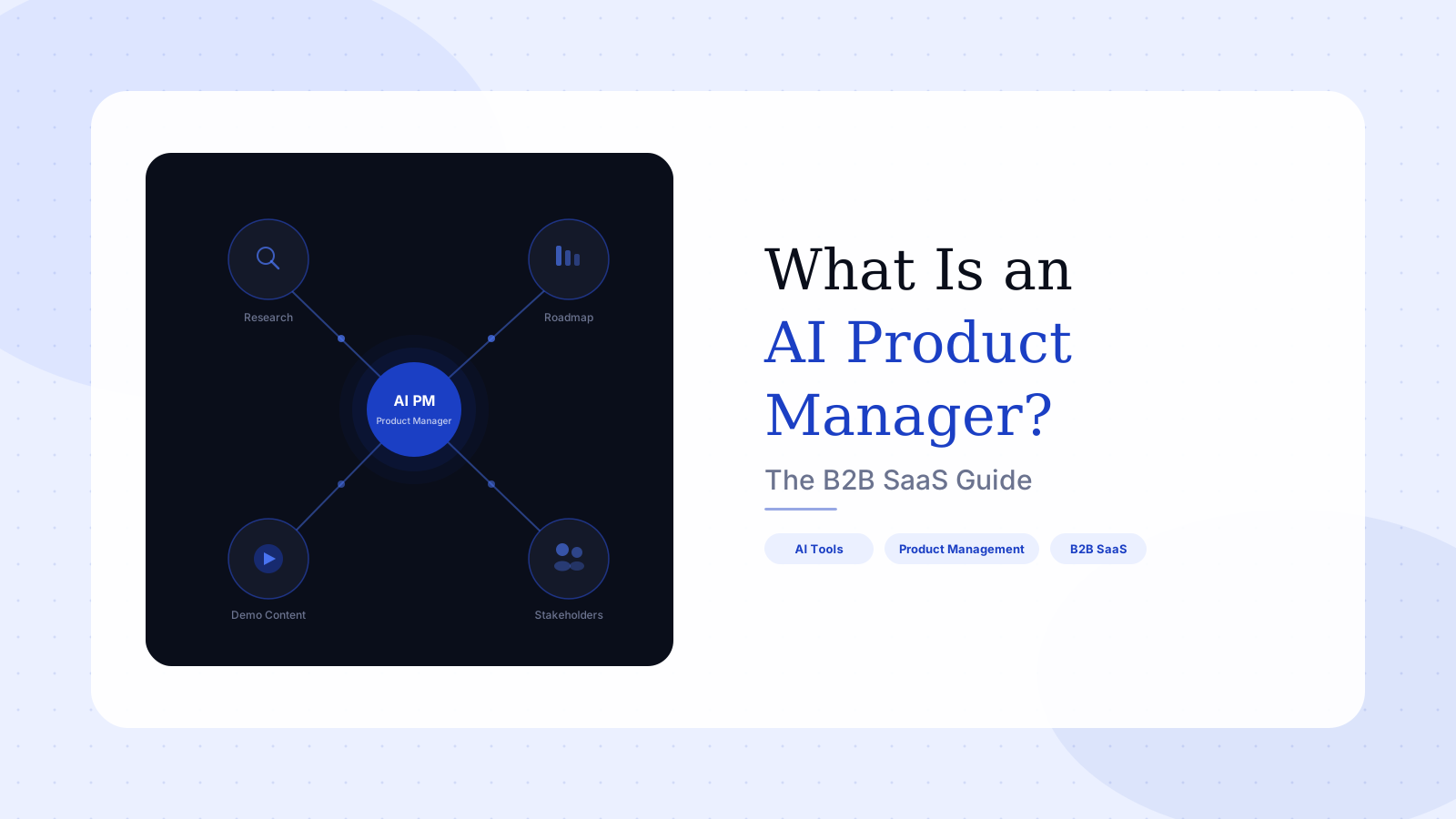
What Is an AI Product Manager? The B2B SaaS Guide
The job title "AI Product Manager" is everywhere right now. It's on LinkedIn profiles added by the thousands in the last twelve months. It appears in job descriptions, often written by hiring managers who aren't entirely certain what it means. And product managers themselves use it two different ways — sometimes to describe what they build, sometimes to describe how they work.
That ambiguity matters. The two meanings require completely different skill sets. Conflating them leads to bad hiring decisions, misdirected training budgets, and product managers chasing machine learning credentials when their actual advantage lies somewhere else entirely.
This guide draws a clean line between the two types of AI product manager, covers what each does differently, explains which tools actually move the needle, and identifies where AI genuinely changes the job versus where it's mostly noise. If you manage products at a B2B SaaS company — or are about to hire someone who does — this is the guide that cuts through the confusion.
In this guide
- What is an AI product manager?
- The two types of AI product manager — and why the distinction matters
- What an AI product manager actually does day to day
- The AI PM toolkit: what actually moves the needle
- Skills that separate a good AI product manager from a great one
- How AI changes the product communication layer
- AI product manager career path and salary
- FAQ
What is an AI product manager?
An AI product manager is a product manager who either manages AI-powered products and features, uses AI tools systematically in their day-to-day workflow, or both.
The first group defines what an AI feature or system should do — setting success metrics for machine learning models, working with data science teams, and translating technical capabilities into user-facing value. Think of the PM behind a recommendation engine, a fraud detection system, or a generative AI writing assistant built into a SaaS product.
The second group are traditional product managers who have rebuilt their workflow around AI tools. They use large language models to synthesize customer feedback, generate draft PRDs, run competitor analysis, and create product narratives faster. They're not building AI. They're using it as a professional force multiplier.
Both groups are called "AI product managers." At the execution level, they have almost nothing in common.
According to McKinsey's State of AI report (November 2025), 88% of organizations now deploy AI in at least one business function — up from 65% just a year earlier. That adoption has a catch: 94% of those same organizations say they're not yet seeing "significant" value from AI. The gap between deploying AI and actually getting value from it is where the AI product manager's job lives.
The two types of AI product manager — and why the distinction matters
This is the distinction most career guides bury in a footnote. It deserves a section.
Type 1: The PM who builds AI products
This PM works on software where AI is the core value proposition or a critical capability. Their day-to-day involves:
- Working with data science and ML engineering teams to define model requirements
- Translating model accuracy, latency, and confidence thresholds into user experience decisions
- Managing the feedback loops that improve model performance post-launch — labeling pipelines, RLHF, and evaluation frameworks
- Setting success criteria that measure product value without relying only on traditional engagement metrics
- Communicating model behavior — including failure modes — to design, engineering, and customers
This role requires a working knowledge of how ML systems behave: why models fail silently, how training data shapes outputs, what "good enough" looks like at different confidence levels. It doesn't require being a machine learning engineer. But it requires enough literacy to ask the right questions of the engineers who are.
One thing this PM does that rarely gets written up: they manage user expectations about AI uncertainty. When a model is 85% confident and wrong 15% of the time, the product has to make that visible without destroying trust. That's a product decision, not a technical one — and most ML teams don't have the PM instinct to make it well.
Type 2: The PM who uses AI in their workflow
This is the faster-growing type — and the more relevant one for the majority of product managers in 2026. This PM hasn't changed what they produce: PRDs, roadmaps, research synthesis, stakeholder presentations, product demo videos. They've changed how fast and how clearly they produce it.
McKinsey Global Institute (2023) estimated that generative AI could automate between 60 and 70 percent of the time knowledge workers currently spend on routine document creation, data synthesis, and communication tasks. For product managers — who spend a disproportionate share of their time in exactly these activities — that's a significant shift in where their hours go.
This type of AI PM can:
- Synthesize 200 customer interviews into a structured theme report in an afternoon instead of a week
- Generate three competing PRD structures from a single brief and pick the strongest elements from each
- Create product story assets — demos, walkthroughs, one-pagers — faster than the product itself changes
- Run competitor analysis across a dozen sources and surface the relevant signal from the noise
The advantage isn't in replacing PM judgment. It's in eliminating the production work that sits between having a good idea and communicating it clearly.
What an AI product manager actually does day to day
Regardless of type, the AI product manager's core job hasn't changed: define what to build, align the team on why it matters, and make sure the right thing ships.
What's changed is the pace and quality of the surrounding work.
Discovery and customer research
Traditional PM discovery: schedule user interviews over three weeks, record and transcribe them, synthesize themes by hand, build a presentation for quarterly review.
AI-augmented discovery: run the same interviews, feed transcripts into an AI analysis tool, get structured themes with representative quotes in an afternoon, validate edge cases with targeted follow-up conversations.
The interviews still happen. The AI synthesis is a starting point — not the endpoint. The bottleneck moves from "how do I analyze all of this?" to "what questions should I be asking in the first place?" That's where PM judgment actually creates value.
A Productboard survey of 379 enterprise product professionals (2025) found that the average AI-powered PM saves 4 hours per task compared to their pre-AI workflow — with the largest gains in research synthesis, first-draft generation, and structured analysis. That's roughly 33 hours per week in time savings across core PM functions. Which raises an obvious question: if PMs are saving that much time, why does McKinsey's data show 94% of companies still aren't seeing significant AI value? The answer, consistently, is that efficiency gains aren't being redirected to strategic work. The time is being absorbed by more tasks, more tools, and more overhead — not better decisions.
Roadmap development and prioritization
AI doesn't replace prioritization decisions. It improves the inputs that inform them. An AI-augmented PM can pull customer feedback signals from support tickets, sales call notes, and NPS responses simultaneously, then ask an AI tool to surface patterns — rather than manually reading through each source one by one.
The output is better information, not automated decisions. A roadmap still requires judgment about what the market actually needs versus what customers say they want, what's technically feasible in the next quarter, and where the company's strategic bet should land. AI doesn't resolve those tensions. It removes the friction of gathering and organizing data before you can think clearly about them.
One contrarian note: AI-generated roadmap inputs can surface the loudest voices rather than the most important signals. Customer feedback that shows up repeatedly in transcripts isn't always the highest-priority problem — sometimes it's just the easiest problem to articulate. AI PMs who understand this calibrate AI-synthesized research against the strategic context, rather than treating pattern frequency as a direct proxy for priority.
Stakeholder communication and product storytelling
This is where AI creates the most underappreciated value for product managers.
A PM's job isn't just to define what gets built — it's to build alignment around it. That means writing product briefs that executives actually read. It means creating presentations that make complex decisions legible to non-technical stakeholders. And it increasingly means producing product walkthrough videos and demo assets that let the product speak for itself when the PM isn't in the room.
Most PMs are excellent at the thinking. They're often slower than they need to be at the communication layer. AI reduces the gap between "I know what we're building and why" and "everyone else knows what we're building and why."
The AI PM toolkit: what actually moves the needle
The number of tools claiming to be "built for product managers" has exploded. Most aren't worth the subscription. These are the categories where AI creates real value for product management work in B2B SaaS.
Research synthesis
Dovetail, Insight7, and similar tools apply AI to qualitative research. They identify themes across interview transcripts, tag sentiment, and surface quotes that illustrate each pattern. For teams running continuous discovery, these tools shift research analysis from a multi-week quarterly exercise to an ongoing, low-friction process.
Document and PRD generation
Claude, ChatGPT, and Notion AI all produce reasonable PRD drafts from structured prompts. The key is treating the output as a forcing function for your thinking — not a finished document. Use the draft to identify what you haven't decided yet, not to avoid deciding. PMs who outsource their reasoning to AI document tools produce work that looks complete but lacks the sharp decisions that engineering teams need to execute.
Competitive intelligence
Klue, Crayon, and Kompyte use AI to track competitor changes — pricing pages, job postings, product announcements, customer reviews — and surface signals that would otherwise require a dedicated team to monitor manually.
A word on tool governance: a WalkMe survey (August 2025) found 78% of employees use unapproved AI tools, while only 7.5% receive extensive AI training from their employer. For AI product managers specifically, this creates a real risk — using unsanctioned tools with customer data, competitive intelligence, or unreleased product details can create legal and compliance exposure. The best AI PMs build a sanctioned tool stack rather than a shadow one.
Demo and communication content
This is the category most AI PM tooling has ignored. Product managers constantly need to show how the product works — to customers, to leadership, to the sales team, to new hires. The traditional options are live demos (time-intensive, dependent on demo environment stability) or screen recordings edited into something presentable (production overhead most PMs avoid entirely).
AI demo video tools like Rimo remove that friction. A PM can go from a brief to a finished, branded product demo video without a production crew. For a function that runs on communication throughput — quarterly roadmap updates, launch announcements, feature walkthroughs for sales — that's a significant change in what a single PM can accomplish.
Reviews on G2 for screen recording and video tools consistently surface the same frustration: tools built for async messaging weren't designed for the controlled, repeatable recording environments that product demo production requires. Recordings cut off mid-take, browser extensions freeze at critical moments, and editing overhead accumulates until teams stop updating demos altogether.
The production cost gap is significant. Traditional video production for a 90-second product demo runs $10,000–$25,000 and 6–8 weeks of production time. AI-native tools compress that to 5–12 hours at a fraction of the cost. For teams shipping features on weekly or bi-weekly cycles, that compression isn't a nice-to-have — it's the difference between demo content that reflects the current product and demo content that's perpetually three sprints behind. AI-native tools that handle the production layer let PMs focus on the story instead of the mechanics.
Turn your product brief into a demo video — no production team needed
Rimo builds polished, on-brand product demo videos from a plain-English brief. Real product screens, no editor required. Built for product teams who ship faster than a production crew can keep up.
Skills that separate a good AI product manager from a great one
The temptation is to think AI fluency means knowing how to write prompts. It's more specific than that.
Evaluation over generation
The most valuable skill an AI product manager develops is calibrated judgment about AI outputs. An AI tool can generate ten options for a PRD section, a positioning statement, or a demo script. The PM who can quickly evaluate quality — who knows which option is actually better and why — captures the advantage. The PM who accepts the first output and moves on loses it.
This requires a sharp understanding of what "good" looks like in your specific domain. Someone who knows what a great product brief looks like can immediately recognize the generated version that misses the mark. Someone who doesn't has no basis for evaluation — and ends up with work that looks complete but isn't rigorous.
Data literacy without data science
AI-powered PMs need to be comfortable with data at a conceptual level — understanding what A/B test results mean, how to interpret funnel metrics, when a sample size is too small to draw conclusions from. They don't need to write SQL. They do need to know what a query is trying to answer, so they can validate that the answer is the right one.
Speed as a competitive discipline
The biggest shift AI tools bring to product management is time compression — getting from idea to artifact faster than the traditional process allows. PMs who treat this as a competitive discipline within their own organization ship more coherent strategies, iterate faster on positioning, and maintain better alignment across more stakeholders than those who don't.
Wistia's 2025 State of Video report found AI use in video production jumped from 18% to 41% in a single year — the largest adoption spike in the report's history. That same pattern — AI dramatically compressing production time for communication outputs — is playing out across every artifact a PM produces. The PMs building systems around that compression today will have structural advantages by 2027.
An honest assessment of where AI underperforms
Great AI product managers know AI struggles with:
- Novel strategic decisions where there's no comparable precedent in training data
- Judgment calls that require deep domain context built up over years in a specific market
- Detecting the difference between what a customer says they want and what they actually need
- Anything requiring genuine empathy with users who aren't well-represented in AI training corpora
Those are exactly the areas where PM judgment compounds in value. AI compresses the mundane. It amplifies the strategic — but only if you know the difference.
How AI changes the product communication layer
This is the angle almost no guide on this topic covers: the biggest productivity gain for an AI-powered PM isn't in research or roadmaps. It's in product communication.
A product manager communicates constantly — to engineering, design, marketing, sales, leadership, and customers. Most of those communications require context-setting that repeats itself with variations: here's what we're building, here's why it matters, here's what you need to know given your role and where you sit in the decision.
AI doesn't replace those conversations. It makes the artifacts that support them dramatically faster to produce.
The demo video script framework that a PM might spend a day crafting can now be structured in an hour. The feature walkthrough that would have required a contractor can be turned around internally in a day using an AI demo video tool. The positioning one-pager that gets rewritten every quarter can be drafted in twenty minutes and revised rather than rebuilt.
This is where AI product managers who understand the communication layer outperform those who only think about research and roadmaps. Building internal alignment isn't less important than building the right product — in most organizations, it's the harder constraint. AI finally makes it tractable.
A concrete example most product marketing guides skip: when a PM ships a new feature, they typically need to brief sales, write the changelog entry, update the demo, draft the email to customers, and produce the internal announcement — often in the same week the feature ships. AI tools let one PM handle that communication surface without a PMM partner.
That matters more than it sounds. According to the Alliance State of Product Marketing Report (2025), 44.3% of product marketing teams are just one or two people. At those team sizes, the PM's ability to produce communication assets independently — or with minimal PMM support — is the constraint that determines what actually ships with a coherent story behind it. AI changes what's possible at every team size.
AI product manager career path and salary
The "AI product manager" title in 2026 doesn't yet command a uniform premium over a traditional PM title — because the label is applied inconsistently. What commands a premium is demonstrated ability to use AI tools to increase output quality, improve research rigor, and move faster through the product lifecycle.
In the US market, the average base salary for an AI product manager sits at approximately $133,600, with senior roles clearing $200,000 in base compensation and significantly more in total comp at growth-stage companies (Axial Search analysis of 592 AI PM job postings, 2025). AI skills as a modifier add a 15–20% premium over traditional PM compensation at the same seniority level — a gap that's growing as hiring managers see the output difference firsthand. Notably, 70% of AI PM job postings require six or more years of experience, which means this is still largely a senior-hire market.
The more meaningful career signal is portfolio velocity: companies hiring PMs in 2026 are selecting for candidates who demonstrate AI-augmented output — showing research synthesized with AI tools, AI-assisted PRDs with sharp decisions, and communication assets produced faster than traditional teams could manage. The strategic thinking still has to be there. The proof is in what you shipped and how fast.
For PMs earlier in their career, the fastest path to an AI PM role isn't a certification or a course. It's building a system — a personal toolkit of AI tools, prompt patterns, and production workflows — that makes you demonstrably faster at every output a PM produces. Then making that system visible in how you work, what you ship, and what you can point to.
The product marketing manager role sits adjacent to the AI PM — often sharing the same communication surface and tool stack. At many startups, a single senior person covers both. Understanding the overlap helps clarify where AI PM responsibilities end and where PMM begins, especially as AI tools make both functions more tractable with smaller teams.
FAQ
What is an AI product manager?
An AI product manager is either a PM who manages AI-powered products (responsible for ML features, data pipelines, and model performance as product decisions) or a PM who uses AI tools systematically in their daily workflow to work faster and more effectively. The two roles are often conflated but require different skills. Most PMs becoming "AI PMs" in 2026 are doing the latter: using AI to amplify their existing output, not building ML systems from scratch.
Do you need to know machine learning to be an AI product manager?
Not necessarily. PMs who manage AI products need enough ML literacy to work effectively with data science teams — understanding how models are trained, evaluated, and fail. PMs who use AI in their workflow don't need ML knowledge; they need strong judgment about AI output quality, data literacy at a conceptual level, and a clear system for integrating AI tools into their existing process.
What tools do AI product managers use?
The most commonly used categories are: AI research synthesis tools (Dovetail, Insight7), AI writing assistance (Claude, ChatGPT, Notion AI), competitive intelligence platforms (Klue, Crayon), and AI video and demo tools for product communication (Rimo). The specific tools matter less than the workflow — how they're integrated into a PM's daily process to compress production time without replacing strategic judgment.
How is an AI product manager different from a traditional product manager?
The core job is the same: define what to build, align the team, and ship the right thing. The difference is in the pace and quality of surrounding work. An AI PM can synthesize customer research faster, generate stronger artifact drafts in less time, and create product communication assets — demos, walkthroughs, one-pagers — without the production overhead that slows traditional PMs down. The judgment and strategy remain entirely human. The synthesis and production are augmented.
What skills should I develop to become an AI product manager?
Start with your existing PM strengths and layer in: the ability to critically evaluate AI-generated outputs (not just accept them), conceptual data literacy (understanding what metrics mean and when to trust them), and fluency with AI production tools for the communication layer — demos, walkthroughs, and product briefs. Real-world skill comes from building a personal system and shipping output with it, not from a certification course.
Is "AI product manager" a real job title or just a trend?
Both, depending on context. At companies building AI products, it's a real and specific role with distinct requirements around ML literacy. At companies where it means "PM who uses AI tools," it's mostly a framing — the underlying job is still product management, with a better toolkit. What matters is what the specific role requires, not the label. In either case, the output expectations are higher in 2026 than they were in 2023, and the teams most likely to meet them are the ones who've built AI tools into their daily practice rather than treating them as an occasional shortcut.
Akshay Sharma
Product Leader · 10+ years in B2B SaaS
Akshay has spent 10+ years building and marketing B2B SaaS products. He writes about product storytelling, demo production, and the operational side of product marketing.