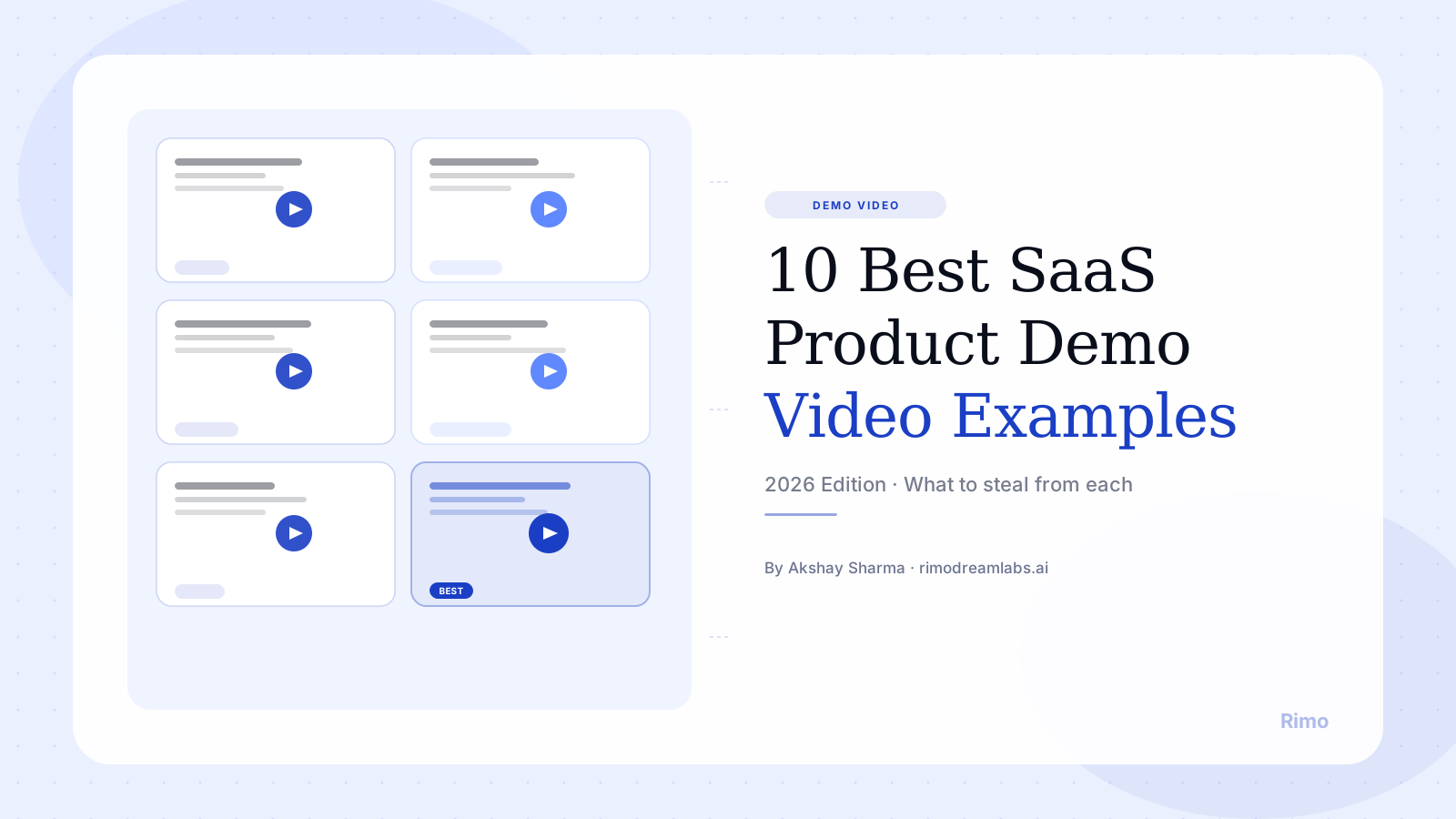
10 Best SaaS Product Demo Video Examples (2026 Edition)
You've watched your competitor's demo video three times. You can't put your finger on why it works — it's not expensive-looking, the voiceover is decent but not polished, and the product isn't obviously better than yours. But it holds attention. Something about how it's structured makes you want to keep watching.
Your own demo video, meanwhile, has been live for two months. The play rate is fine. The completion rate is not. Visitors watch 40 seconds and leave. You've rewritten the voiceover twice. You've tried a different thumbnail. Nothing moved the needle.
The difference isn't production quality. It's structure. The best SaaS product demo video examples — the ones that hold attention, generate trials, and support pipeline — follow patterns that are learnable and repeatable. This post breaks down 10 of them, with one specific lens: what makes each video work, and exactly what you can take from it and apply to your own.
In this guide
- What separates great SaaS product demo video examples from forgettable ones
- The 10 best SaaS product demo video examples
- 1. Slack — narrative over features
- 2. Notion — one product, many personas
- 3. Grammarly — product in context
- 4. HubSpot — buyer-journey structure
- 5. Gong — data before product
- 6. Figma — build around the magic moment
- 7. Intercom — the product as a character
- 8. Calendly — one thing, perfectly
- 9. Monday.com — lead with outcome, prove with product
- 10. Loom — format as proof of concept
- What the best SaaS demo video examples have in common
- The problem nobody talks about: demo video decay
- How to build your own
- FAQ
What separates great SaaS product demo video examples from forgettable ones
Before looking at specific videos, it helps to know what you're actually looking for. The best SaaS product demo video examples share five structural characteristics — and the absence of even one usually explains why a demo underperforms.
Problem specificity. The video names a real problem within the first 15 seconds. Not "manage your work better" — something specific enough that the target buyer thinks that's exactly what happens to me.
Persona clarity. The demo is built for one person. Not "teams," not "businesses" — one kind of buyer, with one kind of job, in one kind of situation. Videos that try to serve everyone end up resonating with no one.
Outcome framing. The best demo videos don't describe features — they describe the state the buyer will be in after using the product. Before. After. The product is the bridge.
Earned brevity. Wistia's 2025 State of Video report found that videos under one minute hold a 50% average engagement rate. The best demos are short not because they cut things out — but because every second earns its place.
Single clear CTA. Every example below ends with one action. Not "learn more, get a demo, or start a trial." One thing. The buyer either does it or they don't.
These aren't aesthetic preferences. They're the structural patterns that consistently produce higher completion rates, more trial starts, and more pipeline. Every example below should be read through this lens.
The 10 best SaaS product demo video examples
1. Slack — narrative over features
Slack's most-studied demo video doesn't look like a demo video. It looks like a short documentary. It follows real people at real companies — describing the chaos of email-driven communication, the missed context, the thread that nobody updated — and then shows how Slack changed the way they actually worked.
The product appears roughly 40 seconds into a two-minute video. By that point, the viewer has already heard three specific problems they recognise. The demo doesn't have to argue that Slack solves anything. The buyer has already been nodding along, and the product becomes the natural resolution to a story they were already inside.
The instinct most teams have is to open a demo with the product. Slack's video shows why that instinct is wrong: the product is not the hero. The buyer's problem is the hero.
What to steal: Write your opening around a situation the buyer is already living before you design a single screen. Start with the problem in specific, human terms. Let the product be the answer to a question the viewer is already asking — not the subject of the first sentence.
2. Notion — one product, many personas
Notion's demo library is worth studying not for any single video, but for how many there are. There's a Notion demo for engineering teams. One for marketing teams. One for freelancers. One for students. The product is identical in every video. Everything else changes.
Each persona gets a different problem statement in the first 10 seconds. Engineering: "your documentation is split across four tools and nobody's reading it." Marketing: "your campaign plans live in someone's head until two days before launch." Different problem, different workflow, different outcome. Same product.
Most B2B SaaS teams produce one demo and broadcast it to every buyer. Notion's library shows what happens when you take the alternative seriously. The conversion difference between a generic demo and a persona-specific one isn't marginal.
What to steal: If your product serves more than one buyer type, build more than one demo. Persona-specific product demo videos routinely outperform generic overviews because they signal to the buyer that they're being talked to — not broadcast at. The core recording can often be shared. The problem framing and first 15 seconds should change per audience.
3. Grammarly — product in context
Grammarly's most effective demos don't show the product inside the Grammarly interface. They show it inside Gmail, Google Docs, and LinkedIn. The buyer watches the tool fix a sentence they would have written — in an app they already have open right now.
This distinction is subtler than it sounds. Most SaaS demo videos show the product in isolation, in a clean custom environment, performing ideally. Grammarly shows it inside the buyer's existing workflow. That specificity makes the before/after immediately legible without any explanation required.
The viewer doesn't have to imagine how this would work in their day. They just watched it working in their day.
What to steal: Demo your product inside the buyer's existing environment, not yours. Show it alongside the tools they already use. The setup work is worth it — it removes the cognitive step of "ok but how would this actually look for me?" and replaces it with "I would use this exactly like that."
4. HubSpot — buyer-journey structure
HubSpot's demo library is organised around buyer stage, not product feature. There are awareness-stage videos that explain what a CRM is and who needs one. Evaluation videos that compare specific workflows before and after. Decision-stage demos that walk a particular use case end-to-end for a named persona.
Most SaaS teams ship one demo and deploy it everywhere — homepage, email sequences, sales follow-ups, paid landing pages. HubSpot builds a library mapped to what a buyer needs to understand at each stage of their decision. No single video carries all the selling weight. Each does one job at one moment in the buying journey.
The side effect is that updates are contained. When the CRM dashboard changes, the decision-stage persona demo needs updating — not the entire library.
What to steal: Before production, map your demo content to funnel stages. An awareness demo and a product walkthrough video serve different purposes for different buyers at different moments. Building both is more work upfront. It's significantly less work when something needs updating — and it converts better at every stage because nothing is trying to do every job simultaneously.
5. Gong — data before product
Gong's demo videos open with a provocation. Not a product feature — a finding. "Deals that include a mutual close plan are 37% more likely to close." "Top performers talk 43% less than average reps in discovery calls." The viewer is handed an insight they can't dismiss before the product is mentioned.
By the time the demo starts, the buyer has two questions: where does this data come from and can I see this for my own team? Both answers are delivered by the product. The demo doesn't need to build the case that Gong is valuable — the data already did it. The product is now evidence for a claim the viewer already finds interesting.
This is most effective when the product genuinely generates interesting output — revenue intelligence, analytics, operations, customer data platforms. But any SaaS product with a data story can borrow the structure.
What to steal: If your product generates insights, leads with the output before showing the tool. Let the finding create the question. Then let the product answer it. The demo becomes proof, not pitch.
Build your own standout SaaS demo video
Rimo generates a complete, persona-targeted demo video from a plain-English brief — no screen recording, no editing software, no video team. See it in action.
6. Figma — build around the magic moment
Figma's early demo videos understood something most SaaS demos miss entirely: every product has one moment that makes a first-time viewer stop and say "oh." For Figma, that moment is two cursors moving on the same design file simultaneously — two people editing in real time, in a tool that previously required file handoffs and lengthy email threads.
The entire demo is structured around creating the conditions for that moment to land. Everything before it is setup. The cursor moment arrives, and the demo is essentially over — the product has proven its core claim visually, without a word of explanation.
Most demos bury their best moment. They treat the "wow" as a feature to be listed, not an experience to be engineered.
What to steal: Identify the single most impressive thing your product does — the moment that makes a first-time user's face change — and build the entire demo around it. Don't save it for the end of a feature list. Create anticipation, then let it hit. One moment remembered is worth five features described.
7. Intercom — the product as a character
Intercom's customer messaging demos follow a consistent structure: a customer arrives with a problem, and the viewer watches the conversation unfold inside Intercom. The product is not the subject of the demo — it's the medium through which a real interaction plays out.
This is a powerful choice. The buyer isn't watching a feature tour. They're watching a customer problem get resolved — and Intercom is how it happened. The product proves itself by being used, not by being described.
There's a difference between showing your product and showing your product working. Intercom consistently does the latter. The demo feels less like marketing and more like watching something real.
What to steal: If your product is used in customer-facing workflows — support, sales, success — build the demo around a complete interaction rather than a feature walkthrough. Show the resolution. Put the product in the context of a real problem being solved. Let it work, and let the viewer watch it work.
8. Calendly — one thing, perfectly
Calendly's demos are defined by what they don't include. No section on team features. No integration walkthrough. No pricing mention. The entire video is: someone shares a Calendly link, the recipient picks a time, the meeting appears on both calendars. Done. Under 90 seconds.
Most SaaS demos try to communicate everything that's possible. Calendly communicates one thing precisely — and trusts that viewers who want more will go find it. The demo earns the next action by completing the one job it set out to do.
The counterintuitive lesson: restraint is a production decision, not a feature decision. Calendly has many features. The demo doesn't show them.
What to steal: For your awareness-stage demo, pick one workflow that best captures the core value of your product and show only that. If a section feels like it could be its own video, it should be its own video. A shorter demo that gets watched completely beats a longer one that gets abandoned at 40 seconds. Every time.
9. Monday.com — lead with outcome, prove with product
Monday.com's demo videos open with a business impact statement before showing any product. "Your team onboards 40% faster." "Marketing campaigns go live two weeks earlier." Then the recording shows how that outcome is achieved, inside a specific workflow.
The sequence matters more than the content. When you lead with outcome and follow with product footage, the demo functions as evidence for a claim the viewer has already heard. When you lead with product and trail with outcome, the outcome feels like an afterthought — something added at the end to justify the features you just toured.
Leading with outcome is harder to write because it requires committing to a specific, measurable claim. Teams that can't name a specific outcome for a specific persona usually end up with generic demos by default.
What to steal: Write the outcome statement before designing the demo. What specific, measurable change will the target buyer experience? Make that the opening line. Then structure every scene in the video as proof of that claim. The demo becomes an argument with evidence, not a product tour with a summary.
10. Loom — format as proof of concept
Loom's demos are made with Loom. This is a small detail that does a significant amount of work.
When the viewer watches a demo of an async video messaging tool — and that demo is itself a polished, clearly structured async video — the product has been proven before a single feature is described. The format of the content is the argument. The existence of the demo is evidence that the tool actually produces what it claims to produce.
Not every SaaS product can pull this off. But when it's possible — when the output of your product is the kind of thing you'd use to communicate with buyers — making the demo an instance of what the product delivers is the most credible move available.
What to steal: Ask whether the format of your demo can demonstrate your product's value, not just describe it. An AI product video maker that produces its own demo using the tool is making the same move. A data tool that presents its pitch as a live dashboard is doing the same. Where it fits, format-as-proof removes the gap between "what we say our product does" and "what it actually produces."
What the best SaaS demo video examples have in common
Ten companies. Ten products. Ten different buyers. But every example above shares the same underlying architecture.
They all open on the buyer's problem, not the product's features. They all show the product in context — inside a real workflow, for a specific persona, solving a named problem. They all end with one action. None of them overpromise. None of them show every feature. None of them try to sell everyone at once.
The insight worth pulling out: specificity is what makes a demo scale. A video built tightly for one persona converts better for that persona — and often converts adequately for adjacent buyers who see enough of their own situation in the framing to keep watching. A generic demo converts poorly for everyone, because no one sees themselves in it.
The other shared trait is restraint. Every example above is shorter than the team probably wanted it to be. The Calendly demo doesn't show team features. The Slack video doesn't demo the integrations. The Figma demo ends the moment the magic moment lands. Knowing what to cut is as important as knowing what to include — and most teams find it harder.
The problem nobody talks about: demo video decay
Here's the one angle missing from every "best demo video examples" list you'll find online: these videos were accurate when they were made. Some of them are years old. The products have shipped past them.
Most B2B SaaS teams build one polished demo and leave it live until someone internally notices the UI no longer matches reality. By then, the demo has been doing the wrong job for months. Buyers watch a workflow that no longer exists. The recording looks professional, but it's showing a product the company shipped past two quarters ago.
G2 reviews of the most commonly used demo creation tools — Loom, Vidyard, and similar screen-recording platforms — surface the same frustration across hundreds of reviews: creating persona-specific variants takes too long, and updating existing demos when the UI changes means starting the production process over from scratch (G2, 2025–2026). Teams don't keep demos current because the tooling makes it expensive to do so. So they don't.
The fix isn't a better content calendar. It's a faster production loop. Teams that automate demo video creation with AI keep their libraries current because a UI change no longer triggers a two-week production cycle. When updating a use-case demo takes a day instead of a sprint, teams actually do it. The library stays accurate. The buyer always sees the real product.
This is the dimension the examples above can't show: they're all frozen in the moment they were made. Your library can't afford to be.
How to build your own
Studying these examples is useful. Building your own is the actual work.
The pattern is consistent across every video above: brief first, recording second. Every standout demo starts with a written answer to three questions — who is this for, what problem are they living, and what does resolved look like — before anyone opens a screen recorder or selects a template.
If you're starting from a product demo video script template, those questions are already structured for you. If you're starting from scratch, they take 20 minutes to answer well. The recording is faster, the edit is tighter, and the result holds together because the story was built before the footage.
The other consistent pattern: every example above understands how long a product demo video should be for its stage and audience. Awareness demos run under 90 seconds. Persona demos stay under three minutes. Nothing runs long for the sake of completeness. Length is a structural decision, not an afterthought.
Rimo generates complete, persona-targeted demo videos from a plain-English brief — without the production cycle that turns every UI update into a project. You describe the buyer, the problem, and the outcome. Rimo builds the video. When a feature ships or the UI changes, you update the brief and rebuild. The whole library stays current without the overhead that quietly kills most demo programs.
FAQ
What makes a SaaS product demo video effective?
The most effective SaaS product demo videos open on a specific buyer problem within the first 15 seconds, show the product inside a real workflow rather than in isolation, and end with one clear action. The structural patterns that consistently drive better performance are problem specificity, persona clarity, outcome framing, and ruthless brevity. Wistia's 2025 State of Video report found that videos under one minute hold a 50% average engagement rate — the best demos earn that engagement by being precise, not comprehensive.
How long should a SaaS product demo video be?
For top-of-funnel awareness demos, 60–90 seconds is the ceiling before engagement drops. For persona-specific or use-case demos, 2–3 minutes is the limit. The best SaaS product demo video examples in this post tend to be shorter than most teams expect — not because they cut important content, but because every second earns its place. For a full breakdown by funnel stage, platform, and buyer type, see the guide on how long a product demo video should be.
Should B2B SaaS teams build multiple demo videos?
Yes. Every high-performing example in this post was built for a specific persona or funnel stage — not a general audience. A single generic overview rarely outperforms a persona-specific demo over time, because different buyers need to see different problems named and different workflows resolved. At minimum, most B2B SaaS teams need an awareness demo, a use-case demo for each primary persona, and a post-discovery follow-up asset. The constraint is production speed — teams that automate demo video creation with AI can maintain a library that a manual production process simply can't.
What is the most common mistake in SaaS demo videos?
Opening with the product instead of the buyer's problem. Most demos begin with a logo animation, a product name, or a feature overview before the viewer has any reason to care. Every effective example in this post names a specific problem — something the target buyer is actively living — before the product appears. The first 10 seconds determine whether someone keeps watching. Most teams spend those seconds on branding.
How do I measure whether my demo video is working?
Completion rate is more useful than play count. A demo with 1,000 plays and 30% completion has delivered its core message to 300 people. A demo with 200 plays and 80% completion has delivered it to 160 — nearly as many, at far less scale. Track completion rate, trial starts from demo viewers, and demo-request conversion rate. Play count tells you the video exists. Those three metrics tell you whether it's doing its job.
Can I produce SaaS demo videos without a video team?
Yes. Wistia's 2025 State of Video report found that 71% of companies now produce video in-house — up from a fraction of that five years ago. The growth of AI product video generators has made it possible for a single PMM to produce demo content that previously required a video editor, a motion designer, and several weeks of back-and-forth. The structural decisions — problem framing, persona specificity, brevity — matter far more than production polish when it comes to conversion.
Akshay Sharma
Product Leader · 10+ years in B2B SaaS
Akshay has spent 10+ years building and marketing B2B SaaS products. He writes about product storytelling, demo production, and the operational side of product marketing.