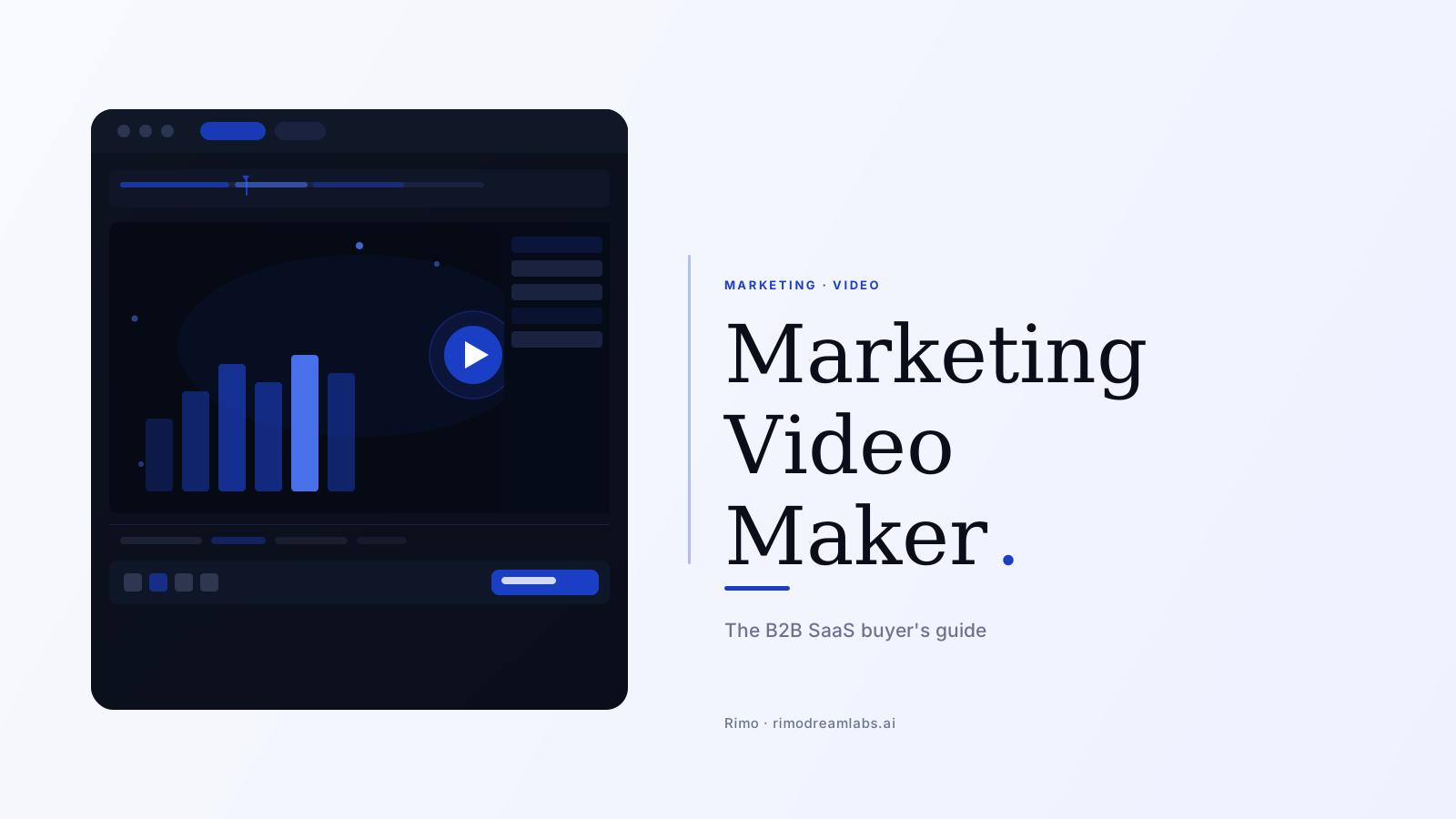
What Is a Marketing Video Maker? The B2B SaaS Buyer's Guide
Your marketing team has 14 browser tabs open. One is a screen recorder. One is a Google Doc with the script. One is your video editor. One is a stock music library. One is your voiceover tool. One is Slack, where someone is asking when the video will be ready.
This is not a production workflow. It is a collection of workarounds that somehow produces a video every few weeks — usually right before a launch, always under pressure, never quite the way you intended.
A marketing video maker is supposed to solve this. But the term covers everything from a $9/month social media template tool to a full enterprise platform built for product-led SaaS teams. Pick the wrong one and you spend six months fighting a tool that was never designed for what you actually need. This guide explains what a marketing video maker is, what the five types look like in a B2B SaaS context, and how to pick one that matches the way your team actually works.
In this guide
What is a marketing video maker?
A marketing video maker is a software platform that enables a team to plan, produce, edit, and distribute video content for marketing purposes — without requiring a dedicated video production agency or a full in-house production crew. It overlaps with the broader business video maker category but focuses specifically on campaigns, demand generation, and product storytelling.
The category is wide. At one end, you have consumer-grade tools built for social media creators: drag-and-drop editors, stock footage libraries, and animated text overlays. At the other end, you have purpose-built B2B platforms that handle screen capture, AI narration, brand-kit enforcement, and multi-format export in a single workflow.
The distinction matters because B2B SaaS marketing videos have requirements consumer tools weren't built for. Your product is complex. Your buyer is skeptical. You need to show real software doing real work — not animations of smiling avatars on gradient backgrounds. A consumer-grade marketing video maker can produce a social media reel that looks polished. It cannot produce a credible product demo that survives enterprise procurement scrutiny.
According to Wistia's 2026 State of Video report, 43% of businesses now produce at least one marketing video per week — a number that has risen steadily for four consecutive years. The teams hitting that velocity aren't doing it with a different production mindset. They're using tools that cut the friction out of the process.
Why B2B SaaS teams need a dedicated marketing video maker
Most B2B SaaS marketing teams start with whatever tools they already have. Loom for async demos. iMovie or CapCut for basic editing. Canva for social thumbnails. That stack works for one or two videos. It does not scale.
The volume problem hits first. When a team is producing eight to twelve videos per quarter — across personas, use cases, product features, and distribution channels — the coordination overhead of a six-tool stack consumes more time than the production itself. G2 reviewers consistently identify this as the top frustration with piecemeal video workflows: "Stitching together creation, repurposing, hosting, and analytics from separate vendors creates friction that compounds with every video you produce."
The brand consistency problem hits second. When five people are recording and editing videos in five different tools, the output diverges. Different fonts, different intro sequences, different color treatments, different voiceover styles. B2B buyers notice inconsistency even when they can't articulate why it makes them trust you less.
The speed problem hits third — and it's the one that causes the most downstream damage. SaaS products ship every two to four weeks. Product demo videos go stale in 90 days on average. A traditional production workflow that takes three to five weeks per video produces a library that's permanently out of date. A marketing video maker built for B2B video marketing compresses that cycle so the content can keep pace with the product.
The 5 types of marketing video your team produces
Not every marketing video requires the same tool. Understanding the five formats your team actually produces helps you evaluate whether a given platform can handle your full workload — or just part of it.
1. Product demo videos
A product demo video shows real software doing a real workflow. It is the highest-stakes format in B2B SaaS marketing — the video that appears on your homepage, in your outbound sequences, and in the evaluation packets your champions share internally.
The best demo videos run 60–90 seconds for top-of-funnel use. They use real product screens, not animations. They speak to one buyer persona doing one specific workflow. Most marketing video makers can technically produce this format, but few are built with the screen capture quality, brand enforcement, and persona-targeting workflow that enterprise B2B demo videos require.
2. Product explainer videos
An explainer video uses narration and visuals to explain a concept or product category — before getting into specific product features. This is a top-of-funnel format: most useful when your target buyer doesn't yet know your category exists or hasn't yet felt the pain your product solves.
The mistake most teams make is using an explainer when a buyer is already in active evaluation. At that stage, they don't need category education — they need proof. An animated explainer sent to a buyer comparing vendors is the wrong message at the wrong moment.
3. Social media and paid ad videos
Short-form social videos — 15 to 30 seconds, built for LinkedIn feed, YouTube pre-roll, or Instagram — are a different production problem. They prioritize hook speed over depth, visual contrast over subtlety, and platform-native formatting over brand consistency.
Most general-purpose marketing video makers have templates for this format. The real constraint is whether you can produce multiple variants fast enough to run actual A/B tests. Teams that treat each social video as a bespoke production don't generate enough volume to learn what works.
4. Product launch videos
A launch video is a short announcement built around a specific feature, major update, or brand moment. It generates excitement, drives awareness, and pushes one action: try the new thing. These run 60–90 seconds, get distributed across email, social, and release notes, and have a shelf life of two to six weeks.
The production cost-value tradeoff here is tricky. Spending three weeks producing a launch video for a minor UI update rarely makes sense. For major platform releases, it usually does. A marketing video maker that lets you produce launch-quality output in hours changes that calculus entirely.
5. Tutorial and onboarding videos
Tutorial videos are step-by-step product walkthroughs that live in your help center, onboarding flows, and knowledge base. They're longer than demo videos — typically three to six minutes — and serve a fundamentally different goal: teaching rather than selling.
The production bar is lower for tutorials than for demo videos because customers watching tutorials are already motivated. But they need to be accurate, and they go out of date as fast as any other demo content. A library of 30 tutorial videos that haven't been updated in a year creates more support tickets than it deflects.
Make marketing videos in hours, not weeks
Rimo turns a plain-English brief into a finished product demo, explainer, or launch video — with real product screens, AI narration, and your brand kit. No editor needed.
How to choose a marketing video maker for B2B SaaS
Most buying guides for this category evaluate tools on feature checklists: does it have captions? Does it have templates? Does it export in 4K? Those questions matter, but they're table stakes. The five criteria that actually differentiate marketing video makers for B2B SaaS teams are:
1. Screen capture quality. If your product lives in a browser, the quality of the screen recording shapes the quality of every demo video you produce. Poor cursor pacing, low resolution, or a cluttered demo environment is not a recording problem — it becomes an editing problem, a re-shoot problem, and ultimately a time problem.
2. AI narration that doesn't sound robotic. Over 16% of AI video generator reviews on G2 cite pricing friction around voiceover workflows — specifically, the cost of professional voiceover that makes outputs sound human. AI narration has closed most of that gap, but the quality varies significantly. Before committing to a platform, test the voiceover on a paragraph that has technical product language. Marketing copy reads fine in most AI voices. Product feature explanations often don't.
3. Brand kit enforcement. When five people are producing videos, brand enforcement cannot rely on individual memory. A marketing video maker worth paying for enforces fonts, colors, logo placement, and intro/outro sequences at the template level — so every output is on-brand by default, not by effort.
4. Multi-format export without re-editing. Your LinkedIn video, your homepage embed, your email GIF preview, and your YouTube thumbnail all require different aspect ratios and lengths. A platform that requires manual re-editing for each format adds hours to every production cycle. Look for multi-format export that automates the resize and reformat.
5. Turnaround from brief to finished video. This is the hardest metric to evaluate from a demo, and the most important one to measure in a trial. Track how long it actually takes — from "we need a video about this feature" to a finished, approved, export-ready file. The best platforms cut this from weeks to hours. For a script to video workflow specifically, the gap between platforms is even wider.
The hidden cost of a fragmented video workflow
The real cost of a piecemeal marketing video stack rarely shows up in a single line item. It shows up in aggregate across every production cycle.
Here is what a four-tool video workflow actually costs a two-person B2B SaaS marketing team: 45 minutes of tool-switching per video. Three to five rounds of Slack threads coordinating approvals. An average of two re-shoots because the screen recording wasn't set up right for editing in the separate editor. One week of delay per video because the voiceover artist or design contractor isn't available when needed.
Multiply that by 40 videos per year and you have a significant amount of untracked cost that never appears on a marketing budget line.
The G2 data is unambiguous on this: only 4.8% of marketing video tool reviewers can quantify the ROI of their current setup. That's not because video doesn't work — it's because fragmented workflows make it nearly impossible to attribute outcomes. If you can't measure it, you can't defend the budget for it.
A unified marketing video production platform makes the full cycle traceable: from brief to script to recording to edit to publish to view time. That traceability is what lets you prove that video is working — and keep the budget to do more of it.
How AI is changing the marketing video maker category
Two years ago, AI in video production meant auto-captions and background noise removal. Today it means something fundamentally different.
The best AI-powered marketing video makers now handle: generating a full voiceover script from a two-sentence brief, synthesizing natural-sounding narration across multiple accents and languages, automating editing decisions (cut timing, transitions, lower-third placement), producing persona-specific versions from a single recording session, and updating a finished video when the product UI changes — without re-recording from scratch.
For B2B SaaS teams, the implication is a complete reset of the unit economics of video production. A team that was producing six videos per quarter — limited by editor bandwidth and voiceover scheduling — can now produce significantly more without adding headcount. The constraint shifts from production capacity to strategic clarity: which videos should we make next, for which persona, at which stage of the buyer journey?
AI doesn't fix a bad video strategy. It amplifies whatever strategy you have. If you're unclear on who the video is for and what it should make them do, producing it faster just gets you to the wrong answer sooner.
That shift is the one that requires the most attention. Speed enables volume. Volume enables testing. Testing reveals what actually converts. But none of that works if the team uses the new speed to produce more generic, all-persona, covers-everything videos instead of more targeted, specific, buyer-stage-matched ones.
The teams getting the most from AI marketing video makers are using the speed to run messaging experiments they couldn't previously afford to run. They produce a demo video with three different hooks, test them against the same audience, and double down on what converts. That kind of iteration was economically impossible when each video took three weeks to produce.
If you're evaluating AI-powered options for creating product demo videos, the right question is not "what features does this tool have?" It's "how fast can I go from a new idea to a finished video ready for distribution?" That turnaround time is the competitive advantage hiding inside the tool specification.
Choose your marketing video maker based on the job it needs to do
A $15/month template tool will produce social content for a consumer brand. It will not produce a credible enterprise demo that holds up in a competitive evaluation. A full-service production agency will produce beautiful video at $5,000–$25,000 per piece — on a timeline that makes it impossible to keep pace with a fast-shipping SaaS product.
The right marketing video maker for a B2B SaaS team sits between those two extremes: fast enough to match your shipping cadence, purpose-built enough to produce content that earns trust with a sophisticated buyer, and AI-powered enough to eliminate the production bottlenecks that have historically kept video teams from scaling.
If you're looking for a fully AI-powered platform built specifically for product marketing teams — one that handles screen capture, narration, brand enforcement, and multi-format export in a single workflow — Rimo is built for exactly that use case.
Start making marketing videos with Rimo
No production team. No video editor. No weeks of turnaround. Just a brief, your product, and a finished video your team is proud to publish.
FAQ
What is a marketing video maker?
A marketing video maker is a software platform that enables teams to plan, produce, edit, and distribute video content for marketing purposes without a dedicated production crew. The category includes consumer-grade template tools, screen-recording-based demo makers, AI-powered script-to-video platforms, and full enterprise video production suites. For B2B SaaS teams, the most useful tools are those that handle real product screen capture, AI narration, and brand enforcement in a single workflow — not consumer tools built for social media content.
What types of videos can a marketing video maker produce?
Depending on the platform, a marketing video maker can produce product demo videos, explainer videos, social media and paid ad videos, product launch videos, and tutorial or onboarding videos. Not all platforms handle all five formats equally well. B2B SaaS teams should evaluate whether a given tool can handle screen recording quality sufficient for enterprise demos — most consumer-grade tools cannot.
How much does a marketing video maker cost?
Pricing ranges from approximately $9/month for basic template tools to $300–$500/month for professional B2B platforms with AI narration, screen capture, and brand enforcement. Enterprise tiers with SSO, team management, and analytics typically start at $500–$1,000/month. G2 reviewers consistently cite pricing friction when platforms charge flat seat fees that don't match project-based production spikes — look for plans that scale with output, not headcount.
Can I make a marketing video without a video editor?
Yes — if the platform handles editing automation. AI-powered marketing video makers can now automate cut timing, transitions, captions, lower-third placement, and multi-format export without manual editing. The workflows that still benefit from a human editor are high-investment hero videos (homepage redesigns, major product launches) where production quality is a competitive signal. For everything else — demos, explainers, tutorials, social ads — AI production quality is sufficient for B2B use.
How long does it take to produce a marketing video with an AI tool?
With an AI-powered marketing video maker, teams report going from a written brief to a draft video in one to three hours for standard formats (60–90 second demos, social ads, feature announcements). Full review, revision, and export cycles typically add two to four hours. Compare this to traditional workflows, which average two to three weeks per video when accounting for script approval, recording, editing, voiceover, and revision rounds. That speed difference is the primary reason 40% of teams plan to increase video production volumes in 2026, according to Wistia's State of Video report.
What is the best marketing video maker for B2B SaaS teams?
The best marketing video maker for B2B SaaS depends on what your team primarily produces. For product demo videos with real product screens, AI narration, and brand enforcement in a single platform, Rimo is purpose-built for this use case. For general social media content, tools like Canva or Promo work well at lower price points. For enterprise training and onboarding, Synthesia handles avatar-based narration at scale. Choose based on the format you produce most, not the longest feature list.
Akshay Sharma
Product Leader · 10+ years in B2B SaaS
Akshay has spent 10+ years building and marketing B2B SaaS products. He writes about product storytelling, demo production, and the operational side of product marketing.