What Is an AI Video Translator? The B2B SaaS Guide (2026)
Your product demo video works. The win rate in North America proves it. The problem is you're now running pilots with enterprise accounts in Germany, Japan, and Brazil — and the video you're proud of is in English, narrated by a voice that doesn't sound like anyone who speaks German, Japanese, or Portuguese.
You can hire a localization agency. Budget $3,000–$8,000 per language, wait six weeks, and discover that the new version doesn't match the product release you shipped last Tuesday.
Or you can use an AI video translator — a tool that converts your existing video into a new language, replaces the audio with an AI-generated voice in the target language, synchronizes it to the original speaker's lip movements, and delivers a localized version in under an hour. The technology isn't perfect. But for product demo videos, onboarding content, and sales enablement materials, it's now good enough to replace the slow agency route in most situations — and the gap between "good enough" and "agency quality" is closing every quarter.
This guide explains what AI video translation actually is, how the technology works under the hood, what the best tools do and don't do well, and how to build localization into your demo production workflow without creating a second full-time job for your team.
In this guide
- What is an AI video translator?
- AI dubbing vs. AI subtitles vs. AI voice cloning
- Why B2B SaaS teams need AI video translation
- The best AI video translator tools for B2B teams
- How to evaluate AI video translation quality
- AI video translation in your demo workflow
- What AI video translators still can't do
- FAQ
What is an AI video translator?
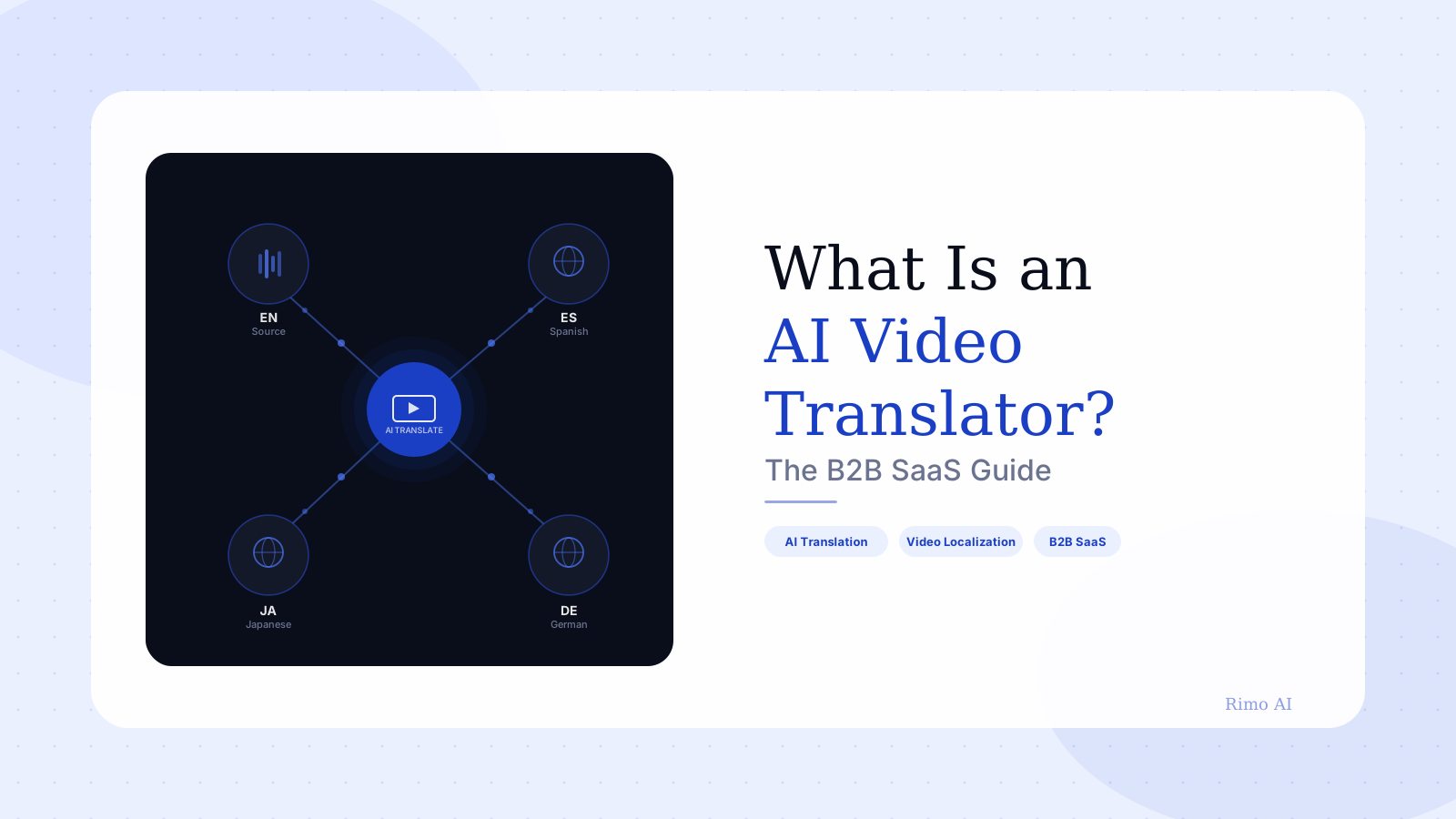
An AI video translator is a software tool that automatically converts a video from one spoken language to another — replacing or supplementing the original audio with translated speech generated by an AI voice model in the target language.
The process involves four distinct technical layers working in sequence. First, automatic speech recognition (ASR) transcribes what the original speaker said. Second, a machine translation model converts that transcript into the target language. Third, a text-to-speech (TTS) engine generates new audio in the target language — typically using a voice cloned from the original speaker or a high-quality synthetic voice. Fourth, a lip-sync model adjusts the video so the speaker's mouth movements broadly match the timing of the translated audio.
The result is a video that looks and sounds like it was recorded by a native speaker — without re-recording anything or setting foot in a studio.
What separates modern AI video translation from the early-generation tools is the quality of voice cloning. Three years ago, AI translation tools produced robotic voices and obvious lip-sync mismatches that made output feel amateurish and undermined product credibility. Current tools — particularly those with speaker voice cloning — produce output that most viewers cannot identify as AI-generated under casual viewing conditions. That quality threshold is what makes AI translation genuinely useful for customer-facing B2B content, not just internal materials where viewers are forgiving.
AI dubbing vs. AI subtitles vs. AI voice cloning
These three terms describe fundamentally different outputs. The wrong choice for your use case costs both money and credibility.
| AI Dubbing | AI Subtitles | AI Voice Cloning | |
|---|---|---|---|
| What it does | Replaces audio with AI-generated speech in target language | Adds translated text captions to the original video | Creates a synthetic model of the original speaker's voice |
| Preserves original voice? | No (uses synthetic or cloned voice) | Yes | Yes (voice model matches original speaker) |
| Requires lip sync? | Yes, for credible output | No | Depends on output format |
| Best for | Demos, training videos, marketing content | Product demo video accessibility, lightweight localization, SEO | High-fidelity spokesperson or executive content |
| Primary accuracy risk | Translation quality + prosody mismatch | Translation quality only | Accent drift and intonation flattening |
| Relative cost | Medium–High | Low | High |
For most B2B SaaS use cases — product demo videos, onboarding walkthroughs, and sales enablement content — AI dubbing is the right choice. Subtitles alone work for training materials where the viewer is already in a reading mindset. Voice cloning at scale is expensive and only worth the investment for content featuring a named executive or brand spokesperson where specific voice recognition carries commercial weight.
One thing most guides on this topic don't address: the choice between dubbing and subtitles is also a cultural question, not just a technical one. Dubbing is strongly preferred in Germany, France, Italy, Spain, and across LATAM (Brazil, Mexico, Colombia). Subtitles are preferred in Japan, South Korea, the Netherlands, and China. Running the wrong format in the wrong market is a fast way to signal that you didn't do your research — which, for an enterprise sale, is exactly the wrong first impression. Knowing your market before choosing your approach is worth the two minutes it takes to ask your regional sales rep.
Why B2B SaaS teams need AI video translation
The global SaaS market is no longer a North American story. APAC — particularly Japan, South Korea, and Southeast Asia — and LATAM — particularly Brazil and Mexico — are growing faster than the US and European markets that most SaaS companies built their original go-to-market motions around.
The problem isn't that B2B buyers in these markets don't speak English. Many do. The problem is that a product demo delivered in someone's second language requires meaningfully more cognitive effort — and cognitive effort is the enemy of purchase confidence. A Japanese enterprise buyer watching an English-language demo has to translate mentally while simultaneously evaluating the product. That divided attention compresses how much of the demo actually registers.
CSA Research (formerly Common Sense Advisory) has tracked this for over a decade. Their most widely cited finding: 76% of global consumers prefer to purchase products with information presented in their native language. In B2B procurement contexts, the effect is more pronounced — buying committees include members at varying English proficiency levels, and a demo that alienates even one technical evaluator can stall an otherwise strong opportunity.
The numbers behind this are significant. Viewers are 80% more likely to watch a video through to completion when it's in their native language (CSA Research). Companies that have localized their key marketing videos report a 35% increase in engagement in non-English-speaking regions — and some have documented conversion rate improvements of 25–65% in localized markets (language services industry benchmarks, 2024). The abandonment rate on untranslated demo content shown to non-English-speaking prospects runs at 60–70% in documented localization case studies.
There are three specific places where AI video translation changes the economics for B2B SaaS teams.
Demo localization at scale
Before AI translation, expanding into Germany, Japan, and Brazil meant three separate production cycles: three adapted scripts, three voice recording sessions, three rounds of lip sync editing, three QA passes. Each market required weeks and thousands of dollars before a single prospect could see a localized product demo.
With an AI video translator, the same team takes one English master, runs it through a translation pipeline, reviews the output for terminology accuracy, and publishes three localized versions in a day. Traditional professional dubbing runs $50–$200 per finished minute. AI dubbing runs $2–$20 per finished minute, depending on tool and features. For a 5-minute demo across three markets, that's the difference between a $4,500 agency project and a $90 self-serve workflow. That math changes which markets are worth pursuing.
Onboarding and training content for global customers
The tutorial videos and onboarding walkthroughs that customer success teams produce in English become localization debt when a company signs enterprise contracts in non-English markets. The customer expects product training their entire team can use — including the members who aren't comfortable navigating English content at native speaker speed.
AI video translation solves this without requiring a separate production workflow per market. One source video, translated into as many languages as the customer base requires. When the product updates and the source video needs a refresh, the localized versions can be regenerated in the same session.
Async sales enablement across time zones
Sales engineers covering APAC enterprise deals operate in a brutal time zone reality: the buyers are awake when the SE is asleep. Product demo videos sent as follow-ups to discovery calls only work if the buyer actually watches them. A twelve-minute English demo sitting in a Tokyo prospect's inbox at 9am competes with everything else demanding their attention — and loses more often than the SE realizes.
The same demo in Japanese, polished and natural, is a different asset entirely. It's the difference between a follow-up that gets watched and a follow-up that gets archived.
The best AI video translator tools for B2B teams
Build demo videos that work in every market
Rimo generates polished, on-brand product demo videos from a plain-English brief and supports multilingual output — so your demos are global-ready from the first frame, not retrofitted after.
The AI video translation market has consolidated around six tools worth evaluating for B2B SaaS use. Here is an honest assessment of each.
HeyGen
HeyGen is the most widely deployed AI video translation tool in the B2B SaaS space. Its Video Translation feature supports 40+ languages, preserves the original speaker's voice using voice cloning, and includes lip sync adjustment. Quality on major European languages — Spanish, French, German, Portuguese — is noticeably stronger than on East Asian languages, where tonal accuracy and prosody sometimes degrade.
The most consistent complaint across G2 and Trustpilot reviews: the credit system is opaque and unpredictable. Multiple reviewers describe burning through their monthly allocation faster than expected — Avatar IV renders consume 20 premium credits per minute, and unused credits expire. One reviewer summarized it as "the tool is excellent; the onboarding around billing expectations is not." For the 3–7 minute demo videos that most B2B SaaS teams actually produce, the math is manageable. For teams with a large library of longer training content, the cost model requires careful planning before you commit.
Rask AI
Rask AI is a dedicated localization tool rather than a general AI video platform. It supports 130+ languages, handles multi-speaker detection, and includes a built-in script editor that lets teams review and adjust the translated text before audio generation. That editorial control is its primary differentiator — teams with technical glossaries, product-specific terminology, or brand language can catch mistranslations before they reach the audio layer.
The limitation is voice quality under demanding conditions. When processing multiple speakers or fast-paced narration, voice cloning fidelity drops. Multiple reviewers specifically flag Portuguese dialect confusion — translated audio mixing Brazilian and European Portuguese mid-sentence — as well as a two-step workflow (translate first, apply lip-sync separately) that adds friction and delays. The translated audio also tends to lose emotional depth: one reviewer noted that "the English dub lacked emotional depth, while the Spanish version of the same audio performed much better" — suggesting output quality varies not just by language but by direction of translation.
Synthesia
Synthesia approaches translation differently: rather than translating an existing video, it regenerates the video from scratch using an AI avatar speaking the target language. No lip sync artifacts — because the entire video is synthetic — but the translated version looks visually different from the original. The avatar's delivery in Spanish is not the same presentation as your original English speaker.
For demo videos built natively inside Synthesia's platform, this is functionally seamless. For teams with screen-recorded or live-presenter content they want to localize, it requires a complete rebuild from the script up. That's a meaningful production overhead if your existing video library is already large.
VEED.io
VEED.io covers the foundational use case competently: automatic subtitles in 50+ languages, auto-transcription, and a basic dubbing feature. It's the right choice for teams that need reliable multilingual subtitles more than full voice replacement. The AI dubbing feature is newer and less polished than HeyGen or Rask AI — but subtitle accuracy is consistently strong, the interface is simple, and pricing is the most accessible in the category.
G2 reviewers rate automatically generated subtitle accuracy around 88–92% for professionally recorded English audio — solid enough for most B2B content but requiring a review pass before anything reaches a customer.
ElevenLabs
ElevenLabs is primarily a voice generation and voice cloning platform, not a full-stack video translator. It doesn't handle lip sync. But for raw voice cloning quality in translation — including in East Asian languages where most tools struggle — ElevenLabs is the current best available. Teams that want maximum voice fidelity and are willing to manage the lip sync component separately (or work with screen recordings where speaker lip movements aren't visible) get better voice output than from any dedicated translation tool.
The workflow demands more technical investment: export audio from ElevenLabs, re-import into a video editor, manually adjust timing. Not appropriate for a PMM team working without engineering support. Worth evaluating for teams where voice accuracy is the primary quality variable.
Papercup
Papercup is the enterprise-grade option: a human-AI hybrid where AI generates the initial dub and professional translators review and refine it. Output quality is the strongest in the market. Cost and turnaround reflect that. Papercup is appropriate for high-stakes content — investor presentations, C-suite keynotes, flagship product launch videos — but not for the ongoing volume of demo and enablement content a typical B2B SaaS team produces.
How to evaluate AI video translation quality
The tools market changes faster than any review can track. Rather than trusting a single source, evaluate translation quality yourself using this four-point framework before committing to a tool.
Accuracy test. Feed each candidate tool a 90-second clip from your standard product demo. Export the translated script and have a native speaker evaluate: factual accuracy of product descriptions, naturalness of idiomatic language versus literal translation, and accuracy of product-specific terminology. This single test eliminates most tools immediately for technical B2B content.
Voice fidelity test. Have a native speaker of the target language watch the translated video with no prior context about the tool. Ask one question: "Does the voice sound natural?" Not perfect — natural. Subtle AI artifacts are almost always present at some level. What you're testing is whether those artifacts are distracting enough to undermine credibility with a professional buyer.
Lip sync tolerance test. Watch the translated video yourself, without sound. Does the mouth movement look broadly synchronized with what a speaker saying those words would look like? Perfect synchronization is a high bar almost no AI tool meets consistently. Acceptable synchronization — where the mismatch isn't obvious to a non-expert — is the practical target.
Technical terminology retention. This is the most commonly missed failure mode. AI translation systems train on general-language corpora. Your product has terminology that doesn't exist in any training dataset: feature names, proprietary concepts, integration names, brand-specific language. Test explicitly whether the tool transliterates correctly, leaves terms in English where appropriate, or mistranslates them into a general-language equivalent that's technically wrong. A translated demo that renames your core feature into a generic synonym is worse than no translation.
AI video translation in your demo workflow
The most practical integration for B2B SaaS teams follows three phases.
Phase 1: Source video hygiene
Translation output quality is bottlenecked by input quality. Before running any video through an AI translator: ensure clean audio with no background noise, clear enunciation at a measured pace (avoid narration faster than 130 words per minute), and scripted delivery rather than improvised narration. The transcription layer is where errors compound — anything that creates uncertainty in transcription cascades into translation inaccuracies downstream.
For screen-recorded demos, this typically means recording the voiceover separately from the screen capture, then recombining before translation. Demos recorded with simultaneous live narration and screen capture tend to have audio quality that degrades transcription accuracy by 10–15%, which compounds directly into translation quality.
The SaaS demo video best practices guide covers the production standards that make source videos translate reliably — reading it alongside this one is worth the thirty minutes if you're building a global demo library from scratch.
Phase 2: Script review before audio generation
Any tool that includes a script editing step — Rask AI, VEED.io — should be used in that mode. Never skip directly to automatic audio generation without reviewing the translated transcript. Your product has terminology, feature names, and brand language that require a human check before they reach a customer in a foreign language.
A mistranslated product name or a literal rendering of your positioning statement actively undermines credibility. It signals to the buyer that the vendor didn't care enough to get this right in their market. That's a specific, recoverable quality failure — but only if you catch it in Phase 2 rather than after distribution.
Phase 3: Native speaker QA before distribution
One native speaker, twenty minutes, a clear pass/fail rubric. This is a sanity check, not a full professional translation review. For internal training content: twenty minutes of QA is proportionate to the stakes. For a flagship demo reaching enterprise buyers in a new market: invest in a professional translator for a formal review pass.
The best SaaS product demo video examples share one characteristic across every market they're used in: they sound like they were made for that audience. That quality requires the QA step. It cannot be automated out.
What AI video translators still can't do
Being clear about current limitations saves you from distributing something that damages rather than builds credibility.
Culturally adapted messaging. AI translation converts words. It does not adapt the sales narrative for a different cultural context. A US-style directness — "let's cut to the chase" — reads as rude in many East Asian business cultures. A relationship-oriented framing that works in Brazil feels too slow for a German engineering buyer. AI translators have no awareness of these differences. A linguistically accurate but culturally tone-deaf video won't generate the hostile reaction that a factually wrong translation would — but it won't close deals either.
Accurate domain-specific jargon. Every SaaS product operates in a domain with specialized vocabulary. Compliance software, DevOps tooling, fintech platforms, healthcare informatics — each has terminology that means something specific in the domain and something different (or nothing) in general usage. AI translation models generalize this vocabulary toward common usage, sometimes correctly, often not. Human review by someone with domain knowledge in the target language is required for technical products.
Emotional register preservation. The best voice cloning reproduces pitch and cadence. It does not reproduce the micro-expressions of enthusiasm, urgency, and conviction that make a compelling demo presenter compelling. A translated demo from a high-energy, credible English presenter will almost always feel flatter in the AI-generated version — more like reading the words than meaning them.
This limitation matters most for B2B video marketing content where the presenter's charisma is part of the asset. The translated version will be technically accurate. It won't always carry the same weight.
What to do next
AI video translation has matured past the point where "it's not quite ready" is a credible objection. The tools work. The output is good enough. The variable is your team's QA discipline — because no AI translation tool at any price point should send localized content to a customer without a native-speaker review pass.
Start with one market, one video, one tool. Run it through the evaluation framework in this guide. Measure whether your localized demo outperforms the English version with the same target audience in that market. Then scale what works.
If you're building product demo videos from scratch and want them global-ready from day one — rather than retrofitting translation after the fact — Rimo generates on-brand, screen-accurate product demos and supports multilingual output as a built-in workflow step.
FAQ
What is an AI video translator?
An AI video translator is a software tool that automatically converts a video from one spoken language to another by transcribing the original audio, translating the transcript, generating new speech in the target language using an AI voice model, and synchronizing the new audio to the speaker's lip movements. The output is a localized version of the original video that sounds and looks like it was recorded in the target language, without requiring a studio re-recording or a professional dubbing agency.
How accurate is AI video translation for B2B content?
Accuracy varies significantly by language pair, tool, and content type. For major language pairs with large training datasets — English to Spanish, French, German, Portuguese — leading tools achieve 88–95% accuracy on general-language content. Technical content with domain-specific terminology requires a human review pass regardless of the tool. Languages with smaller training corpora (Thai, Vietnamese, Tagalog) produce noticeably lower accuracy and require more aggressive QA investment before customer-facing use.
How long does it take to AI translate a video?
For most tools, a 5-minute video in a major language pair takes 5–15 minutes to process automatically. Adding the recommended human script review step adds 20–60 minutes depending on content complexity. The full workflow for a reviewed, customer-ready localized demo video typically runs 1–3 hours start to finish — compared to 3–8 weeks for a traditional localization agency engagement.
What is the best AI video translator for B2B SaaS teams?
The best choice depends on your primary use case. For demo and marketing videos requiring voice cloning and lip sync with the best ease of use: HeyGen. For content requiring precise terminology control via a script editing step: Rask AI. For lightweight subtitle-based localization: VEED.io. For enterprise-grade content where output quality is non-negotiable: Papercup's human-AI hybrid approach. For highest raw voice quality as a component tool, without a full translation workflow: ElevenLabs.
Can AI video translators replace professional dubbing agencies?
For most B2B SaaS content — product demos, onboarding videos, training materials, sales enablement — yes, with a human QA step included. AI translation is fast enough, affordable enough, and accurate enough for customer-facing use in most language pairs. For broadcast-quality marketing content, executive keynotes, and content where brand voice carries specific commercial weight, professional agencies still produce materially better output. The decision is a quality-per-dollar calculation specific to each piece of content, not a blanket replacement question.
Does AI video translation work for screen-recorded product demos?
Yes, and screen-recorded demos are actually among the best use cases for AI video translation. Because the lip movements visible in the video are minimal or absent, lip sync quality matters less — the translated audio can be substituted without the synchronization artifacts that affect full talking-head videos. The primary challenge for screen-recorded demos is product-specific terminology in the narration, which requires the script review step described above. For guidance on producing source demo recordings that translate reliably, see the guide on how to create product demo videos.
Akshay Sharma
Product Leader · 10+ years in B2B SaaS
Akshay has spent 10+ years building and marketing B2B SaaS products. He writes about product storytelling, demo production, and the operational side of product marketing.