What Is AI Voice Over? The B2B SaaS Guide
Your product marketing team just wrapped recording. Forty-five minutes of screen capture, three retakes because someone's Slack notification fired mid-demo, and now you have raw footage that needs a voiceover. Your options: find a contractor, record yourself and hope your home-office acoustics hold up, or put in a request that will come back in ten business days if you're lucky. By Thursday, none of those are the right answer.
This is where most B2B SaaS teams first encounter AI voice over — not as a futuristic experiment, but as the most practical answer to a problem they have right now. Professional-sounding narration for a product demo video, ready in minutes, from a script they already wrote.
But "AI voice over" is a category, not a product. It includes at least three meaningfully different technologies, tools with wildly different pricing models, and a key decision most teams get wrong: whether to use a standalone AI voiceover tool or a platform where AI voice is just one layer inside a complete demo video production workflow. This guide covers all of it — so you make the right choice for your content, not just the most visible one.
In this guide
- What is AI voice over?
- The 3 types of AI voice over every B2B SaaS team should know
- How AI voice over works for product demo videos
- What G2 reviewers say about the top AI voice over tools
- Standalone AI voice over tool vs integrated platform: which one?
- When AI voice over is worth it — and when it isn't
- FAQ
What is AI voice over?
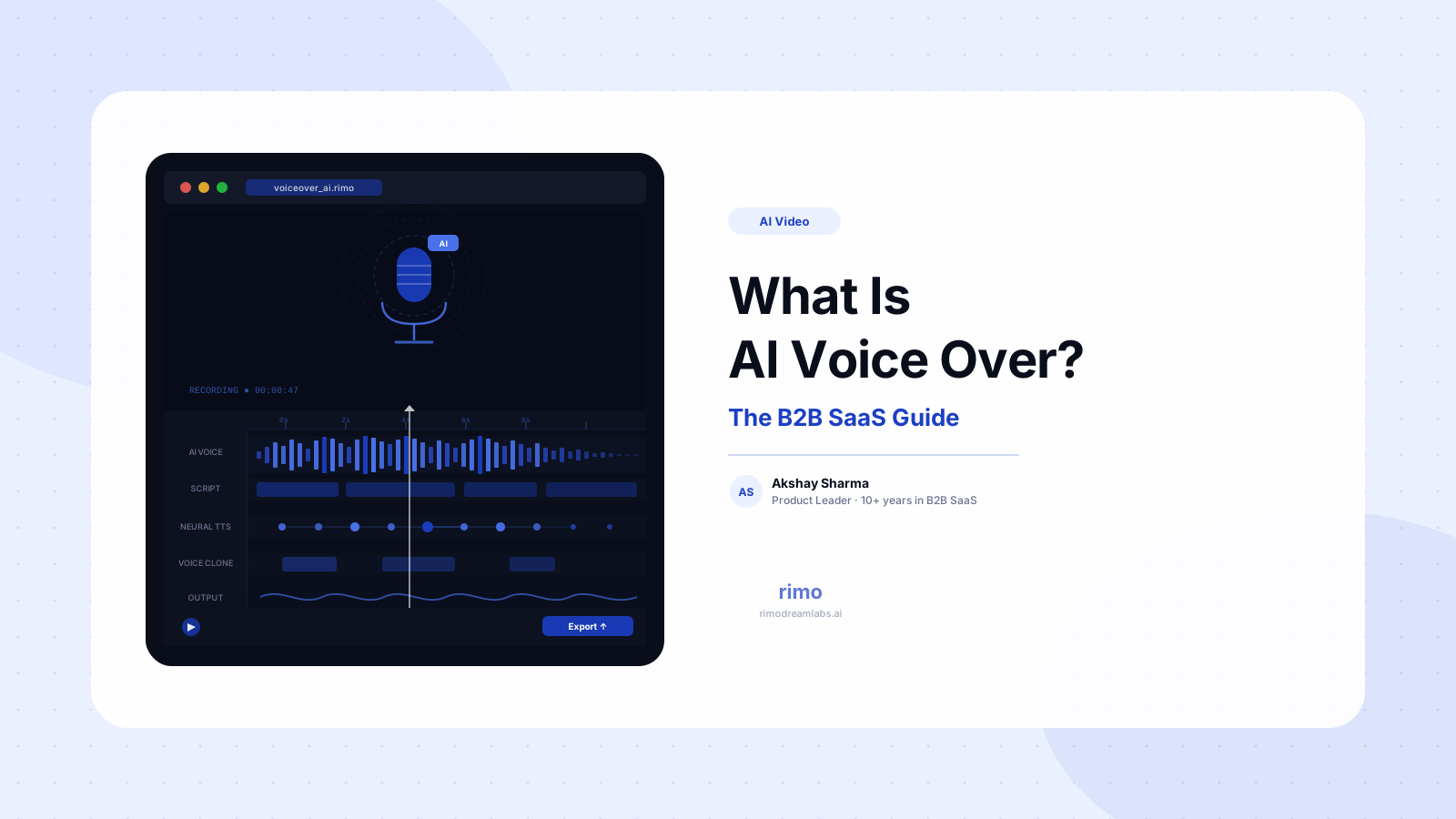
AI voice over is the use of artificial intelligence to generate narration audio from text — producing speech that sounds like a human voice without requiring a human to record it. You provide a script; the system returns an audio file. That audio can then be synced to a video, embedded in an interactive walkthrough, or used anywhere traditional voiceover appears: product demo videos, onboarding walkthroughs, feature explainers, or training content.
The difference between AI voice over and the robotic text-to-speech you remember from GPS devices is now substantial. Modern AI voice over uses neural networks trained on thousands of hours of human speech. The output handles natural pauses, pitch variation, emphasis, and pacing in a way that older concatenated speech systems could not. For most product demo video use cases in B2B SaaS, the gap in quality between a well-chosen AI voice and a professional human recording is now small enough that most buyers won't notice.
What buyers do notice is whether the narration feels natural to the content — whether the pacing matches what's happening on screen, whether the emphasis lands on the right words, whether the voice sounds credible for the product being demonstrated. Those are execution issues, not technology issues. The technology has crossed the "good enough" threshold for B2B SaaS product content. The question is how your team applies it.
One thing that gets missed in most definitions: AI voice over is not inherently tied to any specific format or workflow. It can be used standalone — generate the audio, drop it into your existing video production pipeline — or embedded inside platforms that handle the entire demo creation workflow. That distinction matters more than most teams realize, and it's covered in detail below.
The 3 types of AI voice over every B2B SaaS team should know
Not all AI voice over works the same way. Three distinct technologies sit under that label, and choosing the wrong one for your use case costs real time and money.
Standard text-to-speech (TTS)
The foundational form of AI voice over: you give the system text, it returns audio. Standard TTS is fast, cheap, and widely available — it powers everything from screen readers to automated phone systems. Most free-tier AI voice tools and many lower-priced plans use some form of standard TTS.
The limitation for B2B SaaS product content is control. Standard TTS handles the words but not the performance. If you need a pause before a key feature reveal, a slower cadence on a complex workflow step, or an emphasis that your script's punctuation can't fully convey, standard TTS won't give it to you without extra configuration. For simple, utilitarian narration, it works. For a product demo video where buyer perception depends on tone and timing, it often falls short of what the content actually needs.
Neural text-to-speech
Neural TTS uses deep learning models trained on large datasets of human speech. The output is substantially more natural than standard TTS — capable of handling prosody (the rhythm and melody of speech), emphasis, and pacing in ways that feel closer to how a skilled human reader would deliver the same lines.
This is the technology behind the best-performing voices in platforms like Murf, ElevenLabs, and Microsoft Azure Cognitive Services. When G2 reviewers describe an AI voice as "shockingly natural" or "indistinguishable from a professional recording," they're almost always talking about neural TTS — specifically the premium voice models, not the standard-tier options. The quality gap between a platform's basic voices and its premium neural voices is often more significant than the gap between that platform and a competitor.
Neural TTS is the right default for B2B SaaS product demo videos. The quality is high enough for professional marketing content, the cost is manageable at mid-tier subscription levels, and the voice library is broad enough to match different brand tones, industries, and target markets.
Voice cloning
Voice cloning goes further: instead of generating speech in a pre-built AI voice, it creates a custom voice model based on an audio sample of a specific person's speech. Train the model on five to ten minutes of recording, and it can generate unlimited narration in that voice from any script.
The B2B SaaS use case for voice cloning is narrow but real. If your company has an established on-camera presenter, a CEO who appears in product launch videos, or a voice actor you've used consistently across your content library, voice cloning lets you generate future narration in that voice without re-booking the person. It also enables consistent audio branding for companies that have invested in a distinctive sonic identity.
The limitation is cost and consent. Voice cloning features on enterprise plans at ElevenLabs and Murf add significantly to subscription cost. More critically, cloning a person's voice without their explicit written consent is both a platform policy violation and, in an increasing number of jurisdictions, a legal issue. Several G2 reviewers have flagged a mismatch between how they expected to use voice cloning and what platform policies actually permit. If you're evaluating voice cloning for brand use, secure consent documentation and review the terms before publishing any content.
How AI voice over works for product demo videos
Using AI voice over in a B2B SaaS product demo workflow follows a simple sequence — but there are execution details that determine whether the output sounds polished or clearly artificial.
Start with the script, not the recording. AI voice over requires a finalized script before you generate anything. This sounds obvious, but many teams treat the script as something they'll refine in post. With AI voice over, refining it in post means re-generating the audio — which, depending on your platform, consumes credits or takes meaningful time. Write and lock the full script first. Following a structured AI demo video script template — with scene-by-scene narration mapped to specific on-screen actions — produces consistently better AI voice output than a loose or improvised description.
Voice selection matters more than most teams expect. Different neural TTS voices carry different implied authority, warmth, and pacing. A voice that sounds authoritative in enterprise SaaS demos may feel cold or clinical for a prosumer product. Most platforms offer real-time preview. Run at least three voice options against your first draft before committing — the selection decision is difficult to reverse cleanly in most workflows, particularly if you've already begun syncing audio to video.
Script punctuation is performance direction. Neural TTS systems interpret punctuation as pacing signals. A period produces a longer pause than a comma. An em dash creates a brief beat. Question marks shift inflection upward. If your script uses punctuation wherever it feels grammatically natural rather than where you want a pause or emphasis, the output will reflect that imprecision. Treat every comma, dash, and ellipsis as a direction to the voice model.
Sync is where the work actually is. Generating the audio is fast — often seconds to minutes for a full script. Syncing the audio to screen recording timestamps, trimming silence from the start and end of segments, and aligning specific narration words to specific on-screen actions: that's the part that takes real time if you're doing it inside a general-purpose video editor. This is one of the primary reasons teams using standalone AI voice tools end up spending more time on post-production than they expected when they chose a separate voice tool over an integrated platform.
AI voice already synced to your product screens
Rimo generates narrated product demo videos from a brief — AI voice, screen content, and transitions already aligned. No separate voiceover tool, no sync work, no narration that describes a feature your product shipped past two sprints ago.
What G2 reviewers say about the top AI voice over tools
The most widely used AI voice over tools for B2B SaaS content teams — Murf, ElevenLabs, and Descript — each have genuine strengths. They also share a set of recurring complaints that appear across hundreds of reviews and are worth understanding before you commit to any of them.
Pricing hits harder than the plan pages suggest. Murf AI's G2 reviews flag pricing as the top friction point — not the subscription cost itself, but the gap between what the base plan delivers and what teams actually need. Premium voices, which are the ones that sound genuinely professional, are locked to higher tiers. Enterprise features that most B2B SaaS marketing teams require — API access, voice cloning, custom voice profiles, team collaboration — require custom pricing conversations that typically land at $200–$500 per month for business use. Teams that signed up on a mid-tier plan expecting full access often discover these limits mid-project, which creates real operational friction at the worst possible moment.
Re-rendering consumes credits every time you change a word. ElevenLabs users consistently raise this on G2: changing a single word in your narration script triggers a full re-render, consuming API credits regardless of the scope of the change. For a product demo video where the script goes through two or three internal review cycles — standard in any B2B SaaS marketing team — this billing model makes iteration expensive in ways that aren't obvious at sign-up. Teams that don't account for revision rounds in their initial credit allocation frequently hit plan limits before the video is finalized.
Non-English voice quality lags significantly behind English. Multiple Murf and ElevenLabs reviewers note that voices for Hindi, Spanish, French, and German sound noticeably more robotic than English premium options. For B2B SaaS companies producing demo content for EMEA or APAC markets, this is a material production constraint, not just a quality preference. The underlying cause — training data for English voice models is orders of magnitude larger than for other languages — isn't something any platform solves quickly. If multilingual demo content is a core requirement, evaluate product video software for regional languages and test the specific language voices before committing to any platform.
Native integration with video editing tools doesn't exist. Murf G2 reviewers consistently request native integration with Adobe Premiere and Final Cut Pro. Neither exists. Descript integrates voice editing more tightly with its own video editing workflow, but its AI voice quality for purely synthetic voices sits below ElevenLabs and Murf on the realism dimension. Teams that want AI voice to live inside their existing video editor workflow are currently working around a gap rather than through a solved integration — which means extra steps, extra file handoffs, and extra room for sync errors.
Long scripts cause platform lag. Murf Studio users consistently flag a performance issue with scripts exceeding 1,000 words: the preview feature slows significantly, and the studio interface lags when handling multiple voice tracks or complex scene structures. For a short 60-second explainer, this doesn't matter. For a product walkthrough with 15 or more distinct scenes, script-length lag becomes a real workflow blocker.
The pattern across all three platforms: the tools work, and the voice quality is often genuinely impressive, but the workflow friction accumulates in ways that aren't visible during a free trial. Budget for revision credits, test non-English voices before committing, and model the real cost of the subscription tier that unlocks the features your team actually needs.
Standalone AI voice over tool vs integrated platform: which one?
This is the decision most B2B SaaS teams never explicitly make. They default to whichever AI voice tool comes up first in a search, then build their workflow around it. That default is worth interrogating.
A standalone AI voice over tool — Murf, ElevenLabs, PlayHT — gives you maximum control over voice generation. You select the voice, adjust pacing and emphasis, export the audio file, and bring it into whatever video tool you're using. The workflow has more steps and more handoff points, but if voice quality and granular creative control are your primary requirements, standalone tools offer the most flexibility.
An integrated AI demo platform treats AI voice over as one layer inside a complete demo video workflow. You don't manage voice generation as a separate task. The platform handles the script, the screen content, the narration, and the audio-to-video sync in a single pipeline. The tradeoff: less granular voice control per clip, but dramatically faster time-to-publish and no manual sync work between applications.
The right choice depends on your production model. Teams where a dedicated video editor manages the final assembly — pulling in AI voice audio, screen recordings, and motion graphics in a non-linear editing environment — benefit from the flexibility of standalone tools. Teams where product marketers are producing demo content at sprint cadence, without dedicated production support, are better served by an integrated platform where voice is already aligned to the product content.
There's a durability consideration that almost no standalone tool review addresses: what happens when your product changes?
A standalone AI voice over file is a static audio asset. When the feature it narrates gets updated — renamed, redesigned, moved — the narration is wrong. You're then choosing between re-generating the voice, re-editing the video to sync the new audio, or running stale content that misrepresents your product. Most teams choose the third option without consciously deciding to. An integrated platform that generates voice from your current product state sidesteps this problem: the narration and the product stay in sync because they're produced together. The guide on automating product demos with AI covers this workflow in detail and explains what the production model actually looks like at sprint cadence.
When AI voice over is worth it — and when it isn't
AI voice over earns its place in the B2B SaaS production stack for specific content categories. It underperforms in others. Here's where the line actually falls.
Where it works well:
- Product demo videos and feature walkthroughs. Neural TTS handles this use case cleanly. The narration explains on-screen actions; the voice model handles pacing and emphasis well enough for buyer-facing content. This is the highest-ROI AI voice over use case in B2B SaaS marketing.
- High-volume content production. According to Wistia's 2025 State of Video report, AI users are 57% more likely to produce 50–100 videos per year compared to non-AI teams. At that production volume, human voiceover talent at professional rates is not economically viable. AI voice over is not a compromise at scale — it's the only production model that makes high-volume demo content possible.
- Multilingual content. Generating a Spanish or German narration version from the same script is dramatically faster than re-recording with native-speaking talent, even accounting for the voice quality gap on lower-tier language models. For EMEA or APAC market expansion where speed matters, AI voice over clears the bar — provided you test the target language before committing to a platform.
Where it underperforms:
- Brand storytelling and narrative content. AI voice models have narrowed the quality gap, but human voiceover still wins on emotional warmth and authenticity for content where tone and credibility carry the message. Brand films, executive thought leadership videos, and testimonial content are not the right use cases for AI voice over.
- Content with heavy technical vocabulary. Neural TTS systems often mispronounce company names, product feature names, coined terms, and abbreviations that aren't in the training data. Most platforms let you override individual word pronunciations — but every new product term that ships creates a new potential failure point. For products with dense technical nomenclature, this management overhead is real.
- Content where a specific voice is the asset. If your CEO's voice, a well-known industry figure, or a brand voice actor is part of your video identity, synthetic substitution often feels like a downgrade — even when the audio quality is technically comparable. Voice cloning can preserve that identity at scale, but it requires the consent process and cost structure described above.
The practical rule: if your content's primary job is to show buyers how your product works, AI voice over is the right production choice. If its primary job is to make buyers feel something about your brand, human voiceover is still worth the investment. Most B2B SaaS demo content falls clearly in the first category.
AI voice over is no longer an early-adopter technology. Wistia's 2025 State of Video report shows voice dubbing is the second most commonly adopted AI feature in video production teams — behind only automated captions. Teams using AI in their video workflow produce more content, more frequently, at a lower per-unit cost than teams that don't.
The decision isn't whether to use AI voice over. It's whether to manage it as a separate tool in a multi-step workflow or embed it inside a platform that handles narration, screen content, and sync together. For product marketers running at sprint cadence without dedicated video production support, the integrated approach isn't just faster — it's the only one that keeps demo content current with a shipping product.
Try Rimo free and see how long your next narrated product demo actually takes to produce, from brief to finished video, with AI voice already part of the workflow.
FAQ
What is AI voice over?
AI voice over is the use of artificial intelligence — specifically neural text-to-speech (TTS) or voice cloning technology — to generate human-sounding narration audio from written text, without requiring a human to record it. The output is used wherever traditional voiceover appears: product demo videos, onboarding walkthroughs, explainer videos, training content, and product launch communications. Modern AI voice over uses deep learning models trained on large datasets of human speech, producing results far more natural than older concatenated text-to-speech systems.
How does AI voice over differ from text-to-speech?
Text-to-speech is the underlying technology that converts written text into spoken audio. AI voice over is the application of advanced neural TTS and voice cloning models to produce narration-quality speech. Traditional TTS stitches together pre-recorded phoneme fragments and sounds robotic. Neural TTS — used by modern AI voice platforms — generates speech directly from a deep learning model, handling natural prosody, emphasis, and pacing. For practical purposes: all modern AI voice over uses TTS, but not all TTS qualifies as AI voice over in the current sense. The quality gap between basic TTS and neural TTS voices on the same platform is often the largest quality variable teams encounter.
Which AI voice over tools are best for B2B SaaS product demo videos?
The most commonly used standalone AI voice over tools for B2B SaaS content are Murf AI (strong studio interface, large voice library, team collaboration), ElevenLabs (highest voice realism for English, strong voice cloning), and Descript (voice editing integrated into video editing workflow). Each has meaningful limitations described above in the G2 section. For teams that want AI voice over embedded inside a complete demo video workflow — rather than managed as a separate tool requiring sync work — integrated platforms like Rimo generate narrated product demo videos from a brief, with voice and content already aligned.
How much does AI voice over cost for a B2B SaaS team?
Mid-tier standalone AI voice over subscriptions run $29–$99 per month per user. Enterprise features — voice cloning, API access, team management, custom voices — require custom pricing that typically lands at $200–$500 per month for business use, based on Murf AI G2 reviews (2025). Hidden costs include credit consumption for re-rendering on script revisions (a significant variable depending on how many review rounds your content goes through) and the time cost of manually syncing exported audio files with screen content in a video editor. Integrated AI demo platforms have different pricing models but eliminate the sync overhead and revision-round credit risk entirely.
Can AI voice over replace a human voiceover artist for B2B SaaS product demos?
For product demo videos, feature walkthroughs, and any content where clarity and pacing matter more than emotional warmth, AI voice over is a practical replacement for human voiceover recording at any meaningful production volume. For brand narrative content, executive-led video, and formats where the authenticity of a specific human voice is central to the message, human voiceover still delivers something AI models don't consistently match. The honest answer is that most B2B SaaS product demo content falls in the first category — and for that category, AI voice over has crossed the quality threshold where buyers don't notice the difference.
What is voice cloning and how does it relate to AI voice over?
Voice cloning is a subset of AI voice over technology that creates a custom voice model based on a short audio sample of a specific person's speech — typically five to ten minutes of recording. Once trained, the model generates unlimited narration in that voice from any script. The B2B SaaS use cases are narrow: preserving a specific brand presenter's voice at scale, maintaining audio consistency for a product series with an established voice identity, or enabling a CEO or founder to appear in content without re-recording every time. Voice cloning requires explicit written consent from the person being cloned and is subject to strict platform terms for commercial use. Without that consent, using voice cloning is both a policy violation and, in many jurisdictions, a legal risk.
Is AI voice over detectable by B2B buyers?
With current neural TTS quality — particularly the premium voice models from ElevenLabs and Murf — most B2B buyers do not distinguish AI voice from professional human recording in typical product demo video contexts. Where AI voice over is most detectable: unusual product-specific terminology that the model mispronounces, excessively flat delivery on emotional content, and abrupt pacing that comes from poorly structured scripts. The quality of AI voice over output is now driven more by script quality and voice selection than by the underlying technology. A well-written script, thoughtful punctuation as pacing direction, and the right neural voice model produce results that hold up in buyer-facing content.
Akshay Sharma
Product Leader · 10+ years in B2B SaaS
Akshay has spent 10+ years building and marketing B2B SaaS products. He writes about product storytelling, demo production, and the operational side of product marketing.