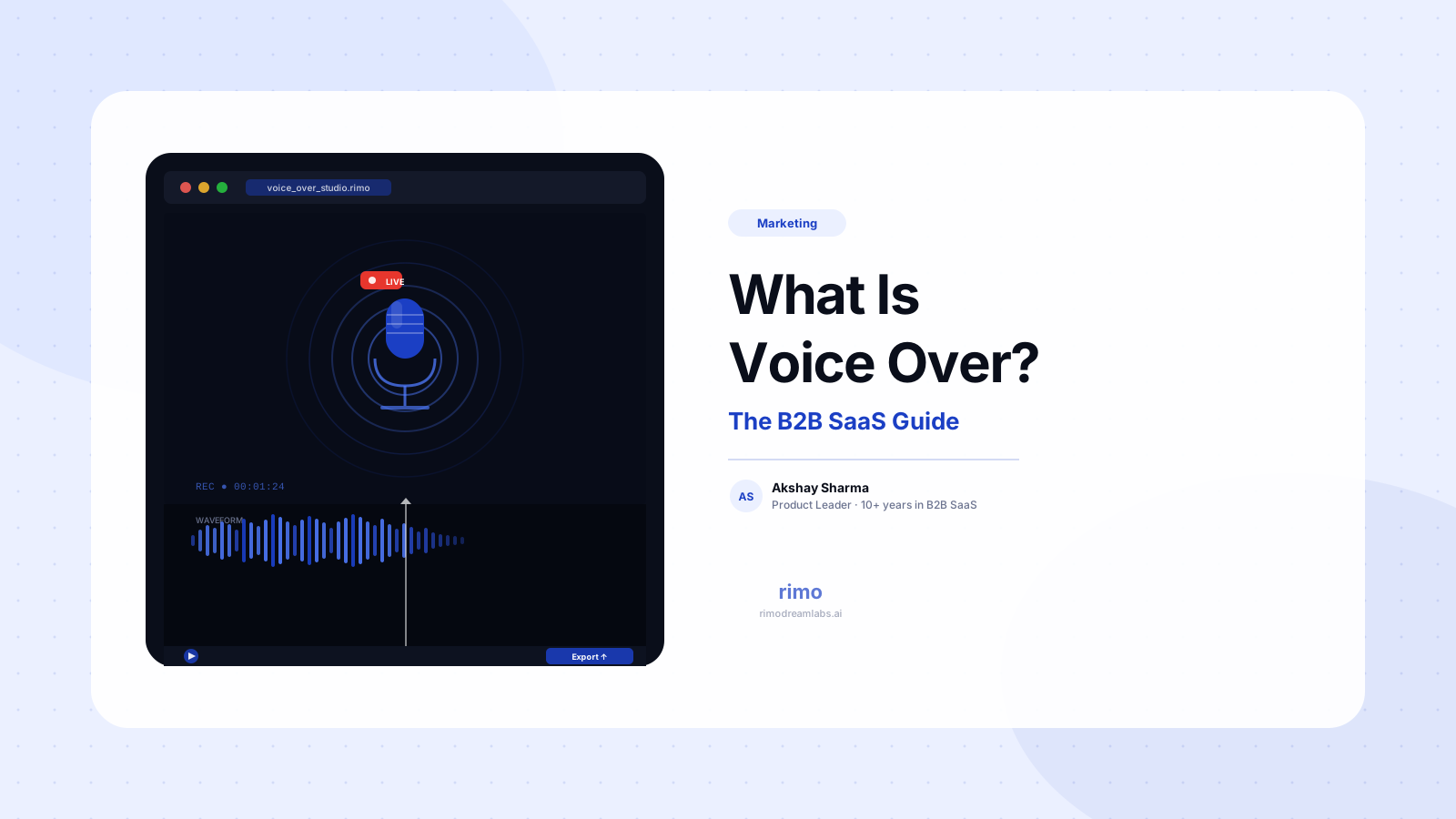
What Is Voice Over? The B2B SaaS Guide
You just recorded a product demo video. The screen capture is clean, the workflow flows logically, and the UI holds up under scrutiny. Then you hit play without sound — and it immediately becomes obvious something critical is missing. Not background music. Not sound effects. The narration that explains what's actually happening on screen, and why it matters to the person watching.
Voice over is what separates a screen recording that informs from one that persuades. B2B buyers watching a product demo don't just want to see the workflow — they want someone to translate those clicks into outcomes relevant to their specific job. Without narration, even the cleanest product UI looks like a tutorial, not a business case.
This guide covers what voice over actually is, the four types B2B SaaS teams use in practice, how it fits into product demo video production, and how to decide between professional talent, in-house recording, and AI narration — based on what your content needs to do and how fast your team needs to ship it.
In this guide
- What is voice over?
- The 4 types of voice over B2B SaaS teams use
- How voice over works in product demo video production
- What G2 reviewers say about voice over workflows
- Human voice over vs AI voice over: how to decide
- When voice over is worth the investment — and when it isn't
- FAQ
What is voice over?
Voice over — also written as voiceover or abbreviated VO — is audio narration recorded by a speaker who doesn't appear on camera, played over video or visual content. The voice provides context, explanation, or guidance that the visuals alone don't carry. You hear voice over in documentaries, product demo videos, training content, explainer videos, and anywhere a narrator needs to guide a viewer through something they're seeing on screen.
In B2B SaaS marketing, voice over serves one primary job: closing the gap between what buyers see and what they need to understand. A prospect watching a product demo doesn't automatically know what they're looking at, why a specific workflow matters, or how it maps to their actual problem. The narration handles that translation. Without it, the most polished UI footage is still just footage.
The term covers several distinct production models in practice — a human talent recording in a professional studio, an AI-generated narration from a text script, or a product marketer recording directly in a screen capture tool. All of those qualify as voice over. What differentiates them is quality, cost, and fit for a specific content type and buyer moment.
One thing that rarely gets mentioned in definitions: voice over is not just a production detail. It's the primary signal buyers use to judge a product demo video's credibility. Audio quality problems — inconsistent levels, room noise, flat delivery — register as product quality problems in the buyer's mind, even when the product itself is excellent.
The 4 types of voice over B2B SaaS teams use
Not all voice over is the same production model or budget line. These are the four types in active use across B2B SaaS content teams, each with a different tradeoff between quality, speed, and cost.
1. Professional human voice over
A trained voice actor records your script with broadcast-quality audio and delivers clean, edited files. Quality ceiling is highest here — skilled voice actors bring natural pacing, emotional range, and the ability to handle the pronunciation of unusual product terminology that AI models frequently mangle.
The tradeoff is production time and cost. A professional VO session takes days to arrange, involves multiple rounds of direction and revision, and runs anywhere from $150 to $800 for a typical 90-to-180-second product demo script, depending on talent tier, marketplace vs direct hire, and usage rights. For flagship content — a homepage hero video, a major product launch — that investment is defensible. For a feature walkthrough that will be outdated in four months, it almost never is.
2. In-house voice over
A team member — typically a product marketer, sales engineer, or product manager — records the narration themselves. Fastest. Cheapest. The narrator usually knows the product better than any external talent could.
The problem is equipment and environment. Most home-office or open-plan recording setups introduce background noise, reverb, and inconsistent levels that make narration sound unprofessional even when the person speaking is articulate. The gap between a decent USB microphone in an untreated room and a studio-recorded track is audible to any B2B buyer — and unlike a well-written script or polished UI, audio quality is one signal buyers can't be coached to ignore.
G2 reviews of screen capture tools used for demo narration consistently surface the same complaint: recordings cut off mid-session, audio levels vary between takes, and there's no clean way to re-record narration independent of screen content. The tools were built for async messaging. They weren't designed for the controlled, repeatable production environment that systematic voice over at volume requires.
3. AI voice over (neural TTS)
AI voice over uses neural text-to-speech technology to generate narration audio directly from a written script. No recording session, no talent scheduling, no studio. You write the script; the platform returns audio in seconds.
For B2B SaaS product content — demo walkthroughs, feature explainers, onboarding videos — neural TTS has crossed the quality threshold where most buyers don't distinguish it from professional human recording, as long as the voice model is well-chosen and the script is written with pacing in mind. Wistia's 2025 State of Video report found AI use in video production jumped from 18% to 41% in a single year, with voice dubbing as the second most adopted AI feature. Teams using AI for narration aren't experimenting — they're producing at scale in ways their pre-AI workflows couldn't support.
The practical limitations aren't about voice quality. They're workflow-specific: script revisions consume rendering credits, non-English voice models still lag behind English equivalents in realism, and product-specific terminology regularly requires manual pronunciation overrides. Those friction points are real but manageable compared to the cycle time and cost of professional talent on a fast-shipping content program.
4. Hybrid voice over
An increasingly common model in B2B SaaS: use professional human voice talent for flagship or long-lived content (homepage videos, major launches, brand films), and AI voice over for operational content that ships frequently (feature updates, onboarding walkthroughs, sales enablement clips). The hybrid approach keeps premium content sounding premium while making high-volume production viable without burning through a talent budget.
The key is being explicit about which content category gets which model — rather than defaulting to whichever is fastest on any given day.
How voice over works in product demo video production
Product demo video production has three parts: a brief, a recording, and a production layer. Voice over sits in the production layer — but decisions made earlier determine whether the narration lands.
Write the script before touching the product. The most common voice over mistake in B2B SaaS content production is recording the screen first and writing the narration afterward. This produces narration that describes what's on screen rather than explaining what it means to the buyer. Narration written before recording — or alongside a detailed storyboard — stays anchored to the buyer's problem instead of cataloguing feature mechanics. A structured product demo video script template maps narration scene-by-scene before any recording begins.
Voice selection changes what the content communicates. Different neural TTS voices — and different human talent profiles — carry different implied authority, warmth, and pacing. A voice with formal cadence and high authority works for enterprise SaaS content aimed at VP-level buyers. A warmer, more conversational delivery works for SMB tools or prosumer products. Teams that never consciously make this choice often end up with narration that subtly undercuts what the product is trying to communicate to its target buyer.
Sync is where production time actually goes. Recording or generating audio is fast. Aligning narration words to specific on-screen frames — so "here's where you trigger the automation" lands at exactly the moment the trigger appears — is where time accumulates. Teams doing this inside general-purpose video editing tools spend significantly more time in post-production than teams using platforms where voice and screen content are handled in a single workflow.
Voice over has a shelf life. A recorded narration is a fixed audio asset. When the product UI changes — the button moves, the feature gets renamed, the workflow gets redesigned — the narration is immediately wrong. Most teams respond by running outdated content rather than rebuilding the video, which creates a slow, invisible credibility problem with every buyer who watches a demo that describes a product that no longer exists. Keeping demo videos short and modular is what makes narration updates manageable — not just a production preference, but a content strategy decision. The guide on AI automation for demo video creation covers how fast-shipping teams solve this problem at sprint cadence.
Narration that stays current with your product
Rimo generates fully narrated product demo videos from a brief — AI voice, screen content, and timing produced together in a single workflow. No separate voice over step, no manual sync, no outdated narration when the product ships.
What G2 reviewers say about voice over workflows
The most commonly used tools for voice over in B2B SaaS demo video workflows — Murf AI, ElevenLabs, and in-browser capture tools — each show recurring friction patterns across hundreds of G2 reviews.
The voices that sound professional are behind higher pricing tiers. The most consistent complaint in Murf AI G2 reviews isn't about voice quality — it's the gap between the voices shown during free trials and the voices accessible on base plans. Teams that evaluate a platform based on its showcase voices and sign up expecting equivalent access frequently discover those specific neural models require a higher-tier subscription. For marketing teams that committed to a platform mid-project, this creates real operational friction at the worst possible moment.
Every script revision costs credits. ElevenLabs users on G2 consistently flag a specific billing dynamic: changing a single word in the narration script triggers a full audio re-render that consumes API credits regardless of the change's scope. On a product demo video going through two or three standard review rounds — normal in any B2B SaaS marketing team — this model makes revision cycles materially more expensive than the initial generation. Teams that don't account for revision rounds in their initial credit estimate frequently hit plan limits before the video is finalized.
Non-English voice quality is a different product. For teams producing demo content for global markets — EMEA, APAC, or LATAM — the difference between English and non-English neural TTS models isn't incremental. Multiple reviewers on Murf AI and ElevenLabs describe Hindi, French, German, and Spanish voice outputs as noticeably more robotic than English premium options. The root cause — English voice training data vastly outscales every other language — is not a quick fix for any platform. If multilingual narration is a core requirement, test the exact language models you need before committing.
In-browser tools weren't designed for production-grade narration. Teams using Loom for demo narration report the same issues repeatedly: unexpected recording cutoffs mid-session, audio levels that vary between takes, and no clean separation between screen content and voice tracks for editing. Loom is excellent for async team communication. It was not designed for the controlled, repeatable voice over recording environment that producing professional demo video content at volume actually requires.
Human voice over vs AI voice over: how to decide
The question most B2B SaaS teams get stuck on is not whether to use voice over — it's whether to invest in human talent or use AI generation. Both have clear and defensible use cases. The decision should be driven by content type and production cadence, not by personal preference or whatever tool surfaces first in a search.
Use professional human voice over when:
- The content will be published for more than 12 months without material updates
- The piece is flagship — a homepage hero video, a major product launch, a brand narrative film
- The narration needs emotional range that a conversational script alone can't convey
- Your product uses dense, unusual technical vocabulary that AI models consistently mispronounce — company-coined terms, product names, or acronyms with non-obvious pronunciation
Use AI voice over when:
- You're producing feature update videos, onboarding walkthroughs, or sales enablement clips on a sprint cadence
- The content will need to be updated within six months of first publication
- You're producing variants for multiple buyer personas and need different voice styles without multiple studio sessions
- You need multilingual narration at any meaningful volume, even accounting for the quality gap on non-English models
The decision that matters most isn't about quality preference. It's about velocity. A flagship homepage video that took five weeks to produce and will run unchanged for two years can justify professional studio talent. A feature walkthrough for a capability shipping next Tuesday cannot — and teams that apply the same production model to both content categories end up with either premium content that's chronically outdated or a backlog that never clears.
The detailed guide on AI voice over covers the specific neural TTS platforms, pricing models, voice cloning, and the technical differences between production tiers — worth reading before committing to any platform.
Voice over is not a production afterthought. For most B2B SaaS demo content, it's the layer that determines whether footage informs or persuades. Get the type right for the content, build the production workflow around the cadence your content actually requires, and the narration will do the job it's meant to do.
If your team is spending more time managing voice over logistics than producing content strategy, try Rimo free. The narration is part of the workflow — not a separate production step that follows everything else.
FAQ
What is voice over?
Voice over is audio narration recorded by an off-screen speaker, heard over video or visual content. In B2B SaaS video production, voice over explains what buyers are seeing on screen — translating product feature workflows into business outcomes for the person watching. It appears in product demo videos, explainer videos, onboarding content, sales enablement clips, and any format where narration adds context that visuals alone don't carry. The speaker is heard but not seen.
What is the difference between voice over and narration?
The terms are used interchangeably in most production contexts. Technically, narration can refer to any spoken commentary — including an on-camera presenter. Voice over specifically refers to narration where the speaker is not visible on screen. In B2B SaaS video production, both terms typically mean the same thing: recorded or AI-generated commentary playing over product footage, screen recordings, or visual content.
How much does professional voice over cost?
Professional voice over for a typical B2B SaaS product demo (90–180 seconds of script) runs $150 to $800, depending on talent tier, marketplace vs direct hire, and usage rights. AI voice over subscriptions run $29–$99 per month at mid-tier plans. Enterprise features — voice cloning, API access, team management, custom voices — require custom pricing that typically lands at $200–$500 per month for business use, based on Murf AI G2 reviews from 2025. Hidden costs in AI platforms include rendering credits consumed by script revisions, which can exceed the base subscription cost on content with multiple review rounds.
Can AI voice over replace professional voice actors for B2B SaaS product demos?
For product demo videos, feature walkthroughs, and content where clarity and workflow explanation matter more than emotional depth, AI voice over is a practical replacement at any meaningful production volume. Wistia's 2025 State of Video report found AI use in video production more than doubled year-over-year, with voice dubbing as the second most adopted AI feature. For brand narrative content, executive thought leadership video, and formats where the authenticity of a specific human voice is central to the message, professional talent still delivers qualities AI models don't consistently match.
What is the best voice over style for a B2B SaaS product demo?
Conversational and authoritative — not announcer-style or overly formal. The narration should sound like a knowledgeable colleague walking through the product: credible enough to be trusted, warm enough to be approachable. Pacing is as important as tone. Narration that outpaces the on-screen action loses buyers; narration that lags behind the visuals feels disconnected. Short sentences — one idea per sentence — consistently produce better pacing in both human delivery and AI-generated voice.
How do you write voice over for a product demo video?
Write the script before recording anything. Map each narration sentence to a specific screen action or UI state. Lead with the buyer's problem, not the feature's name. Use short sentences — neural TTS models and human narrators both handle short, clear sentences better than long, clause-heavy ones. Treat punctuation as pacing direction: commas create brief pauses, em dashes create beats, periods create hard stops. A full guide to structuring demo narration is in the product demo video script template.
Akshay Sharma
Product Leader · 10+ years in B2B SaaS
Akshay has spent 10+ years building and marketing B2B SaaS products. He writes about product storytelling, demo production, and the operational side of product marketing.