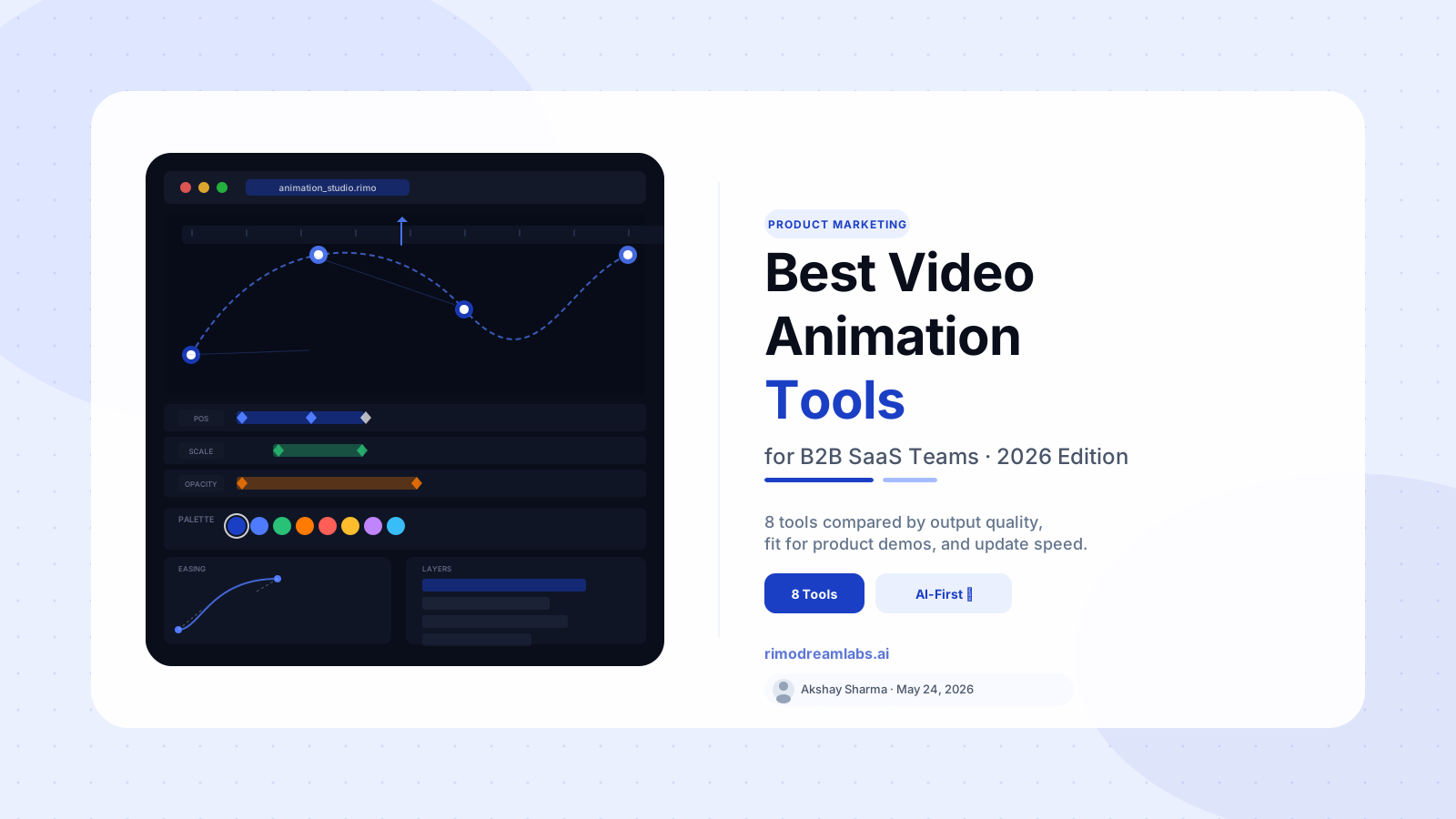
Best Video Animation Tools for B2B SaaS Teams (2026)
Your product just shipped a redesigned dashboard. The animated explainer on your website — the one your CEO loves, the one sales pastes into every deck — now shows a workflow that no longer exists. Your head of sales asks when the updated version goes live. Your designer is heads-down on the next launch. You're the PMM, and this is somehow your problem to solve.
You start searching "best video animation tools." Four tabs open. Three free trials later, you've exported one video that looks like a 2015 startup pitch and you're back to square one — except now it's Thursday afternoon.
Most "best video animation tools" roundups are written for solo creators making YouTube content, not for product marketers maintaining a live demo library at product sprint speed. The evaluation criteria are different. The real bottlenecks are different. And the tool that works for a consumer content creator is almost never right for a B2B SaaS team. This guide is built for your actual use case.
In this guide
- What to look for in video animation tools for B2B SaaS
- The 8 best video animation tools for B2B SaaS teams (2026)
- What G2 reviewers say about video animation tools
- The update cost nobody talks about
- How to choose the right video animation tool
- FAQ
What to look for in video animation tools for B2B SaaS
Most reviews of video animation tools evaluate the same five things: template variety, export quality, pricing, ease of use, and G2 star rating. Fine criteria if you're making a one-time logo intro.
For a B2B SaaS marketing team, they miss the point entirely.
Here's what actually matters:
Product UI animation capability. Most video animation platforms are built around character libraries, shape morphing, and kinetic text. They were never designed to show software interfaces moving through a workflow — which is the single thing most B2B SaaS teams actually need to animate. Before evaluating any tool seriously, test whether it can produce a clean, professional representation of your product in motion. Most can't.
Update speed, not just creation speed. This is the criterion every review skips. How fast can you update a video that already exists? If your product ships a UI change and you have to rebuild the entire animation from scratch, you've traded one bottleneck for another. The tools worth using either treat content elements as independent editable layers, or they generate content from a brief so the entire output regenerates on demand without a manual rebuild.
Brand consistency at scale. Template-based tools give every company access to the same 40 character styles and 12 color schemes. When every SaaS startup uses Vyond with the same Motion Pro template, your explainer video looks identical to your competitor's. Brand differentiation matters — and tools that lock you into shared asset libraries make it structurally difficult.
Team collaboration without version chaos. Animated content in B2B SaaS is rarely a solo activity. Someone makes the first version, a stakeholder wants changes, legal reviews the copy, the CEO comments on the transition timing. A tool with no collaborative review workflow creates email chains, screenshot feedback, and the eternal "is this the final final version?" problem. The best tools include a review link or comment layer natively.
AI narration accuracy on technical vocabulary. If your tool generates voice narration, test it on your actual product terminology before committing. Generic text-to-speech models mis-pronounce product names, feature names, and company names with unusual spelling. In a polished B2B SaaS product demo video, one mis-narrated feature name undermines everything else.
These criteria are largely absent from standard "best video animation tools" roundups. Keep them in mind as you read the comparisons below.
The 8 best video animation tools for B2B SaaS teams (2026)
1. Rimo — AI-generated product demo animation, no video team required
Best for: Product marketing teams producing demo videos, feature walkthroughs, and onboarding animations at sprint cadence.
Rimo is different from every other tool on this list. Rather than starting with a template and animating manually on a timeline, Rimo generates narrated product demo videos from a plain-English brief. You describe the product, the workflow, the buyer persona, and the outcome — Rimo handles script, narration, screen content, and video production in a single pipeline.
For B2B SaaS teams, this changes the equation. The bottleneck isn't animation skill or template availability — it's the gap between how fast the product ships changes and how fast marketing content can reflect those changes. Rimo closes that gap by design. When your UI updates, you update the brief and regenerate. No timeline, no character editor, no re-recording session.
This means the creation process and the update process are the same process. That's the thing most animation tools can't offer.
Rimo is purpose-built for product demo and walkthrough content, which means it's not the tool for a general-purpose character animation or a brand identity video. But for product marketing teams whose primary video output is demo and walkthrough content, it handles the most painful part of the job.
Pricing: Free plan available. Paid plans from $49/month.
Key limitation: Specialized for product demo content. Not designed for character animation, whiteboard-style video, or general brand motion graphics.
2. Vyond — Business character animation, the enterprise default
Best for: Customer education, enterprise sales enablement, HR training content requiring human characters.
Vyond (formerly GoAnimate) has been the enterprise standard for business animation for over a decade. Its character library is the largest of any business-focused tool, its lip-sync quality is meaningfully better than competitors, and its output resolution holds up in webinar recordings and large-screen presentations.
For B2B SaaS teams producing explainer content that features human characters — think customer success onboarding, or a video walking an enterprise buyer through a proof-of-concept workflow — Vyond produces credibly professional results without requiring a dedicated video animator.
The counterintuitive problem: Vyond's templates have been used by so many companies for so long that experienced buyers now recognize the house style instantly. The "Professional Business Person Explains Things" character in the Motion Pro template is to B2B animation what Comic Sans is to typography — you see it everywhere, which means it communicates nothing distinctive. Getting past the templates into genuinely branded output takes real time investment.
One other thing worth knowing before you sign up: Vyond rolled out a credit-based pricing system in May 2025, moving text-to-speech and several AI features behind a credit consumption model. G2 reviewers were pointed in their criticism — phrases like "exorbitant pricing" and "suffocating AI credit system" appear in reviews from that period. Users report burning through credits just for previewing or sharing drafts. If you're evaluating Vyond today, clarify exactly how credits are counted before committing to the Professional tier.
G2 rating: 4.4/5 (1,400+ reviews)
Pricing: $99/month Starter (annual), $199/month Professional (annual), $1,649/user/year Enterprise.
Key limitation: Templates are widely recognizable; credit-based pricing adds unpredictable per-use cost; custom branded output requires significant time investment to produce cleanly.
3. Animaker — Comprehensive DIY animation for budget-conscious teams
Best for: Startups and solo marketers producing animated social content on a limited budget.
Animaker covers significant ground at a low price point. Character animation, infographic animation, whiteboard video, and basic screen recording all live in one platform. For a startup PMM who needs to produce a variety of animated formats without a dedicated video production budget, that breadth has real practical value.
The tradeoff is depth and performance. G2 reviewers describe a persistent stability problem: "The app constantly lags, making it almost impossible to get anything done. Every time I try to create or edit something, it freezes, forcing me to refresh the page and start all over again." Another reviewer puts it bluntly: "It's super glitchy and scenes just start disappearing all of a sudden." For a team on deadline, that's not a minor inconvenience — it's a production blocker. The free plan includes a persistent watermark on all exports, making it effectively unusable for any published professional content.
Teams that stick with Animaker long-term use it primarily for social media content — LinkedIn clips, short-form announcement videos — rather than for hero product demos. The output ceiling is lower than Vyond, and the tool shows that at longer run times.
G2 rating: 4.7/5 (550+ reviews — high satisfaction, but mostly from social and educational users, not enterprise B2B teams)
Pricing: Free (with watermark), $19/month Starter, $35/month Pro.
Key limitation: Slow rendering pipeline; cluttered interface; free plan too restricted for professional use; output quality ceiling is visible in longer-form content.
4. Powtoon — Animated presentations for B2B marketing
Best for: Short animated sales decks, internal stakeholder presentations, social video clips that blend slide and animation formats.
Powtoon occupies the interesting middle ground between animated presentation and video production tool. If you need a slide-based walkthrough that moves — text animating in, icons transitioning, simple scene changes — Powtoon gets you there faster than any traditional animation tool. It genuinely requires less learning than Vyond for users who already know how to build slide decks.
For B2B SaaS teams, Powtoon earns its place for sales motion overviews, animated value proposition content, and animated competitor comparison charts. It doesn't earn its place for showing actual product interfaces, and it struggles with the kind of polished 90-second product walkthrough video that buyers expect on a pricing page.
Pricing structure is a pain point reviewers mention repeatedly. Free exports are watermarked and capped at 3 minutes. The first paid tier ($23/month) removes the watermark but preserves significant feature restrictions. Most professional use requires the $60/month Business plan, which makes the entry price lower than the effective price.
G2 rating: 4.4/5 (500+ reviews)
Pricing: Free (restricted, no video download), $15/month Lite, $59/month Pro+, $99/month Agency.
Key limitation: Downloading your own video requires the $59/month Pro+ tier; template style is recognizable across many B2B brands; poor fit for product UI animation.
5. Renderforest — Template-based brand video and logo animation
Best for: Brand intro sequences, logo animations, quick event promo videos.
Renderforest is the fastest tool on this list for producing template-based brand content. Logo animation for a presentation intro, a branded transition card for a webinar recording, a quick promotional cut from stock footage — Renderforest handles all of these in minutes, without a learning curve worth mentioning.
For B2B SaaS product marketing, Renderforest's useful scope is narrow. It's not built for demo video production, for character animation, or for any kind of product UI storytelling. Teams use it for brand-adjacent content — the intro card at the top of a feature announcement, the animated social ad, the motion graphics in a pitch deck — rather than as a primary video animation tool.
The free plan's output quality degrades meaningfully: lower resolution, watermarks, and limited export formats. Template variety is broad but starts feeling repetitive once you've used the platform for a quarter. At $9.99/month for the Lite plan, it's reasonable for light individual use.
G2 rating: 4.4/5 (250+ reviews)
Pricing: Free (limited quality), $9.99/month Lite, $19.99/month Pro, $29.99/month Business.
Key limitation: Limited customization beyond templates; quality drops noticeably on lower plans; not suited for product demo or walkthrough content.
6. Biteable — Fast animated video for social and email
Best for: LinkedIn video ads, email video thumbnails, short animated social clips.
Biteable earns its place on this list for one specific, valuable use case: producing short animated video content for social ads and email marketing quickly and with above-average template quality. For a demand generation team that needs a consistent supply of 30–60 second animated clips, it removes most of the production overhead and delivers polished enough output for most social contexts.
What Biteable doesn't do: long-form content, product UI animation, character animation with dialogue, or anything requiring customization beyond color and text swapping. It's a social content machine, not a product video studio. Teams sometimes mistake its low price and polished templates for versatility — then hit the ceiling hard when trying to produce a 2-minute product demo.
G2 rating: 4.3/5 (260+ reviews)
Pricing: Free (very limited), $49/month Pro.
Key limitation: Shallow creative depth; optimized for short-form social content only; not appropriate for substantive product storytelling.
7. Doodly — Whiteboard-style animation
Best for: Educational explainers, hand-drawn aesthetic content, training videos targeting non-technical audiences.
Doodly produces one animation style: the whiteboard format, where a cartoon hand draws or writes content on screen as the narration progresses. For specific audiences — professional services buyers, healthcare, education, non-technical enterprise users — this format performs well because it signals "explanation" rather than "pitch."
For B2B SaaS product marketing, whiteboard animation is largely a stylistic mismatch. The format communicates "here's how a concept works," not "here's our actual product interface." And because Doodly does only one thing, there's no growth path once you need any other format.
The honest assessment: Doodly is purpose-built and fast for its specific use case. If your content strategy specifically requires whiteboard-style explainers — product concept overviews for non-technical economic buyers, for example — it's the right tool. Otherwise, it's a tool you'll use twice and then replace with something that can do more.
Pricing: $39/month Standard, $69/month Enterprise.
Key limitation: Single animation style only; no team collaboration features; limited export options; no pathway to other formats.
8. Adobe Express — Design-native animation for Creative Cloud teams
Best for: Teams already inside Adobe Creative Cloud; design-led marketing teams needing polished template-based animation without leaving the Adobe ecosystem.
Adobe Express (formerly Adobe Spark) gives design-oriented teams access to animation without leaving the Adobe environment. For teams already paying for Creative Cloud, the animation capabilities in Express add genuine value at no incremental cost. Templates are polished, brand kits connect to existing Adobe assets, and export quality is reliable across formats.
The ceiling is visible. Adobe Express is an animation entry point, not an animation studio. Teams producing professional-grade animated product videos — with voiceover sync, complex motion paths, and product UI representation — will hit that ceiling within a few projects. The tool is best understood as a strong step up from Canva for teams that need tighter brand control and Adobe integration, not as a replacement for purpose-built animation tools.
G2 rating: 4.3/5 (3,000+ reviews across Express categories)
Pricing: Included with Creative Cloud ($54.99/month individual). Standalone Express at $9.99/month.
Key limitation: Limited depth for complex animation needs; ceiling reached quickly for serious production work; value is primarily in ecosystem integration, not animation capability.
Most animation tools require a template, a timeline, and a recording session.
Rimo generates narrated product demo animations from a plain-English brief — no video team, no screen recording, no stale content problem. When your product changes, you update the brief and regenerate.
What G2 reviewers say about video animation tools
Before signing a contract with any video animation tool, it's worth knowing what users say six months in — not at the point of purchase. G2 reviews tell that story clearly, and three pain points show up consistently across nearly every major platform.
"Making one video was fine. Making twenty broke us." Multiple reviewers across Vyond, Animaker, and Powtoon describe the same pattern: the first video took longer than expected, but subsequent videos got faster as they learned the tool. Then the product changed. Or a new persona needed a different cut. Or the campaign required five regional variations. That's where the workflow breaks. Animation tools built for one-off creation don't scale to library management — and in B2B SaaS, you're always managing a library, not creating individual assets.
"Our videos look like everyone else's." Template saturation is a documented problem across G2 reviews of Vyond and Powtoon specifically. Reviewers describe noticing competitor brands — sometimes direct competitors — using the same character styles and transition sequences. When your product explainer uses the same animation template as three companies in your category, the video communicates nothing unique about your product.
"The pricing seems fine until it isn't." Across Vyond, Powtoon, and Biteable specifically, reviewers describe the same pattern: a reasonable entry price that obscures a much higher true cost. Powtoon requires Pro+ (at $59/month) just to download a video you've already created. Vyond's credit system means you can run out of credits while previewing content. Biteable users report their subscription cost "doubled twice in one year." The sticker price and the production cost are not the same number, and almost no comparison article surfaces that distinction clearly.
The consistent pattern in positive reviews is equally telling: teams satisfied with animation tools are using them for a specific, narrow use case and not stretching beyond it. Vyond users who are happy use it for training content. Biteable fans use it for social cuts. The unhappy users bought a general animation tool hoping it would solve a product marketing problem it was never designed to address.
The update cost nobody talks about
Every "best video animation tools" comparison reviews the cost to create a video. None of them review the cost to update it.
This omission is significant for B2B SaaS teams.
According to Wyzowl's 2025 State of Video Marketing report — which has tracked video production trends for 12 consecutive years — 93% of marketers now report positive ROI from video marketing, the highest percentage ever recorded. And 71% of companies now produce video in-house (Wistia, 2025), which means the video update burden has shifted from external agencies to internal teams. SaaS companies, which ship product changes on two-week sprint cycles, face this problem at a higher rate than any other segment. Every tool on this list — with the exception of Rimo — requires a manual rebuild every time the underlying product changes in any meaningful way.
That rebuild isn't just a time cost. It's a context cost that most teams don't account for. The PMM who built the original animation may have moved on. The style decisions made in the initial project aren't documented anywhere. The character voiceover files may be in a folder on someone's local drive. Rebuilding a 90-second animation often takes longer than the original build because the institutional memory is gone.
This is the structural argument for AI-generated product demo video tools that produce content from a brief rather than from a manually built timeline. When the product brief changes, the video updates. The creation workflow and the maintenance workflow are the same workflow — which means update costs trend toward zero.
Most B2B SaaS teams don't think about this when evaluating animation tools. They think about it on their fourth or fifth update cycle, when the true cost of manual maintenance becomes visible.
How to choose the right video animation tool
The right tool depends primarily on what type of animation content you produce most frequently. Here's a direct decision framework.
You need product UI walkthrough or demo animation → Rimo is the only purpose-built option on this list for this use case. Every other tool will require workarounds to represent software interfaces in motion cleanly, and none of those workarounds produce output that looks like the actual product.
You need professional character animation for sales, training, or onboarding → Vyond is the category leader. Budget for the Professional plan ($89/month) — the Essential tier lacks the features that make the tool worth using at that price point.
You need a steady supply of short animated social clips → Biteable for export speed and template quality. Animaker if you need broader format variety and can tolerate slower rendering.
You need brand content — logo intros, presentation graphics, promo cuts → Renderforest for quick template-based production. Adobe Express if you're already in Creative Cloud and brand asset integration matters.
You're a solo PMM with no animation budget → Start with Animaker's free plan to learn animation fundamentals, then evaluate paid tools once you know specifically which limitations matter to your workflow.
HubSpot's research shows that 73% of B2B decision-makers prefer watching a product demo video over reading a whitepaper or product brief. That's the real audience for the content you're building — and the tool you choose should be evaluated on whether it can serve that audience credibly, not whether it looks impressive in a free trial walkthrough.
One principle worth keeping: never evaluate a video animation tool based on the tool's own demo or tutorial videos. Evaluate it based on the third or fourth video you'll need to make — the one where the product has changed, the timeline is tight, and you need to update content that already exists. That's the workflow that breaks most tools. That's the workflow worth stress-testing before you sign up.
The product demo video that represents your product is never finished. It's only current or stale. The right animation tool is the one that lets you keep it current at the speed your product moves.
Most teams end up with an animation tool that made sense for one project, then quietly becomes the standard through inertia. The question worth asking before that happens: which tool will still be right six months from now, when you have twenty videos in the library, a product update that changes three screens, and half your original team has turned over?
That's the question most video animation tool comparisons don't answer. For B2B SaaS product marketing teams, the answer points toward tools built around regeneration rather than manual rebuild — because the product will change on schedule, and the video has to change with it.
Try Rimo free and generate your first animated product demo in under an hour, with no video team, no recording session, and no timeline to maintain.
FAQ
What is the best free video animation tool for B2B SaaS teams?
Animaker offers the most feature-complete free plan among dedicated animation tools — it includes character animation, infographic templates, and basic screen recording without requiring a paid subscription. The main constraint is a persistent watermark on all exports, which prevents use in any published professional content. For product demo animation specifically, Rimo's free plan is purpose-built for B2B SaaS product marketing and generates professional narrated walkthroughs without requiring animation experience or a recording session.
What video animation software do professional business animators use?
Professional animators producing high-quality B2B content typically use Adobe After Effects for AI motion animation and motion graphics, paired with Adobe Premiere Pro or DaVinci Resolve for final editing. Vyond is widely used by business animation specialists producing character-based explainer content without full After Effects expertise. For software interface animation specifically — showing product UIs in motion — dedicated tools like Rimo or Principle are increasingly common. Most B2B SaaS teams don't need the full professional stack; they need a tool their PMM can use independently without a production team.
Which is better for B2B SaaS: Vyond or Animaker?
Vyond produces higher-quality output with more professional character animation, better lip-sync, and a larger enterprise asset library — but at a higher price ($89/month for the plan worth using) and with a steeper learning curve. Animaker is better for teams on tighter budgets who need broader format variety and can accept lower output quality and slower rendering. If your animation needs center on product demo or walkthrough content, neither tool is optimized for that use case — both are built for character and motion graphics animation rather than software UI storytelling.
How long does it take to create an animated product demo video?
With a traditional animation tool like Vyond or Animaker, a polished 90-second product demo animation typically takes 4–8 hours: scripting, asset selection, animation, voiceover generation or recording, and export. Teams new to the platform should add 2–4 hours of learning overhead on the first project. With an AI-generation tool like Rimo, the same output compresses to under an hour — the script, animation, and narration are produced from a brief, without manual timeline work. The more significant saving is update time: traditional tools require a near-full rebuild when the product changes; Rimo requires a brief update.
Can a product marketing manager create animated demo videos without a video team?
Yes. Every tool on this list is designed for non-specialist use. Rimo is the most approachable for PMMs who need professional output quickly — it generates narrated product walkthroughs from a text description, without animation, screen recording, or voiceover experience required. Animaker and Vyond are fully self-serve but require meaningful time investment to produce professional-looking output. Most PMMs who use these tools successfully start with one clear use case and one template style, then expand as they build familiarity.
What is the best video animation tool specifically for SaaS product demos?
For B2B SaaS product demo content, Rimo is the purpose-built option — it generates narrated product walkthroughs from a brief without requiring a screen recording session or manual animation workflow. Traditional animation tools like Vyond and Animaker can produce demo content, but require the team to manually build product UI visuals inside the tool's asset library — which is time-intensive, produces output that looks like generic animation rather than the real product interface, and requires a full rebuild every time the product UI changes.
Akshay Sharma
Product Leader · 10+ years in B2B SaaS
Akshay has spent 10+ years building and marketing B2B SaaS products. He writes about product storytelling, demo production, and the operational side of product marketing.