What Is a Context Hint in ChatGPT Ads? Best Practices & Limitations (2026)
Every ad platform has a primitive — a basic unit of targeting that everything else gets built around. On Google, it's the keyword. On Meta, it's the audience. On ChatGPT, it's something neither of those: a block of plain-language text describing the kinds of conversations your ad should be eligible to appear in.
OpenAI calls this a Context Hint, and it's set at the ad group level for every ChatGPT Ads campaign. It's also the part of the platform with the least established guidance. OpenAI's own documentation describes what a context hint is in a few sentences and explicitly declines to promise how it behaves — hints "help guide matching but do not guarantee delivery in specific conversation types," and they are "not exact-match keywords."
That ambiguity is exactly why it's worth a dedicated look. This guide covers what a Context Hint actually is, how it's evaluated, a practical framework for writing one as a B2B advertiser, and — just as importantly — what the current version of this targeting system can't do yet.
In this guide
- What is a Context Hint?
- How Context Hints differ from keywords and audiences
- The anatomy of a good Context Hint
- Our framework: three layers of Context Hints for B2B
- Operational best practices
- Limitations of the current version
- Common mistakes
- FAQ
What is a Context Hint?
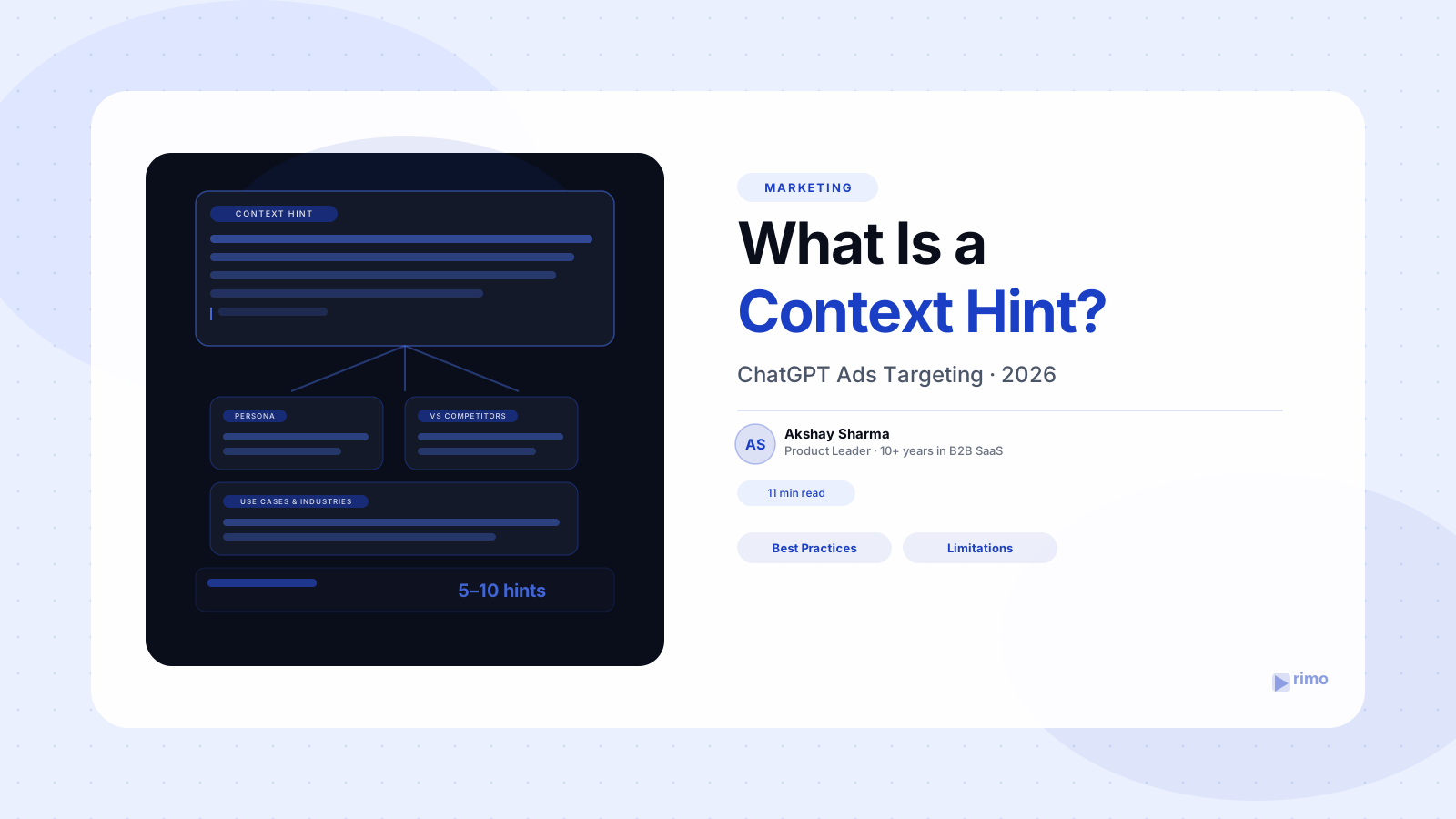
A Context Hint is a short, natural-language description — typically one to two sentences — of the conversations, topics, or moments where your product or service is genuinely relevant. You write it as plain English text in the ad group setup, and OpenAI's ad-matching system uses it, alongside the live content of a user's conversation, your landing page, your ad title, and your ad copy, to decide whether your ad is a good fit for that moment.
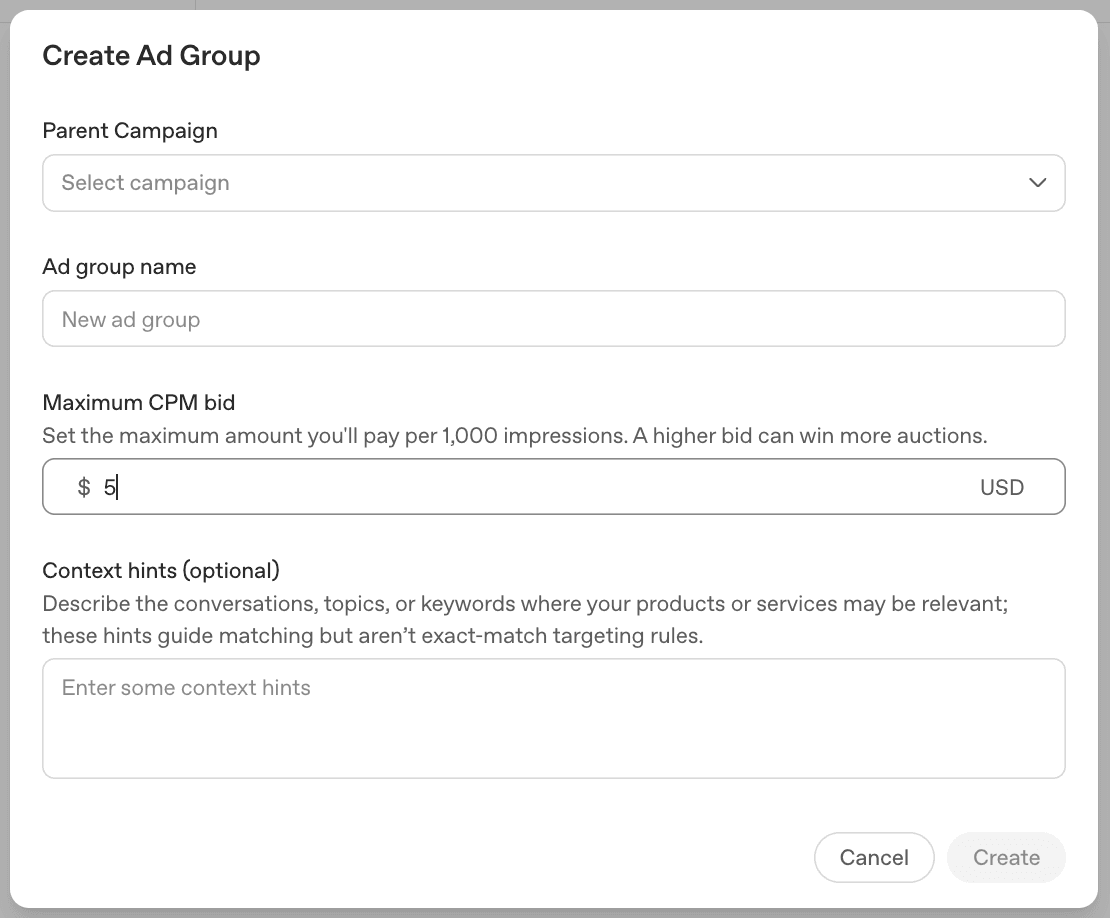
OpenAI's own description of the field, visible directly in the interface, reinforces this: it asks advertisers to "describe the conversations, topics, or keywords where your products or services may be relevant," and notes that these hints guide matching but aren't exact-match targeting rules — language worth reading closely, since it's the clearest first-party signal of how the field is meant to be used.
There's no keyword bidding, no audience builder, and no demographic targeting involved. You're not telling the system who to show your ad to in the way a Facebook campaign defines an audience by age, location, and interests. You're describing the shape of the conversation — who's likely speaking, what they're trying to figure out, and why your product fits into that moment.
Per OpenAI's help documentation, this sits at the ad group level — not the campaign level and not the individual ad level. That placement is deliberate: the ad group is the layer of the hierarchy where targeting lives, and a context hint is the targeting input for that layer, the same way an audience definition is the targeting input for a Meta ad set.
The system evaluates ad eligibility through what's described as a relevance-weighted, second-price auction — your context hints contribute to a relevance score, which combines with your bid to determine whether your ad wins placement below a given ChatGPT response.
How Context Hints differ from keywords and audiences
It helps to be explicit about what a context hint is not, because the instinct for most performance marketers — understandably — is to treat it like a keyword list or an audience definition.
It's not a keyword list. A Google Ads keyword names a query — the exact (or close-variant) string a user types. A context hint doesn't name a query. It describes a situation. "Best CRM for a 50-person sales team" as a search keyword targets that literal phrase. As a context hint, the equivalent input would describe the kind of conversation a sales leader at a growing company might be having — which could surface your ad across many differently-worded conversations that share that underlying intent.
It's not an audience definition. There's no demographic targeting, no interest-based audience, no lookalike modeling based on user profiles. The system isn't matching your ad to people with certain characteristics — it's matching your ad to conversations with certain characteristics, in the moment those conversations are happening.
It's evaluated holistically, not as a filter. A context hint doesn't function as an on/off gate that either admits or excludes a conversation. It's one input — alongside your ad's title, description, and landing page — into a relevance score. This means the hint and the rest of your ad creative need to tell a consistent story; a context hint describing one scenario and an ad creative addressing a different one will likely produce a weaker relevance signal than either would on its own.
It's probabilistic, not guaranteed. OpenAI states plainly that context hints "do not guarantee delivery in specific conversation types." You're shaping the probability distribution of where your ad can appear — you're not building an allowlist.
The anatomy of a good Context Hint
Across the operator guides that have emerged since ChatGPT Ads opened up, a consistent pattern shows up for what a well-formed context hint contains. A useful way to think about it is three components in a single sentence:
Persona + Intent + Scope
- Persona — who is likely having this conversation. "Marketing leaders," "supply chain managers," "engineering directors at mid-market companies."
- Intent — what they're trying to do or figure out. "Comparing CRM platforms," "evaluating tools to reduce demo production time," "trying to cut sales cycle length."
- Scope — the qualifying detail that narrows it to your actual buyer. "For a 50-person team," "in the logistics industry," "without hiring a video editor."
Put together: "Supply chain managers at mid-market manufacturers evaluating tools to improve inventory visibility without adding headcount." That single sentence carries a persona, an intent, and a scope — giving the matching system a coherent moment to recognize, rather than a scattershot set of keywords.
Two other patterns worth knowing, beyond the workhorse persona-plus-intent structure:
- Outcome hints describe the result a user is chasing rather than the tool category: "Teams trying to cut demo video production time from weeks to hours."
- Stack comparison hints describe a migration or switching moment: "Teams currently using [Competitor] and asking whether there's a faster alternative."
Both of these are valuable additions to a B2B context hint set because they capture conversations that wouldn't necessarily mention your product category by name at all.
Write hints as a sentence, not a tag cloud. "Demo video software, screen recording, sales enablement, B2B SaaS" gives the matcher four disconnected fragments. "Sales engineers at B2B SaaS companies looking for faster ways to build product demo videos for enterprise deals" gives it one coherent moment. The second version is the one that maps onto real conversations.
Our framework: three layers of Context Hints for B2B
Given how little prescriptive guidance exists from OpenAI directly, we recommend B2B advertisers build their context hints around three layers — each capturing a different kind of conversation your buyers are likely to have. You don't need three separate ad groups for these (though you can structure it that way); the point is to make sure your hint set, collectively, covers all three.
Layer 1: Conversations your ICP personas are having
Start with the specific roles that make up your buying committee, and describe the conversations those roles have — in their language, not your product's language.
- A Product Manager might be asking ChatGPT about prioritization frameworks, how to communicate roadmap changes to stakeholders, or how to gather better customer feedback.
- A CMO might be asking about attribution models, how to justify a martech budget increase, or how to scale content production without growing headcount.
- A Supply Chain Manager might be asking about inventory forecasting accuracy, vendor risk scoring, or how peers in their industry handle demand volatility.
None of these example conversations mention any product category by name — they're conversations a person in that role has regardless of whether they're actively shopping. That's the point: this layer builds broad relevance with the people who eventually become your buyers, even before they're in an active evaluation.
Layer 2: Conversations evaluating products in your category — including competitors
This layer captures the closest thing to bottom-funnel intent that ChatGPT Ads offers: conversations where someone is actively comparing tools.
- "What's the best [category] tool for a [team size/type]"
- "[Competitor A] vs [Competitor B] for [use case]"
- "Alternatives to [Competitor], cheaper / faster / easier to use"
- "Is [category] worth it for a team our size"
This is the layer where naming your category clearly — and being willing to reference the competitive landscape your buyers are actually asking about — matters most. A hint that only describes your own product's features misses the entire class of conversation where someone is actively building a shortlist.
Layer 3: Conversations about your product's use cases across industries and roles
The third layer is the most specific, and often the highest-converting: conversations about the exact job your product does, in the specific industries and team contexts you sell into.
For a demo video platform, this might look like:
- "Creating product demo videos for SaaS sales teams without a video editor"
- "Automating customer onboarding walkthroughs for a fintech product"
- "Building a video library for a marketing team covering multiple product lines"
Each of these names a job-to-be-done, a team type, and (where relevant) an industry — giving the matcher a very specific moment to recognize, and giving your ad creative a very specific thing to be relevant to.
Combine all three layers across your ad group's hint set. If you're following the 5–10-hints-per-group guidance (more on that below), a reasonable split is 2–3 hints from each layer — persona conversations, competitive-evaluation conversations, and use-case conversations — all still anchored to the single intent that ad group represents. The layers aren't three different targets; they're three angles on the same buyer moment.
Operational best practices
Beyond the content of the hints themselves, a few operational patterns have emerged as practical guidance for structuring context hints well:
One ad group, one intent. This is the single most repeated piece of guidance across both OpenAI's own documentation and third-party operator guides. If your context hints describe two meaningfully different personas or use cases, split them into two ad groups. Mixing intents dilutes the relevance signal for both.
Roughly 5–10 hints per ad group. Enough variants of the same underlying theme to give the matcher surface area, without sprawling into multiple unrelated scenarios. Some operator guides extend this range to 5–15; either way, the hints should read as variations on one theme, not a list of different themes.
Keep each hint concise — roughly one to two sentences. Hints that try to describe an entire buyer journey in one block of text tend to drift across multiple scenarios, which appears to reduce matching precision. A hint that names a persona, an intent, and a scope in a single sentence is usually enough.
Structure around funnel stage. It's useful to think about whether a hint describes an exploration-stage conversation (someone learning about a problem space, not yet aware of solutions) or a consideration-stage conversation (someone actively comparing named options). Both are valid, but they call for different ad creative and landing pages — which is itself a reason to keep them in separate ad groups.
Treat the first several weeks as a learning period. Because this is a new, contextually-matched system with no long performance history for most categories, give a new ad group meaningful time and budget before drawing conclusions — and before rewriting your hints based on early results that may just be noise.
Keep hints consistent with your AEO content. If your organic content — built for answer engine optimization — describes your product and category one way, and your context hints describe it differently, you're working against yourself. The language your buyers actually use, consistently applied across paid and earned AI surfaces, is the throughline that makes both work better.
Limitations of the current version
Context Hints are new, and it's worth being direct about what the current version can't do — both so you calibrate expectations, and so you don't spend time trying to configure something that isn't there yet.
No guarantee of delivery. This is the headline limitation, stated directly by OpenAI: hints "do not guarantee delivery in specific conversation types." There's no way to force your ad to appear in a specific kind of conversation — only to make it more likely to be considered relevant when one occurs.
No demographic or behavioral audience targeting. You cannot define an audience by age, job title, company size, or browsing behavior the way you would on Meta or LinkedIn. The only audience-shaping tool available is uploading a list for matching or exclusion (for example, excluding your existing customers) — everything else is conversation-context-based, not person-based.
Strict privacy boundary — and no visibility into it. OpenAI's architecture keeps chat content, names, emails, IP addresses, and precise locations inside ChatGPT. Advertisers receive only aggregated performance data — no access to the conversations that triggered an impression, even in aggregate themed form. This is a deliberate privacy design choice, not a temporary gap, but it does mean you're optimizing somewhat blind: you can see that an ad group is performing well or poorly, but not which of your hints, or what kind of conversation, is driving it.
No exact-match control. Unlike a Google Ads exact-match keyword, there's no way to say "only match this precise phrase." The system is semantic and probabilistic by design, which means you can't fully predict — or fully prevent — which conversations your ad might be considered for.
Restricted categories and sensitive topics. OpenAI prohibits ad matching near sensitive topics — health, mental health, politics, and conversations involving predicted under-18 users. Several categories (adult content, financial trading, crypto, and other regulated industries) face additional restrictions. If your product sits adjacent to any of these areas, expect a narrower addressable surface than the raw conversation volume might suggest.
Geographic and language scope is still limited. At launch, advertiser geo-targeting covers a small set of countries (US, Canada, Australia, New Zealand at the campaign level, with more granular US-only geo at the ad group level). If your buyers are concentrated outside these markets, context hints — however well-written — won't help, because the underlying inventory isn't there yet.
No established benchmarks. Because the platform and the targeting mechanism are both new, there's no mature library of "this type of hint performs at X rate in this category" the way there is for Google Ads keywords. Early guidance on hint counts, learning windows, and budgets is directionally useful but should be treated as a starting point, not a settled standard.
Common mistakes
Writing hints that describe your product, not your buyer's conversation. "AI-powered demo video platform for B2B teams" describes what you sell. It doesn't describe a conversation anyone is having. Rewrite it as the conversation: "Marketing teams asking how to produce product demo videos faster without a video editor."
Using one mega-hint to cover everything. A single long paragraph trying to capture every persona, use case, and competitor in one hint dilutes relevance for all of them. Split by intent into separate ad groups instead.
Ignoring Layer 2 (competitive evaluation) out of caution. Some B2B teams hesitate to reference competitors in their context hints. But conversations where someone is actively comparing tools in your category — by name — are some of the highest-intent moments available on this platform. Leaving this layer out means missing the closest thing to bottom-funnel intent that exists here.
Expecting the hint to do the ad's job. A strong context hint with a generic ad (title, image, landing page that don't reflect the same persona/intent/scope) still produces a weak overall relevance signal. The hint sets up the moment; the ad has to follow through on it.
Rewriting hints too early. Given the learning-period guidance from early operators, changing hints every few days based on small sample sizes is more likely to add noise than insight. Let an ad group run long enough to produce a real signal before iterating.
The takeaway
A Context Hint is the targeting primitive of ChatGPT Ads — a plain-language description of a conversation, set at the ad group level, that feeds into a relevance-weighted auction alongside your ad creative and landing page. It replaces keywords and audiences, but it isn't either of those things: it's probabilistic, conversation-based, and currently offers no visibility into which conversations are actually driving your results.
For B2B advertisers, the most reliable approach is to write hints as persona-plus-intent-plus-scope sentences, covering three layers — your ICP personas' everyday conversations, competitive-evaluation conversations in your category, and use-case conversations across the industries you serve — with 5–10 hints per ad group, one intent per group, and a real learning period before you optimize.
The limitations are real: no delivery guarantees, no demographic targeting, a strict privacy boundary, and limited geography at launch. None of that makes the channel not worth testing — it just means treating context hints as a contextual signal you're shaping, not a switch you're flipping.
Once your context hints and ad creative are aligned around a specific use case, the landing page that use case points to is the next thing that needs to deliver — ideally with a demo that shows exactly what the ad promised. Rimo turns a product brief into a polished demo video without a production team, which is useful for building out the use-case-specific pages this kind of targeting rewards.
FAQ
What is a Context Hint in ChatGPT Ads?
A Context Hint is a short, plain-language description — typically one to two sentences — of the conversations, topics, or moments where your product is relevant, set at the ad group level. OpenAI's ad-matching system uses it, along with the live conversation, your landing page, and your ad creative, to determine whether your ad is a good match for a given moment. Per OpenAI's documentation, hints "help guide matching but do not guarantee delivery in specific conversation types" and are "not exact-match keywords."
How is a Context Hint different from a keyword?
A keyword names a query — the literal string a user might type. A context hint names a situation: who's likely in the conversation, what they're trying to do, and why your product is relevant. A keyword is matched exactly or by close variants; a context hint is evaluated semantically and probabilistically as part of a relevance score, alongside your ad's title, description, and landing page.
How many Context Hints should I write per ad group?
Most guidance — including OpenAI's own — points to roughly 5 to 10 hints per ad group, all variants of a single audience-intent-topic theme. Some operator guides extend this to 5–15. The key constraint is that all the hints in one ad group should represent one intent or persona; if you need to cover a second persona or use case, create a separate ad group.
What's the best structure for writing a Context Hint?
A useful formula is Persona + Intent + Scope: who is having the conversation, what they're trying to accomplish, and a qualifying detail that narrows it to your actual buyer. For example: "Supply chain managers at mid-market manufacturers evaluating tools to improve inventory visibility without adding headcount." Two other useful patterns are outcome hints (describing the result a user wants, e.g., "cut sales cycle from 90 to 60 days") and stack-comparison hints (describing a switching moment, e.g., "teams currently using [Competitor] looking for a faster alternative").
What can't Context Hints do yet?
The current version offers no guaranteed delivery into specific conversation types, no demographic or behavioral audience targeting, no visibility into which conversations actually triggered an impression (due to OpenAI's privacy architecture), no exact-match control, and limited geographic and language coverage at launch (a handful of English-speaking markets). Sensitive categories — health, politics, finance, and others — also face matching restrictions.
Should B2B context hints mention competitors by name?
Yes — this is one of the highest-value and most underused parts of a B2B context hint set. Conversations where a user is actively comparing your category's tools by name ("[Competitor A] vs [Competitor B]," "alternatives to [Competitor]") represent some of the closest-to-bottom-funnel intent available on the platform. Avoiding competitor references out of caution means missing this entire category of conversation.
Tags: ChatGPT Ads · Context Hints · OpenAI Advertising · B2B SaaS · Ad Targeting · Paid Media
Akshay Sharma
Product Leader · 10+ years in B2B SaaS
Akshay has spent 10+ years building and marketing B2B SaaS products. He writes about product storytelling, demo production, and the operational side of product marketing.